Big Sacaton (Sporobolus wrightii)
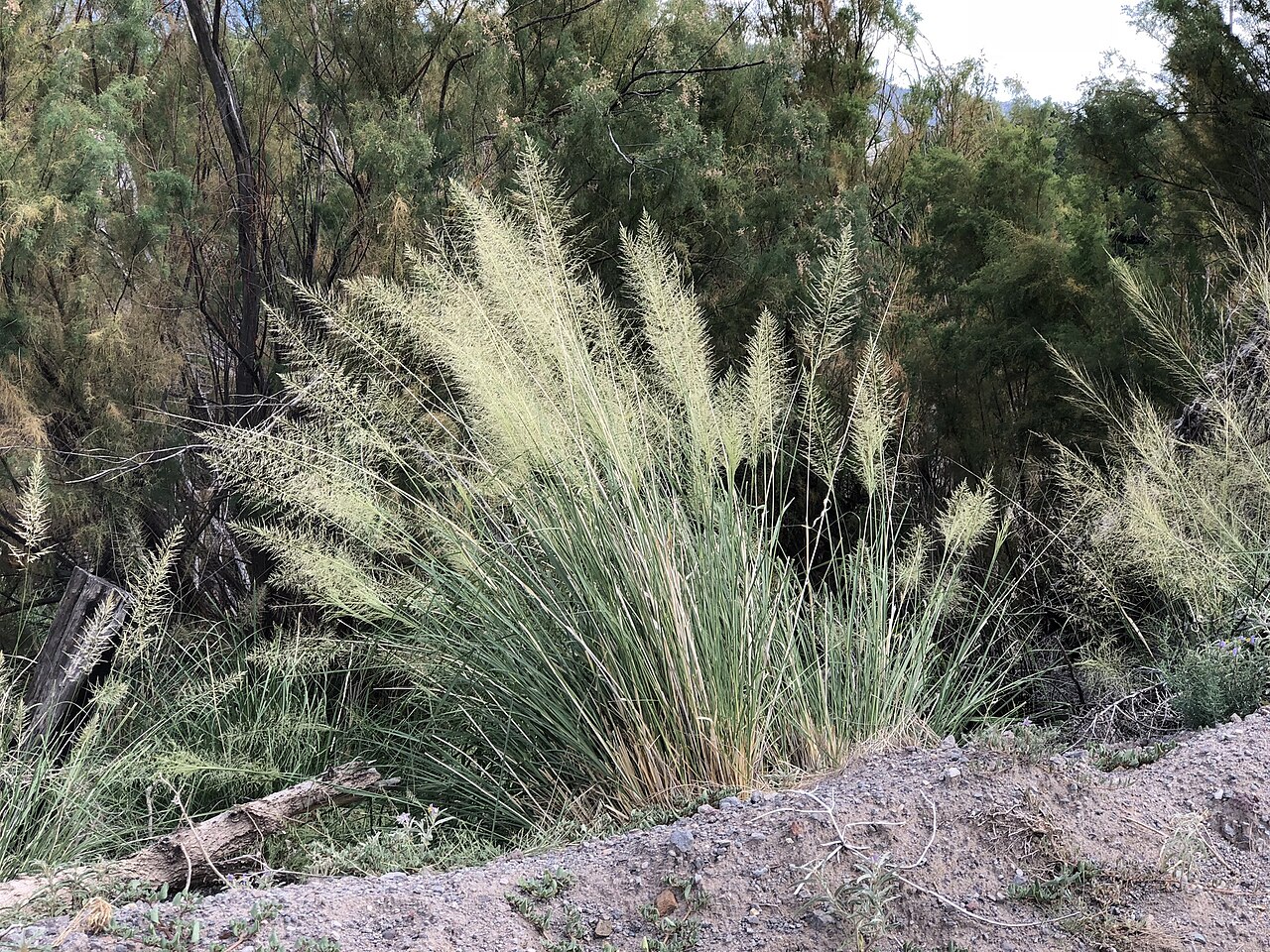
Sporobolus wrightii, commonly called Big Sacaton or giant sacaton, is one of the largest native bunchgrasses in North America — a true giant of the Southwest’s desert grasslands that can tower 5 to 8 feet tall in full bloom. Once dominant across vast expanses of desert floodplain and swale grassland in Arizona and New Mexico, big sacaton forms dense, fountain-shaped clumps that were historically so extensive they shaped their own grassland type, the “sacaton bottomland.”
Big sacaton is a warm-season perennial grass in the Poaceae (grass family), closely related to and once classified as a variety of alkali sacaton (Sporobolus airoides). It thrives where other grasses struggle: in heavy, poorly drained desert soils that flood briefly after summer storms and then bake dry the rest of the year. This tolerance for both flood and drought, combined with its sheer size, makes it an exceptional choice for large-scale restoration, erosion control along washes, and dramatic specimen plantings in low-water landscapes.
Though much of its historic bottomland grassland has been lost to overgrazing, channelization, and groundwater decline over the past century, big sacaton remains an important forage and wildlife species where it persists, and it is increasingly used in riparian restoration projects across its range.
Identification
Big sacaton is unmistakable once mature — nothing else in its range reaches the same scale — but young plants can be confused with alkali sacaton, its smaller, more widespread relative.
Stems & Growth Form
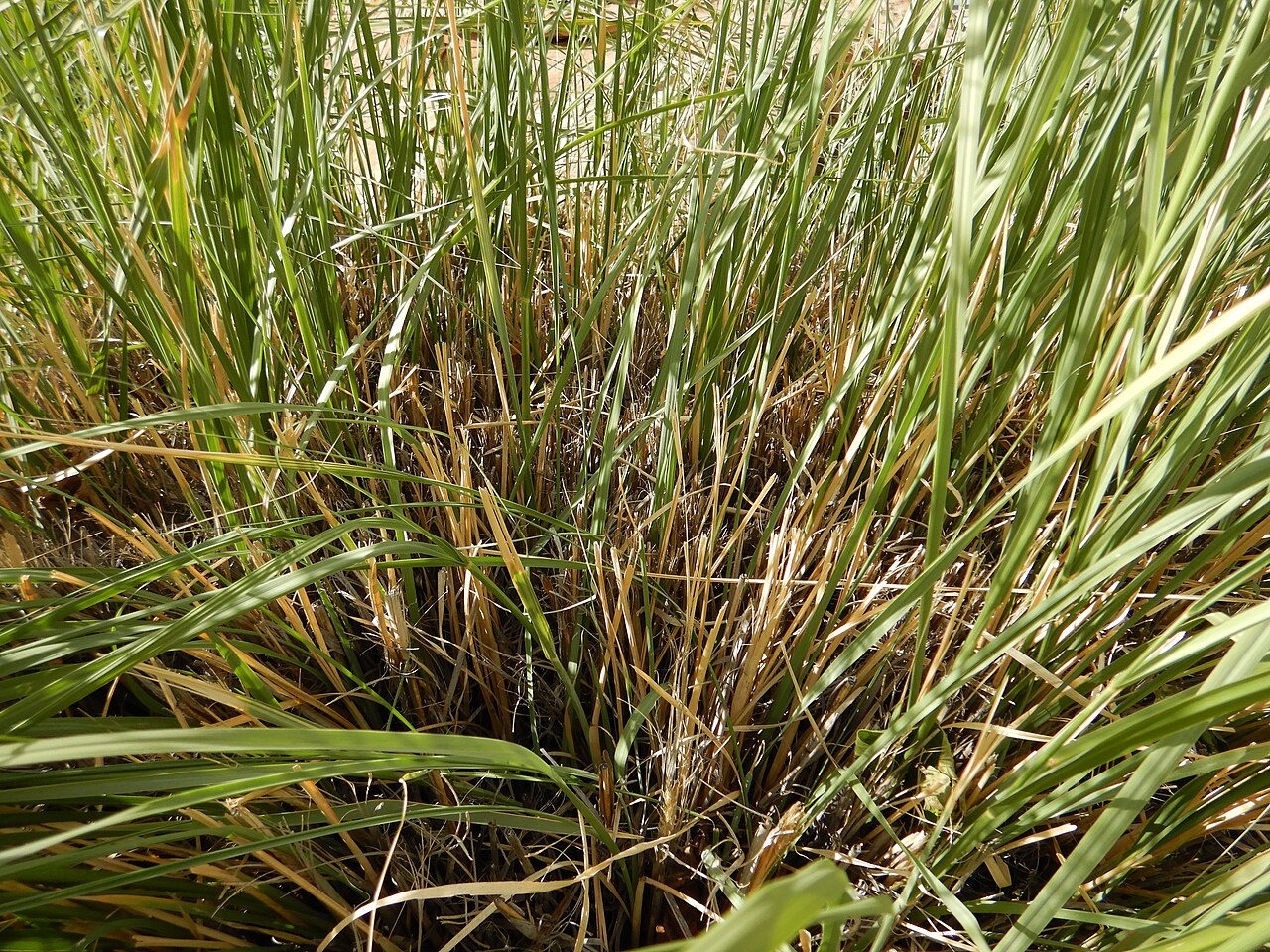
Big sacaton grows as a dense, coarse bunchgrass, with thick clumps of stiff, upright stems (culms) reaching 3 to 8 feet tall. Clumps expand slowly outward from a tough, fibrous crown, eventually forming large tussocks a foot or more across at the base. The basal leaf sheaths and culm bases often show a straw-gold to purplish tinge by late summer.
Leaves
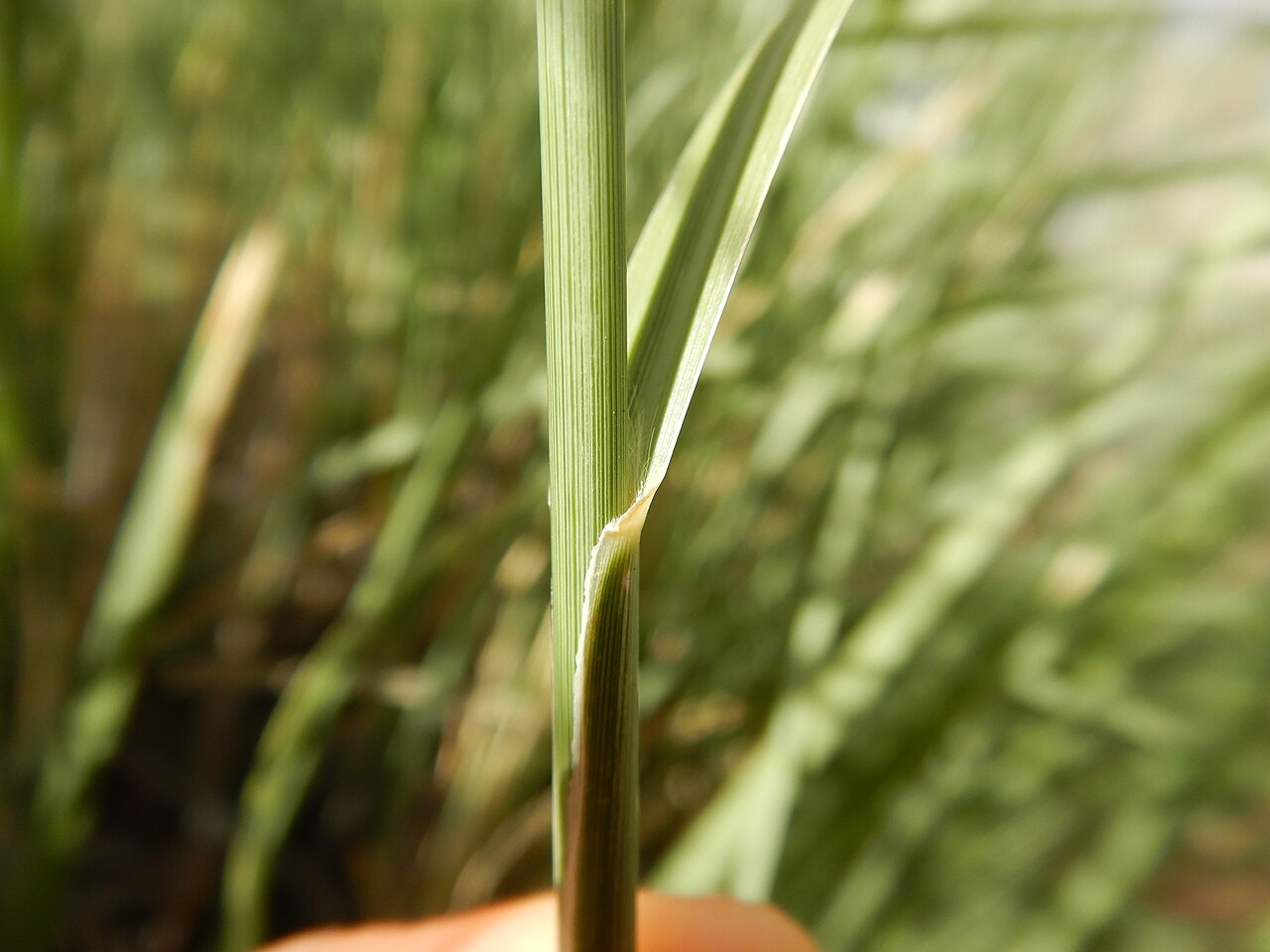
Leaf blades are long, narrow, and flat to slightly folded, 8 to 24 inches long, tapering to a fine point, with a thin, membranous ligule at the junction of blade and sheath — a useful field mark for separating sacaton grasses from superficially similar species. Leaves arch gracefully outward from the base, giving mature clumps their characteristic fountain silhouette.
Flowers & Seedhead
The flowering structure is a large, open to somewhat contracted panicle, 8 to 24 inches long, held well above the foliage on tall stems. Panicles are purplish to straw-colored when fresh, maturing to a pale tan. Compared to alkali sacaton, big sacaton’s panicle branches bear spikelets nearly to the base and the tiny pedicels are shorter and more appressed, giving the whole seedhead a denser, more one-sided (secund) look.
Fruit & Seeds
Seeds are tiny grains enclosed in a thin husk (the spikelet), shed in enormous numbers from the mature panicle in fall. A single large clump can produce an impressive volume of seed, which is part of why the species regenerates so readily on bare, disturbed floodplain soil after flooding.
Quick Facts
| Scientific Name | Sporobolus wrightii |
| Family | Poaceae (Grass) |
| Plant Type | Perennial Warm-Season Bunchgrass |
| Mature Height | 3–8 ft (0.9–2.4 m) in bloom |
| Mature Spread | 2–4 ft (0.6–1.2 m) clump diameter |
| Growth Rate | Moderate; slow to establish, long-lived once set |
| Sun Exposure | Full Sun |
| Water Needs | Low to moderate; tolerates seasonal flooding |
| Soil Type | Heavy clay, loam or sandy floodplain soils |
| Soil pH | Neutral to alkaline; tolerates saline/alkali soils |
| Bloom Time | August – October |
| Flower Color | Purplish, aging to straw-tan |
| Fall Color | Golden tan |
| Fruit | Tiny grass seed (caryopsis), produced in large numbers |
| Deer Resistant | Mostly, though grazed readily by livestock |
| USDA Hardiness Zones | 6–10 |
Native Range
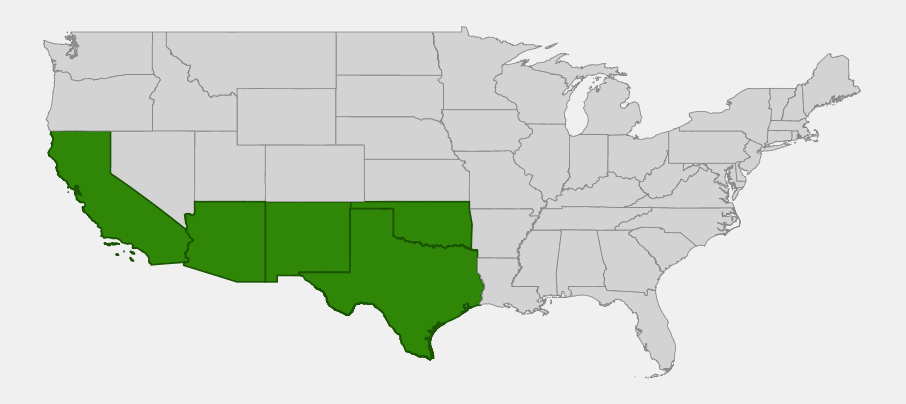
Big sacaton is native to the arid and semi-arid Southwest, occurring across Arizona and New Mexico, into the Trans-Pecos region of western Texas, scattered sites in western Oklahoma, and the desert valleys of southeastern California, extending south into northern and central Mexico. It is most abundant in Arizona, where it once formed extensive bottomland grasslands along major desert rivers such as the Santa Cruz, San Pedro, and Gila.
The species grows at elevations from roughly 2,000 to 7,000 feet, concentrated in desert grassland, desert scrub, and shrubsteppe habitats. It is characteristically a plant of floodplains, desert marshes, seasonal lakebeds, and swales — low spots that collect runoff after summer monsoon storms — rather than upland desert slopes. Big sacaton stands play an important role in trapping sediment and slowing floodwater in these settings.
Historic sacaton bottomland grasslands, once covering large areas of southern Arizona, have been greatly reduced by a combination of 19th- and 20th-century overgrazing, arroyo-cutting and channel incision, and groundwater pumping that lowered water tables below the reach of sacaton roots. Where intact stands remain, or where the species has been reintroduced through restoration plantings, big sacaton continues to anchor some of the Southwest’s most productive native grassland.
📋 Regional plant lists featuring Big Sacaton: Arizona & New Mexico
Growing & Care Guide
Big sacaton rewards patience: it is slower to establish than many smaller grasses, but once its deep, extensive root system is in place, it is tough, long-lived, and remarkably adaptable to the boom-and-bust water cycle of the desert Southwest.
Light
Plant in full sun. Big sacaton does not perform well in shade and will not produce its characteristic tall, dense clumps without strong sun exposure.
Soil & Water
Big sacaton is naturally suited to low, heavy soils that collect runoff — it tolerates brief flooding and standing water far better than most grasses, as well as considerable soil salinity and alkalinity. In cultivation it also does well in ordinary garden loam with occasional deep watering, and established plants are drought tolerant, surviving on natural rainfall in much of their range once their roots reach deeper soil moisture. Avoid light, fast-draining sand without any seasonal moisture, which can leave young plants undersized.
Planting Tips
Start from containers rather than direct seeding where possible, since seedlings establish slowly and are vulnerable to competition in the first year or two. Plant in spring after the last frost so roots have the full growing season to develop before winter. Space clumps 3 to 5 feet apart to allow for their eventual mature spread, and water deeply but infrequently during establishment to encourage deep rooting.
Pruning & Maintenance
Cut clumps back to 6 to 10 inches in late winter before new growth begins; this removes the previous year’s dead stems and keeps the clump tidy. Big sacaton tolerates occasional fire or mowing well and often resprouts vigorously afterward, a trait shaped by its evolutionary history in a landscape of periodic grass fires. Established plants need little other care.
Landscape Uses
Big sacaton’s scale and toughness suit several distinct roles:
- Erosion control along washes, swales, and drainage channels
- Riparian and floodplain restoration plantings
- Dramatic specimen or screen planting where its full size can be appreciated
- Low-water pasture or forage plantings on appropriate soils
- Wildlife habitat plantings in large native landscapes
Wildlife & Ecological Value
Where big sacaton grasslands remain intact, they provide some of the most structurally complex habitat in the desert Southwest, with tall, dense cover found almost nowhere else in the regional landscape.
For Birds
The dense clumps provide nesting and roosting cover for grassland birds, and the abundant seed crop feeds sparrows and other seed-eating species through fall and winter. Birds that favor burned or recently disturbed sacaton stands take advantage of the flush of insects and seed that follows fire.
For Mammals
Sacaton grassland is important habitat for collared peccary (javelina), which rely on these stands for cover, and for a range of small mammals that nest and forage within the dense tussocks. Historically, big sacaton bottomlands supported substantial livestock grazing, and the species remains valuable, nutritious forage where it is not overgrazed.
For Pollinators
As a wind-pollinated grass, big sacaton does not rely on insect pollinators, but its dense basal cover shelters ground-nesting native bees and other insects that in turn support the broader desert food web.
Ecosystem Role
Big sacaton is a foundational species of desert bottomland grassland, trapping sediment during flood events, slowing runoff, and stabilizing streambanks and floodplain soils. Its deep root system helps recharge soil moisture and resist erosion in landscapes that otherwise flood violently and dry quickly. The loss of sacaton bottomland across much of its historic range is considered a significant factor in the degradation of desert riparian systems in the Southwest, which is part of why the species is now a priority in many restoration programs.
Cultural & Historical Uses
Big sacaton grassland has long been central to ranching economies in the desert Southwest; 19th- and 20th-century cattle operations in southern Arizona depended heavily on sacaton bottomlands as some of the most productive natural forage in an otherwise sparse desert landscape, and the grass remains valued as livestock feed where stands persist.
Indigenous peoples of the region, including the Pima (Akimel O’odham) and other Southwestern groups, lived alongside extensive sacaton bottomlands along desert rivers for generations, and the grass’s historic abundance along waterways such as the Gila River shaped settlement and agricultural patterns in the area, though specific traditional uses of the plant itself are not well documented in available sources.
In the modern era, big sacaton’s history is as much a cautionary tale as a success story: heavy grazing pressure, arroyo-cutting, and groundwater decline through the 1900s eliminated large areas of historic sacaton grassland, and its recovery is now an explicit goal of many riparian and floodplain restoration projects across Arizona and New Mexico.
Frequently Asked Questions
Is big sacaton the same as alkali sacaton?
No, though they are close relatives and big sacaton was once classified as a variety of alkali sacaton (Sporobolus airoides var. wrightii). Big sacaton is considerably larger, with coarser, taller clumps and a denser, more one-sided seedhead, and it favors lower, wetter floodplain sites compared to the more widespread alkali sacaton.
How much water does big sacaton need?
Established plants are quite drought tolerant and survive on natural rainfall through most of their range, but the species performs best, and grows largest, where it receives occasional deep soil moisture or seasonal flooding, reflecting its native habitat in desert floodplains and swales.
How tall does big sacaton get?
Mature clumps typically reach 3 to 5 feet in foliage, with flowering stems and plumes extending the overall height to 6 to 8 feet in good growing conditions, making it one of the tallest native bunchgrasses in the Southwest.
Can big sacaton tolerate salty or alkaline soil?
Yes. Like its close relative alkali sacaton, big sacaton tolerates saline and alkaline soil conditions that would stunt or kill many other grasses, which is part of why it does well in desert floodplain and basin settings.
Is big sacaton good for erosion control?
Yes, its dense root system and tolerance of periodic flooding make it one of the better native grasses for stabilizing washes, swales, and drainage channels in the arid Southwest.

Looking for a nursery that carries Big Sacaton?
Browse our native plant nursery directory: Arizona · California · New Mexico & Oklahoma · Texas