Seaside Goldenrod (Solidago sempervirens)
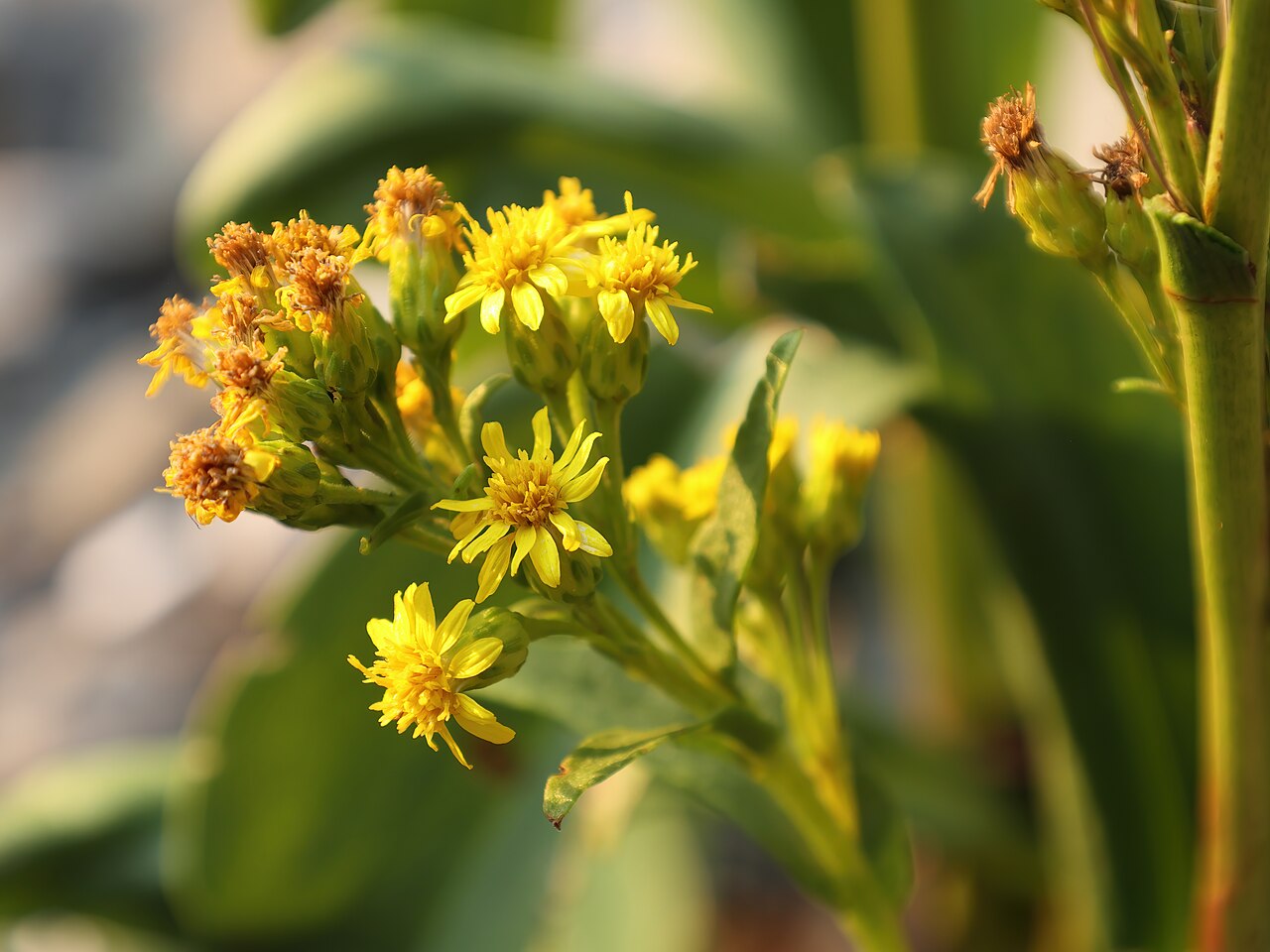
Seaside goldenrod (Solidago sempervirens) combines substantial, almost succulent foliage with an airy display of yellow flower heads late in the growing season. On an Atlantic shore it may rise above dune vegetation or occupy the upper edge of a salt marsh, its thick leaves standing out among grasses. It gives a coastal planting color when many spring and early-summer flowers have finished.
The name needs a little care. Older floras often include southern seaside goldenrod and Azorean plants within a broad Solidago sempervirens. The University of Waterloo Astereae Lab treats Solidago mexicana and Solidago azorica separately. This guide follows that narrower treatment for native range and photographs: northern seaside goldenrod of the Atlantic coast from northern North Carolina to Newfoundland. A record beside a salted inland road does not establish local nativity.
For gardeners in coastal Maryland and Virginia, this is a useful candidate for a sunny, salt-exposed native planting with room for tall flowering stems. It is not a recommendation for every location in those states, and it is not a native choice for inland West Virginia merely because all three states share a regional list. Match the plant to the coastal habitat and use nursery stock with a documented regional origin.
Identification
Growth Form
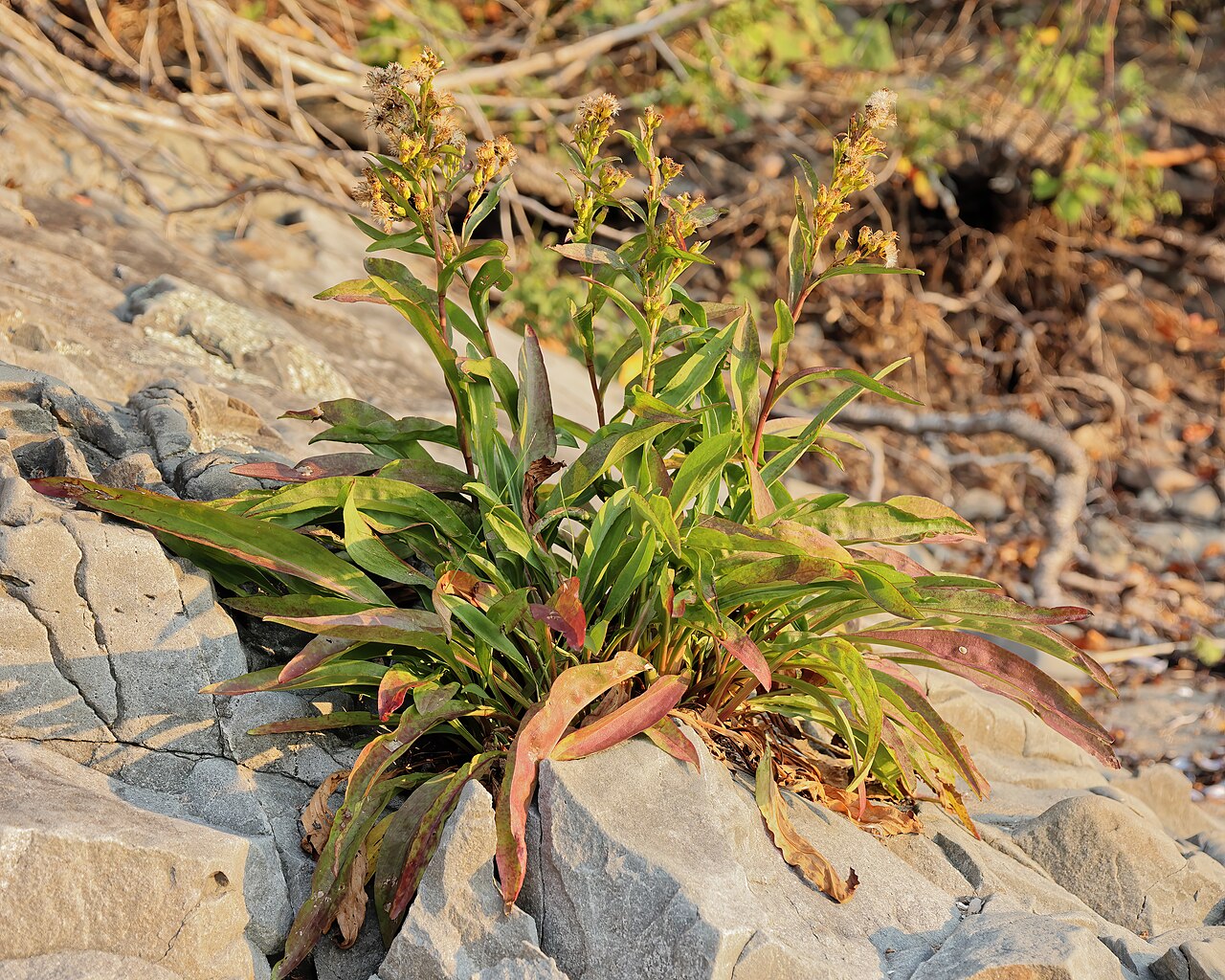
A basal cluster of leaves supports upright flowering stems that branch toward the top. Mature flowering plants are commonly several feet tall, with vigorous specimens approaching the upper end of a roughly two-to-eight-foot range. A young rosette is much lower than the flowering plant, so a nursery pot can underestimate the eventual visual mass. The plant is clump-forming rather than a rapidly running, rhizomatous goldenrod.
Leaves
The leaves are thick, smooth-looking, and mostly untoothed, with the lower leaves larger and more elongated than those near the flower cluster. Upper stem leaves remain conspicuous instead of becoming tiny scales. Their fleshy texture is one of the best field clues, especially alongside finer-leaved inland goldenrods. Leaf size varies with the position on the stem; compare several leaves rather than relying on one detached blade.
Flowers
Numerous small yellow flower heads are arranged in branching clusters near the stem tips. Each head contains ray florets around central disk florets, so what looks like a single miniature daisy is itself a group of flowers. Branches may arch and carry heads predominantly to one side. Flowering usually develops in late summer and autumn, with timing shifting by latitude and local weather.
Fruits and Winter Structure
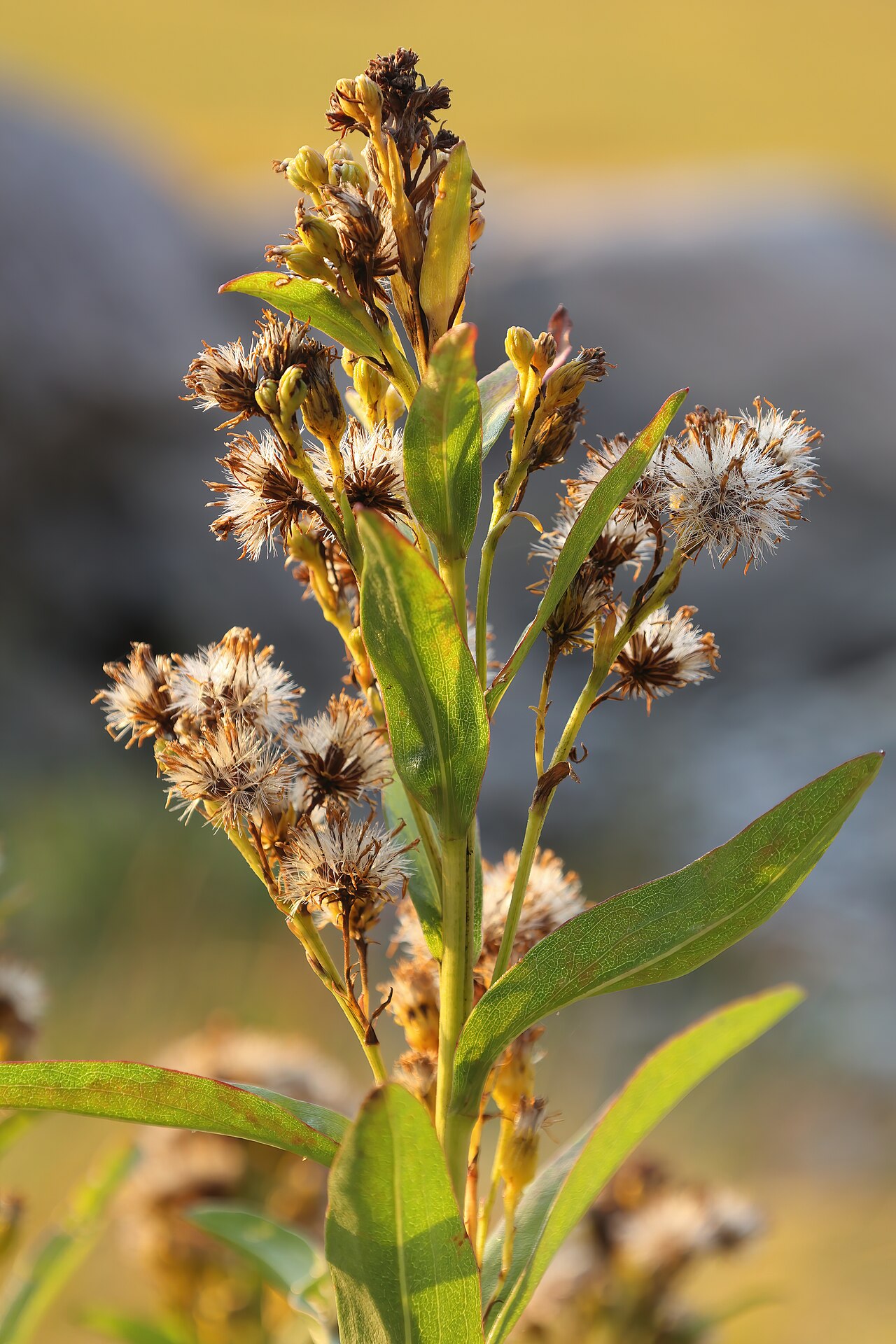
After flowering, small dry fruits develop with pale hair-like structures that assist wind dispersal. The seed heads turn the plant from bright yellow to tan and silver. Standing stems can retain useful texture after the foliage declines. Do not confuse the natural aging of a fruiting head with disease: a mixture of fresh flowers, brown spent heads, and developing seed on one plant is normal.
Similar Plants and Taxonomy
Southern seaside goldenrod, Solidago mexicana, has often appeared as S. sempervirens var. mexicana. Azorean plants photographed under the broad name may belong to S. azorica. Reliable separation can require a regional key and several characters, not a single count of petals. For planting decisions, a trustworthy nursery identification and provenance are more useful than assuming every online seaside-goldenrod photograph shows the same taxon.
Quick Facts
| Common Name | Seaside goldenrod; northern seaside goldenrod |
| Scientific Name | Solidago sempervirens L. (narrow northern Atlantic treatment) |
| Family | Asteraceae — aster family |
| Plant Type | Herbaceous perennial; clump-forming |
| Mature Height | Usually 2–8 ft in flower; young rosettes much lower |
| Sun Exposure | Full sun best; light partial sun tolerated |
| Water Needs | Average to moist; tolerates some drying and coastal wet conditions |
| Soil Type | Sandy or gravelly coastal soils; drainage and aeration matter |
| Bloom Time | Late summer through autumn, depending on latitude |
| Flower Color | Yellow |
| Salt Tolerance | High; suited to appropriate coastal exposure |
| USDA Hardiness Zones | NC State lists USDA zones 3–8; select regional stock |
| Wildlife Value | Late-season nectar and pollen for visiting insects |
| Garden Caution | May reseed; inland introduced populations are not local natives |
Native Range
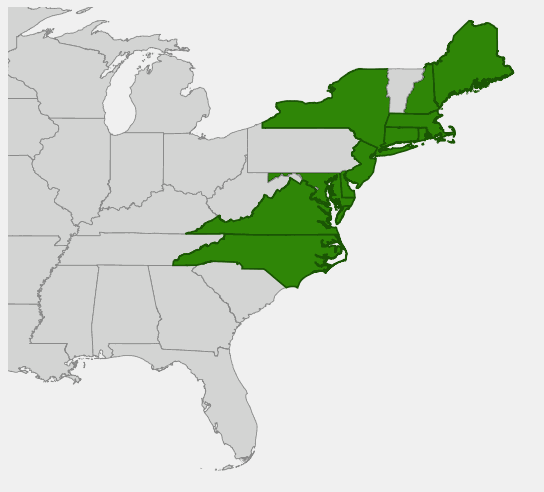
The native range shown here is deliberately narrower than some older database maps. Under the Astereae Lab treatment, northern seaside goldenrod occurs along the Atlantic coast from northern North Carolina northward to Newfoundland. The U.S. map shades the Atlantic coastal states along that corridor, not their entire interiors. Canadian portions of the range are not represented by this U.S.-only illustration.
Coastal marsh margins, dunes, beaches, and other open maritime habitats provide the relevant ecological context. A plant may occupy an upper marsh edge without being suitable for continuous deep submergence. Within a state, shoreline exposure, soil texture, salinity, and competition can matter more than a broad hardiness-zone label. Use a local flora or herbarium record when deciding whether a particular inland site is within the native range.
Waterloo documents introductions much farther inland, including Ontario, Ohio, and Michigan, often associated with road salt. Broader southern records may involve Solidago mexicana, and Azorean records may involve S. azorica. These distinctions explain why the linked USDA profile or older gardening references can show more locations than this conservative native-range map. The difference is intentional rather than a claim that the databases use identical species boundaries.
📋 Regional plant list: Maryland, Virginia & West Virginia
Growing & Care Guide
Choose the Right Site
Start with sunlight and space. A location receiving substantial direct sun supports stronger flowering and a more upright habit than a shaded corner. Allow the flowering stems to occupy the background or middle of a coastal perennial planting. Along a narrow path, place the basal clump far enough back that arching flower branches do not obstruct passage when the plant reaches its seasonal size.
Soil and Drainage
Think of an aerated coastal rooting zone rather than a permanently flooded pot. Sandy and gravelly soils are a natural fit, and the plant can handle moisture variation, but a compacted depression with stagnant water is a different environment. In a garden bed, correct severe compaction before planting. Avoid burying the crown beneath a thick layer of wet mulch or rich compost.
Planting Nursery Stock
Plant at the depth at which the crown grew in its container, with the top of the root mass level with the surrounding soil. Water thoroughly after planting so the soil settles against the roots. If roots circle densely around the pot, gently loosen the outer mat. A small, correctly planted specimen generally establishes more sensibly than a large plant forced into an undersized hole.
Water During Establishment
Even a salt-tolerant coastal plant needs adequate water while its roots expand beyond the nursery root ball. Check the soil rather than watering on a rigid daily schedule. Keep the root zone from drying completely during the first establishment period, then adjust to rainfall, soil texture, and plant response. Persistent wilting in dry sand calls for investigation; constantly saturated soil calls for a different correction.
Fertilizer and Excess Growth
Routine high-nitrogen feeding is unnecessary in most suitable garden soils. Excess fertility can produce taller, softer stems that need support and may not suit a naturalistic coastal planting. Begin without fertilizer unless a soil test identifies a relevant deficiency. The objective is a resilient plant appropriate to the site, not the largest possible flowering stalk.
Pruning and Seasonal Height
Where a shorter, more branched display is wanted, a gardener may pinch or cut back young stems before flower development, commonly in early summer. This can alter flowering time and is optional, not a requirement for plant health. Do not repeatedly shear a natural population. In a wildlife-oriented garden, leave at least some stems and seed heads standing through the dormant season.
Seedlings and Boundaries
Although this goldenrod is not a strongly running rhizomatous colonizer, it can produce seedlings in favorable open ground. Inspect nearby bare soil and remove unwanted seedlings while small. Deadheading before seed maturation reduces dispersal where that is important. Outside the native coastal range, its ability to establish along disturbed salty sites is a reason to choose a locally native alternative instead.
Propagation
Nursery propagation may use seed or division of established cultivated clumps. Seed-grown plants preserve variation, while division reproduces the parent. Follow a regional nursery protocol for sowing timing and any pretreatment rather than assuming every goldenrod germinates identically. Collect seed only where permitted and where harvesting will not diminish a wild population; buying propagated stock is the simpler garden route.
Containers
A large container can display the foliage and flowers, but it changes the water balance substantially. Sandy potting media can dry quickly in sea wind, while a blocked drainage hole can keep the root ball waterlogged. Use a container with reliable drainage, adequate depth, and enough stability for tall stems. Do not treat container survival as evidence that the species is locally native.
Troubleshooting
Weak leaning growth often suggests insufficient light, excessive fertility, or an exposed stem that needs neighboring support. Sparse flowering may reflect youth, shade, or repeated cutting at the wrong time. Inspect any damaged foliage before treating it: some insect feeding is compatible with the purpose of a native planting. Avoid routine broad-spectrum sprays on a plant intended to support flower-visiting insects.
Landscape Uses
- A late-season flowering layer in an Atlantic coastal native garden.
- A sunny upper-marsh or dune-edge planting matched to local conditions and permissions.
- A substantial foliage contrast beside finer coastal grasses.
- A seasonal observation plant for flowers, pollinator visits, and wind-dispersed seed.
Wildlife & Ecological Value
Late Flowers
The late flowering season makes seaside goldenrod a useful source of floral resources after many earlier perennials have finished. Watch individual heads on a warm day to see different visitors using them. The exact community varies by site and season; a garden guide should not promise a particular butterfly on every plant or turn a general goldenrod association into a species-specific guarantee.
A Habitat Planting, Not Just a Flower
Ecological value improves when the goldenrod is part of a varied native planting with different flowering times and structural layers. Retaining some stems, avoiding unnecessary pesticides, and protecting nearby soil and vegetation are practical complements to planting it. A single nectar-rich plant cannot substitute for a functioning coastal habitat, but it can contribute to a thoughtful garden.
Goldenrod and Hay Fever
Goldenrod is often blamed because its conspicuous flowers appear during the same season as wind-pollinated ragweed. Its flowers are primarily insect-pollinated; its presence is not the same as a cloud of ragweed pollen. Individual sensitivities still exist, so this distinction is botanical context rather than medical advice. It is not a reason to remove every yellow autumn flower from a garden.
Cultural & Historical Uses
The name sempervirens refers to persistent greenness, an understandable impression where a basal rosette remains green through favorable seasons. It should not be read as a promise of fully evergreen foliage in every climate or garden. Winter appearance depends on weather, exposure, and the stage of the plant.
The history of the scientific name is especially relevant to modern native-plant shopping. Southern and oceanic populations once grouped broadly with this species are separated in some contemporary treatments. This guide therefore states its taxonomic scope instead of combining every old record into an apparently precise native map.
For present-day coastal gardening, the plant’s most useful role is ornamental and ecological: durable-looking foliage, a late yellow display, and a connection to Atlantic shoreline vegetation. This article does not recommend medicinal or edible use. Obtain cultivated plants from reputable suppliers and leave naturally occurring dune and marsh populations undisturbed.
Frequently Asked Questions
Is seaside goldenrod native throughout Maryland and Virginia?
No. This guide concerns the Atlantic coastal taxon. A shaded state on the map does not make every inland county or garden part of its native habitat.
Why do some maps show the Gulf Coast?
Older or broader treatments include southern seaside goldenrod, often called var. mexicana. Some modern treatments recognize Solidago mexicana separately.
Will it spread by runners?
It is clump-forming rather than a strongly running goldenrod, but seed can establish new plants in suitable open ground.
Can it grow in salty soil?
It has high coastal salt tolerance, but that does not mean it thrives in any amount of salt, any drainage condition, or continuous deep water.
Should I remove the stems after flowering?
Not necessarily. Retaining some seed heads and stems adds winter structure. Remove unwanted seedlings or deadhead selectively if dispersal needs limiting.
Sources & Further Reading
- NC State Extension: seaside goldenrod
- University of Waterloo Astereae Lab: taxonomic treatment and range
- Native Plant Trust: Solidago sempervirens
- Lady Bird Johnson Wildflower Center: broader species treatment
Find Native Plants
Ask growers about nursery propagation and regional provenance. Browse our Maryland native plant nurseries, Virginia native plant nurseries, West Virginia native plant nurseries directory for suppliers.