Poverty Oatgrass (Danthonia spicata)
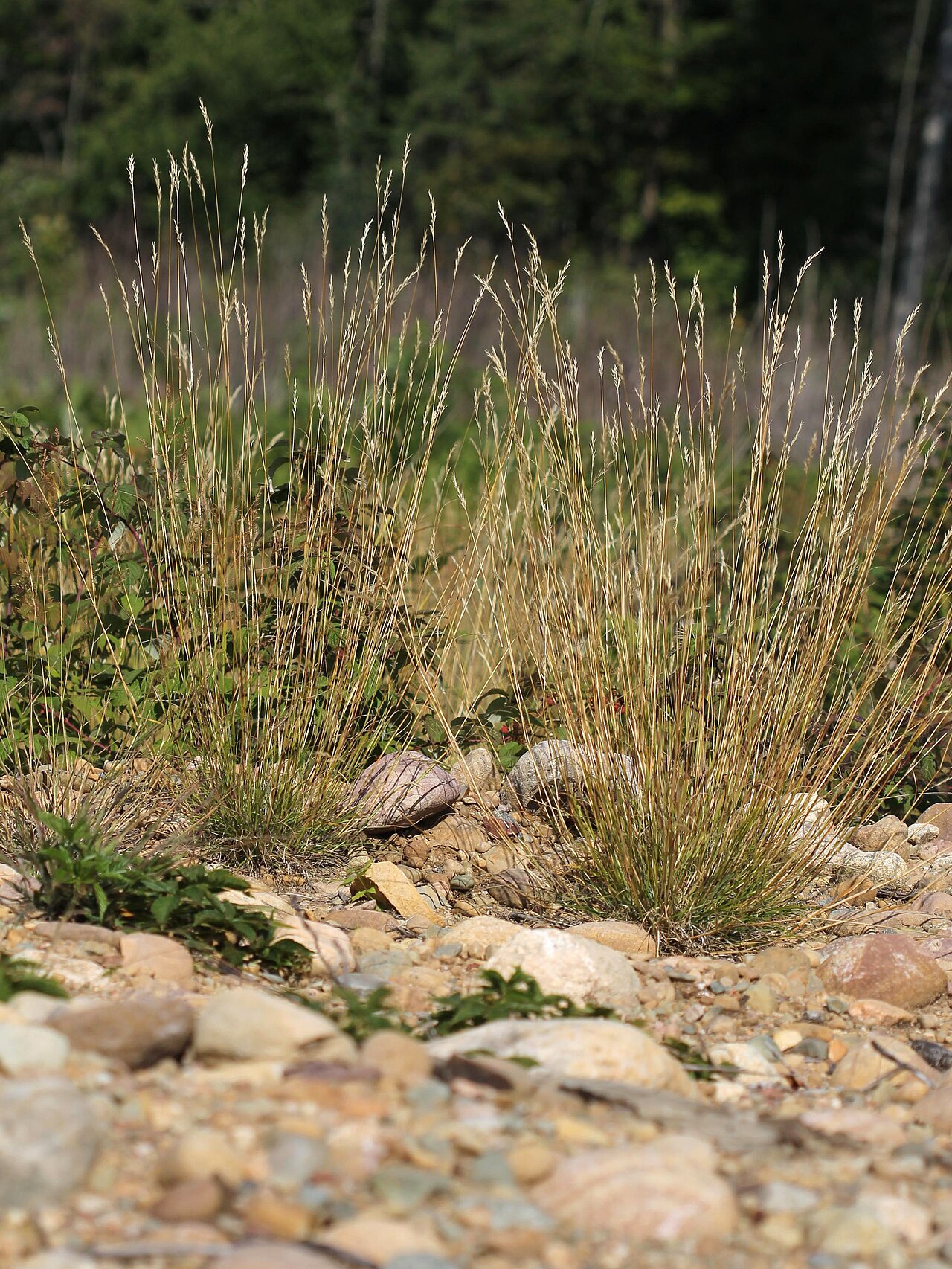
Poverty oatgrass (Danthonia spicata) is a modest native bunchgrass with an unusually useful identification clue: old basal leaves curl and twist around the base of the plant. Its slender flowering stems rise above a low tuft, carrying a narrow group of spikelets rather than a large ornamental plume. It rewards close observation more than a glance from across a parking lot.
The common name describes its association with lean sites, not a defect in the plant. Dry, thin, sandy, or rocky soils that produce a disappointing conventional lawn can support this grass in the right region and habitat. It occurs widely in North America, including Maryland, Virginia, and West Virginia, and belongs in a discussion of low-input native ground layers rather than a list of tall prairie showpieces.
It is important to understand its growth pattern before planting. Poverty oatgrass forms tufts and tillers from the base; it does not build a spreading sod by rhizomes or stolons. A planting may develop through seedling recruitment and enlargement of individual clumps, but it should not be sold as an instant, uniformly green substitute for heavily used turf. Its best garden role follows the character of the site.
Identification
The Basal Tuft
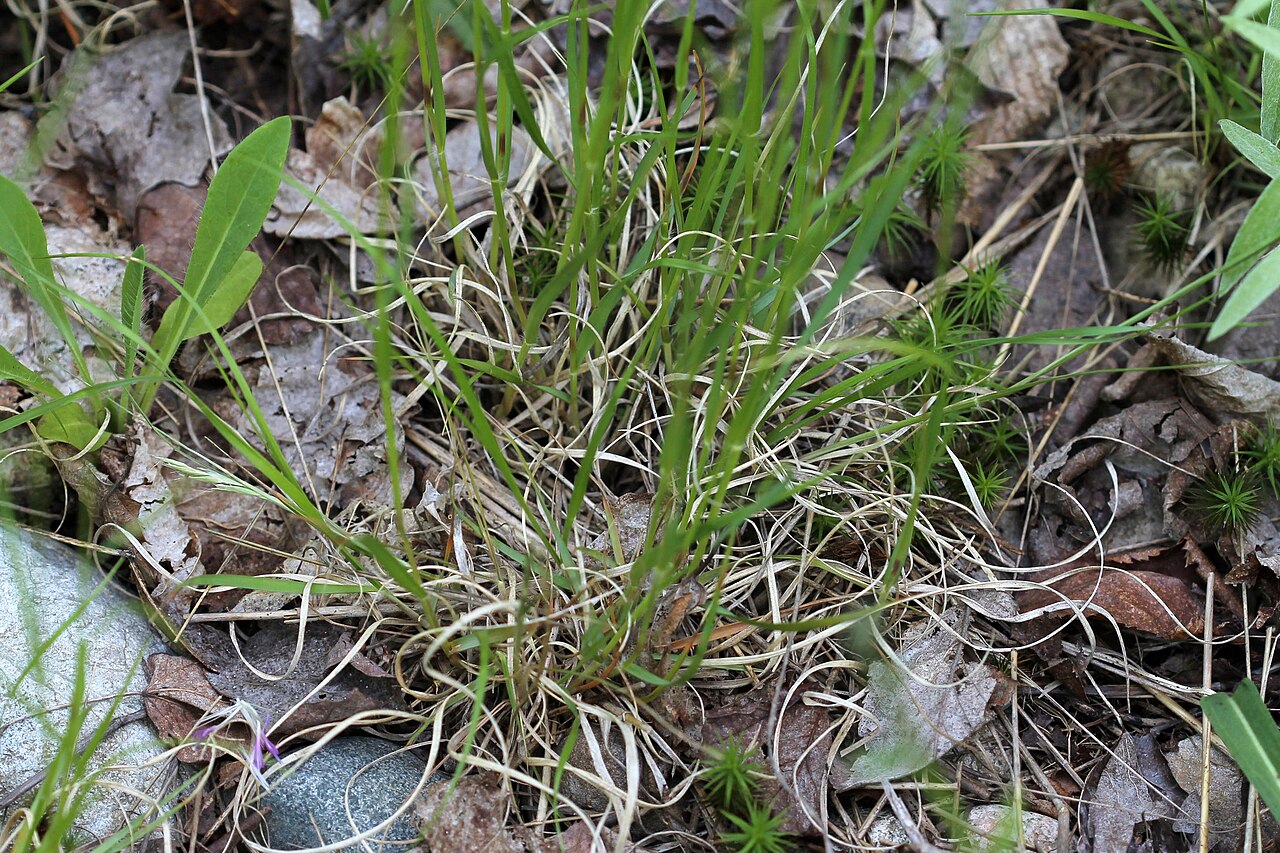
Look first at the lower leaves. A plant typically has a compact tuft of narrow blades, with older blades remaining at the base in conspicuous curls or twists. That persistent thatch gives the clump a wiry appearance and is more diagnostic than the general green color of fresh growth. Do not remove all the old blades before attempting identification; they carry useful information.
Leaves and Hairs
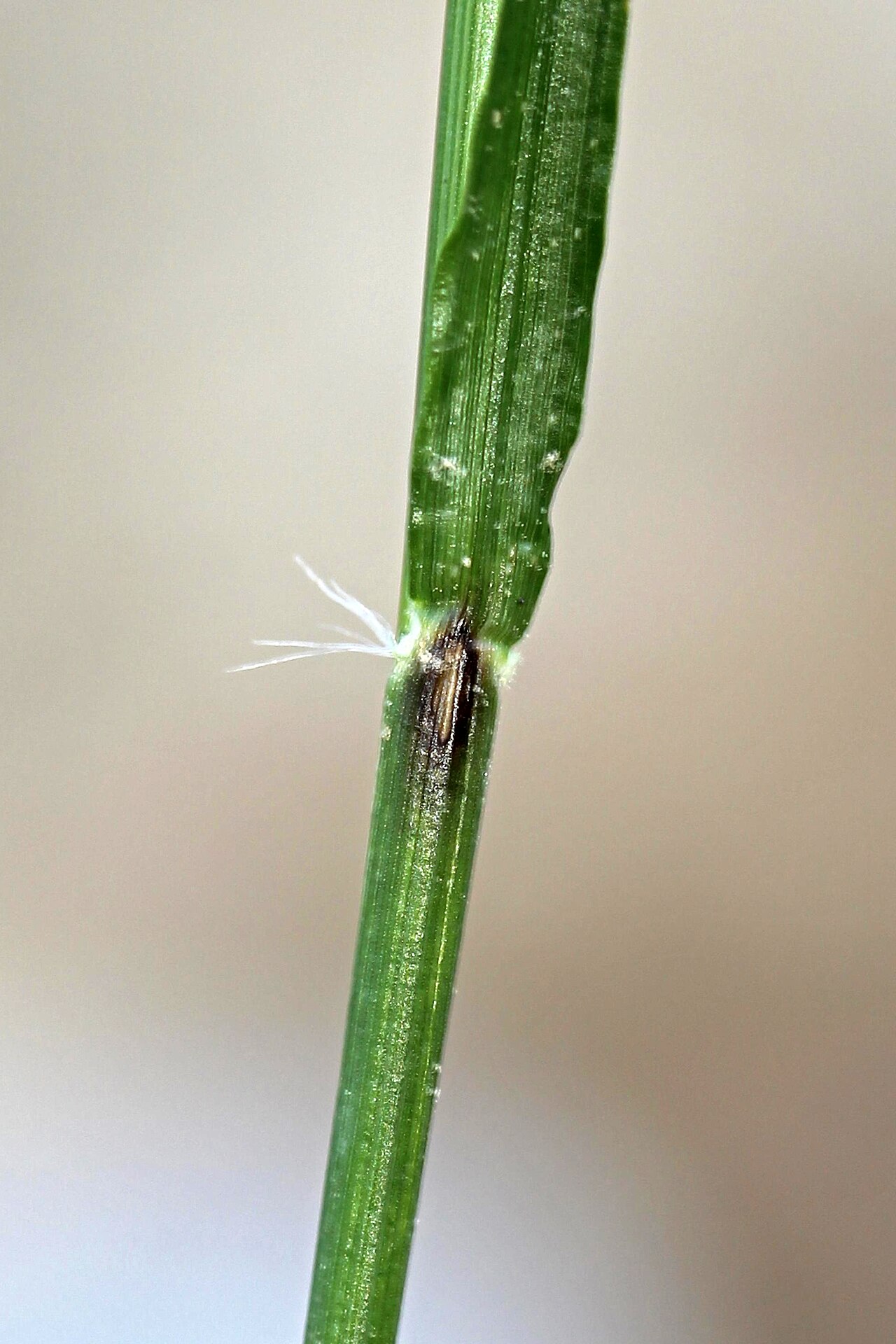
The leaves are relatively short and narrow compared with the flowering stems. Hairs around the leaf sheath and the junction between blade and stem are helpful features when examined closely. A hand lens can be more useful than a distant photograph. Hairiness and size may vary, so use a regional grass key rather than identifying the plant solely from one hairy leaf.
Flowering Stems
Slender stems rise above the basal foliage, commonly reaching roughly one to two feet, with some plants approaching about thirty inches. The leafy tuft stays much lower. A height listed for a flowering stem is therefore not the height of a dense grass screen. The stems are part of a fine-textured ground layer and can be difficult to see until their spikelets mature.
Spikelets and Awns
The inflorescence is narrow and relatively sparse, with several spikelets rather than a broad feathery spray. Individual florets carry characteristic awns that become easier to examine as they mature. The U.S. Forest Service account describes a panicle with two to thirteen spikelets. Shape, awns, and the arrangement of florets help separate oatgrasses from superficially similar small bunchgrasses.
Hidden Flowers
Not all reproduction is visible at the stem tip. Poverty oatgrass can produce enclosed, self-pollinating flowers within leaf sheaths as well as exposed flowers in the aerial inflorescence. This is an important biological feature, but it is not something to infer from a casual photograph. The exposed seed head alone does not represent every seed the plant may produce.
Similar Grasses
Other Danthonia species and several fine-leaved grasses can resemble it from a distance. Curled old basal leaves are a strong clue, but a complete identification should combine the tuft, sheath characters, spikelet structure, and regional occurrence. If collecting seed for restoration, confirm the plant before harvest rather than relying on the common name written on an old field sketch.
Quick Facts
| Common Name | Poverty oatgrass; poverty grass |
| Scientific Name | Danthonia spicata |
| Family | Poaceae — grass family |
| Plant Type | Native perennial bunchgrass |
| Mature Height | Low basal tuft; flowering stems commonly 1–2 ft, up to about 30 in |
| Growth Habit | Clumping; no spreading rhizomes or stolons |
| Sun Exposure | Sun, partial shade, or open woodland shade |
| Water Needs | Dry to average in suitable aerated soil |
| Soil Type | Lean sandy, gravelly, rocky, or thin soils |
| Seasonal Pattern | Cool-season grass; timing varies across its broad range |
| Flowers | Small grass florets in narrow spikelets, not showy petals |
| Propagation | Seed and basal tillering; cultivated clumps can be divided |
| Regional Fit | Native in MD, VA, and WV; match local habitat and seed origin |
| Garden Caution | Not a dense, high-traffic lawn or a tall screening grass |
| Foliage | Narrow basal blades; old leaves persist in characteristic curls |
Native Range
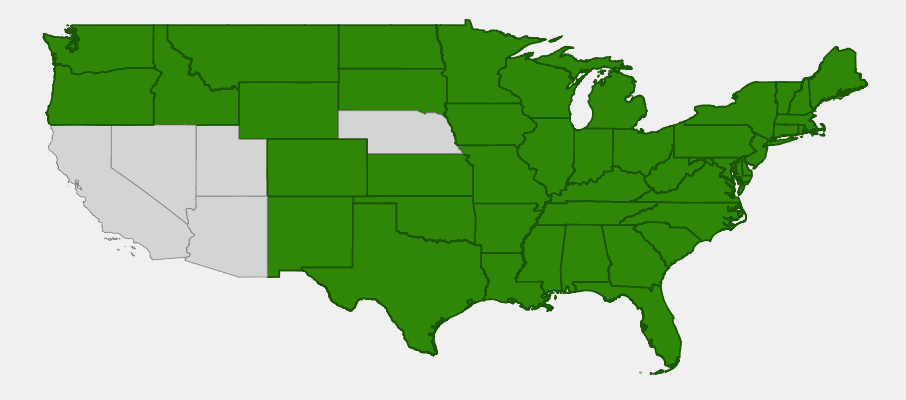
Poverty oatgrass has a broad North American distribution, extending across much of Canada and the United States and south into Mexico. The Lady Bird Johnson Wildflower Center distribution list includes Alaska and much of the contiguous country, while the Forest Service describes its wide range and regional habitat variation. This broad range does not make every seed source interchangeable.
In the Mid-Atlantic it is associated with dry woods, openings, rocky ground, and other comparatively lean sites. It may occur beneath an open canopy as well as in sun. The useful garden lesson is that soil fertility, competition, and drainage deserve attention alongside the amount of sunlight. A fertile irrigated bed filled with vigorous tall plants can be a poor match for a small grass adapted to less productive ground.
The map follows the state distribution documented by the Wildflower Center and is only a screening tool. It does not show county-level occurrence, local abundance, or the distinctions sometimes applied to western forms. Consult a regional flora and choose locally appropriate nursery material when working near the edge of the range or undertaking ecological restoration. The illustration shows the contiguous United States; Alaska and Canadian occurrences are described in the text but are outside its frame.
📋 Regional plant list: Maryland, Virginia & West Virginia
Growing & Care Guide
Start with a Suitable Site
A lean, well-aerated site with modest competition is a sensible starting point. Look at existing vegetation and the way water moves through the soil. An open woodland edge, rocky garden margin, or low-fertility meadow opening may be more appropriate than a rich flower bed. Do not assume that a patch where conventional turf struggles is automatically suitable; deep shade, compaction, and chronic waterlogging are different problems.
Light and Competition
This grass can grow in sun and in woodland light, but the structure of the surrounding vegetation matters. A low tuft can disappear beneath tall, dense neighbors even when the site receives adequate sunlight. Use companions that leave room near the soil surface. In a shaded setting, an open canopy with seasonal light and a relatively sparse ground layer is a better model than a dark evergreen thicket.
Soil Preparation
Remove perennial weeds before planting rather than expecting a small bunchgrass to suppress them immediately. Avoid wholesale soil enrichment. A light correction of compaction or a change in surface management may be useful, but adding a deep layer of rich compost can favor more aggressive plants. Preserve the existing soil profile where possible, particularly in a woodland garden with established tree roots.
Planting Plugs
Set nursery plugs with the crown at the surrounding soil level. Firm the soil gently around the roots and water to settle it. Do not bury the basal tuft beneath mulch. Mark small plants during establishment so they are not mistaken for weeds or stepped on. Space them according to the desired patch structure and nursery guidance, remembering that individual tufts will not send out long runners to fill every gap.
Establishment Water
Water newly planted plugs enough to keep the small root ball from drying before roots reach surrounding soil. Once established in a suitable site, the plant is adapted to relatively dry conditions, but that is not a reason to neglect a fresh transplant. Check moisture below the surface. Repeated shallow sprinkling can encourage weeds without adequately supporting root development.
Avoid Unnecessary Fertilizer
The plant’s association with poor ground is a useful warning against routine feeding. Fertilizer may change the competitive balance of the planting more than it helps the oatgrass. If a plant is weak, first check drainage, planting depth, disturbance, and competing vegetation. A soil test is more informative than applying a general lawn fertilizer simply because the foliage is not lush.
Seed Establishment
Seed can be used, but germination and establishment are not always immediate or uniform. The species has seed dormancy and population-level variation, and professional propagation protocols may include specific treatments. Follow a reputable nursery or regional propagation protocol for the actual seed lot. This garden guide does not recommend improvised chemical scarification or promise that a handful of seed scattered into existing turf will establish a stand.
Division
An established cultivated clump can sometimes be divided into rooted portions, provided each portion retains a sound crown and roots. Work during a suitable cool or moist period rather than severe heat or drought. Replant promptly and support establishment with water. Division is a way to increase a garden plant, not a reason to dig small wild populations from thin soils where disturbance can persist.
Mowing and Foot Traffic
A low native planting may tolerate occasional management, but poverty oatgrass should not be promised as a resilient sports lawn. Repeated close mowing can remove flowering stems and alter reproduction; repeated traffic can compact the thin soils in which it grows. If the goal is a natural ground layer, use paths to concentrate foot traffic and retain some unmown areas for the plant’s complete seasonal cycle.
Seasonal Tidying
The curled old leaves are part of the normal appearance of the plant. A mixture of green and straw-colored material is not automatically a sign of failure. Remove litter selectively if it smothers the crown, but avoid combing every tuft into an artificially clean shape. Standing stems and old blades also help you relocate the plant when its fresh growth is inconspicuous.
Watching the Planting Develop
Monitor recruitment and neighboring vegetation over more than one season. A few new seedlings can be a good sign in a naturalistic patch, while a sudden decline may follow shading, soil enrichment, or repeated disturbance. Keep a simple record of planting date, seed source, light, and moisture. Those observations are more useful for future decisions than judging success solely by first-season height.
Landscape Uses
- A fine-textured native ground layer in suitable dry open woodland.
- A low-input planting on lean rocky or sandy ground where local populations occur.
- A component of a diverse native meadow opening, not a dominant tall-grass screen.
- An educational planting for observing curled basal leaves and grass reproductive structures.
Wildlife & Ecological Value
Part of the Ground Layer
Small bunchgrasses contribute structure near the soil surface, where a garden can otherwise become bare between taller flowers. Their value is not measured only by a showy bloom. Keeping a varied patch with low herbs, grasses, and undisturbed soil supports a more complex habitat than replacing every gap with mulch. The exact animal community depends on the larger setting.
Insect Associations
The Wildflower Center lists this grass as a host for the Indian skipper and, in appropriate parts of the range, the Chryxus arctic. These associations should be read geographically: planting one grass does not guarantee that a butterfly whose range or habitat is absent will appear. Avoid broad-spectrum insecticides if supporting local insects is part of the planting goal.
Forage Claims Need Restraint
The Forest Service account describes variable forage use and declining palatability as the season advances. This is not a basis for promoting poverty oatgrass as a high-yield pasture grass or a universally important livestock feed. For a home native garden, its fit with the site, ground-layer structure, and documented local ecological relationships are the more appropriate reasons to grow it.
Seed and Persistence
Exposed and enclosed flowers give the plant more than one reproductive route, while basal tillering maintains the tuft. That combination helps explain persistence on variable sites without invoking spreading underground runners. Allowing some plants to complete seed development is useful when a self-renewing patch is desired, provided seedlings remain appropriate to the garden and surrounding habitat.
Cultural & Historical Uses
Poverty oatgrass is a good example of a common name shaped by land use. A farmer or gardener seeking lush forage may view thin, nutrient-poor ground as impoverished, while a native-plant observer sees a distinct habitat with its own specialists. The name should not lead to an assumption that the plant is unhealthy when it grows with a modest, wiry appearance.
Botanical accounts emphasize features that casual lawn management tends to erase: persistent curled blades, awned florets, and enclosed self-pollinating flowers. Learning these characters changes an anonymous patch of grass into an identifiable species. It also reduces the risk of introducing the wrong grass under a vague nursery label.
In contemporary native gardening, the most defensible use is a site-matched, low-input ground layer grown from propagated regional material. This article makes no recommendation for medicinal or edible use. Leave wild plants in place, and use nursery stock or responsibly sourced seed rather than removing clumps from sensitive rocky or woodland habitats.
Frequently Asked Questions
Does poverty oatgrass spread into a solid lawn?
It forms bunches and basal tillers, not a runner-forming sod. Seedlings may fill some suitable gaps over time, but dense turf should not be promised.
Why are the old leaves curled and brown?
Persistent curled or twisted old basal blades are a characteristic feature. Assess the fresh growth and crown before deciding the plant is unhealthy.
Can it grow in shade?
It occurs in woodland conditions as well as sun, but dense competition and very dark shade can still make a site unsuitable. Match the local habitat rather than relying only on a shade label.
Should I fertilize it to make it lush?
Usually not. It is associated with lean sites, and added fertility can favor competitors. Investigate the cause of poor growth before feeding.
Can I identify it from the seed head alone?
Use several characters, including the curled basal leaves, sheath features, spikelets, and regional range. A regional grass key is especially important before collecting restoration seed.
Sources & Further Reading
- U.S. Forest Service Fire Effects Information System: Danthonia spicata
- Lady Bird Johnson Wildflower Center: poverty oatgrass
- Native Plant Network: Danthonia propagation protocol
- USDA PLANTS: Danthonia spicata
Find Native Plants
Ask growers about nursery propagation and regional provenance. Browse our Maryland native plant nurseries, Virginia native plant nurseries, West Virginia native plant nurseries directory for suppliers.