Mayapple (Podophyllum peltatum)
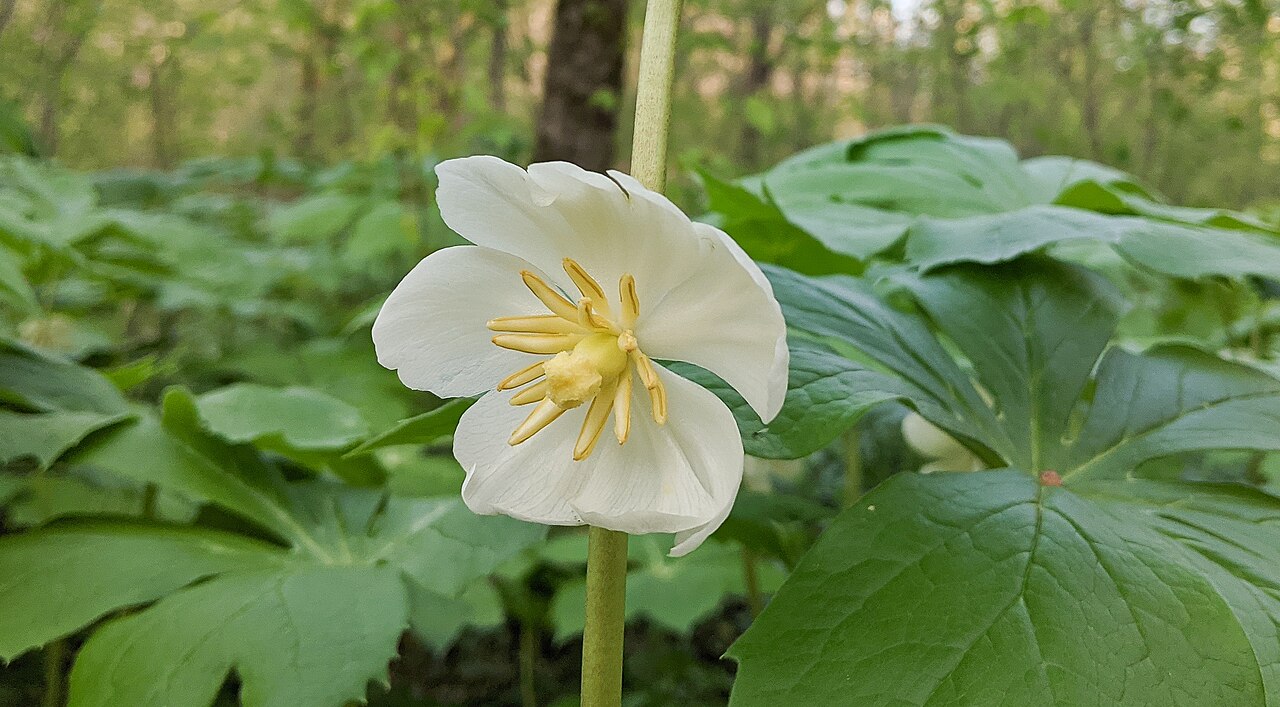
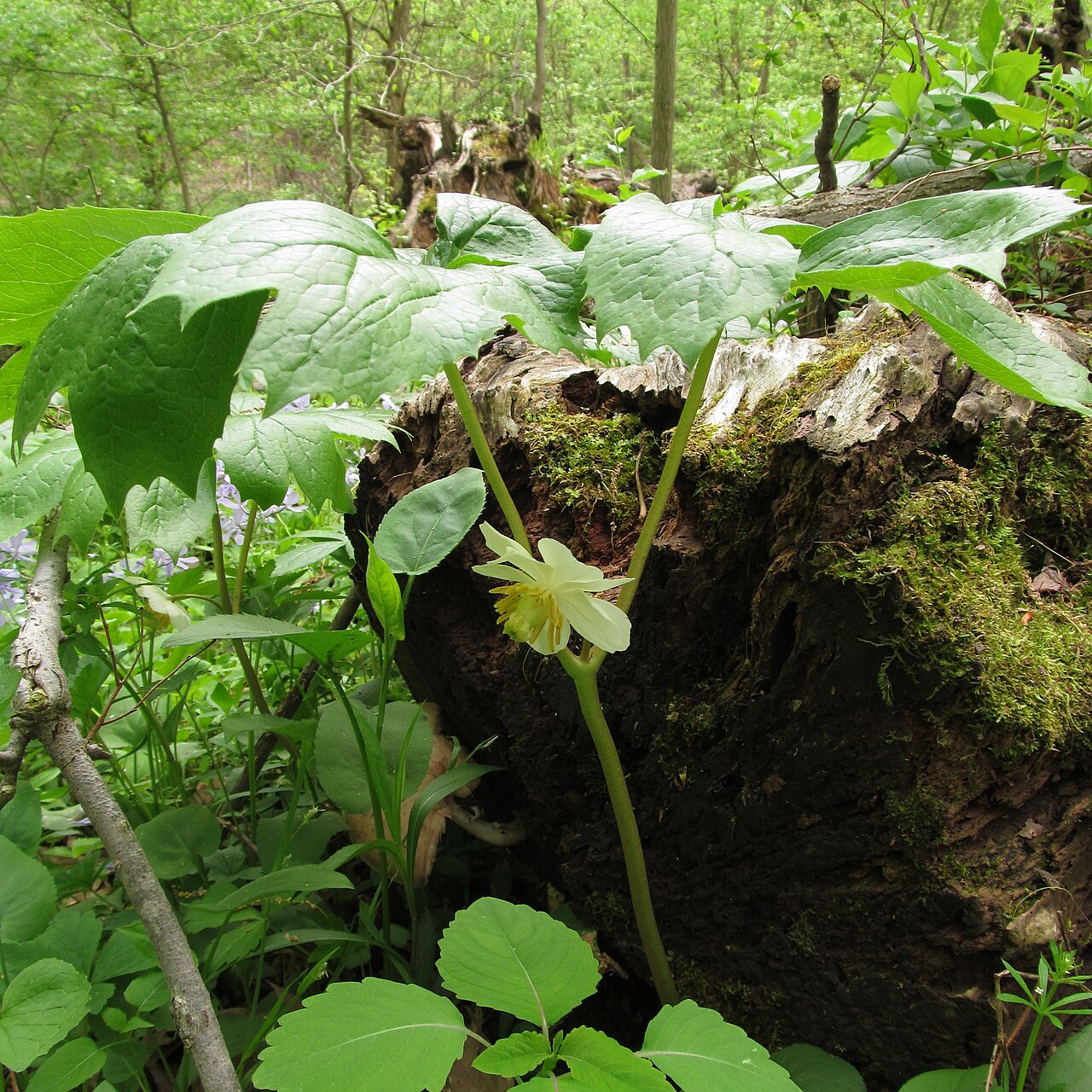
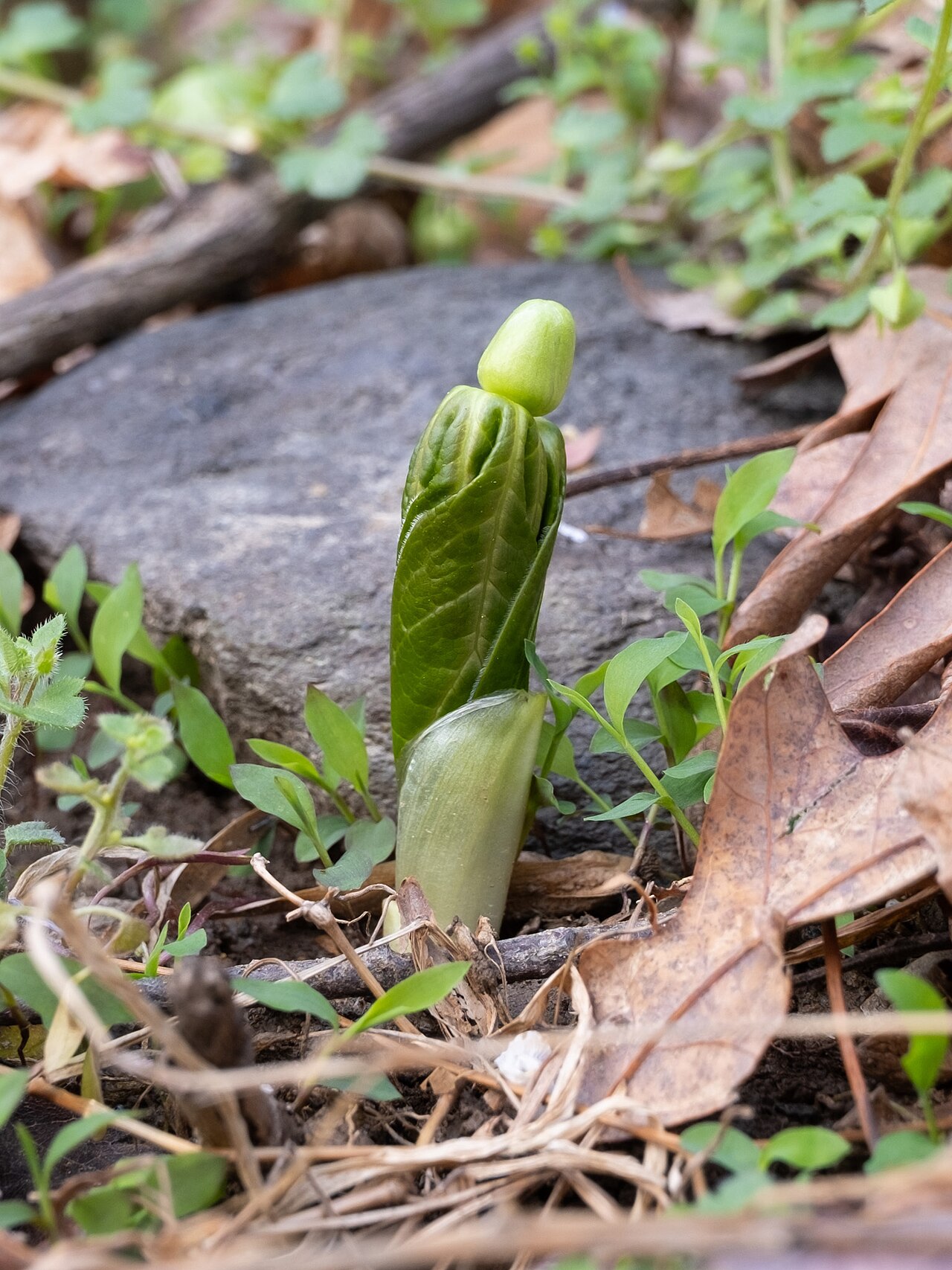
Mayapple (Podophyllum peltatum) announces spring with folded shoots that open into broad green umbrellas. A colony can give a woodland floor an almost architectural pattern, each leaf held above a simple upright stem. The white flowers are less obvious: look beneath a pair of leaves on a mature flowering shoot, where a single bloom hangs at the fork.
This is a native of eastern North American woods, including Maryland, Virginia, and West Virginia. It is not a desert native and should not be promoted as indigenous to New Mexico. Its ability to tolerate seasonal dryness within an eastern forest does not translate into a recommendation for hot, exposed, arid landscaping. A shaded, humus-rich bed with spring moisture is the right garden analogy.
Mayapple is also a plant whose seasonal behavior and toxicity need to be understood before planting. It spreads by underground rhizomes, can form a substantial colony, and commonly goes dormant in summer. Roots, leaves, seeds, and unripe fruit are poisonous. Use it as a woodland ornamental away from places where children or pets may sample plants, and do not treat this guide as a foraging or home-remedy instruction.
Identification
Emerging Shoots
The spring shoot pushes upward with its folded leaf or leaves wrapped around the stem. As it expands, the blade opens into a broad umbrella-like shape with deep lobes. The stem is smooth-looking and unbranched below the leaf junction. A colony often emerges together, making a strong seasonal display that later changes completely as the plants flower, fruit, and retreat into dormancy.
Leaves
Leaves are large, deeply lobed, and held nearly horizontally. Nonflowering shoots commonly carry one leaf, while flowering shoots carry two. That distinction is useful when looking for flowers: a healthy one-leaf shoot is not necessarily failing because it has no bloom. The leaf stalk attaches inward from the blade’s edge, contributing to the umbrella appearance and the name peltatum.
Flowers
A mature two-leaf shoot can bear one nodding white flower at the fork. The waxy petals surround numerous stamens, and the bloom is often hidden unless viewed from below. Flowering is generally in spring, commonly April or May in the region. Avoid lifting leaves repeatedly or bending stems just to display the flower; position the plant where it can be observed without damaging the shoot.
Fruit and Dormancy
Pollinated flowers can form an oval green fruit that becomes yellow as it ripens. Fruiting is not guaranteed on every flowering stem. Later, leaves often yellow and disappear as the plant enters summer dormancy, particularly as conditions become warmer or drier. Mark the colony and avoid digging it over. A bare-looking patch in midsummer may contain healthy living rhizomes waiting for the next spring.
Quick Facts
| Scientific Name | Podophyllum peltatum L. |
| Family | Berberidaceae (barberry family) |
| Plant Type | Rhizomatous woodland perennial with summer dormancy |
| Mature Height | 1–1.5 ft |
| Mature Spread | Individual shoots about 9–12 in; rhizomes form much larger colonies |
| Growth Rate | Colony-forming once established; seedlings mature slowly |
| Sun Exposure | Partial shade to shade |
| Water Needs | Average woodland moisture, especially during spring growth |
| Soil Type | Humus-rich, well-drained sandy to loamy woodland soil |
| Soil pH | Often acidic; match local woodland conditions |
| Bloom Time | Spring, commonly April–May |
| Flower Color | White |
| Fall Color | Usually dormant before autumn rather than providing fall color |
| Fruit | Oval fruit, green becoming yellow; plant is poisonous and not a casual food crop |
| Deer Resistant | Often avoided, but damage is still possible |
| USDA Hardiness Zones | 3–8 |
Native Range
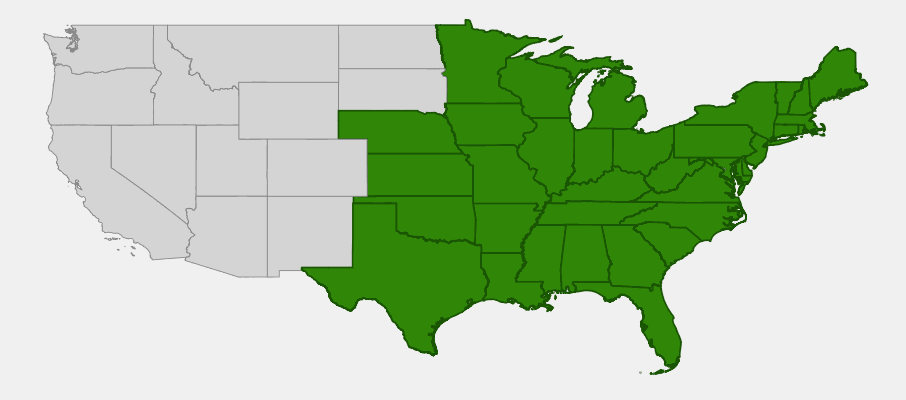
Mayapple’s native range extends across much of eastern North America, from southern Canada through eastern and central U.S. forests and south into Texas and Florida. It occurs in colonies in deciduous woods, shaded fields, and along suitable riverbanks and roadsides. That broad outline still leaves important local differences: not every shaded site in a listed state supports a native population.
The map summarizes the eastern and central U.S. range listed by botanical and extension sources. It does not include New Mexico or the desert Southwest. A plant’s common name appearing in a gardening article about a state is not evidence of nativity there. For restoration work, consult a state flora or natural-heritage program and obtain appropriately sourced plants.
Within the Mid-Atlantic, mayapple is best understood as a spring woodland colony. Soil moisture supports the early growth, while the deciduous canopy moderates the summer environment. Planting it under hot exposed conditions and attempting to compensate with occasional watering does not reproduce that habitat. Preserve existing wild colonies and use propagated garden material rather than digging rhizomes from woods.
📋 Regional plant list: Maryland, Virginia & West Virginia
Growing & Care Guide
Light
Partial shade to shade fits its woodland habit. Spring light beneath deciduous trees can support growth before the canopy closes. Avoid hot afternoon exposure, especially where soil dries quickly. A site that looks shaded in winter may receive intense reflected heat after nearby surfaces warm, so consider the whole growing season. Mayapple does not need to be moved into sun to force flowering on young one-leaf shoots.
Soil and Water
Provide humus-rich soil that holds spring moisture while draining well. The original root or rhizome planting should not dry out during establishment. Once settled in appropriate woodland conditions, the plant can tolerate seasonal drying partly through dormancy. Do not interpret that as a general drought-landscaping claim. Avoid standing water around rhizomes and do not pack a wet clay hole with rich compost and assume the resulting pocket will drain.
Planting Tips
Choose the eventual colony area before planting. Set nursery stock at its original level and give rhizomes room to expand without immediately entering a path or crowding delicate small plants. Keep a durable marker at the edge so the dormant area is not dug over later. A light layer of leaf litter can maintain a woodland surface. Avoid planting where the fruit will be mistaken for an edible garden crop or where pets habitually chew vegetation.
Pruning and Seasonal Maintenance
Do not mow the foliage while it is actively growing. Leaves replenish the underground system before dormancy. Allow natural yellowing, then remove collapsed material only as needed for the garden. If the colony spreads beyond its intended boundary, manage dormant garden rhizomes carefully rather than repeatedly damaging emerging shoots. Wear gloves when handling plant material and keep removed pieces out of reach of children and animals.
Propagation
Division of established cultivated rhizomes during dormancy is the most direct way to increase a known plant. Retain a viable bud and sound rhizome section, replant promptly, and keep the site suitable for spring emergence. Seed propagation takes patience: seedlings may need several years to reach flowering size, and seed handling and stratification should follow a reliable protocol. Do not harvest wild rhizomes. Keep provenance records if the planting has a conservation purpose.
Designing Around Dormancy
Plan the summer appearance before relying on mayapple as a groundcover. Its broad leaves may vanish when a garden visitor expects a full green bed. Use neighboring plants that provide later interest without smothering the mayapple crown or requiring summer digging through the colony. Keep paths clearly defined, and use a label or edging cue to show that the dormant patch is intentional rather than neglected.
Landscape Uses
- Create a spring woodland colony where its umbrella leaves can spread.
- Use near a shaded path that allows flowers to be viewed from the side without bending stems.
- Include in a seasonal native garden with later-interest neighbors and clear dormant-area markers.
- Plant only where its poisonous parts will not be casually sampled by children or pets.
Wildlife & Ecological Value
For Pollinators
Bees visit the spring flowers, including larger bees able to work beneath the leaves. The hidden position of a flower does not mean it has no ecological function. Retain a variety of woodland flowering plants nearby and avoid insecticide exposure. Fruiting depends on successful pollination and plant condition, so absence of fruit alone is not proof that a plant has been misidentified.
For Fruit-Eating Wildlife
Extension references record wildlife, including box turtles and squirrels, eating the fruits. That observation is not a safety instruction for people: animal diets and human toxicity risks are not interchangeable. Leave fruit for wildlife where that fits the garden and does not create an access risk for children or pets.
For Browsing Mammals
Mayapple is often considered relatively resistant to deer and rabbits, but a colony can still be trampled, sampled, or disturbed. Do not use toxicity as a substitute for responsible garden placement or as a guarantee of pristine leaves. Protect new plants where local animal traffic repeatedly prevents establishment.
Ecosystem Role
Rhizomes produce a seasonal ground-layer colony, and the broad spring leaves alter light and space for nearby small plants. In a garden that means mayapple needs room; native does not mean it will politely remain inside a tiny planting hole. In natural woods, protect the established colony and surrounding soil rather than fragmenting it for ornamental collection.
Cultural & Historical Uses
Common names such as umbrella leaf and mayapple describe visible features, while American mandrake reflects older naming traditions. It is not the Mediterranean mandrake, and shared common names should never be used to infer medicinal equivalence. The scientific name and recognizable woodland growth pattern are more reliable identifiers.
Mayapple has a documented history in medicinal use and pharmacological study. That history should be separated from home treatment: the plant contains potent toxic compounds, and roots or extracts are not safe household remedies. Modern medicines derived from plant chemistry are standardized products, not an invitation to prepare a garden plant yourself.
Its value in a native garden is already substantial without harvesting it. The spring emergence, hidden flower, fruit development, and summer retreat offer a clear lesson in woodland seasonality. A nursery-propagated colony can provide that experience while wild populations remain undisturbed.
Frequently Asked Questions
Why does my mayapple have one leaf and no flower?
One-leaf shoots are usually vegetative. Flowering shoots typically have two leaves with a flower at the fork. A healthy nonflowering shoot is still contributing to the colony.
Has it died when the leaves disappear in summer?
Often not. Summer dormancy is normal, especially as conditions warm or dry. Mark the colony and avoid disturbing its underground rhizomes while the surface looks empty.
Is mayapple native to New Mexico?
No. This species is associated with eastern and central North American woodlands, not the desert Southwest. Choose a locally native plant for an arid New Mexico landscape.
Can I eat the fruit?
This guide does not recommend harvesting it. Roots, leaves, seeds, and unripe fruit are poisonous, and the plant should not be treated as a casual edible. Keep it away from places where children or pets may sample it.
Will one plant stay in a small clump?
It can spread by rhizomes into a colony. Give it room, plan for summer dormancy, and manage the boundary of a cultivated patch when needed.
Sources & Further Reading
- NC State Extension: Podophyllum peltatum
- Lady Bird Johnson Wildflower Center: mayapple
- USDA PLANTS: Podophyllum peltatum
Find Native Plants
Ask growers about nursery propagation and regional provenance. Browse our Maryland native plant nurseries, Virginia native plant nurseries, West Virginia native plant nurseries directory for suppliers.