Rose Vervain (Glandularia canadensis)
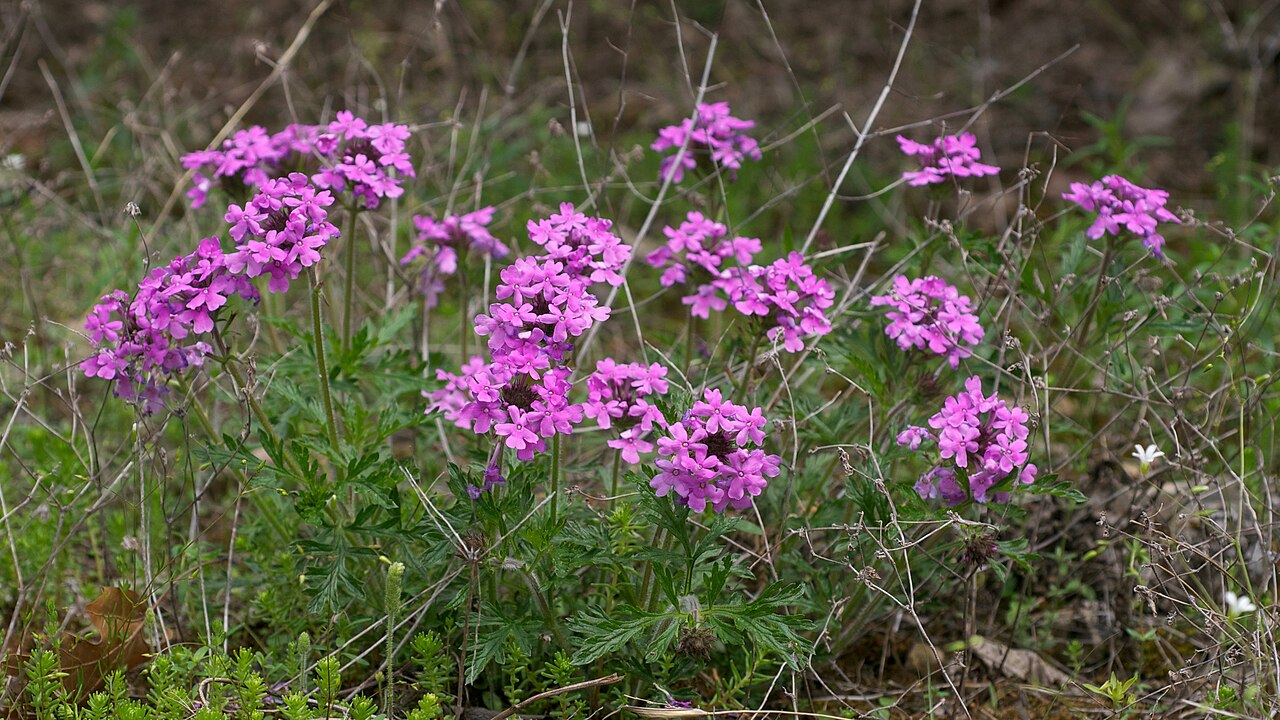
Rose vervain spreads its pink-purple flower clusters close to the ground, adding color where a tall meadow plant would block a path or overwhelm a small border. Glandularia canadensis is a native low-growing perennial, often listed under its older name Verbena canadensis. Its branching stems, divided opposite leaves and clustered tubular flowers make a distinctive combination when examined together.
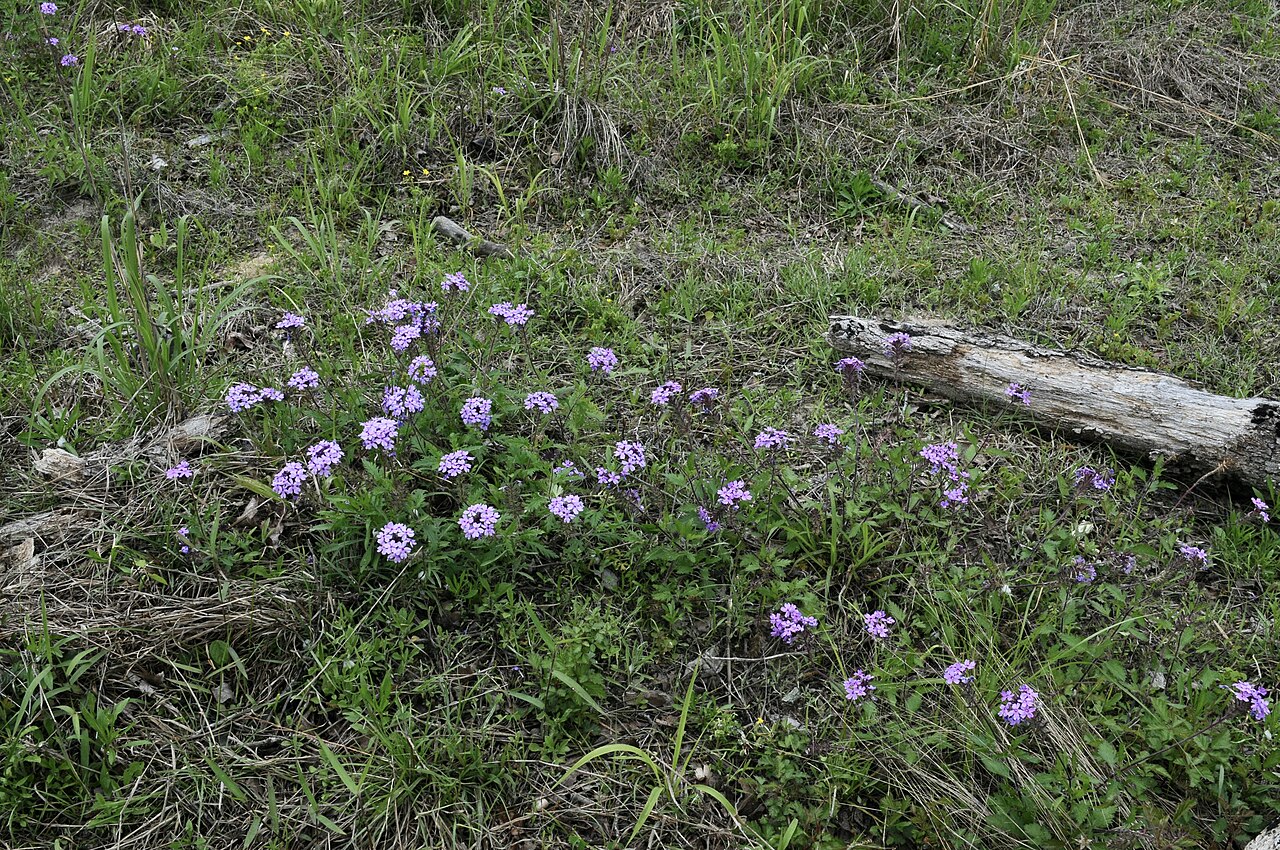
This is a plant to choose carefully at a nursery. The name verbena is applied to many species, cultivars and hybrids, and a bright hanging-basket plant is not automatically the regional native described here. Ask for the scientific name and propagation source. The photographs on this page show identified plants in Arkansas and Texas rather than using an unrelated red bedding verbena as a substitute.
In a suitable sunny, freely drained spot, rose vervain can make a colorful front-of-border patch and attract flower-visiting insects. It is usually short-lived rather than a permanent woody groundcover, and it can renew itself through seed or rooted stems in favorable conditions. Planning for that habit is more realistic than expecting every original plant to remain unchanged for years.
Identification
Stems and habit
Stems spread outward close to the ground and can root where nodes contact suitable soil. Flowering tips rise above the leafy mat. A typical garden plant is about 6–18 inches tall with a wider spread, often around 1–2 feet or more under favorable conditions. The exact outline depends on the form and site. It is not the tall, narrow-spiked blue vervain of wet meadows, nor is it a climbing vine.
Leaves
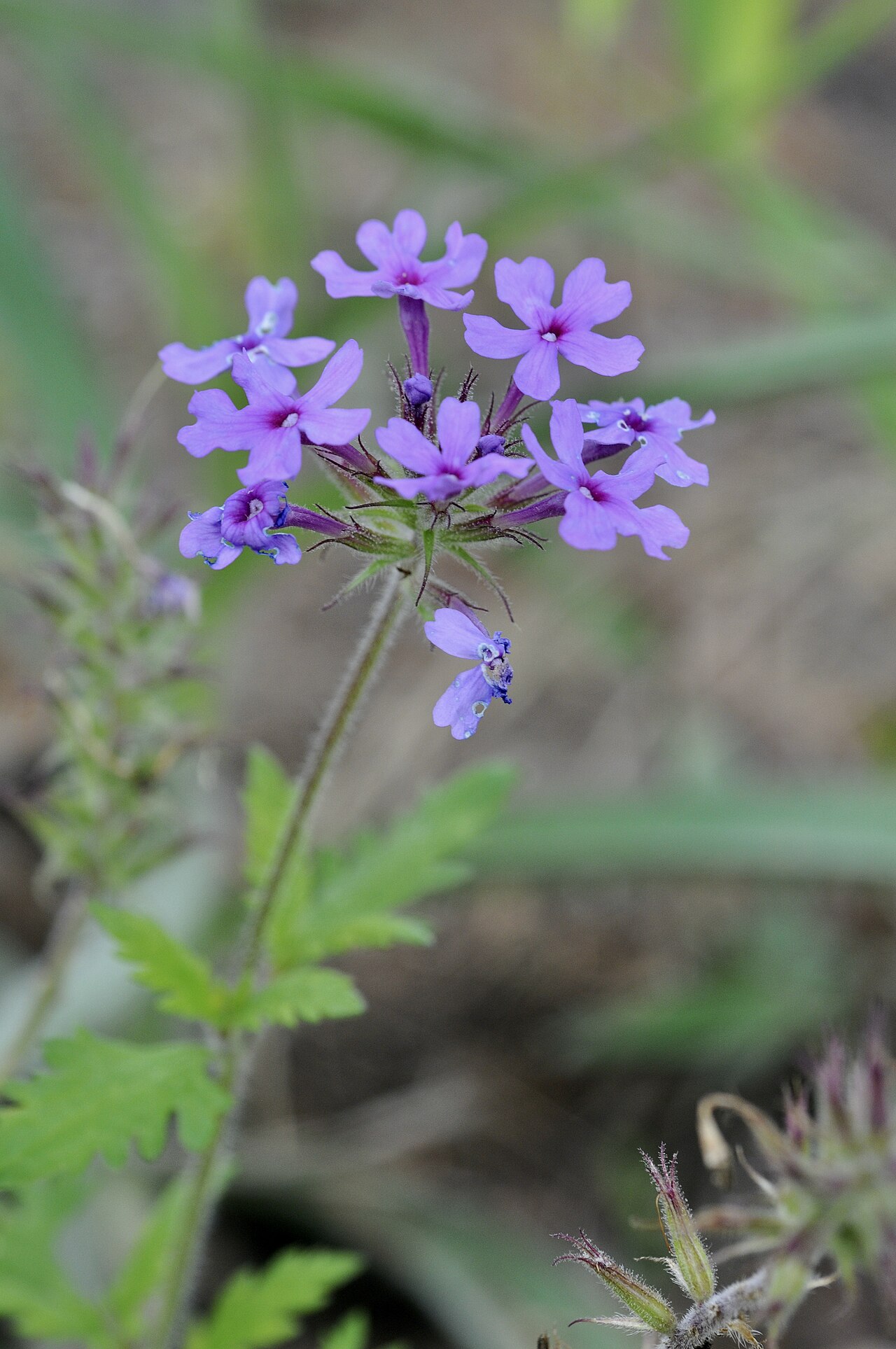
Leaves occur opposite one another and are toothed or deeply lobed, producing a more cut-leaved texture than a simple smooth oval. Examine the leaves along with the flowers when checking a nursery plant. Some hybrid and cultivar labels are unreliable, and color alone does not resolve identity. Photographs of the stem nodes and mature leaves are especially useful when comparing a plant to a regional botanical key.
Flowers
Many small tubular flowers are packed into rounded or somewhat flattened clusters. Their spreading lobes create the appearance of a pink, rose or purple cushion above the foliage. Bloom can extend from spring into later seasons, but drought, heat and the individual plant influence how continuous it is. Do not promise uninterrupted flowers every day; a healthy plant may flower in flushes and rest between them.
Fruit and similar plants
The small dry fruits follow the flowers and can contribute to self-sowing. Seedlings may appear away from the original crown, so retain labels and verify volunteers before distributing them. Glandularia canadensis is the accepted name used by Kew for the species historically called Verbena canadensis. The presence of canadensis in the name should not be used to infer that it is native everywhere in Canada; distribution must be checked independently.
Quick Facts
| Scientific Name | Glandularia canadensis (synonym Verbena canadensis) |
| Family | Verbenaceae (vervain family) |
| Plant Type | Low-growing, often short-lived perennial; spreading herb/subshrub |
| Mature Height | About 6–18 inches |
| Mature Spread | Commonly 1–2 feet or wider as stems root |
| Growth Rate | Moderate to fast in suitable conditions |
| Sun Exposure | Full sun |
| Water Needs | Dry to average after establishment; drainage essential |
| Soil Type | Sandy, gravelly or well-drained garden soil |
| Soil pH | Adaptable; use locally suitable soil rather than automatic amendments |
| Bloom Time | Spring into summer or fall, often in flushes |
| Flower Color | Rose-pink to purple in typical species plants |
| Fall Color | Not a principal ornamental feature |
| Fruit | Small dry fruits; can self-seed |
| Deer Resistant | May be browsed; do not assume deer resistance |
| USDA Hardiness Zones | Zones 6–10 in NC State guidance; local form and winter drainage affect persistence |
Native Range
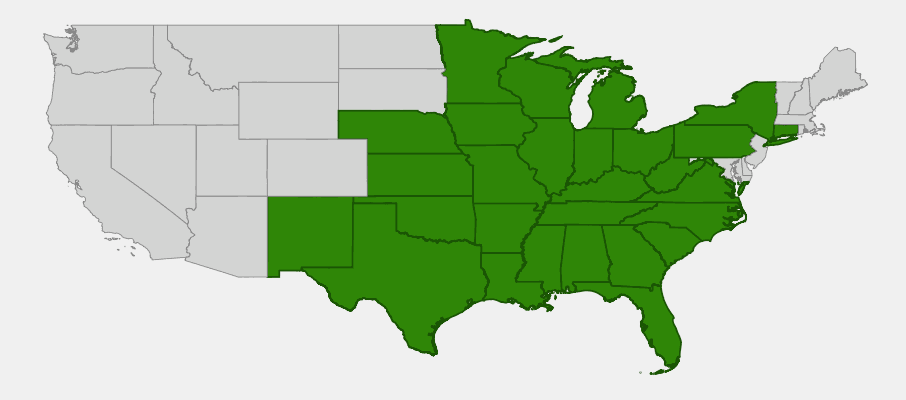
Kew places Glandularia canadensis across central and eastern portions of the United States, including Arkansas, Louisiana, Oklahoma and Texas. The map uses its current state-level native list. That broad outline does not establish native occurrence in every county; regional floras and herbarium records are the right next step for restoration or conservation work.
Open dry places, roadsides, sandhills and similarly drained sites are useful habitat models. A roadside occurrence should still be evaluated for local nativity rather than assumed indigenous simply because the plant grows without care. For gardens in the four-state region linked below, match both moisture conditions and plant provenance. A sunny sandy site and a wet shaded hollow are not interchangeable just because they lie in the same state.
Kew lists Colorado and Germany as introductions, so they are not shaded as native here. The northern edge of the species’ treatment can differ among regional sources, and the scientific epithet is not a Canadian range statement. The photographs include documented Arkansas and Texas locations that illustrate the species in the core regional setting rather than implying that cultivated occurrences elsewhere establish a native range.
📋 Regional plant list: Arkansas, Louisiana, Eastern Oklahoma and Eastern Texas
Growing & Care Guide
Light
Choose full sun for a compact, floriferous plant. A spot under dense shrubs is a poor substitute even if the soil is dry. In a front border, remember that taller perennials can shade a low plant from the side by midsummer. Give the mat its own open space instead of relying only on a sunny location at the time of planting.
Soil and water
Drainage is the key practical requirement. Sandy or gravelly soil can be a good fit, and ordinary garden soil can work if water does not linger around the crown. Water new plants while roots establish, then adjust to rainfall and soil moisture. Drought tolerance describes an established plant in an appropriate site; it does not mean a small root ball should be left dry immediately after planting. Avoid frequent shallow watering that keeps the surface damp without helping deeper roots.
Planting
Obtain nursery-propagated species plants or documented seed rather than digging a wild patch. Verify labels before planting because garden verbenas are a taxonomically mixed trade group. Set the crown at its former depth, water it in and allow space for stems to spread. A low wall or path edge can show the habit well, provided the adjoining soil is not compacted or chronically wet. In containers, drainage holes and a suitable growing medium are essential.
Pruning and maintenance
Removing spent clusters can keep a garden plant tidy and encourage a compact appearance, but leave some fruiting material if self-sowing is welcome. Do not bury the spreading stems beneath a heavy mulch blanket. Trim only as needed to keep paths open or remove damaged growth. If an older plant declines, consider its short-lived nature and site conditions before assuming that hard pruning or fertilizer will restore it.
Propagation
Rooted nodes and cuttings can preserve the identity of a known garden plant; seed can provide variation when the source is well documented. Keep new divisions or cuttings from drying while roots develop, then gradually acclimate them to the final sunny site. Named cultivars may not come true from seed. For native habitat work, prioritize a verified regional species population rather than selecting plants solely for an unusual flower color.
Troubleshooting
Sparse bloom can reflect shade, severe drying, age or competition. Crown decline in a wet winter suggests a drainage problem. A plant sold as a native verbena but producing an unexpected habit or leaf shape deserves an identity check, not merely different care. Keep purchase records and photographs of mature leaves and flowers. Where deer are common, test a protected group first; NC State notes that browsing can occur despite the plant’s dry-site adaptability.
Landscape Uses
- A low flowering edge along a sunny native border.
- A rock-garden pocket with enough soil for roots and good drainage.
- A container of verified species material near a sunny seating area.
- A patch among low open-site natives where taller plants will not shade it.
Wildlife & Ecological Value
Pollinators
Flower clusters attract butterflies and other nectar-seeking insects. Placing a patch where it can be watched makes the difference between assumed and observed wildlife value clear. Keep pesticides away from bloom and provide other species for times when rose vervain is not flowering. A few low flowers can be an important part of a varied garden, but they do not replace the need for larval host plants and shelter.
Birds
This is not a berry-bearing plant or a major woody refuge. Its contribution to a bird-friendly garden is indirect and complementary: insects, low vegetation and seasonal structure within a larger planting. Combine it with locally native shrubs and grasses where space allows rather than attributing every habitat function to a small flowering mat.
Mammals
Deer may browse rose vervain, so a resistance claim should not drive a large purchase. Protect young plants where necessary and observe local pressure. No forage or medicinal recommendation is made here. In a pet-accessible garden, sound identification and routine supervision remain more useful than assuming that the word native guarantees suitability for every use.
Ecological fit
The spreading habit can occupy small sunny gaps, but the species should still be used within an appropriate local plant community. Avoid moving cultivated hybrids into natural areas under the assumption that they are equivalent to a regional wild population. Record the source of seed or stock, and keep nonnative bedding verbenas separate when the goal is a documented native planting.
Cultural & Historical Uses
Verbena canadensis remains common in garden literature, while Glandularia canadensis is the accepted name in the Kew account used here. Retaining the synonym in plant records makes older regional tables understandable without creating duplicate species entries. This is a botanical naming change, not evidence that a gardener’s correctly identified plant has become a different organism.
Garden verbenas have been selected in many colors and forms, and some familiar nursery plants are hybrids or named selections rather than a local wild-type accession. That horticultural history is part of the appeal of the group, but it also explains why careful purchasing matters. A showy pot label should be followed by a question about identity and origin when ecological fidelity is the goal.
This article does not recommend ingesting the plant or using it as medicine. The useful contemporary story is the selection of a regional native for a low, sunny planting, supported by accurate labels and nursery propagation. Learning to recognize its opposite divided leaves, spreading stems and clustered flowers helps gardeners keep that intention intact when plants are divided, shared or replaced.
Frequently Asked Questions
Is Verbena canadensis the same as Glandularia canadensis?
Yes, the former is a synonym of the latter in the treatment used here. Other plants sold simply as verbena may be different species or hybrids.
Will it survive in wet soil?
Persistent wetness is not the intended condition. Choose well-drained soil and pay particular attention to winter drainage.
Does the name mean it is native throughout Canada?
No. Scientific epithets are not range maps. The Kew distribution used here lists U.S. native states and does not establish a Canadian native range.
Can I use a red bedding verbena instead?
Not if the goal is this verified native species. Flower color and a shared common name do not prove identity; ask for the scientific name and source.
How do I keep it flowering?
Provide sun, appropriate drainage and establishment water, and remove spent clusters if desired. Expect seasonal flushes rather than a guarantee of uninterrupted bloom, and renew short-lived plants when needed.
Sources & Further Reading
- NC State Extension: rose verbena
- Kew: Glandularia canadensis accepted name and range
- USDA PLANTS: rose mock vervain
Find Native Plants
Ask growers about nursery propagation and regional provenance. Browse our AR native plant nurseries, LA native plant nurseries, OK native plant nurseries, TX native plant nurseries directory for suppliers. Explore the native nursery finder.