Foxtail Pine (Pinus balfouriana)
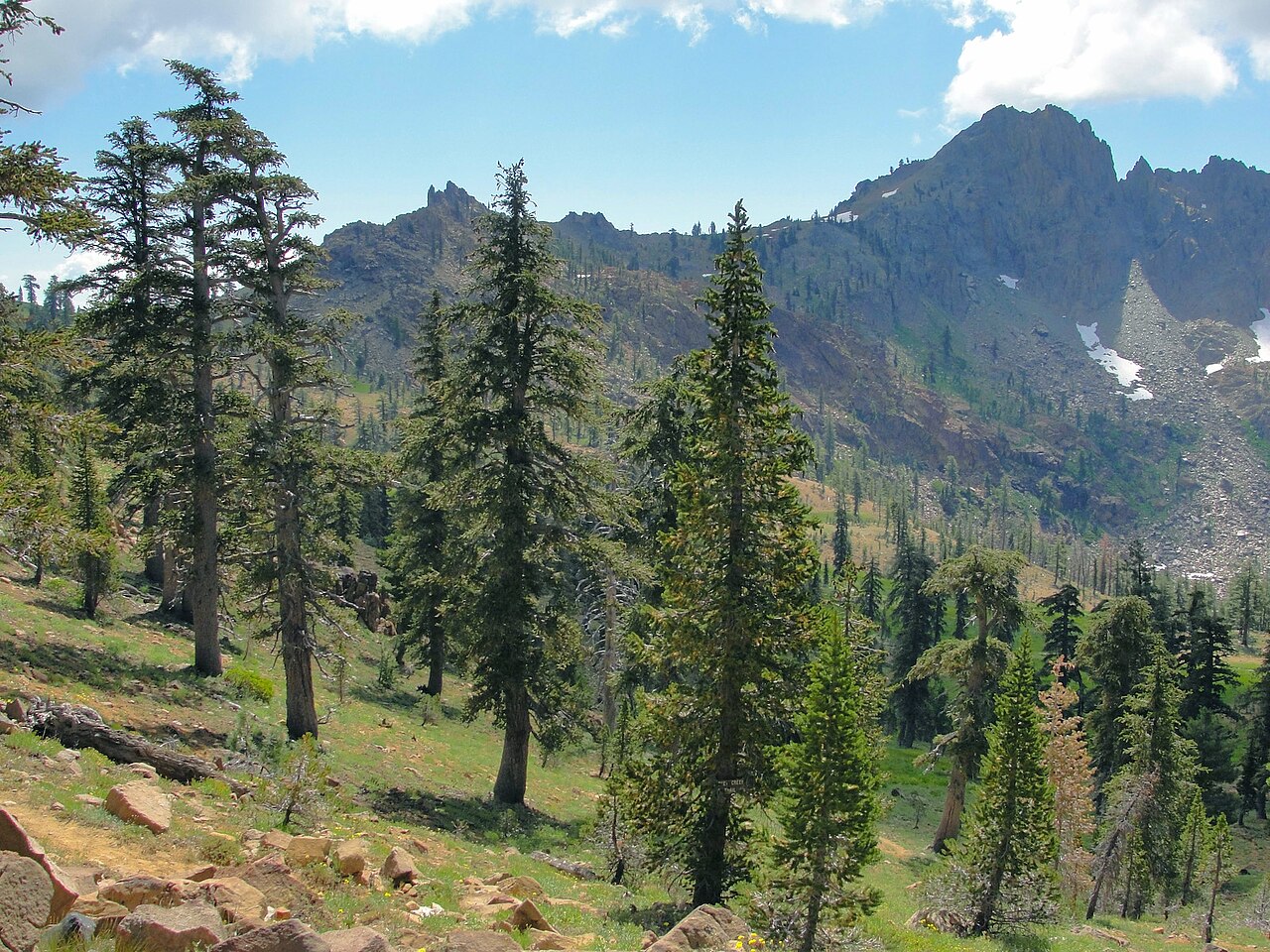
Pinus balfouriana, the Foxtail Pine, is a rare, long-lived, high-elevation pine found only in California — nowhere else in the world. It occurs in two widely separated populations: a northern group restricted to the Klamath Mountains of Siskiyou, Trinity, Shasta, and Tehama counties in far northern California, and a southern group (sometimes treated as a separate subspecies, P. balfouriana subsp. austrina) scattered through the southern Sierra Nevada in the Sequoia and Kings Canyon high country. These two populations are separated by several hundred miles with no pines of this species growing between them, a striking disjunct distribution that has long fascinated botanists.
Foxtail Pine takes its name from its dense, bushy foliage, in which the short needles crowd densely along the last several years of twig growth, giving each branch tip a thick, bottle-brush or fox’s-tail appearance unlike the more open, tufted look of most other pines. It is closely related to the famous Great Basin Bristlecone Pine (Pinus longaeva) of Nevada, Utah, and the White Mountains, and shares that relative’s extreme longevity, gnarled old-growth form, and tolerance of harsh, wind-blasted, high-elevation sites — though Foxtail Pine does not reach quite the record-breaking ages of its bristlecone cousin.
This is not a garden tree for most people — its native habitat is subalpine and alpine terrain above 7,000 feet, often on exposed rocky ridges and talus slopes where winters are brutal and growing seasons short. But for mountain properties within its elevation range, or for conifer collectors and botanical gardens able to replicate those conditions, Foxtail Pine is a slow-growing, strikingly sculptural tree with a presence unlike almost anything else in the California flora.
Identification
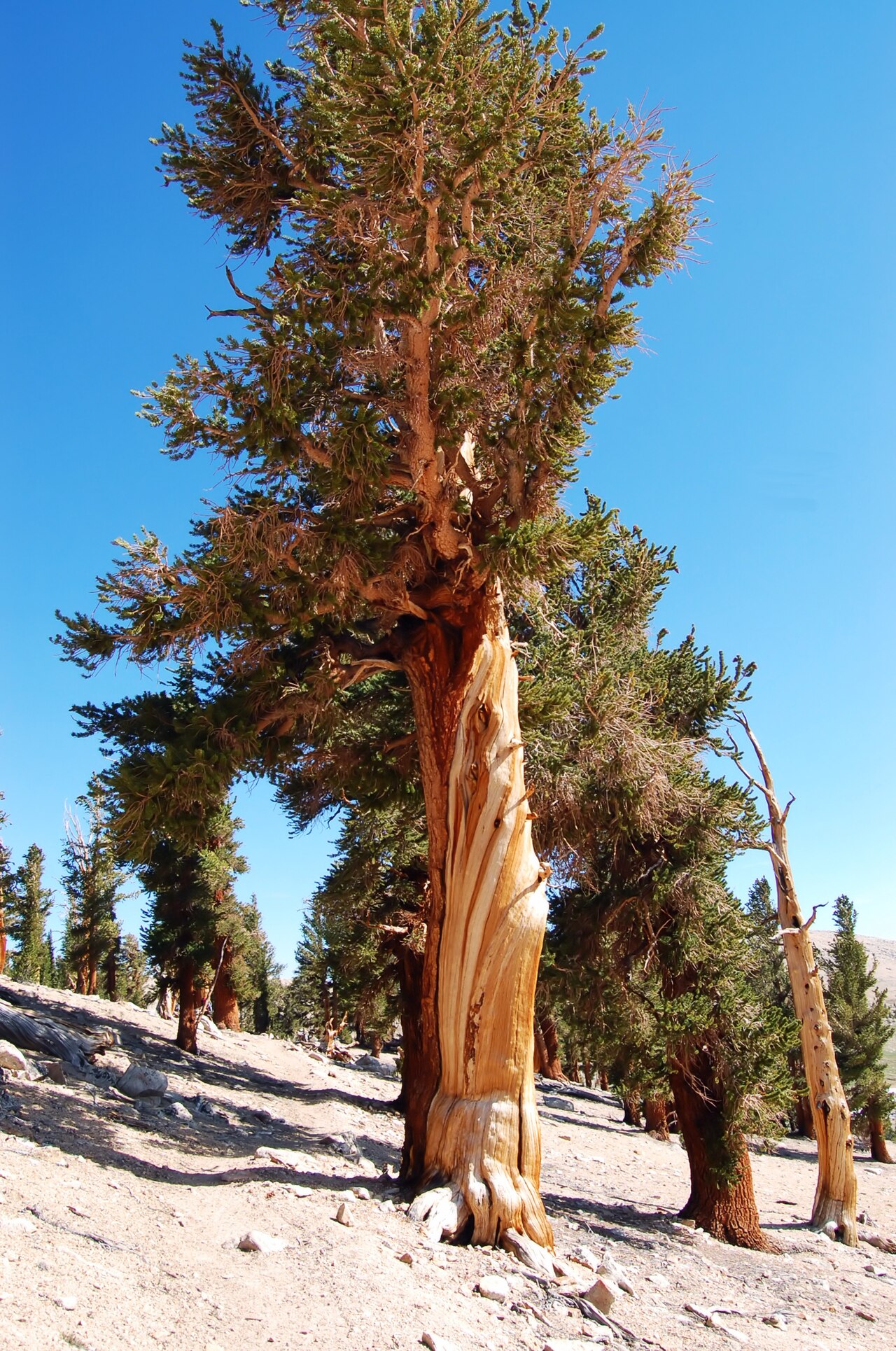
Foxtail Pine is a small to medium evergreen conifer, usually 20 to 50 feet (6–15 m) tall at maturity, though old individuals on the most exposed sites are often shorter, twisted, and multi-trunked from storm damage and ice. Young trees have a fairly narrow, conical crown; with age the crown becomes irregular, flat-topped, or wind-sculpted, especially near timberline.
Bark & Stems
Bark is thin, smooth, and whitish-gray on young trees, becoming thicker, reddish-brown, and deeply furrowed into irregular plates with age. On old, weathered trees at the highest, most exposed sites, much of the trunk is often bare, polished, sun-bleached deadwood, with a narrow strip of living bark feeding a small tuft of foliage — the same striking “strip-bark” growth habit seen in bristlecone pines, an adaptation that lets the tree survive with only a fraction of its cambium alive.
Leaves
Needles are short, 1 to 1.5 inches (2.5–4 cm) long, dark blue-green, and borne in bundles (fascicles) of five. They are retained on the twig for 10 to 20 years or more, far longer than most pines, which causes them to accumulate densely along the last several years of branch growth — the dense, cylindrical clustering that gives the foliage its distinctive “foxtail” look.
Fruit & Seeds
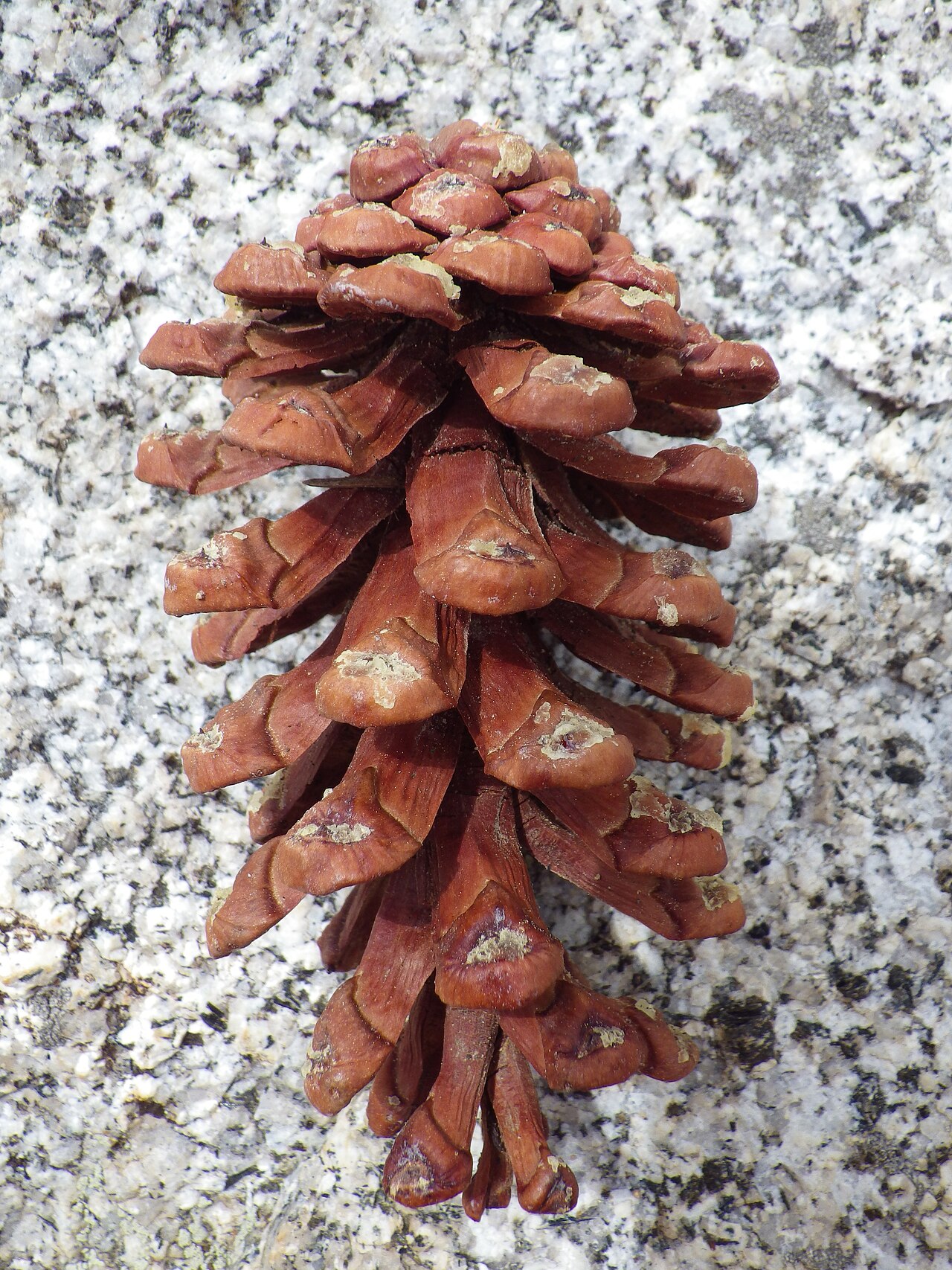
Seed cones are cylindrical to narrowly egg-shaped, 3 to 5 inches (8–13 cm) long, purplish-brown when mature, with each scale bearing a short, slender, often weak or absent prickle — a useful difference from the similar-looking cones of Great Basin Bristlecone Pine, whose scales bear longer, more bristle-like prickles (the source of that species’ common name). Cones mature over two seasons and release small winged seeds that are an important food source for Clark’s nutcrackers and other high-elevation wildlife.
Quick Facts
| Scientific Name | Pinus balfouriana |
| Family | Pinaceae (Pine) |
| Plant Type | Evergreen Coniferous Tree |
| Mature Height | 20–50 ft (6–15 m) |
| Mature Spread | 15–25 ft (4.5–7.5 m) |
| Growth Rate | Very slow |
| Sun Exposure | Full Sun |
| Water Needs | Low |
| Soil Type | Thin, rocky, well-drained; granite or ultramafic substrates |
| Soil pH | 5.5–7.0 (acidic to neutral) |
| Bloom Time | June – July (pollen cones) |
| Flower Color | Red to purplish (male cones) |
| Fall Color | None (evergreen) |
| Fruit | Purplish-brown cylindrical seed cones, 3–5 in |
| Deer Resistant | Yes |
| USDA Hardiness Zones | 4–7 |
Native Range
Foxtail Pine is endemic to California, occurring in two disjunct populations with no known wild trees in between. The northern population grows in the Klamath Mountains of Siskiyou, Trinity, Shasta, and Tehama counties, generally above 6,000 feet on exposed subalpine ridges and rocky slopes, including the Trinity Alps and Russian Wilderness areas. The southern population — often distinguished as subsp. austrina — occurs in the southern Sierra Nevada, mainly in and around Sequoia and Kings Canyon National Parks, typically between about 9,000 and 11,500 feet.
Across both populations, Foxtail Pine favors harsh, exposed sites with thin, rocky soil, including granite outcrops in the Sierra and serpentine or other ultramafic substrates in parts of the Klamath Mountains, where it faces less competition from faster-growing conifers. These marginal, difficult sites — along with the species’ extremely slow growth and long needle retention — contribute to its exceptional longevity, with some Sierra individuals documented at over 2,000 years old.
In the Sierra, Foxtail Pine typically grows near or above the upper limit of other conifers, often alongside or just below stands of Whitebark Pine and Mountain Hemlock, in a landscape of exposed granite, talus, and short alpine growing seasons. In the Klamath Mountains it occupies a broadly similar high-elevation niche on serpentine and other rocky ridges.
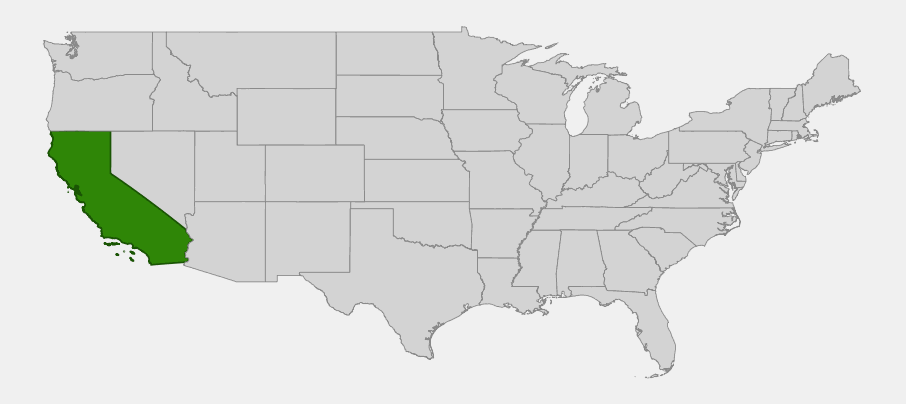
📋 Regional plant lists featuring Foxtail Pine: none — its native range is limited to two disjunct high-elevation areas of California not covered by a dedicated regional plant list on this site.
Growing & Care Guide
Foxtail Pine is a specialist’s tree. It is almost never available at general nurseries and is best attempted only by conifer enthusiasts or on mountain properties that genuinely replicate its harsh, high-elevation native habitat — it does not perform well, and often fails outright, in lowland or mild-winter gardens.
Light
Give it full, unobstructed sun. In the wild, Foxtail Pine grows at or near timberline on completely open, exposed ridges, and it does not tolerate shade or competition from taller vegetation at any life stage.
Soil & Water
Plant in thin, rocky, extremely well-drained soil — rich garden loam is unsuitable and can shorten the tree’s life. Established trees need very little water and are highly drought tolerant, reflecting their origin on dry, wind-exposed, high-elevation rock. Good drainage is critical in every season; standing water or heavy, poorly drained soil is fatal.
Planting Tips
This is a tree for cold-winter, high-elevation mountain gardens only — it struggles badly in mild, low-elevation climates and is not recommended outside conditions similar to its native subalpine habitat. Growth is extremely slow, so plant the largest container stock available and expect a tree that changes little from year to year even under good conditions. Full exposure to wind, rather than shelter, mimics its natural growing conditions.
Pruning & Maintenance
Established trees need essentially no pruning; the irregular, wind-sculpted form that develops naturally with age is part of the tree’s appeal and should not be corrected. Avoid any fertilization or soil amendment, which can push unnaturally fast, weak growth in a species adapted to extreme scarcity.
Propagation
Propagation is from seed, which benefits from an extended period of cold, moist stratification mimicking a high-elevation winter. Germination and early growth are slow, and container seedlings should be grown on for several years in lean, well-drained mix before any attempt at outplanting.
Landscape Uses
Appropriate uses are limited mostly to:
- High-elevation mountain gardens within or similar to its native range
- Rock gardens and alpine plant collections with excellent drainage
- Specimen plantings for conifer collectors and botanical gardens
- Conservation and research plantings given the species’ restricted range
Wildlife & Ecological Value
Despite its harsh, sparsely vegetated habitat, Foxtail Pine supports a distinctive community of high-elevation wildlife adapted to the same extreme conditions the tree itself tolerates.
For Birds
Clark’s nutcrackers are especially important to this pine, harvesting and caching its seeds across the landscape; uncollected caches that germinate are a significant source of new seedlings, making the bird something of a planting partner for the tree. Mountain chickadees and other high-elevation songbirds also use foxtail pine stands for foraging and shelter.
For Mammals
Chipmunks and ground squirrels feed on and cache seed, and the gnarled, often hollow old trunks of ancient trees can provide shelter for small mammals in an otherwise exposed, rocky landscape. Mule deer pass through foxtail pine habitat seasonally, though dense use is limited by the sparse understory typical of these sites.
For Pollinators
As a wind-pollinated conifer, Foxtail Pine offers no floral resources to pollinators, but the alpine and subalpine wildflower communities often found nearby, in more sheltered pockets of soil, support native bees and other high-elevation pollinators during the short summer season.
Ecosystem Role
Foxtail Pine is a foundational species of two of California’s most extreme, isolated high-elevation plant communities. Its extraordinary longevity — among the greatest of any tree species — makes old stands a living record of centuries of climate history, and its restricted, disjunct range makes it a conservation priority distinct from more widespread Sierra conifers.
Cultural & Historical Uses
Because Foxtail Pine grows only in remote, high-elevation terrain largely above the zone of permanent habitation, it played a more limited role in Indigenous material culture than lower-elevation pines with edible seeds or accessible timber, though Native peoples traveling through the high Sierra and Klamath country would have been familiar with it as a landmark species of the alpine zone.
In the twentieth century, Foxtail Pine drew scientific attention largely because of its close kinship with Great Basin Bristlecone Pine and its own remarkable age — dendrochronologists have used old Sierra foxtail pines to help build long tree-ring chronologies used in dating and climate reconstruction, much as bristlecone pine has been used elsewhere in the Great Basin.
Today the species is valued primarily for scientific, scenic, and conservation reasons rather than any commercial or utilitarian use; nearly all of its range lies within protected wilderness and national park land in the Klamath Mountains and southern Sierra Nevada.
Frequently Asked Questions
Where does Foxtail Pine grow?
Only in California, in two separate high-elevation areas: the Klamath Mountains of the far north (Siskiyou, Trinity, Shasta, and Tehama counties) and the southern Sierra Nevada around Sequoia and Kings Canyon National Parks. It does not grow in Oregon or any other state.
How is Foxtail Pine different from Bristlecone Pine?
The two are close relatives in the same pine group, but Great Basin Bristlecone Pine (Pinus longaeva) grows in Nevada, Utah, and California’s White Mountains, while Foxtail Pine is restricted to the Klamath Mountains and southern Sierra Nevada. Foxtail Pine cone scales bear short, weak prickles, while bristlecone pine cones have longer, more bristle-like prickles — the feature that gives bristlecone pine its name.
How old can Foxtail Pine trees get?
Some Sierra Nevada individuals have been documented at over 2,000 years old, making this one of the longest-lived tree species in North America, though it does not reach the extreme ages (over 4,000 years) recorded for Great Basin Bristlecone Pine.
Can I grow Foxtail Pine in my garden?
Only if you have a cold-winter, high-elevation site with excellent drainage and full sun that mimics its native subalpine habitat. It generally fails in mild-climate or low-elevation gardens and is rarely offered by general nurseries.
Is Foxtail Pine endangered?
It is not federally listed as endangered, but its naturally restricted, disjunct range and the threats of a warming climate to high-elevation habitat make it a species of conservation concern that is closely monitored in both the Klamath Mountains and southern Sierra Nevada.

Looking for a nursery that carries Foxtail Pine?
Browse our native plant nursery directory: California