
Genipap (Genipa americana)
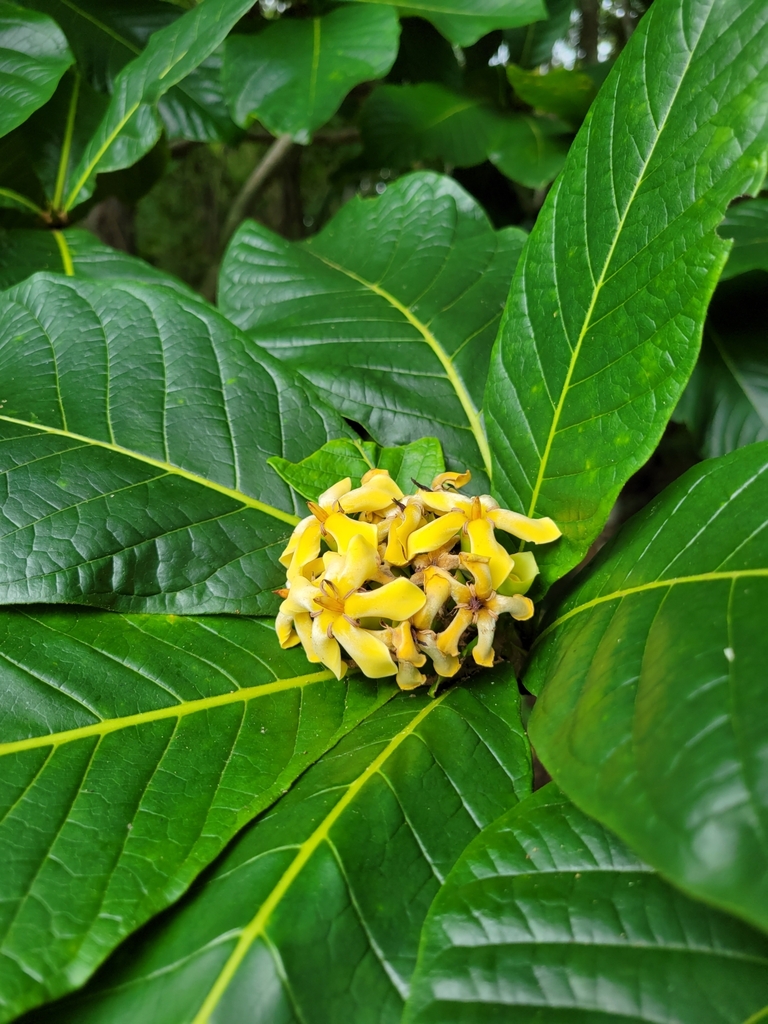
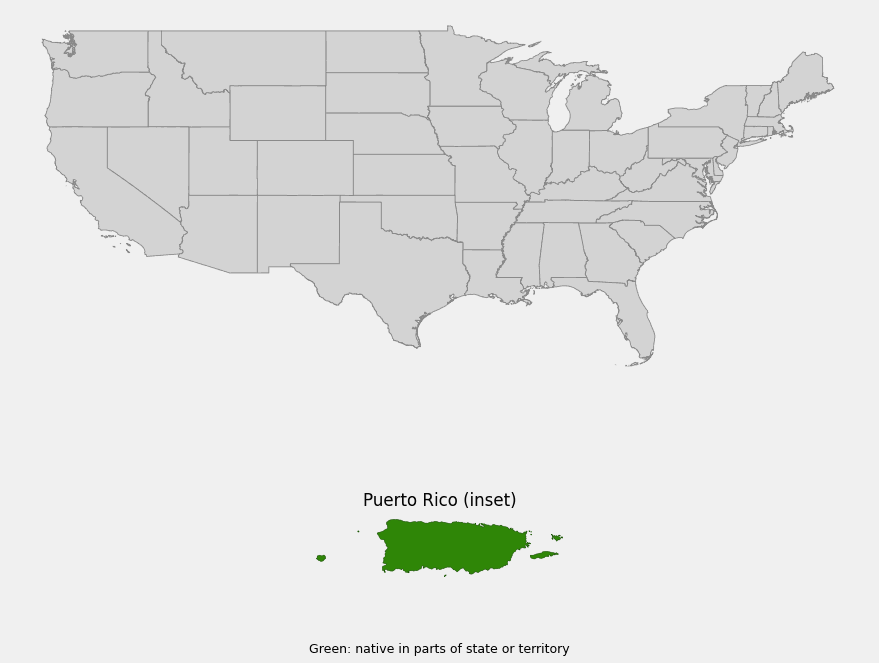
Genipa americana, the Genipap, is a tropical tree of the coffee family (Rubiaceae) known in Puerto Rico as jagua or genipapa. USDA PLANTS lists it under the common name jagua and records it as native to Puerto Rico and the U.S. Virgin Islands. In English the tree is sometimes called genip and its fruit genipap. A form once separated as Genipa caruto is now included in the same species.
Genipap is native from the Caribbean and southern Mexico through Central America to Paraguay and northern Argentina. The Smithsonian’s Flora of the West Indies records it as native in Puerto Rico, including Vieques, as well as in Cuba, Hispaniola, the Virgin Islands and the Lesser Antilles. It is a fast-growing tree with large, glossy leaves, fragrant white flowers that age to yellow, and round, grayish fruits.
The fruit is the famous part. Ripe genipap is eaten fresh or made into drinks, jams and ice cream, while the clear juice of the unripe fruit turns deep blue-black on the skin. Peoples across tropical America have used it for body paint for centuries, and today it is sold as “jagua” temporary tattoo ink. This guide covers how to identify jagua, where it grows, how to grow it and its value to wildlife.
Identification
Genipap is easiest to recognize by its combination of large, glossy, opposite leaves crowded toward the branch tips, clusters of white-and-yellow tubular flowers and round, grayish-brown fruits about the size of a tennis ball.
Form & Bark
Genipap is a medium to large tree, commonly 30 to 50 feet tall in cultivation and reaching up to about 100 feet (30 m) in the forests of South America. The trunk is straight and up to about 2 feet (60 cm) thick, with smooth to slightly fissured gray-brown bark. Young trees have a narrow, irregular or pyramidal crown that becomes rounded with age. The tree is semi-deciduous and often drops many of its leaves while carrying fruit.
Leaves
The leaves are simple, opposite and large: 4 to 14 inches (10–35 cm) long and 2.5 to 5 inches (6–13 cm) wide, broadest above the middle and tapering to the base. They are glossy dark green with smooth edges and are crowded near the ends of the stout twigs.
Flowers
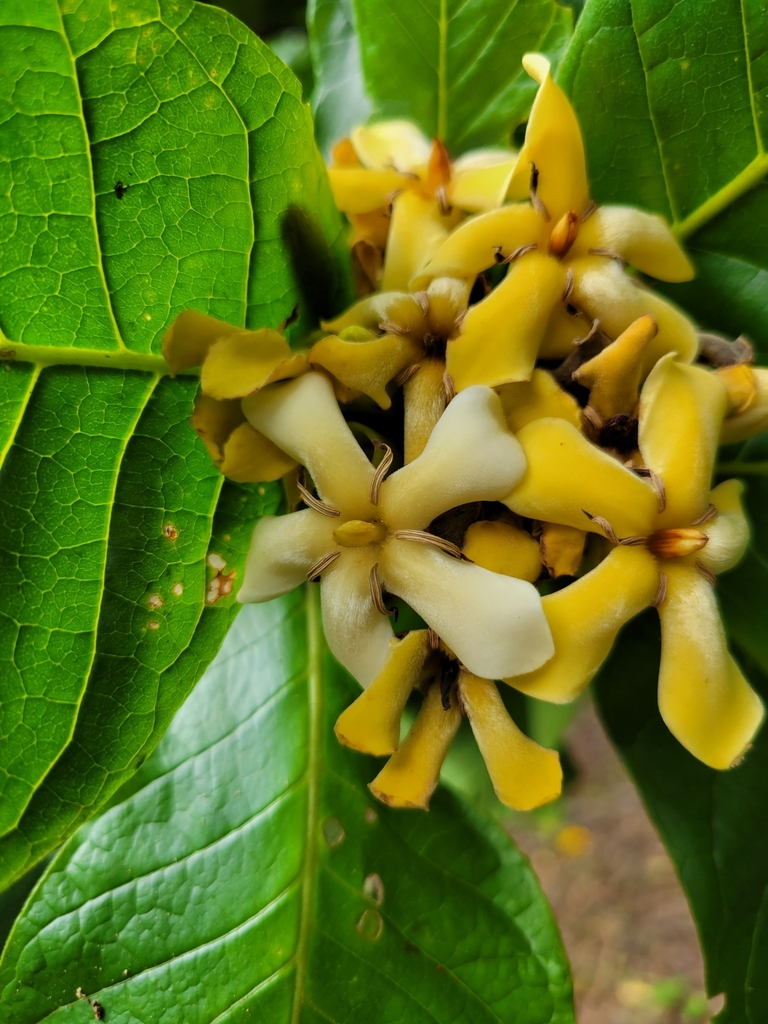
The flowers grow in small clusters (cymes) up to 4 inches long at the branch tips. Each is slightly fragrant, with a bell-shaped calyx and a trumpet-shaped corolla about 0.8 to 1.8 inches (2–4.5 cm) long, divided into five or six spreading lobes. They open white and fade to golden yellow, so a cluster often shows both colors at once.
Fruit
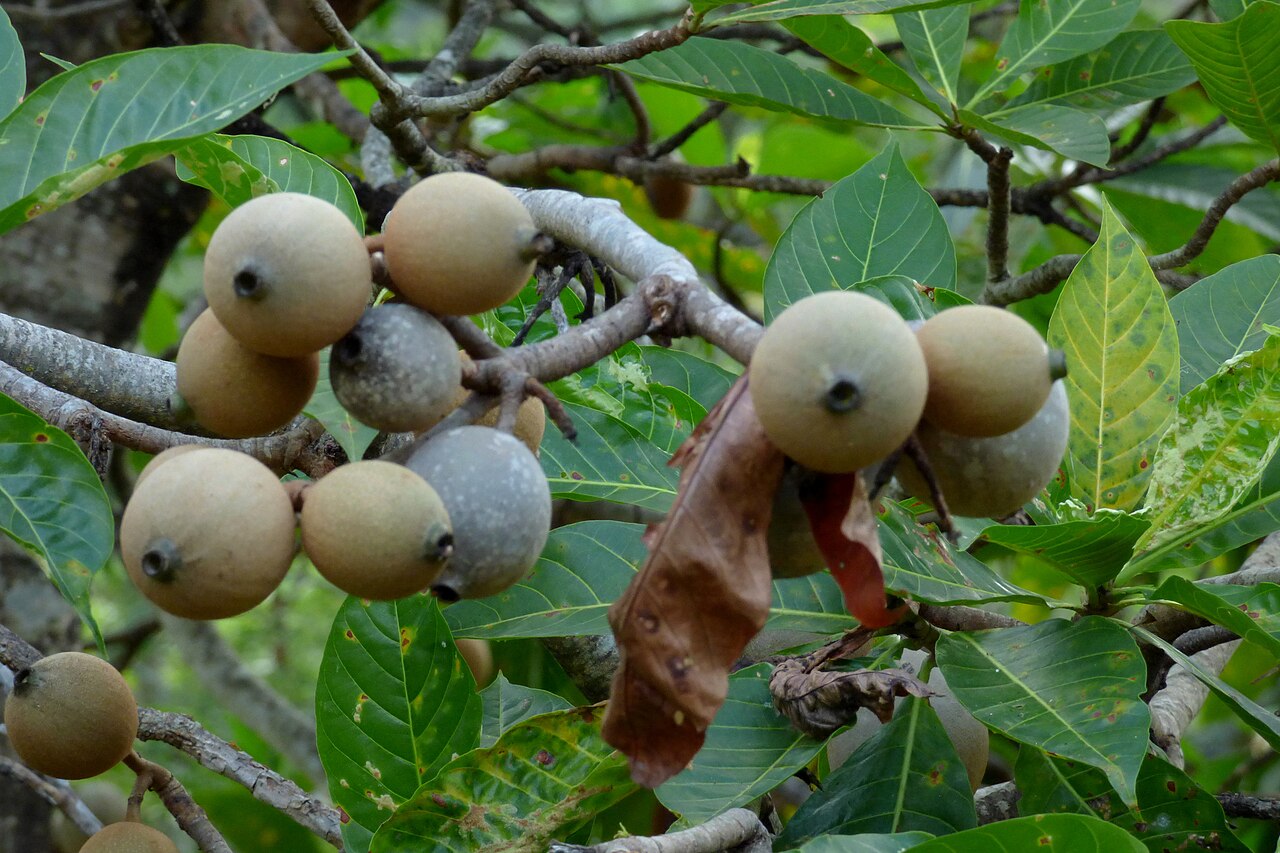
The fruit is a thick-skinned, round to egg-shaped berry about 1.5 to 3 inches (4–8 cm) long, grayish to light brown and slightly rough when ripe. Inside, a soft, aromatic, sweet-tart pulp surrounds many flat seeds. Cut unripe fruit and its colorless juice slowly turns blue, then nearly black, as the compound genipin reacts with air and skin proteins.
Quick Facts
| Scientific Name | Genipa americana L. |
| Family | Rubiaceae (coffee or madder family) |
| Plant Type | Semi-deciduous tree |
| Mature Height | 30–50 ft (rarely to 100 ft) |
| Mature Spread | 20–30 ft; narrow when young, rounded with age |
| Growth Rate | Fast |
| Sun Exposure | Full sun |
| Water Needs | Moderate to high; tolerates seasonal flooding |
| Soil Type | Deep, moist alluvial soils best; adaptable |
| Soil pH | Acidic to neutral |
| Bloom Time | Spring to summer; may flower irregularly in the tropics |
| Flower Color | White, aging to golden yellow |
| Fall Color | None; may drop leaves while fruiting |
| Fruit | Grayish-brown edible berry, 1.5–3 in; unripe juice dyes skin blue-black |
| Deer Resistant | Not rated (no deer in Puerto Rico) |
| USDA Hardiness Zones | Frost-free tropics only (about zones 10b–12) |
Native Range
Genipap is one of the most widespread trees of tropical America. It is native from the Caribbean and southern Mexico through Central America and across tropical South America to Paraguay and northern Argentina, from sea level up to about 3,900 feet (1,200 m). Because people have carried and planted it for its fruit and dye for so long, some botanists think its original range may have been centered in northern South America.
USDA PLANTS lists jagua as native in Puerto Rico and the U.S. Virgin Islands. The Smithsonian’s Flora of the West Indies records it in Puerto Rico and on Vieques, on St. John and St. Thomas, in Cuba and Hispaniola, and on several of the Lesser Antilles, including Martinique, St. Lucia, St. Vincent, the Grenadines and Grenada. It is also widely planted around homes and farms for its fruit.
Across its range genipap favors deep, moist, alluvial soils. It grows along rivers and in forests that flood seasonally and is known to tolerate waterlogged ground, which makes it useful for planting along streams and in low, wet spots. Its seeds are spread both by animals that eat the fruit and by water.
📋 Regional plant lists featuring Genipap: Puerto Rico
Growing & Care Guide
Genipap is an easy, fast-growing tree for Puerto Rico’s lowlands and other frost-free areas. It is a good choice for a backyard fruit tree, a stream-side planting or a native shade tree in a large yard.
Light
Plant in full sun for the best growth, flowering and fruit. Young trees tolerate some shade but grow more slowly.
Soil & Water
Genipap grows best in deep, moist, fertile soil and is notably tolerant of wet ground and seasonal flooding, so it is a good choice for low spots and stream banks. It also grows in ordinary garden soil. Water young trees regularly during dry spells until they are established.
Planting Tips
Give it room: a mature tree can be 30 to 50 feet tall. Plant it away from patios, cars and light-colored paving, where dropped fruit can stain. Grafted or seed-grown nursery trees both work; seedlings can begin to bear in about three years under good conditions.
Pruning & Maintenance
Prune young trees to a single strong leader and remove crossing or broken branches. Little else is needed. Pick up fallen fruit near walkways. Wear gloves when handling unripe fruit, since its juice will dye your hands blue-black for one to two weeks.
Propagation
Grow genipap from fresh seed taken from fully ripe fruit. Wash the pulp off, sow the seeds shallowly in a moist, well-drained mix and keep them warm. Sow seed soon after cleaning rather than storing it. Trees can also be grafted to reproduce good fruiting selections.
Landscape Uses
- Edible fruit: ripe fruit for fresh eating, drinks, jams and ice cream
- Natural dye: unripe fruit juice makes a blue-black skin and craft dye
- Stream-side and wet sites: tolerates seasonal flooding on alluvial soils
- Shade tree: large, glossy evergreen to semi-deciduous canopy
- Wildlife food: fallen fruit feeds birds and mammals
Wildlife & Ecological Value
Genipap is a generous wildlife tree: its flowers feed insects, its leaves host moth caterpillars and its large crop of fruit falls to the ground for animals to eat.
For Pollinators
The slightly fragrant, white to yellow tubular flowers attract a variety of insects. Genipap leaves are a food plant for the caterpillars of the fadus sphinx moth (Aellopos fadus), a day-flying hawkmoth found in the West Indies and tropical America.
For Birds
The thick-skinned fruits are too large for most small birds to swallow, but birds may feed on the soft pulp of fruit that has split open after falling. The tree’s dense, glossy foliage also offers cover and perching sites.
For Mammals
Across its range many mammals eat the fallen fruit and help spread the seeds. Puerto Rico’s native land mammals are mostly bats, so on the island much of the fallen fruit is simply carried off by water or rots in place.
Ecosystem Role
Because genipap tolerates flooding and grows quickly, it helps stabilize stream banks and floodplains. Fruit that falls into rivers is carried downstream, which spreads the seeds along waterways.
Cultural & Historical Uses
The name Genipa comes from the Tupi word for the tree, which also gave Portuguese jenipapo and English genipap. Carl Linnaeus described the species in 1759. In Puerto Rico and Cuba it has long been known as jagua.
The blue-black dye made from unripe genipap fruit is one of the oldest body paints of the Americas. Indigenous peoples of South America paint their skin with it, often together with the red dye of achiote (Bixa orellana). The stain does not wash off but fades in one to two weeks as the skin renews, which is why jagua has become popular as a temporary tattoo ink. Some people develop an allergic skin reaction to it.
Genipap wood is strong, flexible and easy to work, and it has been used for tool handles, boxes, small boats, cabinetwork and general carpentry. The fruit has also been used in traditional medicine and to make a fermented drink.
Frequently Asked Questions
Is genipap the same as jagua?
Yes. Genipa americana is called jagua in Puerto Rico and much of Latin America, which is also the name USDA uses. Genipap (or genip) is the English name, and it is jenipapo in Brazil and huito in Peru.
Is genipap fruit edible?
Yes, ripe fruit is edible. It has a strong, sweet-tart, aromatic flavor and is usually made into drinks, jams, preserves or ice cream. The juice of unripe fruit is used as a dye rather than eaten.
How does jagua dye work?
Unripe fruit contains genipin, which is colorless in the juice but reacts with proteins in the skin and with air to form a deep blue-black color over several hours. It stains only the outer layer of skin and fades in about one to two weeks.
Can I grow genipap in Puerto Rico?
Yes. It grows well in sunny, moist lowland sites, tolerates wet soil and seasonal flooding and grows quickly from fresh seed. Give it room, since it can become a large tree, and plant it away from paving where fallen fruit might stain.
What other native trees grow well with genipap?
In moist or wet lowland sites in Puerto Rico, consider ceiba, bloodwood (palo de pollo) for swampy ground, Santa María and ausubo.

Looking for a nursery that carries Genipap?
Our nursery directory does not yet include Puerto Rico. Browse the native plant nursery directory by state: Alabama–Arkansas · California · Colorado–Hawaii · Idaho–Kansas · Kentucky–Montana · Nebraska–Oklahoma · Oregon · Pennsylvania–Virginia · Washington · West Virginia–Wyoming