
Golden Leather Fern (Acrostichum aureum)
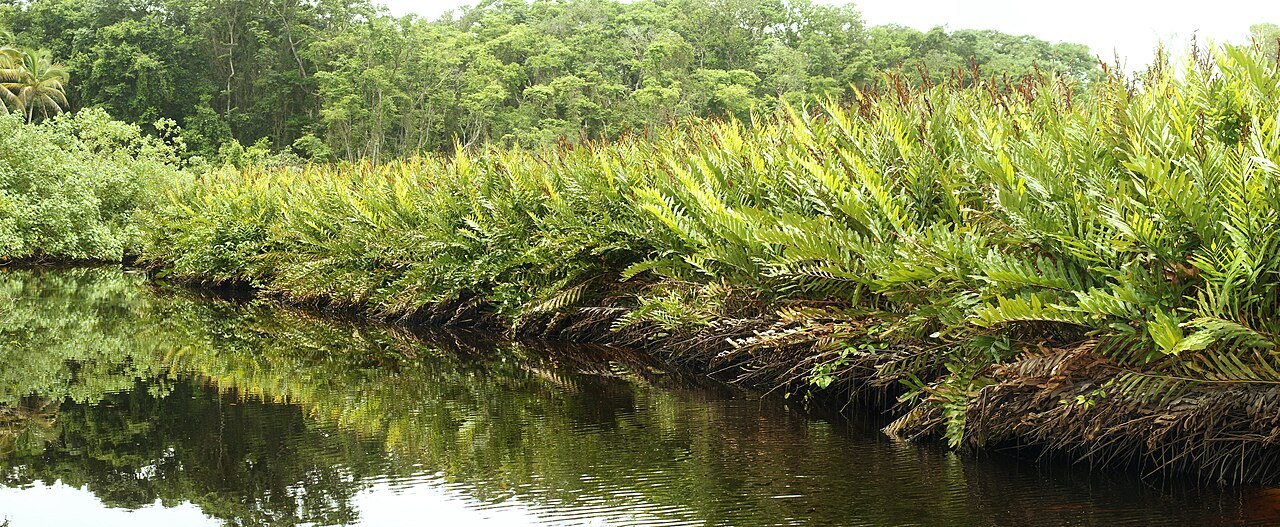
Acrostichum aureum, the Golden Leather Fern, is one of the largest ferns in the Americas and one of very few ferns that can live with salt water around its roots. USDA PLANTS lists it as golden leatherfern, and it is also called mangrove fern, swamp fern and sea fern. It grows in mangrove swamps, salt marshes and on river banks across the tropics and subtropics of the world, including Puerto Rico and the coast of South Florida.
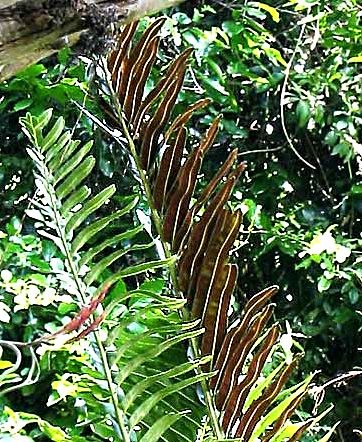
The plant forms big clumps of stiff, upright, leathery fronds, each divided into widely spaced, strap-shaped leaflets. The name “golden” refers to the fertile leaflets at the tip of some fronds, whose undersides are covered in a felt of spore cases that turns rusty gold to brown.
This guide explains how to tell golden leather fern from its close relative, the giant leather fern, where it grows in Puerto Rico and Florida, how to grow it in a wet or brackish garden, and the role it plays in mangrove ecosystems.
Identification
Two leather ferns grow in Puerto Rico and Florida, and they often grow together. Golden leather fern is the smaller and more salt-tolerant of the two. The fertile fronds are the easiest way to tell them apart.
Growth Form
A large evergreen fern that grows from a thick, woody, creeping rhizome and forms dense clumps. Fronds usually grow 3 to 6 feet (1 to 2 m) long, and occasionally longer in sheltered, rich sites. The outer fronds arch outward while the central ones stand nearly upright.
Fronds
Each frond is once-divided (pinnate), with a stout stalk and up to about 30 leaflets (pinnae) that are leathery, glossy, dark green and spaced well apart along the midrib. The leaflets are oblong to strap-shaped with smooth edges and rounded or bluntly pointed tips, and the fine veins form a net-like pattern. New fronds often emerge reddish bronze.
Spores
Golden leather fern has no flowers. Spores are produced on the undersides of the upper leaflets of some fronds: typically only the top five to eight pairs are fertile, while the lower leaflets on the same frond stay green and sterile. The fertile undersides are completely covered by a dense layer of spore cases (sporangia), brick red to rusty brown, rather than in the separate dots of most ferns.
Golden vs. Giant Leather Fern
The Giant Leather Fern (Acrostichum danaeifolium) is larger, often 6 to 12 feet tall, with many more, closely spaced leaflets, and its fertile fronds are usually fertile over all or most of their length. Golden leather fern is smaller, has fewer, widely spaced leaflets, and only the top leaflets are fertile. Golden leather fern is also the one more often found in salty or brackish sites, while giant leather fern is more common in fresh water.
Quick Facts
| Scientific Name | Acrostichum aureum L.; USDA common name: golden leatherfern |
| Family | Pteridaceae (brake fern family) |
| Plant Type | Large evergreen fern |
| Mature Height | 3–6 ft |
| Mature Spread | 3–6 ft clumps, slowly spreading by rhizomes |
| Growth Rate | Moderate |
| Sun Exposure | Full sun to partial shade |
| Water Needs | High; wet to flooded soil, fresh or brackish |
| Soil Type | Wet mud, peat and muck; tolerates salt |
| Soil pH | Slightly acidic to slightly alkaline |
| Bloom Time | No flowers; produces spores through the year |
| Flower Color | None (rusty brown spore masses) |
| Fall Color | None; evergreen |
| Fruit | None; reproduces by spores |
| Deer Resistant | Yes, rarely browsed |
| USDA Hardiness Zones | 10–11 |
Native Range
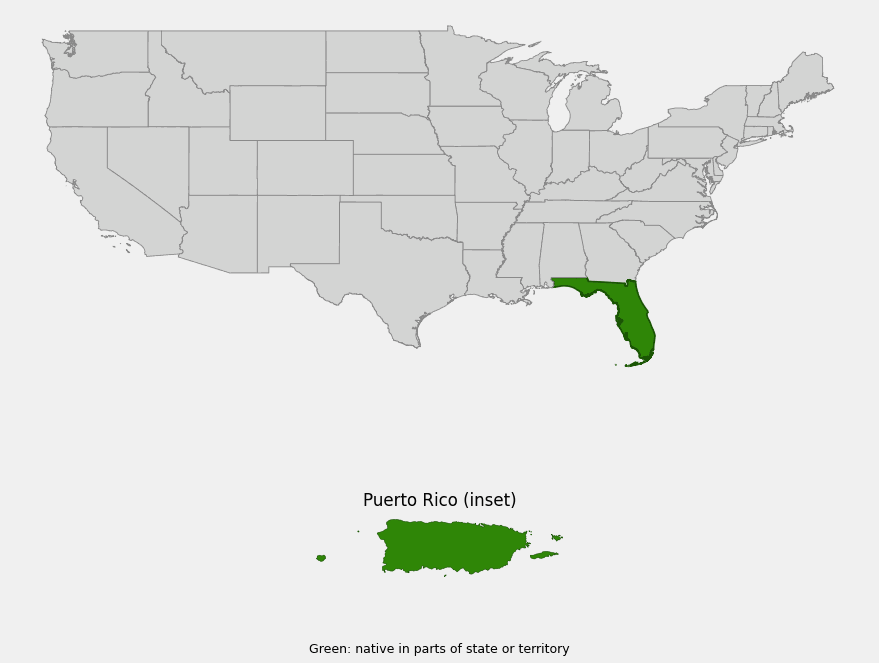
USDA PLANTS lists Acrostichum aureum as native to Florida in the lower 48 states, to Puerto Rico and the U.S. Virgin Islands, and to the Pacific Basin. It is listed as introduced in Hawaii. Worldwide it is pantropical, found along tropical and subtropical coasts in the Americas, Africa, Asia, Australia and the Pacific islands. In Florida it is limited to coastal areas of the southern peninsula and the Keys, where it is much less common than the giant leather fern.
It is a plant of coastal wetlands: mangrove swamps, salt marshes, the edges of brackish lagoons and tidal creeks, and river banks near the sea. It usually grows on slightly higher ground within mangroves, on mounds and banks that are flooded only by the highest tides, and in openings where mangroves have been cut or damaged. In Puerto Rico it grows in coastal mangrove and swamp areas around the island.
It is not listed under the U.S. Endangered Species Act. Because it can be confused with the giant leather fern in nurseries, buy plants labeled with the scientific name, and don’t dig ferns from mangroves, which are protected habitats.
📋 Regional plant lists featuring Golden Leather Fern: Puerto Rico · North & South Florida
Growing & Care Guide
Golden leather fern is a dramatic plant for wet ground, pond edges and coastal gardens where few other ferns survive. It needs constant moisture and warm temperatures. It does not need salt; fresh water is fine, which makes it easy to grow in a water garden or a large pot standing in water.
Light
It grows in full sun to partial shade. Plants in full sun stay more compact, with stiffer, yellow-green fronds, while plants in shade grow taller and darker green. In full sun, the soil must never dry out.
Soil & Water
Grow it in wet, mucky or peaty soil at the edge of a pond, ditch, swale or rain garden, or in standing water a few inches deep. It tolerates brackish water and occasional salt flooding. In containers, use a heavy, organic soil and keep the pot in a saucer of water. It will not tolerate drying out.
Planting Tips
Plant divisions or potted plants with the crown at or just above the waterline. Give it room: a mature clump can spread 6 feet or more. Along the coast it can fill gaps at the landward edge of mangrove plantings or line a canal bank where it helps hold soil.
Pruning & Maintenance
Cut old, brown or damaged fronds at the base to keep clumps tidy. Otherwise it needs little care. In very rich, wet sites it can spread vigorously and may need to be divided or cut back to keep it in bounds.
Propagation
The easiest method is division: cut a section of rhizome with several fronds and replant it in wet soil. It can also be grown from spores sown on wet, sterile peat or potting mix kept in a closed container; the spores germinate better in fresh water than in salt water.
Landscape Uses
- Pond and water garden edges: thrives in wet soil and shallow water
- Coastal and brackish sites: tolerates salt spray and occasional tidal flooding
- Mangrove restoration: fills the landward edges and openings of mangrove plantings
- Bank stabilization: the dense rhizomes bind mud along ditches and canals
- Bold foliage: a striking, tropical-looking accent for wet ground
Wildlife & Ecological Value
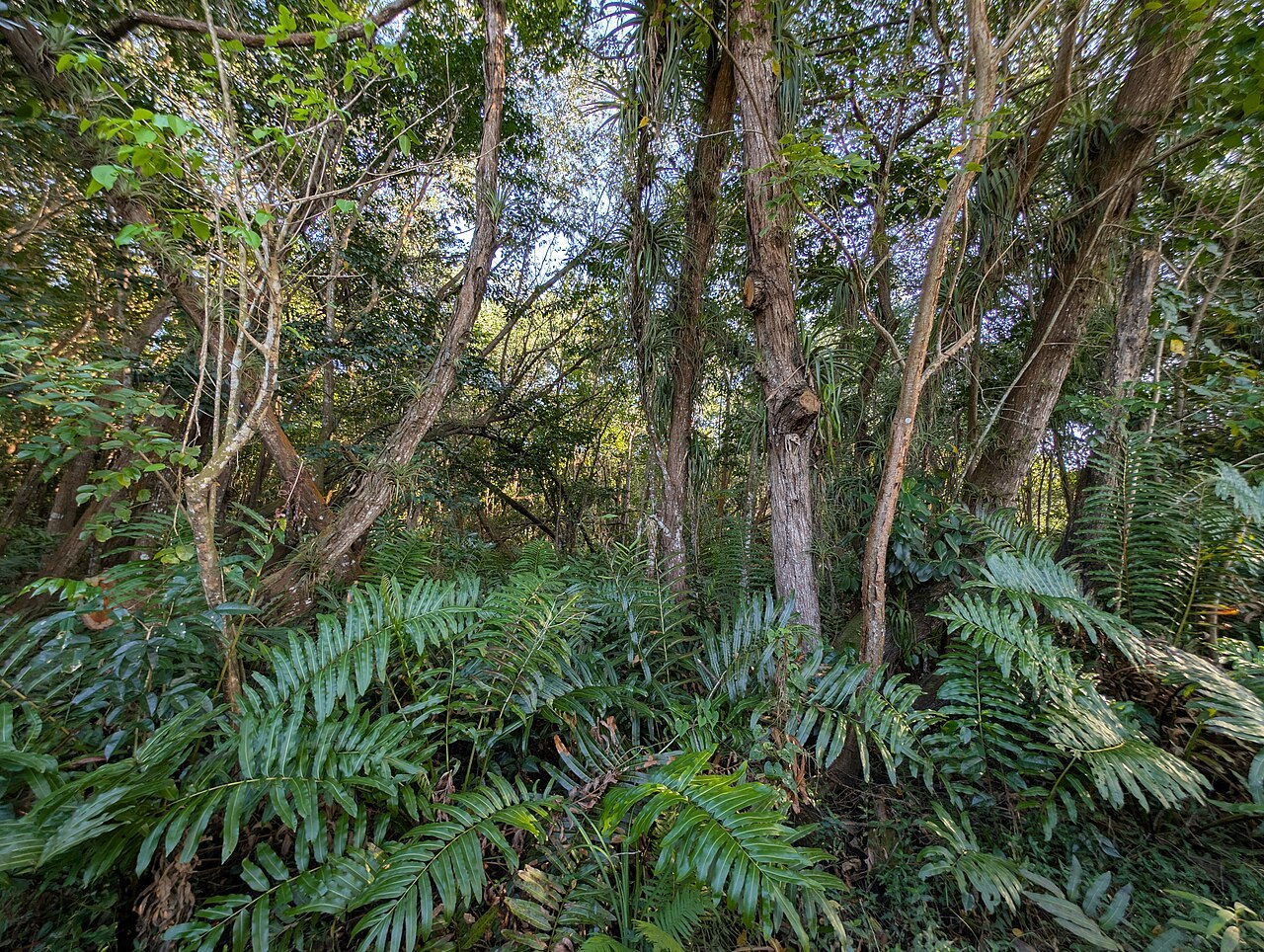
In mangrove swamps, golden leather fern is part of the structure of the forest edge and helps catch and hold the mud that mangroves depend on.
For Pollinators
As a fern, golden leather fern has no flowers and offers no nectar or pollen. Pollinators in a garden will need nearby flowering plants such as buttonwood and other coastal natives.
For Birds
Dense stands give cover and nesting sites to marsh and mangrove birds, and wading birds forage along the muddy edges where the fern grows.
For Mammals
Large clumps provide shelter for small animals along coastal wetlands. The tough, leathery fronds are seldom eaten by browsing mammals.
Ecosystem Role
Its creeping rhizomes and mass of roots trap sediment and help stabilize banks and raised areas within mangroves. It is among the first plants to move into gaps after mangroves are cut or damaged, and dense stands can slow the return of mangrove seedlings, although some mangroves regenerate within it. Crabs, snails and other small animals shelter at the bases of the clumps.
Cultural & Historical Uses
Linnaeus named the plant in 1753. The genus name comes from the Greek akros, “highest,” and stichos, “row,” referring to the spore cases at the tips of the fronds, and aureum means “golden.”
In parts of Asia, the young fronds are eaten. In Cambodia they are used in salads, and in Goa, India, the young fiddleheads are cooked in a spicy coconut gravy.
Golden leather fern is unusual among ferns: it is one of very few that can grow in salty soil, and among aquatic ferns it is the only one that grows in, and is sometimes submerged by, the ocean.
Frequently Asked Questions
How do I tell golden leather fern from giant leather fern?
Look at the fertile fronds. In golden leather fern, only the top five to eight pairs of leaflets are fertile, covered underneath with brown spores. In the Giant Leather Fern, the fertile fronds are usually fertile along most or all of their length. Giant leather fern is also larger, with more numerous, crowded leaflets.
Does it need salt water?
No. It tolerates brackish water and salt flooding, but it grows well in fresh water and ordinary wet garden soil.
Can it grow in a regular garden bed?
Only if the soil stays wet all the time. It is a wetland plant and will decline quickly in average, well-drained garden soil.
Is it invasive?
It is native in Puerto Rico and South Florida. In very favorable wet sites it can spread into dense stands, so give it space or divide it as needed.
Where does it grow on the U.S. mainland?
USDA lists it as native only in Florida, where it grows in coastal areas of the southern peninsula and the Keys. It is listed as introduced in Hawaii.

Looking for a nursery that carries Golden Leather Fern?
Our nursery directory does not yet include Puerto Rico. Browse the native plant nursery directory by state: Alabama–Arkansas · California · Colorado–Hawaii · Idaho–Kansas · Kentucky–Montana · Nebraska–Oklahoma · Oregon · Pennsylvania–Virginia · Washington · West Virginia–Wyoming