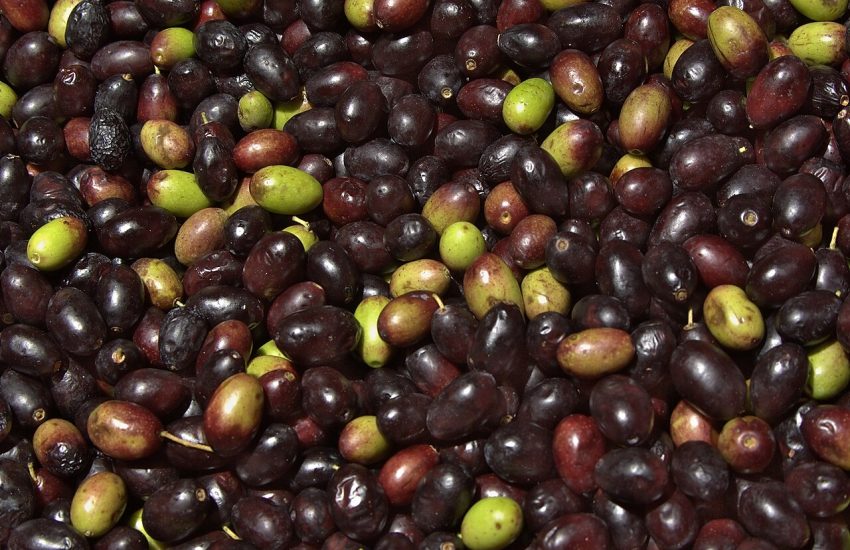
White Mangrove (Laguncularia racemosa)
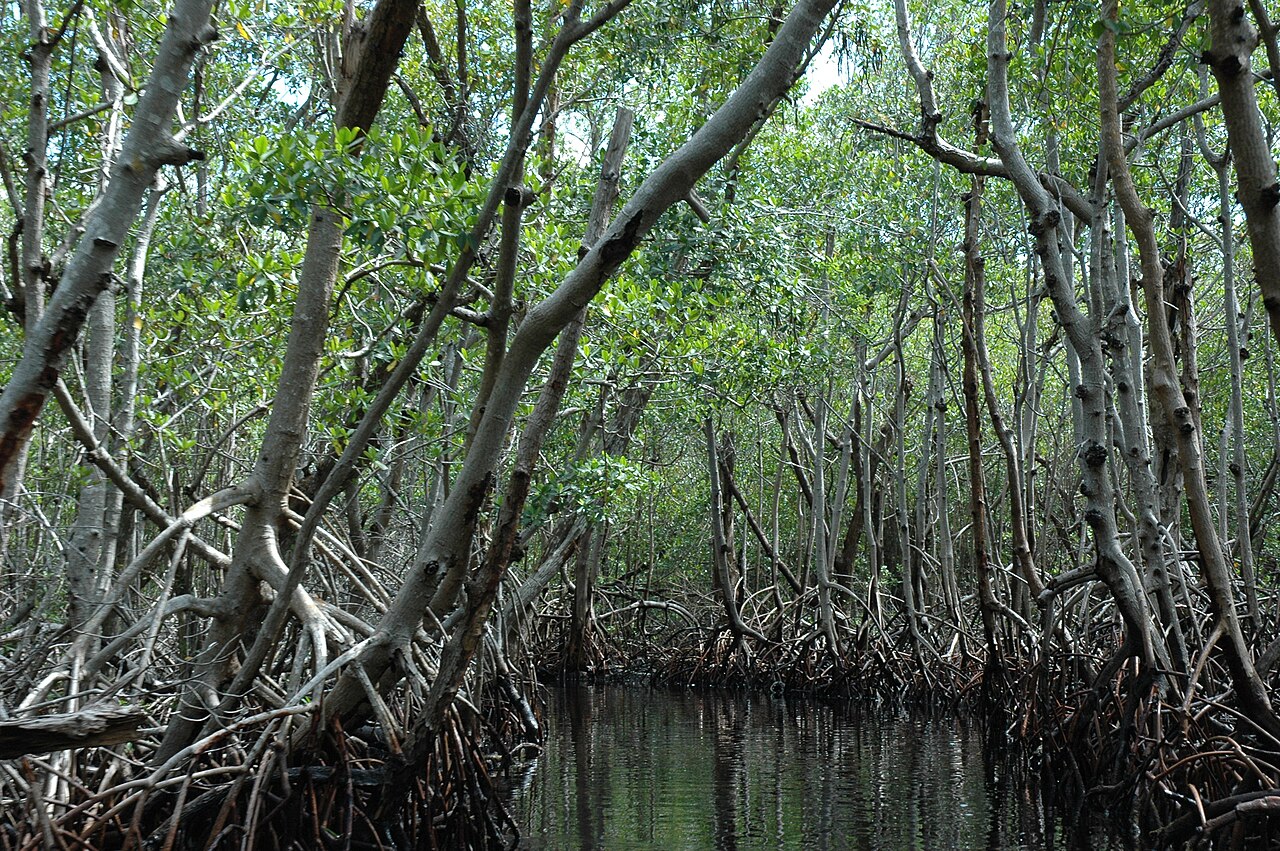
Laguncularia racemosa, the White Mangrove, is the least conspicuous but no less important of Florida’s three native mangrove species. Lacking the dramatic prop roots of red mangrove or the forest of breathing roots sent up by black mangrove, white mangrove instead looks, at first glance, almost like an ordinary broadleaf shrub — a trait that leads many Florida property owners to underestimate (and sometimes illegally remove) a tree that is just as ecologically important, and just as legally protected, as its more obviously “mangrove-looking” relatives.
White mangrove grows as a shrub or small to medium tree, typically 10 to 40 feet tall in Florida, with rounded to elliptical, leathery, pale yellow-green leaves held on distinctly reddish petioles. It occupies the highest, driest and least frequently flooded zone of a mangrove community, often growing at the upland transition edge alongside buttonwood, where tidal inundation is occasional rather than constant. Instead of prop roots or pneumatophores, white mangrove typically shows a more modest root system, sometimes with low, peg-like root projections in wetter sites, and it relies on a pair of small, distinctive glands at the base of each leaf blade to help excrete excess salt.
Like Florida’s other native mangroves, white mangrove is protected under state law because of its role buffering shorelines and supporting coastal fisheries, and trimming or removal is regulated. Because it can look deceptively like a non-mangrove shrub to an untrained eye, it is especially important for Florida property owners to correctly identify it before doing any landscape work near the coast.
Identification
White mangrove’s growth habit ranges from a low, multi-stemmed shrub on marginal or frequently disturbed sites to an upright small tree 20 to 40 feet tall with a single trunk in more established stands, generally the least dramatic-looking in form of Florida’s three mangroves.
Bark & Stems
Bark is light gray to grayish-brown, smooth on young stems and becoming somewhat fissured and scaly with age. Twigs and petioles are often tinged reddish, a helpful but not always reliable field clue alongside the leaf glands.
Leaves
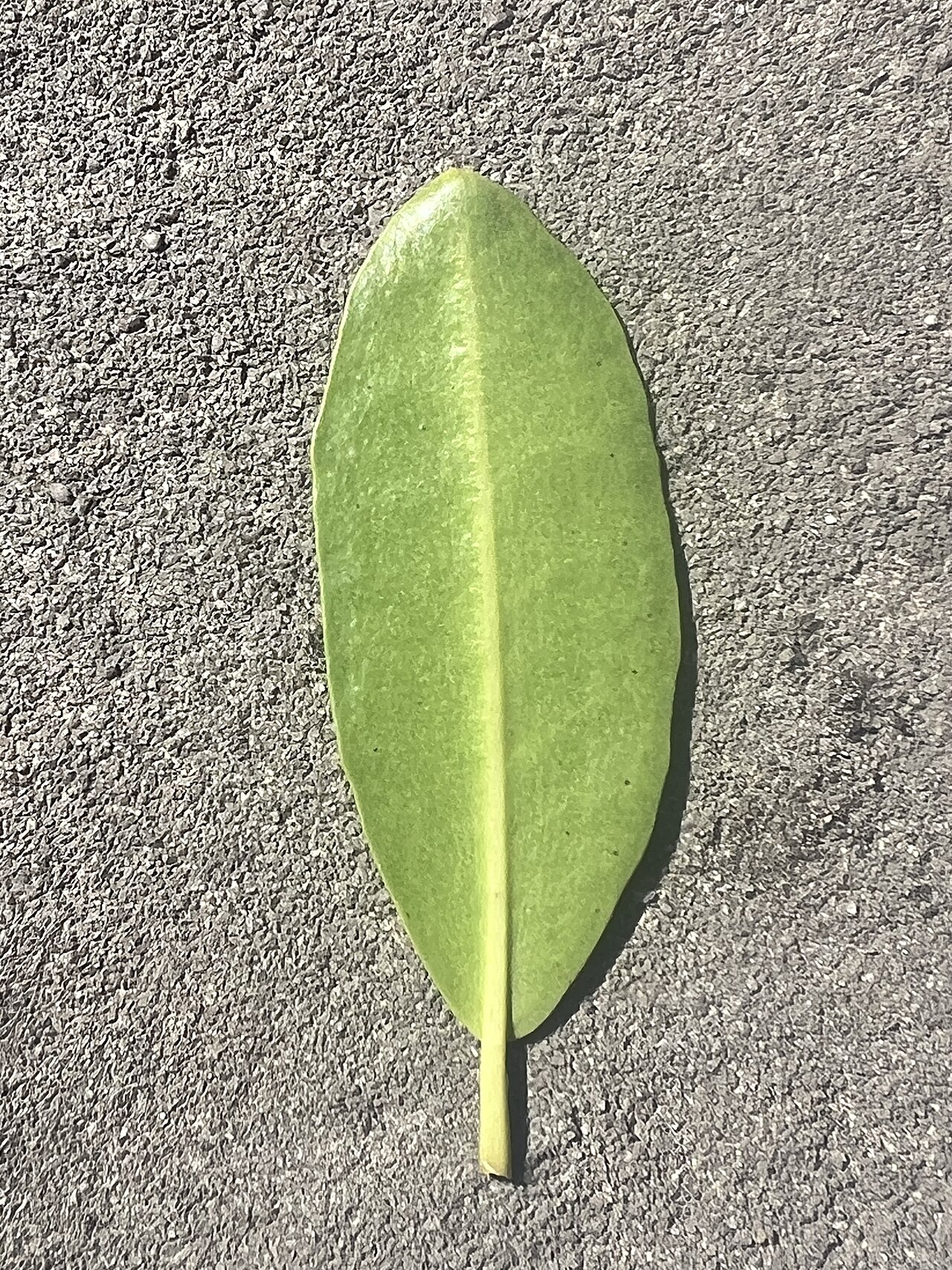
Leaves are opposite, elliptical to oblong with a rounded or slightly notched tip, 2 to 3 inches long, thick and leathery, pale yellow-green to grayish-green — generally lighter and less glossy than red or black mangrove leaves. The single most reliable identification feature is a pair of small, round glands (domatia) at the junction of the leaf blade and the reddish petiole, visible on close inspection; these glands help the plant manage salt and are not present on Florida’s other mangroves.
Flowers
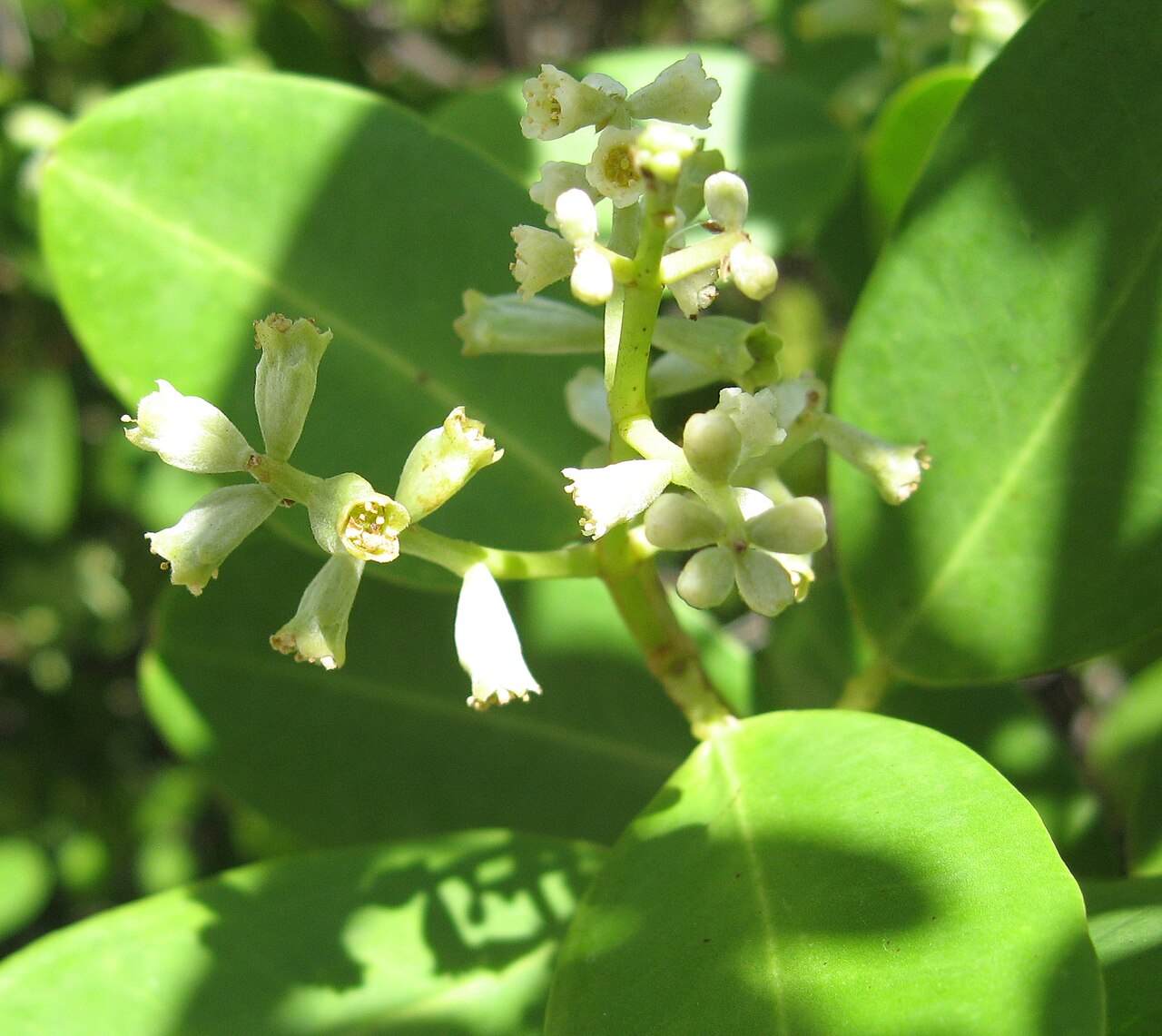
Small, greenish-white, bell-shaped flowers are borne in dense, rounded spikes at the branch tips, blooming mainly in spring through summer. Though modest, the flowers attract a range of pollinating insects, and the plant flowers more conspicuously and more often than some descriptions suggest, especially during Florida’s warm growing season.
Fruit & Seeds
The fruit is a small, ribbed, somewhat flattened, football-shaped capsule about ½ to ¾ inch long, greenish to reddish-brown, that floats and disperses on tidal currents like other mangrove propagules, though white mangrove shows less pronounced vivipary (pre-germination on the parent plant) than red or black mangrove.
Quick Facts
| Scientific Name | Laguncularia racemosa |
| Family | Combretaceae (White Mangrove) |
| Plant Type | Evergreen shrub or small-to-medium tree |
| Mature Height | 10–40 ft |
| Mature Spread | 10–25 ft |
| Growth Rate | Moderate |
| Sun Exposure | Full Sun |
| Water Needs | Moderate to High; occasional tidal flooding, not constant |
| Soil Type | Brackish to saline soils, upland mangrove transition zone |
| Soil pH | Wide tolerance in saline conditions |
| Bloom Time | Spring – summer |
| Flower Color | Greenish-white |
| Fall Color | Evergreen; no notable fall color |
| Fruit | Small, ribbed, football-shaped floating capsules |
| Deer Resistant | Not typically applicable (tidal habitat) |
| USDA Hardiness Zones | 10 – 11 |
Native Range
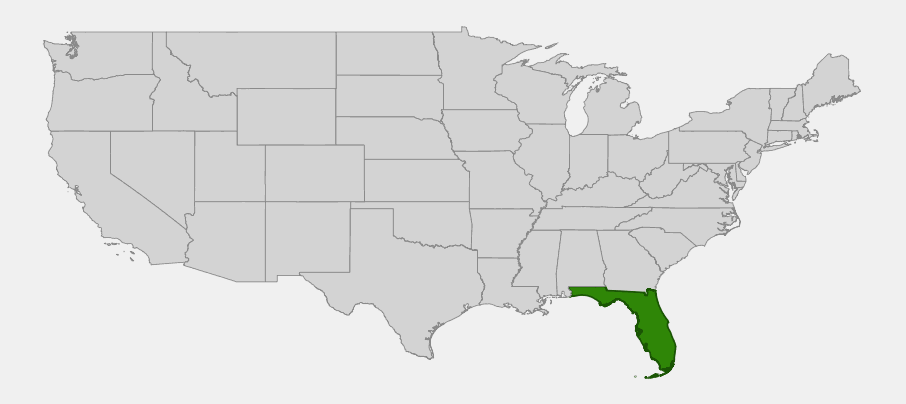
In the United States, white mangrove is native to Florida, concentrated in South Florida and the Keys and extending somewhat up both the Gulf and Atlantic coasts of the peninsula, generally not ranging quite as far north as the more cold-tolerant black mangrove. Like Florida’s other mangroves, it is frost-sensitive and has essentially no presence beyond the state’s frost-free coastal zones.
Within a mangrove community, white mangrove typically occupies the highest and driest ground of the three species, forming the landward edge of the mangrove zone where tidal flooding is occasional rather than constant, often grading into stands of green buttonwood and other upland coastal species. This upper intertidal position is a useful clue when trying to distinguish it from red and black mangrove growing closer to open water.
Outside Florida, white mangrove is widespread throughout the Caribbean, the Gulf and Atlantic coasts of Mexico and Central America, and much of tropical South America and West Africa, overlapping extensively with the ranges of red and black mangrove across the region.
📋 Regional plant lists featuring White Mangrove: none yet — no plantnative.org regional list currently covers coastal Florida; see our full native plant directory for other Florida-native species.
Growing & Care Guide
White mangrove is, like Florida’s other mangroves, a specialized coastal species rather than a conventional landscape plant, though its tolerance for slightly drier, less constantly flooded conditions makes it somewhat more adaptable to waterfront property plantings than red mangrove.
Light
Plant white mangrove in full sun; it does not perform well in shade or heavily crowded conditions.
Soil & Water
White mangrove tolerates a somewhat wider range of soil moisture than red or black mangrove, occupying the drier, less frequently flooded upper edge of the intertidal zone, but it still needs reliably brackish-to-saline conditions and occasional tidal or storm-driven flooding to thrive; it is not suited to ordinary upland garden soil.
Planting Tips
As with Florida’s other native mangroves, planting white mangrove is usually undertaken as part of a permitted shoreline restoration, mitigation, or living shoreline project; confirm permitting requirements with state and local agencies first. Because white mangrove can resemble an unremarkable shrub, have it positively identified before any coastal landscape work to avoid accidentally violating mangrove protection rules.
Pruning & Maintenance
Trimming and removal of white mangrove in Florida fall under the same Mangrove Trimming and Preservation Act that covers red and black mangrove; limited trimming for view corridors may be allowed under specific conditions, but removal generally requires a permit. Because white mangrove is the easiest of the three species to mistake for an ordinary landscape shrub, property owners should take particular care to confirm its identity before any trimming.
Landscape Uses
White mangrove’s role, like the other Florida mangroves, is primarily ecological:
- Upland-edge shoreline stabilization at the landward margin of mangrove restoration sites
- Living shoreline and mitigation plantings in Florida coastal projects
- Buffer plantings between developed land and lower, wetter mangrove zones
- Habitat restoration in degraded upper mangrove and coastal transition areas
Wildlife & Ecological Value
Though less visually dramatic than red or black mangrove, white mangrove makes essential contributions to Florida’s coastal wildlife and ecosystem function, particularly at the landward edge of mangrove forests.
For Birds
White mangrove provides nesting habitat and cover for a range of coastal birds, and its position at the higher, drier edge of a mangrove stand gives some bird species a transition zone between open mangrove canopy and upland coastal vegetation. Wading birds and songbirds alike use the canopy for shelter and foraging.
For Mammals
The upper mangrove zone white mangrove often dominates provides important cover and movement corridors for coastal mammals, helping connect wetter mangrove habitat with adjacent upland vegetation.
For Pollinators
White mangrove’s flower clusters attract bees and other pollinating insects, contributing — like black mangrove — to the broader mangrove nectar resource that supports Gulf Coast and South Florida beekeeping, even though it is less commonly highlighted than black mangrove for honey production specifically.
Ecosystem Role
White mangrove helps stabilize the upper, landward edge of mangrove forests, buffering wave energy and filtering runoff before it reaches the lower, wetter mangrove zones and open water. Its position at the ecological transition between mangrove wetland and upland coastal vegetation makes it an important structural link in Florida’s layered coastal plant communities, and like the other mangroves, it contributes to the overall storm-buffering and fisheries-supporting value of Florida’s mangrove coastline.
Cultural & Historical Uses
White mangrove has historically received less direct economic use than red mangrove (valued for tannin-rich bark) or black mangrove (valued for its honey), but it has traditionally been used in parts of its wider Caribbean and Latin American range for small-scale construction wood and fuel, similar to the other mangroves. Its bark also contains tannins and has seen some local use in leather curing, though on a smaller scale than red mangrove.
In Florida, white mangrove’s modern significance is overwhelmingly ecological and regulatory. Because it is easy to overlook or misidentify as an ordinary shrub, increased public and professional education about all three native mangrove species — spurred by Florida’s mangrove protection laws beginning in the 1980s — has been important in preventing unpermitted removal of white mangrove stands during coastal development and landscaping.
Today, white mangrove’s main cultural role is as an indicator species: its presence on a property signals the upper edge of a protected mangrove community, informing landowners and regulators alike about where mangrove protections apply as coastal development pressure continues across Florida.
Frequently Asked Questions
How do I identify white mangrove if it doesn’t have obvious mangrove roots?
Look for a pair of small, round glands at the base of each leaf blade where it meets the reddish petiole — this is the most reliable field mark. The leaves themselves are rounded, pale yellow-green, and generally duller than red or black mangrove leaves.
Is white mangrove protected like red and black mangrove?
Yes. In Florida, all three native mangrove species — red, black and white — fall under the Mangrove Trimming and Preservation Act, which regulates trimming and generally requires a permit for removal.
Where does white mangrove grow compared to the other mangroves?
It typically occupies the highest, driest ground within a mangrove community, at the landward transition edge where tidal flooding is occasional rather than constant — upslope from black mangrove, which in turn grows upslope from red mangrove along the water’s edge.
Can white mangrove be mistaken for a non-native shrub?
Yes, and this is a common problem — its rounded, unremarkable leaves and lack of dramatic roots mean it is sometimes overlooked or misidentified during landscape work, which can lead to accidental, illegal removal. Positive identification using the leaf-base glands is important before any trimming near the Florida coast.
Does white mangrove tolerate drier conditions than other mangroves?
Relatively speaking, yes — it occupies the driest, least frequently flooded zone of the three native mangroves, though it still requires reliably brackish-to-saline soil and occasional tidal influence; it is not suited to ordinary upland garden conditions.

Looking for a nursery that carries White Mangrove?
Browse our native plant nursery directory: Florida
For its upland-edge companion species along the Florida coast, see our page on Green Buttonwood. If you’re planning a Florida coastal landscape, see our guide to shade trees for South Florida.