Blue Ash (Fraxinus quadrangulata)
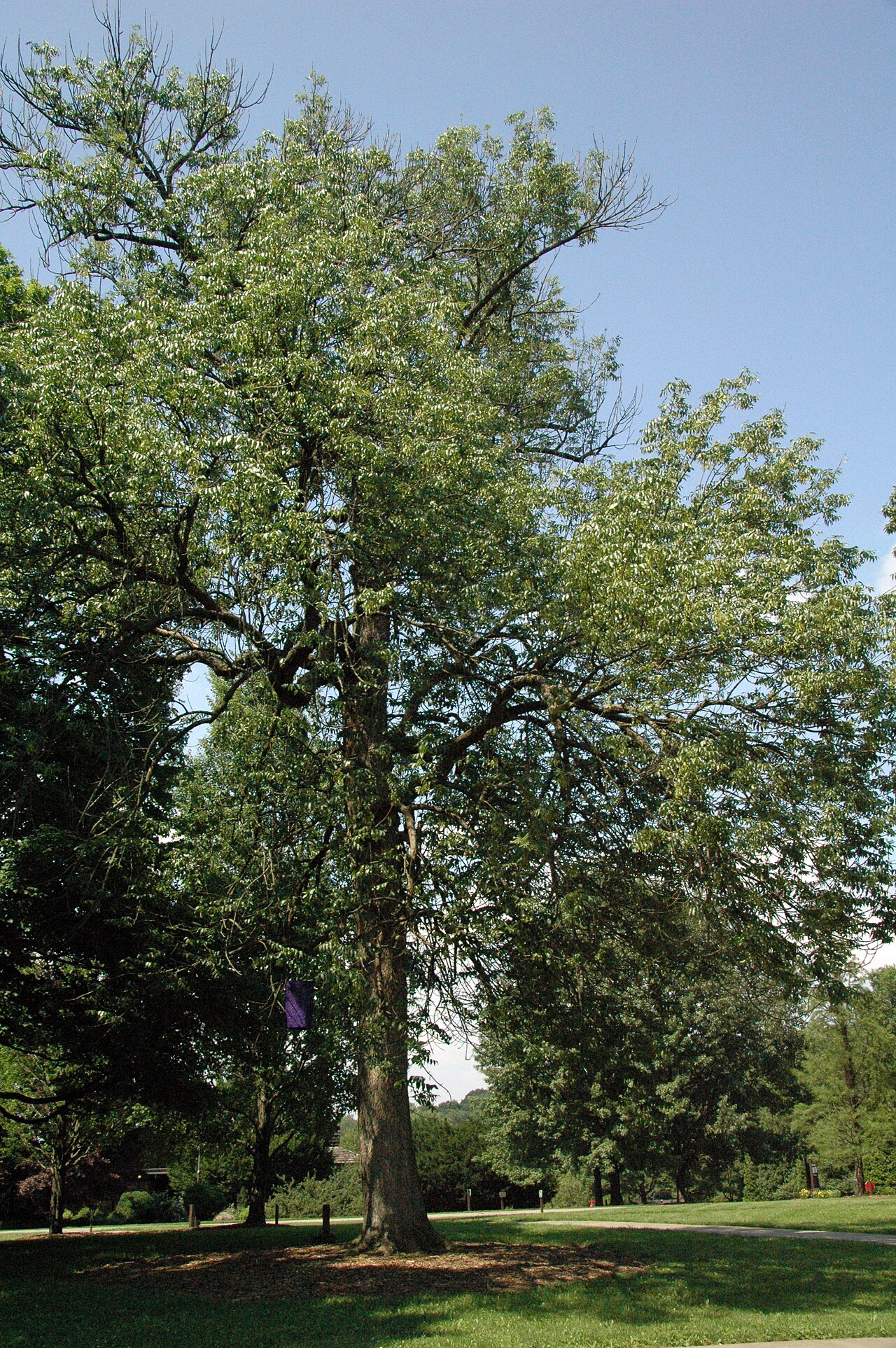
Fraxinus quadrangulata, commonly known as Blue Ash, is a distinctive native tree of the Interior Low Plateau and Ozark-Midwest region, named for the unusual four-angled, sometimes winged young twigs that give the species its species name quadrangulata. It is the only North American ash with square-in-cross-section stems, a feature gardeners and foresters can feel with a fingertip even before looking at a single leaf. Historically, Blue Ash also earned its common name from the blue dye early settlers extracted by soaking its inner bark in water, a mucilage that turns blue-green on exposure to air.
Blue Ash is a medium to large deciduous tree, typically 50 to 70 feet tall, with a straight trunk, tight diamond-patterned bark, and compound leaves made up of 7 to 11 narrow, finely toothed leaflets. It favors limestone-derived soils and is a signature species of the dry, rocky glades, bluffs, and calcareous woodlands of the Bluegrass region, the Ozark Highlands, and the Interior Low Plateau, though scattered, often disjunct populations reach north into the upper Midwest and east into the Appalachians.
Because it tends to grow on thin, rocky, well-drained limestone soils that other trees find inhospitable, Blue Ash has become an increasingly valuable landscape and restoration tree as emerald ash borer has devastated populations of green and white ash across its range. While not immune to the borer, Blue Ash shows meaningfully lower mortality than other native ashes, and many foresters and native-plant growers now view it as one of the more resilient ash species for long-term planting in calcareous soils.
Identification
Blue Ash is best identified by the combination of square or four-winged young twigs, opposite branching typical of ashes, and compound leaves with narrow, sharply toothed leaflets. The corky-winged twigs are the single most reliable field mark and separate it from every other North American ash.
Bark & Stems
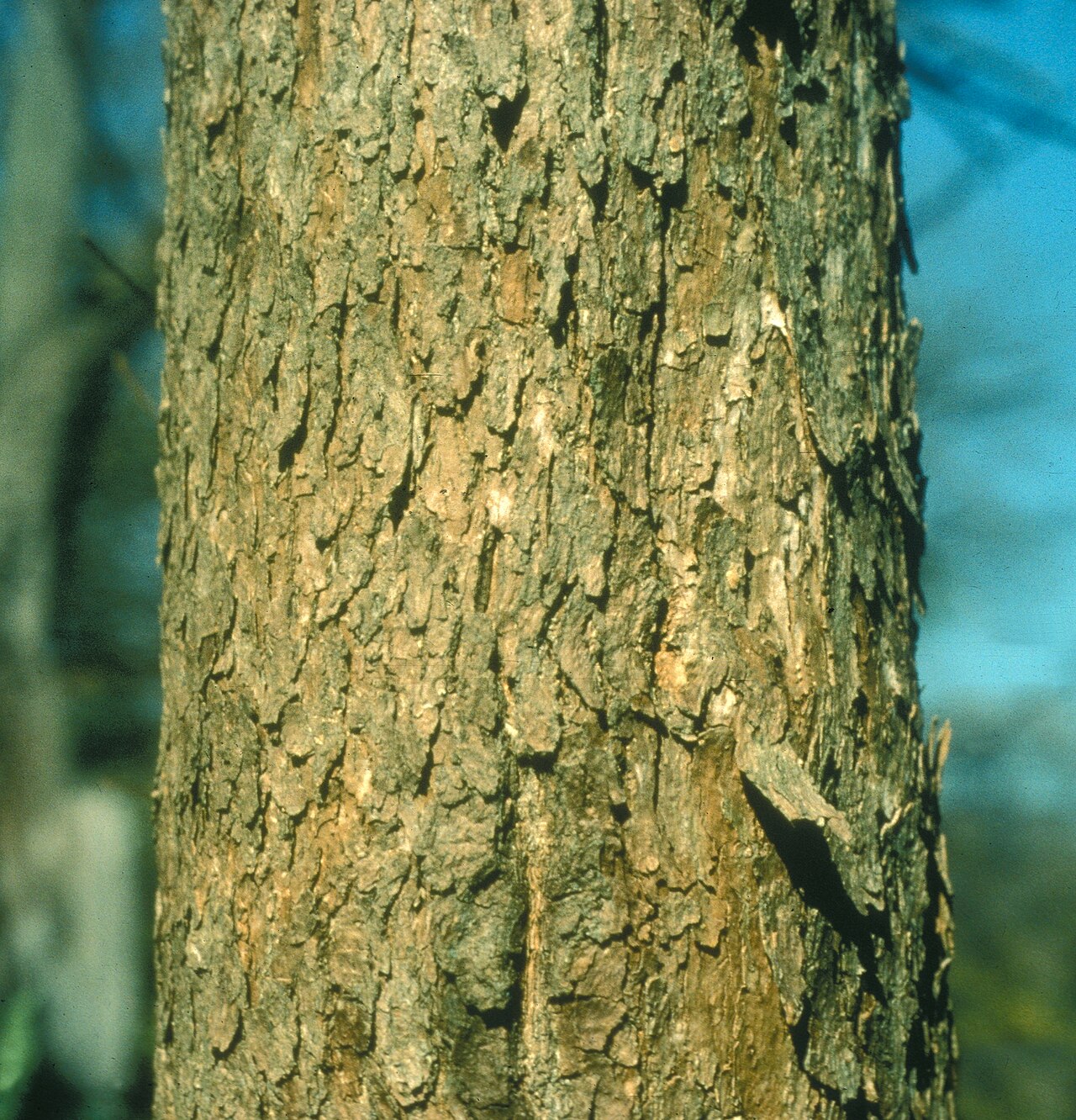
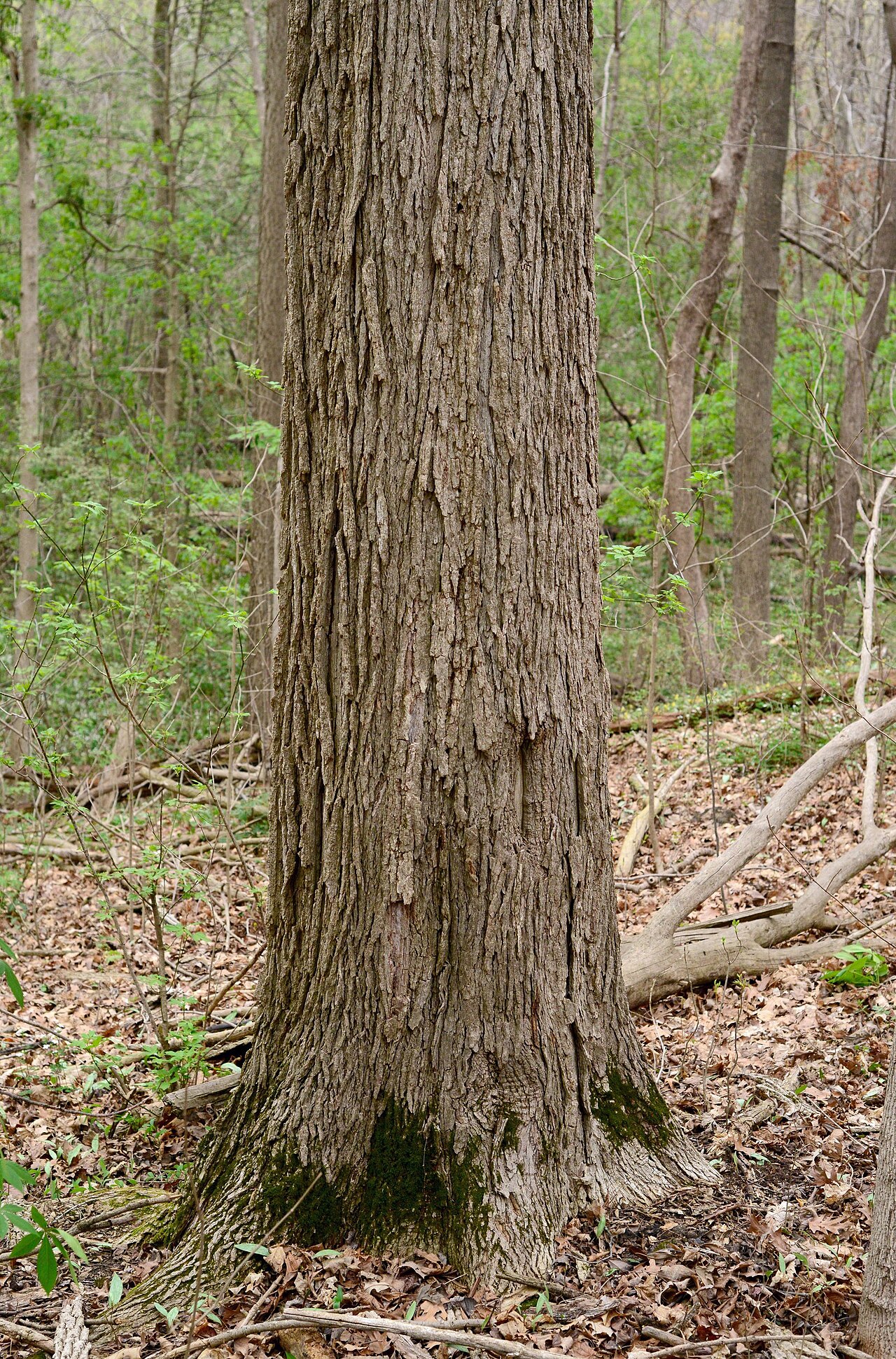
Mature bark is gray-brown and breaks into thin, flat, somewhat shaggy plates arranged in a loose diamond or scaly pattern, less deeply furrowed than white ash. Young twigs are distinctly four-angled in cross-section, and on vigorous young growth these angles often develop thin corky wings or ridges running the length of the stem — a trait unique among native ashes and the easiest way to confirm identification in winter.
Leaves
Leaves are opposite and pinnately compound, 8 to 12 inches long, usually with 7 (occasionally 5 to 11) lance-shaped to elliptical leaflets, each 3 to 5 inches long with sharply toothed margins and a short stalk. Leaflets are dark green above and paler beneath, turning yellow and sometimes a soft purplish-yellow in fall, generally less showy than white ash’s fall color but still attractive against limestone glades.
Flowers
Like other ashes, Blue Ash is wind-pollinated with small, inconspicuous, petal-less flowers borne in loose clusters before the leaves emerge in spring. Most trees are perfect-flowered (bearing both functional male and female parts on the same flower), unlike the typically dioecious habit of white and green ash, which affects seed-set patterns described below.
Fruit & Seeds
The fruit is a single-winged samara, 1 to 2 inches long, broader and more rounded at the tip than the samaras of white or green ash, often notched. Because many Blue Ash trees are self-fertile, a solitary tree can still produce a crop of viable seed, unlike dioecious ashes that require separate male and female trees nearby.
Quick Facts
| Scientific Name | Fraxinus quadrangulata |
| Family | Oleaceae (Olive) |
| Plant Type | Deciduous tree |
| Mature Height | 50–70 ft |
| Mature Spread | 25–40 ft |
| Growth Rate | Slow to moderate |
| Sun Exposure | Full sun to part shade |
| Water Needs | Low to moderate once established |
| Soil Type | Shallow, rocky, limestone-derived soils |
| Soil pH | Neutral to alkaline |
| Bloom Time | Early spring, before leaf-out |
| Flower Color | Greenish, inconspicuous |
| Fall Color | Yellow |
| Fruit | Single-winged samara, 1–2 in. |
| Deer Resistant | Moderately |
| USDA Hardiness Zones | 4–7 |
Native Range
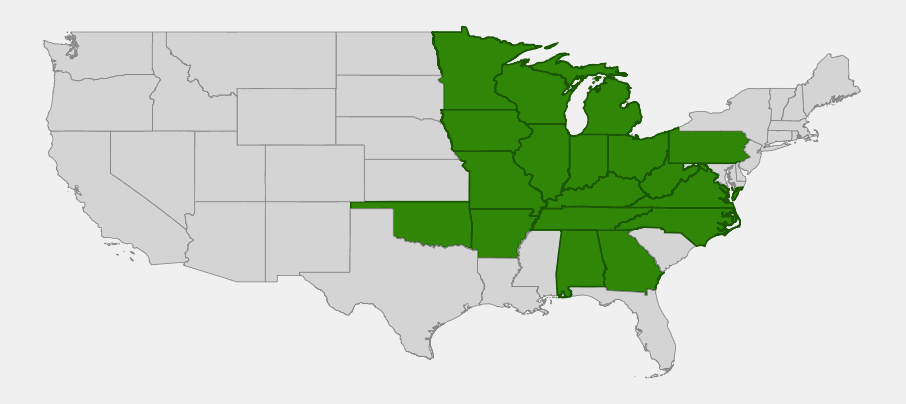
Blue Ash’s core range follows the limestone geology of the Interior Low Plateau and Bluegrass region of Kentucky and southern Ohio and Indiana, the Ozark and Ouachita highlands of Missouri and Arkansas, and the till plains and driftless limestone country of Illinois, Iowa, Wisconsin, and southeastern Minnesota. From this core it thins out into more scattered, often locally rare populations east through the Appalachians into Pennsylvania, Virginia, and West Virginia, and south through Tennessee into the mountains and piedmont of Georgia, Alabama, and North Carolina, with a notable outlying population near Blanco Canyon in Oklahoma.
Unlike most other native ashes, Blue Ash is a calciphile — a plant tied closely to calcium-rich, alkaline soils — and this preference explains why its range is so patchy rather than continuous. It is frequently found on dry limestone bluffs, cedar glades, rocky uplands, and thin-soiled woodlands where few other large trees compete successfully, and it is notably absent from the acidic sandy soils common across much of the Southeast and Atlantic Coastal Plain.
Blue Ash is not native to the Pacific states, the Rocky Mountain West, New England, or the Deep South coastal plain; widely planted specimens outside its limestone-belt range, including occasional urban plantings in acidic-soil regions, should not be mistaken for naturally occurring populations.
Native Range
| U.S. States | Alabama, Arkansas, Georgia, Illinois, Indiana, Iowa, Kentucky, Michigan, Minnesota, Missouri, North Carolina, Ohio, Oklahoma, Pennsylvania, Tennessee, Virginia, West Virginia, Wisconsin |
| Canada | Southern Ontario |
| Ecoregion | Interior Low Plateau, Ozark-Ouachita Highlands, Central Till Plains |
| Elevation Range | Near sea level–3,000 ft |
| Habitat | Limestone glades, rocky bluffs, calcareous uplands and woodlands |
| Common Associates | Chinquapin oak, eastern redcedar, hackberry, bur oak |
📋 Blue Ash is native to parts of the areas covered by Illinois, Iowa & Missouri, Ohio and Indiana, Michigan, Wisconsin, & Eastern Minnesota, Kentucky and Tennessee, Arkansas, Louisiana, Eastern Oklahoma, and Eastern Texas, Georgia, Alabama and Mississippi, North Carolina and South Carolina, Maryland, Virginia, and West Virginia, and New York, Pennsylvania, and Northern New Jersey.
Growing & Care Guide
Light
Blue Ash grows best in full sun but tolerates part shade, especially as a young tree establishing beneath a more open canopy. In its native cedar glades and limestone woodlands it often grows in fairly open conditions with filtered light.
Soil & Water
This is a tree for alkaline, rocky, well-drained soils — it is unusually tolerant of shallow, droughty, limestone-derived ground that would stunt most other large shade trees, and it does not perform well in acidic or consistently wet soils. Once established it is quite drought-tolerant, reflecting its native habitat on dry glades and bluffs.
Planting Tips
Choose a site with neutral to alkaline soil; amend acidic soils with lime if Blue Ash is a priority planting, since it struggles outside its preferred pH range. It tolerates poor, rocky, compacted soils better than most shade trees, making it a strong candidate for difficult urban sites built on limestone-derived fill. Give it room for a broad, rounded crown at maturity.
Pruning & Maintenance
Prune in late winter to remove dead, crossing, or damaged limbs and establish strong scaffold branching while young. Blue Ash is less susceptible to emerald ash borer mortality than white or green ash, but it is not immune, so monitor for thinning canopy, D-shaped exit holes, and woodpecker activity, and consult a certified arborist about systemic treatment options for high-value specimens in infested areas.
Propagation
Propagate from seed collected in fall; samaras typically require a period of cold, moist stratification to break dormancy before spring germination. Because many Blue Ash trees are self-fertile, a single tree can often produce a viable seed crop without a second tree nearby, simplifying seed collection from isolated specimens.
Landscape Uses
- Shade tree for alkaline, rocky, or compacted urban soils
- Restoration planting on limestone glades and calcareous woodlands
- Emerald-ash-borer-resilient alternative where other native ashes have declined
- Street or park tree on limestone-derived soils
- Specimen tree valued for its unusual corky-winged twigs
Wildlife & Ecological Value
For Pollinators
Though wind-pollinated and not a significant nectar source, Blue Ash’s early spring flowers provide some of the first available pollen of the season for generalist bees active before most other plants have bloomed.
Birds
Finches, cardinals, and other seed-eating songbirds feed on Blue Ash samaras, and the tree’s open, rounded crown offers good nesting structure for a range of woodland birds.
Mammals
Squirrels and other small mammals eat the seeds, and deer browse young foliage, though Blue Ash is only moderately palatable compared with more preferred browse species.
Ecosystem Role
As one of the few large trees adapted to thin, droughty limestone soils, Blue Ash is a foundational species of cedar glade and calcareous woodland ecosystems, stabilizing shallow soils on rocky slopes and providing canopy structure where few other trees can establish. Its comparative resilience to emerald ash borer has also made it an important genetic resource as forest managers work to sustain native ash populations through the ongoing borer epidemic.
Cultural & Historical Uses
Blue Ash takes its common name from a historical practice: early settlers in Kentucky and the Ohio Valley soaked the tree’s inner bark in water to produce a blue dye, used to color cloth and other materials, as the clear mucilage released by the soaked bark oxidizes to a blue-green color on exposure to air. The wood, hard and strong like other ashes, was used regionally for tool handles, furniture, and flooring where available, though the tree’s naturally patchy distribution meant it was never harvested at the commercial scale of white ash.
Because of its distinctive corky, winged twigs, Blue Ash has long been a tree botanists and foresters point to as a teaching example of how a single morphological trait can reliably distinguish one species from its close relatives, even among trees as similar in general appearance as the native ashes.
Today the species draws renewed attention less for traditional uses and more for its relative resistance to emerald ash borer, which has elevated it from a regionally specialized limestone-glade tree to a genetic resource actively studied and planted as part of efforts to maintain ash diversity in eastern North American forests.
Frequently Asked Questions
How do I tell Blue Ash from White Ash or Green Ash?
Look at the young twigs: Blue Ash twigs are distinctly four-angled or corky-winged in cross-section, a trait no other native ash shares. White and green ash have round twigs and somewhat different leaflet shapes and bark texture.
Is Blue Ash resistant to emerald ash borer?
No native ash is fully immune, but research and field observation consistently show lower borer mortality in Blue Ash compared with white and green ash, likely linked to differences in bark chemistry and growth habit. It still requires monitoring in infested areas.
Does Blue Ash need a limestone soil to thrive?
It strongly prefers neutral to alkaline, calcium-rich soils and performs poorly on acidic ground. If your soil is acidic, another native tree will likely be a better long-term choice unless you are prepared to amend soil pH.
Can one Blue Ash tree produce seed on its own?
Often yes. Many Blue Ash flowers are perfect (containing both male and female parts), so an isolated tree can self-pollinate and set viable seed, unlike the typically separate-sexed white and green ash.
Is Blue Ash a good shade tree for home landscapes?
Yes, especially on rocky, alkaline, or compacted urban soils where other shade trees struggle. It is slower-growing than green ash but more tolerant of difficult limestone-derived sites and increasingly favored where emerald ash borer has thinned other ash populations.
Looking for a nursery that carries native plants for your area? Visit our regional nursery directories: Alabama to Arkansas, Colorado to Hawaii (includes Georgia), Idaho to Kansas (includes Illinois, Indiana & Iowa), Kentucky to Montana (includes Kentucky, Michigan, Minnesota & Missouri), Nebraska to Oklahoma (includes North Carolina, Ohio & Oklahoma), Pennsylvania to Virginia (includes Tennessee), and West Virginia to Wyoming (includes Wisconsin) for growers near Blue Ash’s native range.