
Giant Woollystar (Eriastrum densifolium)
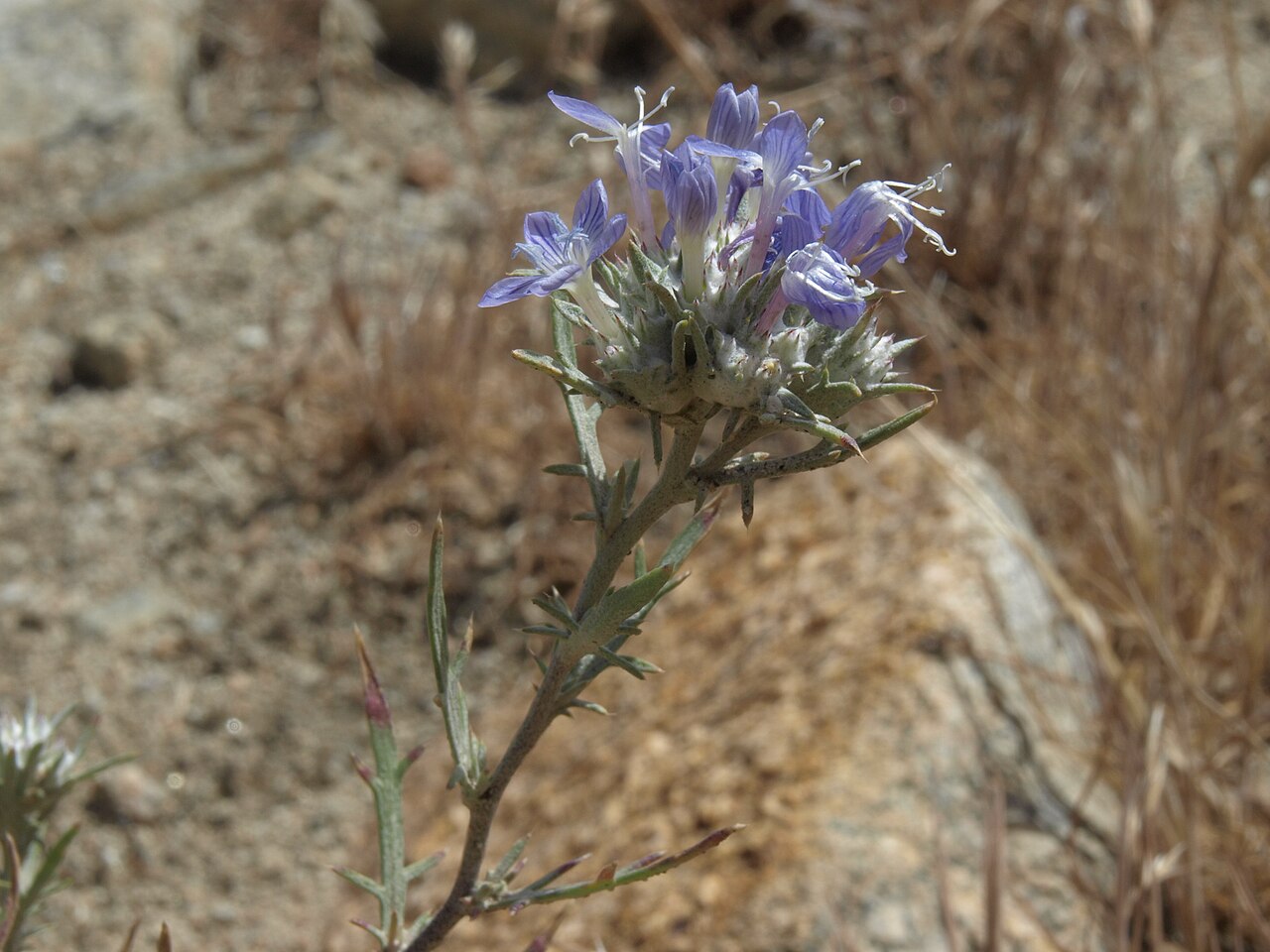
Eriastrum densifolium, known as Giant Woollystar or giant woolly-star, is a silvery, shrubby wildflower of sandy washes, alluvial fans, dunes and dry slopes in central and southern California, extending into northern Baja California. Through the heat of summer, when most other wildflowers have finished, it carries dense heads of bright blue to pale blue, star-shaped flowers wrapped in white wool and spiny bracts. It is the largest and showiest member of its genus.
Giant woollystar belongs to the phlox family (Polemoniaceae). Most woollystars are small annuals, but this species is a perennial subshrub, woody at the base, with many erect stems and narrow, spine-tipped leaves covered in gray to white hairs. Botanists recognize several subspecies across its range, from coastal sage scrub and chaparral to the edges of the Mojave Desert and the eastern Sierra Nevada.
One of them, the Santa Ana River woollystar (subsp. sanctorum), is listed as endangered by both the U.S. Fish and Wildlife Service and the State of California. Gardeners can grow the more widespread forms from nursery stock or seed in dry, sunny native gardens, but wild plants, and especially the endangered subspecies, should never be collected. This guide covers how to identify giant woollystar, where it grows, and how to grow it responsibly.
Identification
Giant woollystar is easy to recognize in summer by its clusters of blue flowers in woolly heads on gray, shrubby plants. The subspecies differ mainly in hairiness, height, flower size and habitat.
Stems & Growth Habit
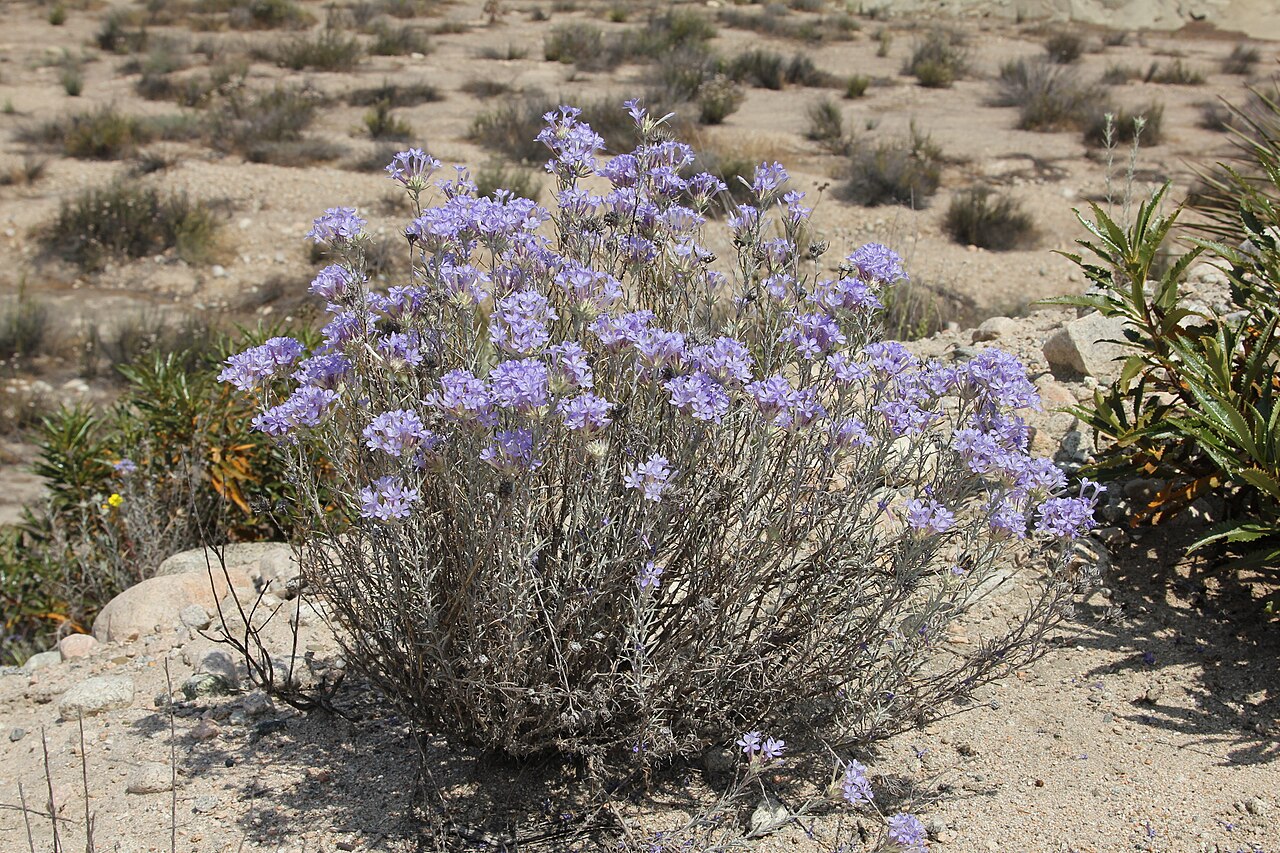
It is a perennial subshrub with a woody base and many slender, upright to spreading stems, usually 1 to 3 feet tall. Older plants form rounded clumps. The stems and leaves range from slightly hairy and green to densely woolly and gray-white, depending on the subspecies and how dry the habitat is.
Leaves
The leaves are numerous, crowded along the stems (the “densifolium” in its name means densely leafy), narrow and stiff, about ½ to 2 inches long. Many have one to several narrow, pointed side lobes near the base, and each lobe ends in a small spine. Leaves are covered to varying degrees in cobwebby wool.
Flowers
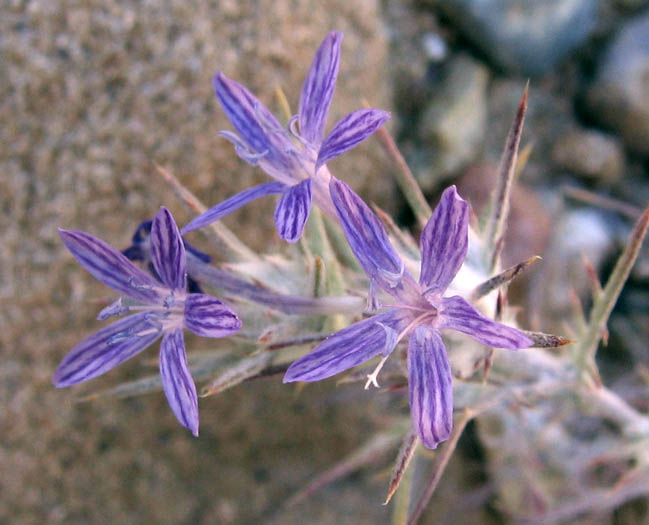
The flowers are packed into dense, rounded heads at the tips of the stems, surrounded by woolly, spine-tipped, leaf-like bracts. Each flower is funnel-shaped with a narrow tube and five spreading lobes forming a flat star about ½ to 1 inch across. They are bright blue to lavender, pale blue or nearly white, often with darker pinstripes, and the stamens stick out from the throat. Giant woollystar blooms mainly from about May to September, with peak flowering in early to midsummer.
Fruit & Seeds
Each flower produces a small, three-chambered capsule containing a few small seeds, which fall near the parent plant or wash downslope with winter rains.
Quick Facts
| Scientific Name | Eriastrum densifolium (Benth.) H. Mason |
| Family | Polemoniaceae (phlox family) |
| Plant Type | Perennial subshrub (woody-based wildflower) |
| Mature Height | 1–3 ft |
| Mature Spread | 1–3 ft |
| Growth Rate | Moderate |
| Sun Exposure | Full sun |
| Water Needs | Very low; summer-dry |
| Soil Type | Sandy, gravelly or rocky, very well-drained soils |
| Soil pH | About 6.0–8.0 |
| Bloom Time | May–September |
| Flower Color | Bright blue to lavender, pale blue or whitish |
| Fall Color | None; gray-green to silvery foliage |
| Fruit | Small three-chambered capsule |
| Deer Resistant | Yes; spiny, woolly foliage is seldom browsed |
| USDA Hardiness Zones | 8–10 |
Native Range
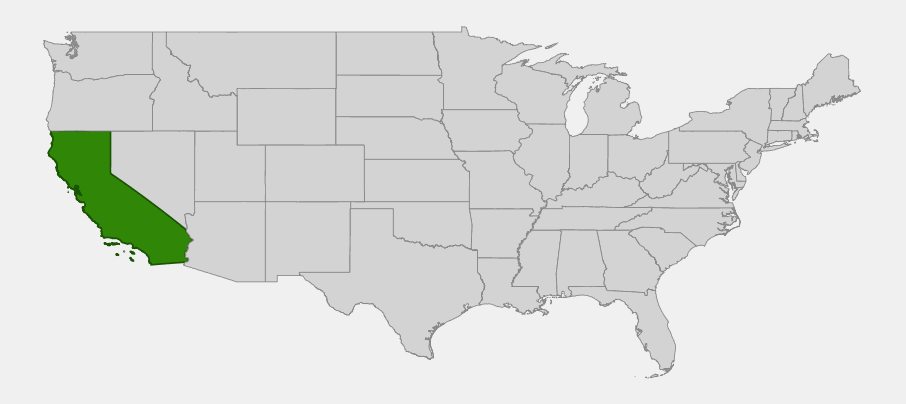
Giant woollystar is native to California and northern Baja California. USDA PLANTS lists it from California only within the United States. It ranges from the Central Coast and the southern Sierra Nevada foothills south through the Transverse and Peninsular Ranges, the coastal plains of southern California, and the western edges of the Mojave and Colorado deserts, reaching the Owens Valley on the east side of the Sierra.
It grows in open, sunny places with loose, well-drained soil: sandy and gravelly washes, alluvial fans and benches, stabilized dunes, coastal sage scrub, chaparral openings, Joshua tree and pinyon woodland, and disturbed sandy roadsides. Different subspecies occupy different parts of this range, from the coastal and inland valleys (subsp. densifolium and subsp. elongatum) to the mountains (subsp. austromontanum) and desert edges (subsp. mohavense).
The Santa Ana River woollystar (subsp. sanctorum) is restricted to old alluvial floodplain terraces of the Santa Ana River and its tributaries in inland southern California. It depends on occasional floods that scour and redeposit sand, creating the open habitat it needs. Flood control, sand and gravel mining and development have greatly reduced that habitat, and the subspecies was federally listed as endangered in 1987.
📋 Regional plant lists featuring Giant Woollystar: California & Nevada
Growing & Care Guide
Giant woollystar is a rewarding plant for dry, sunny gardens in southern and central California, valued for its summer blue flowers when little else blooms. It is offered occasionally by California native plant nurseries and seed companies. Grow only nursery-propagated plants or commercially produced seed, and never collect from the wild. The endangered Santa Ana River woollystar is protected by federal and state law.
Light
Give it full sun. In shade it becomes leggy, flowers poorly and is prone to rot.
Soil & Water
It needs very well-drained sandy, gravelly or decomposed granite soil, like the washes and alluvial fans where it grows wild. Heavy clay and poorly drained soils are usually fatal. Water lightly to establish young plants through their first dry season, then let natural rainfall carry it. Summer watering, especially in heavy soil, shortens its life.
Planting Tips
Plant in fall or winter so roots grow with the winter rains. Set plants slightly high on a mound or slope, and use gravel rather than bark mulch around the crown. It looks best in drifts with other sun-loving natives such as buckwheats, sages and broom-sages on dry slopes or in a sandy wash garden.
Pruning & Maintenance
Cut back old flowering stems lightly in fall or winter to keep plants compact and encourage fresh growth. Avoid fertilizer. Plants are relatively short-lived in gardens, so let some seed fall to produce replacements.
Propagation
Sow seed in fall in a sandy, well-drained mix, or scatter it directly onto bare, sandy soil before winter rains. Cuttings of new growth can also be rooted in a very fast-draining medium. Seedlings are sensitive to overwatering and damping off.
Landscape Uses
- Summer-dry native gardens: a silvery accent with blue flowers in the hottest months
- Sandy wash and gravel gardens: thrives in loose, fast-draining soils where many plants fail
- Pollinator gardens: summer nectar for native bees, butterflies and bee flies
- Slope plantings: for dry, sunny banks with coastal sage scrub plants
- Habitat restoration: in alluvial scrub, coastal sage scrub and wash restoration within its range
Wildlife & Ecological Value
Giant woollystar flowers when much of southern California is dry, so it is an important late-season food source for pollinators in sage scrub and alluvial habitats.
For Pollinators
Its blue, funnel-shaped flowers are visited by many native bees, including bumble bees, digger bees and other solitary bees, and by bee flies, butterflies and day-flying moths. Keeping native pollinators in the landscape is part of conserving the rare Santa Ana River woollystar.
For Birds
Seed-eating birds such as sparrows and finches may pick at its seeds, and its stems give low cover in open scrub. It is not a major bird plant.
For Mammals
Its spiny, woolly foliage is rarely browsed by deer or rabbits. Small mammals such as kangaroo rats and pocket mice forage for seeds in the sandy habitats it shares with them.
Ecosystem Role
Giant woollystar is an early colonist of open, sandy ground after floods, fires or other disturbance, and it helps hold sand on washes and dunes. In alluvial fan scrub it is one of the characteristic plants of a habitat type that has become rare in southern California.
Cultural & Historical Uses
George Bentham first described this plant in the genus Gilia in the nineteenth century, from specimens collected in California. Botanist Herbert L. Mason later moved it to Eriastrum, a genus name meaning “woolly star,” for the woolly heads and star-shaped flowers of its members.
The Santa Ana River woollystar became one of the best-known rare plants of the Inland Empire when it was federally listed as endangered in 1987, alongside the slender-horned spineflower. Its habitat lies in the path of flood-control projects such as the Seven Oaks Dam on the upper Santa Ana River, and conservation plans and preserves have since been created to protect the remaining populations and the floodplain processes they depend on.
For California native gardeners, giant woollystar is a classic plant of the summer garden, offering blue flowers in the dry season. It is a reminder that some of California’s most interesting native plants grow not in lush gardens but in sandy washes and on dry, open fans.
Frequently Asked Questions
When does giant woollystar bloom?
Mainly in summer, from about May to September, with peak bloom in early to midsummer. That late bloom makes it valuable for pollinators in dry California landscapes.
Is giant woollystar endangered?
The species as a whole is not, but one subspecies, the Santa Ana River woollystar (E. densifolium subsp. sanctorum), is listed as endangered by the U.S. Fish and Wildlife Service and the State of California. It must never be collected or disturbed.
Can I grow giant woollystar in my garden?
Yes, in dry, sunny gardens with sandy or gravelly, fast-draining soil within its California range. Use nursery-propagated plants or commercial seed, give it full sun, and avoid summer water.
Why is it called woollystar?
The flower heads are wrapped in white, woolly hairs, and each flower opens into a flat, five-pointed star. The genus name Eriastrum means “woolly star.”
Does giant woollystar need summer water?
No. Once established it needs little or no summer water. Extra water, especially in heavy soil, tends to rot the roots and shorten the plant’s life.

Looking for a nursery that carries Giant Woollystar?
Browse our native plant nursery directory: California

