Graceful Bedstraw (Galium porrigens)
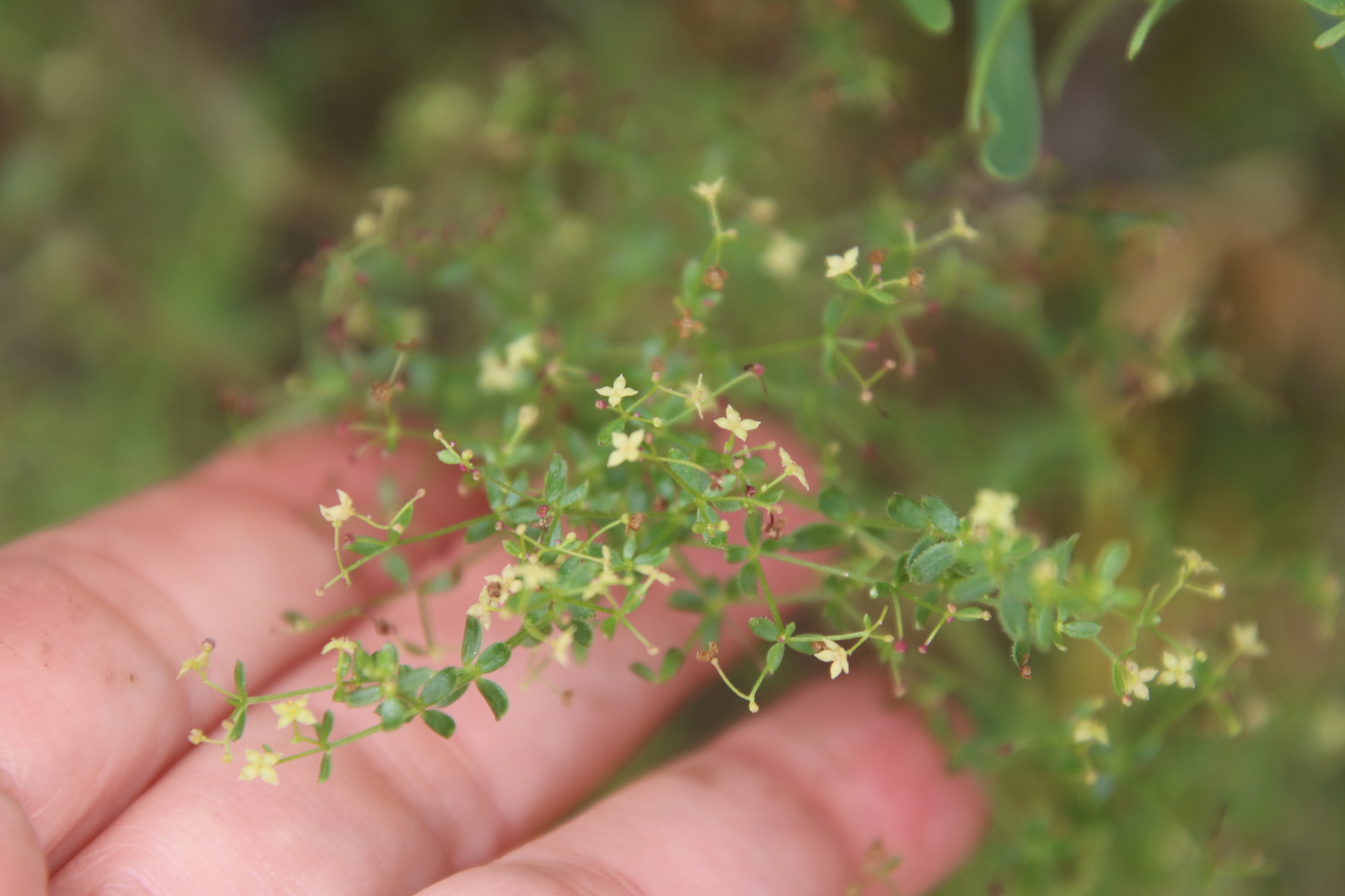
Galium porrigens, commonly known as Graceful Bedstraw or Climbing Bedstraw, is a modest but hardworking native perennial of California’s chaparral and coastal sage scrub. It belongs to the Rubiaceae (madder) family, the same family that includes coffee and the garden favorite sweet woodruff, and it shares the family’s signature whorled leaves. Rather than standing upright, Graceful Bedstraw sprawls and scrambles through the branches of its neighbors, using tiny, backward-pointing prickles on its stems and leaf edges to hitch a ride upward into the shrub canopy.
This is not a showy plant — its star-shaped flowers are barely a sixteenth of an inch across and its foliage is thin and wiry — but it fills an important niche as a shade-tolerant groundcover and scrambling vine beneath oaks, manzanitas, and chamise. Gardeners who want authentic chaparral understory texture, rather than another bare mulch bed under their native shrubs, find Graceful Bedstraw a useful, low-water filler that asks for almost nothing once established.
Graceful Bedstraw is a California specialty, reaching just over the state line into southwestern Oregon. It is not aggressive and does not compete for the spotlight; instead, it quietly knits together the lower layers of a chaparral or oak woodland planting, holding soil, offering cover for small animals, and disappearing from notice until you look closely enough to see its tangle of fine stems threading through everything around it.
Identification
Graceful Bedstraw is a sprawling, weak-stemmed perennial that rarely stands on its own. Instead, its square, wiry stems recline along the ground or climb into supporting vegetation, typically reaching 1 to 3 feet in length, occasionally longer where it has something to scramble over. The stems, like the leaf margins, are lined with tiny recurved prickles — too small to be called thorns, but rough enough to catch on clothing, fur, and neighboring foliage, which is exactly how the plant gets around.
Stems
Stems are four-angled (square in cross-section, typical of the bedstraw genus), slender, and often reddish where exposed to sun. They branch repeatedly and can form loose, tangled mats a foot or two across, or climb a few feet into an adjacent shrub when support is available.
Leaves
Leaves are narrow and elliptic to oblong, usually under an inch long, and arranged in whorls — typically of four, though the pairs are often unequal in size, giving the whorl an asymmetric look. Leaf margins and the midrib beneath are set with the same small recurved prickles found on the stems, giving the foliage a slightly rough, clinging texture when handled. The leaves are evergreen to semi-evergreen in mild coastal climates.
Flowers & Fruit
Flowers are tiny — about 1/16 to 1/8 inch across — with four cream to pale yellow-green petals fused at the base into a small, flattish star. They are borne singly or in small loose clusters from the leaf axils, opening mainly in spring. The fruit that follows is a pair of small, dry, bur-like nutlets covered in hooked bristles, built to snag onto the fur of passing animals for seed dispersal, the same trick used by its weedy cousin, cleavers (Galium aparine).
Quick Facts
| Scientific Name | Galium porrigens |
| Family | Rubiaceae (Madder) |
| Plant Type | Perennial Scrambling Vine / Subshrub |
| Mature Height | 1–3 ft trailing (taller where it climbs into shrubs) |
| Mature Spread | 1–3 ft |
| Growth Rate | Moderate |
| Sun Exposure | Part Shade to Shade (tolerates more sun near the coast) |
| Water Needs | Low once established |
| Soil Type | Well-drained; rocky, sandy, or clay loam |
| Soil pH | 6.0–7.5 |
| Bloom Time | February – May |
| Flower Color | Cream to pale yellow-green |
| Fruit | Paired bristly, hook-covered nutlets (burs) |
| Deer Resistant | Yes, generally avoided |
| USDA Hardiness Zones | 8–10 |
Native Range
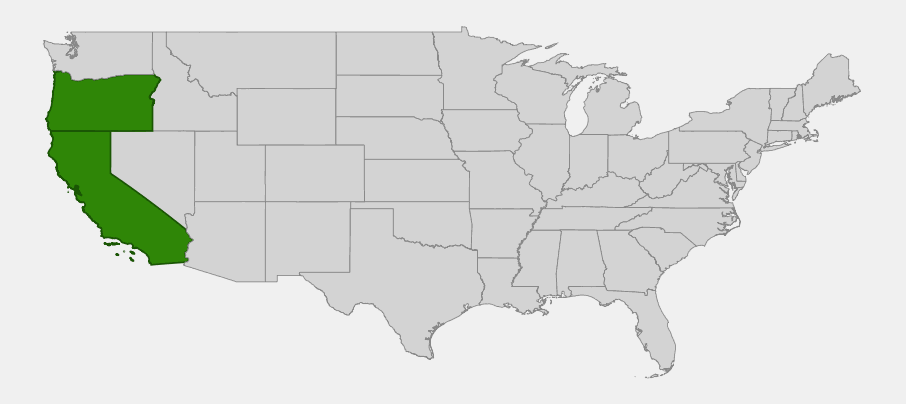
Graceful Bedstraw is native to California, where it occurs from the Coast Ranges and Transverse Ranges down through Southern California’s chaparral and coastal sage scrub, and into the Sierra Nevada foothills. Its range just crosses the state line into the far southwestern corner of Oregon. This is a California chaparral specialist first, with only a marginal toehold farther north — it is not native to Washington or anywhere else in the Pacific Northwest, despite occasional nursery listings that lump it in with broader “Pacific Coast” plant collections.
Across this range, Graceful Bedstraw grows from near sea level up to around 5,000 feet in elevation, favoring the dappled shade beneath chaparral shrubs, oak woodland understories, and coastal sage scrub where it can scramble over rocks and neighboring plants. It is a classic associate of chamise, manzanita, scrub oak, and California sagebrush plant communities, tucked into the same dry, rocky slopes that define much of California’s wildland character.
Because it depends on the specific dry-summer, mild-winter climate of California’s Mediterranean ecoregion, Graceful Bedstraw does not naturalize or persist as a garden plant far outside this native range. Gardeners in the Pacific Northwest’s wetter, cooler climate should not expect to replicate California chaparral conditions easily, and should instead look to regionally native bedstraws for groundcover duty in their own gardens.
📋 Regional plant lists featuring Graceful Bedstraw: Western Oregon & Western Washington
Growing & Care Guide
Graceful Bedstraw is an easygoing plant for anyone recreating a California chaparral or oak woodland garden, but it is not a plant for a typical lawn-adjacent flower bed — it wants dry shade and neighbors to lean on.
Light
Part shade to full shade suits it best, mimicking the understory conditions of chaparral and oak woodland where it naturally grows. In cooler coastal gardens it will tolerate more sun, but inland heat and bright exposure tend to scorch the thin foliage. Use it beneath established native shrubs or trees rather than in open, sunny beds.
Soil & Water
Good drainage is essential — Graceful Bedstraw is adapted to the lean, rocky soils of chaparral slopes and does not tolerate soggy ground. Once established, it needs little to no supplemental irrigation and should be allowed to dry out between waterings, consistent with its summer-dry native climate. Overwatering in summer is the most common way to lose this plant in cultivation.
Planting Tips
Plant from container stock in fall, ahead of winter rains, so the roots can establish before the dry season. Tuck it at the base of established shrubs, oaks, or rock outcrops where it can scramble upward or trail across open ground. It is not aggressive and will not smother neighboring plants the way some groundcovers do.
Pruning & Maintenance
Little maintenance is needed. Cut back tangled or dead growth after the dry season if it looks untidy; otherwise, leave it alone. It has no significant pest or disease problems in its native range and does not require fertilizing in typical garden soils.
Landscape Uses
Graceful Bedstraw fills a specific, useful role:
- Dry shade groundcover beneath oaks and chaparral shrubs
- Scrambling filler to soften the base of taller native shrubs
- Chaparral restoration plantings where authentic understory texture is wanted
- Rock garden trailing over boulders and slopes
- Low-water native gardens that need a low, unobtrusive groundcover
Wildlife & Ecological Value
Though inconspicuous, Graceful Bedstraw contributes quietly to chaparral ecosystem function and supports a small but important set of wildlife interactions.
For Pollinators
The tiny spring flowers attract small native bees and flies capable of working such small blooms, offering a minor but reliable nectar source in the chaparral understory during the late winter and spring bloom window.
For Birds & Mammals
The dense, tangled growth habit provides low cover for small birds and ground-dwelling animals moving through chaparral understory. The bristly fruit attaches to the fur of mammals passing through, which is the plant’s primary means of seed dispersal — the same mechanism used by its common roadside relative, cleavers.
Ecosystem Role
As a scrambling groundcover, Graceful Bedstraw helps stabilize soil on the dry slopes it occupies and adds a low structural layer to chaparral and oak woodland communities that might otherwise be bare between larger shrubs. Its presence is a small but telling sign of an intact, undisturbed chaparral understory.
Cultural & Historical Uses
Graceful Bedstraw has no significant recorded history of use by Indigenous peoples or early settlers, unlike some of its showier bedstraw relatives. The genus Galium as a whole has a long association with dyeing (the roots of some species yield red dye) and with coagulating milk — the common name “bedstraw” comes from the historical European practice of using dried, fragrant bedstraw species to stuff mattresses — but there is no documented record of Graceful Bedstraw itself being used this way by California tribes.
Today the plant is valued primarily by native plant gardeners and restoration practitioners who want an authentic, low-maintenance groundcover for chaparral and oak woodland plantings, rather than for any historical or culinary use.
Frequently Asked Questions
Is Graceful Bedstraw native to Oregon?
Only barely. Its native range just reaches the far southwestern corner of Oregon; the species is overwhelmingly a California plant. It is not native to Washington.
Does Graceful Bedstraw climb like a true vine?
It scrambles rather than twines or clings with tendrils. Tiny hooked prickles on its stems and leaves catch onto neighboring branches, letting it lean and climb into shrubs for support, but it has no attachment organs of its own.
Is Graceful Bedstraw the plant that sticks to clothing and fur?
Its small bristly fruit can catch on fur and fabric, similar to its weedy relative cleavers (Galium aparine), though Graceful Bedstraw is far less aggressive and not considered a nuisance plant.
How much water does Graceful Bedstraw need?
Very little once established. It is adapted to California’s dry summers and should be kept on the dry side; overwatering, especially in heavy soil, is the most common cause of failure in cultivation.
Will Graceful Bedstraw take over my garden?
No. It is a modest, non-aggressive plant that stays within a one-to-three-foot patch or trails lightly into nearby shrubs. It is not considered weedy or invasive anywhere in its native range.

Looking for a nursery that carries Graceful Bedstraw?
Browse our native plant nursery directory: California · Oregon