Woodland Sunflower (Helianthus divaricatus)
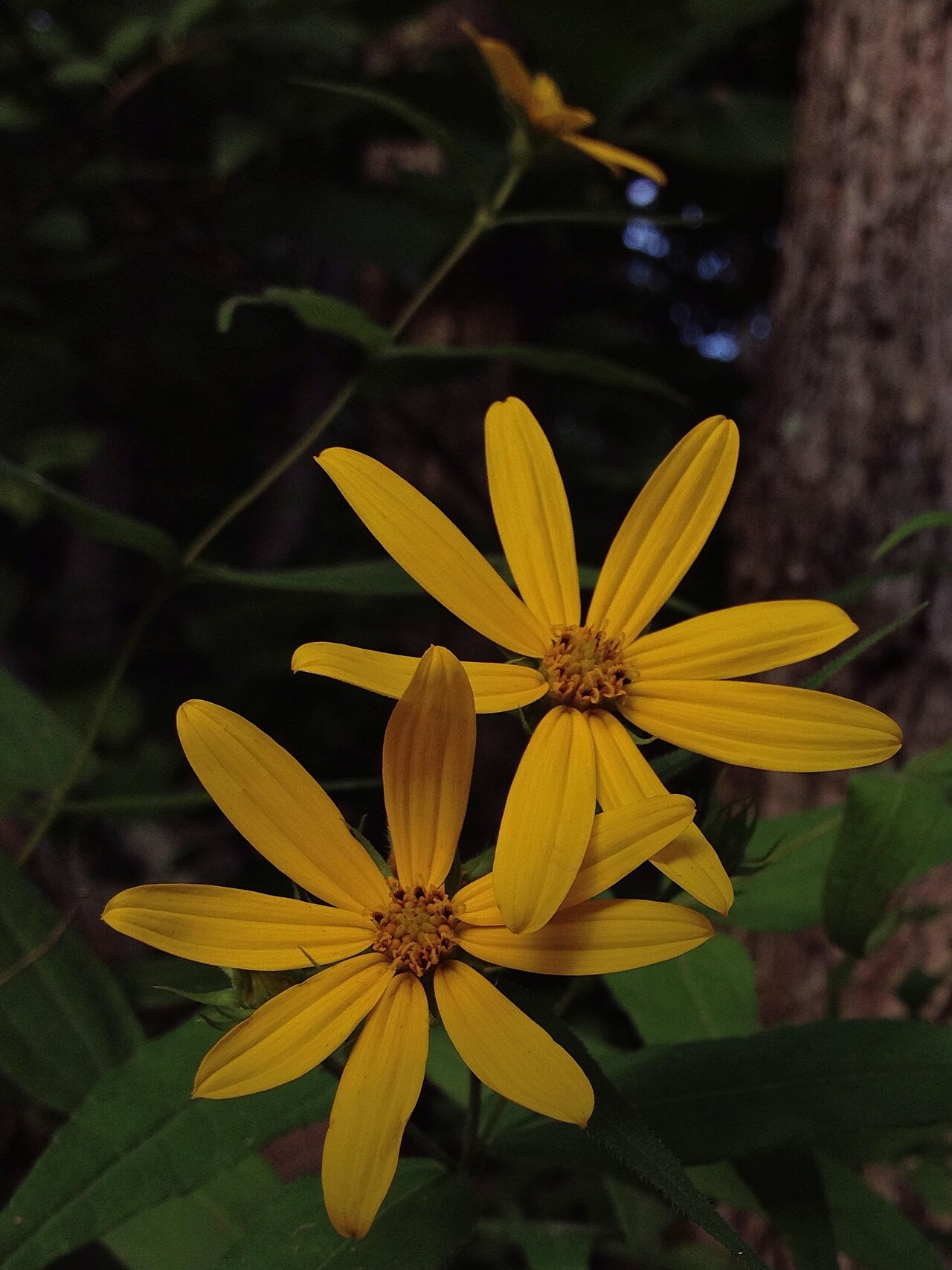
Helianthus divaricatus, the Woodland Sunflower (also called rough sunflower or rough woodland sunflower), is a rhizomatous perennial wildflower native to open woodlands and woodland edges across the eastern and midwestern United States. Unlike the towering common sunflower of roadsides and gardens, this is a modest, colony-forming plant of dry upland forests, where its cheerful yellow flowerheads brighten the dappled shade of midsummer and early fall.
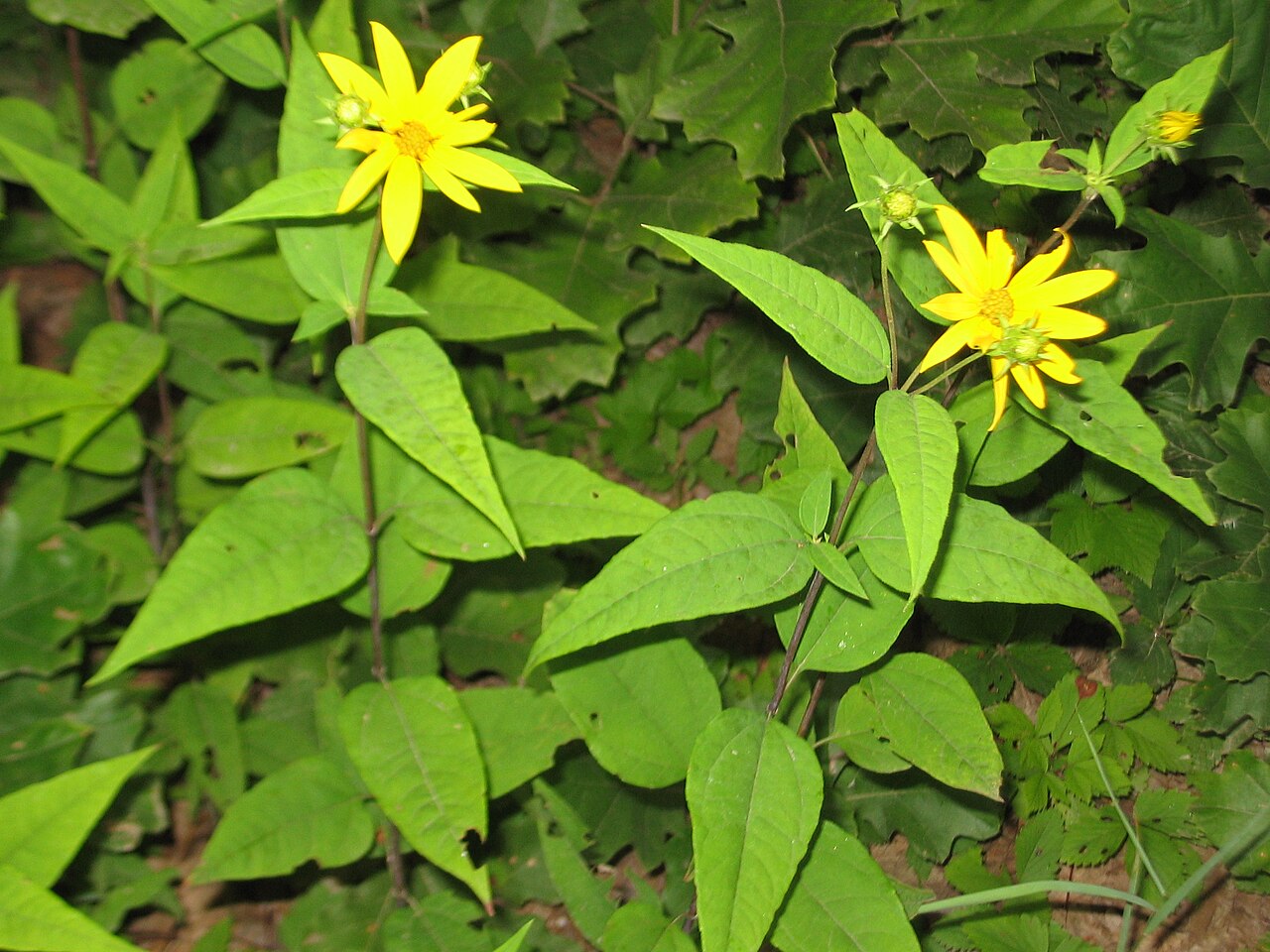
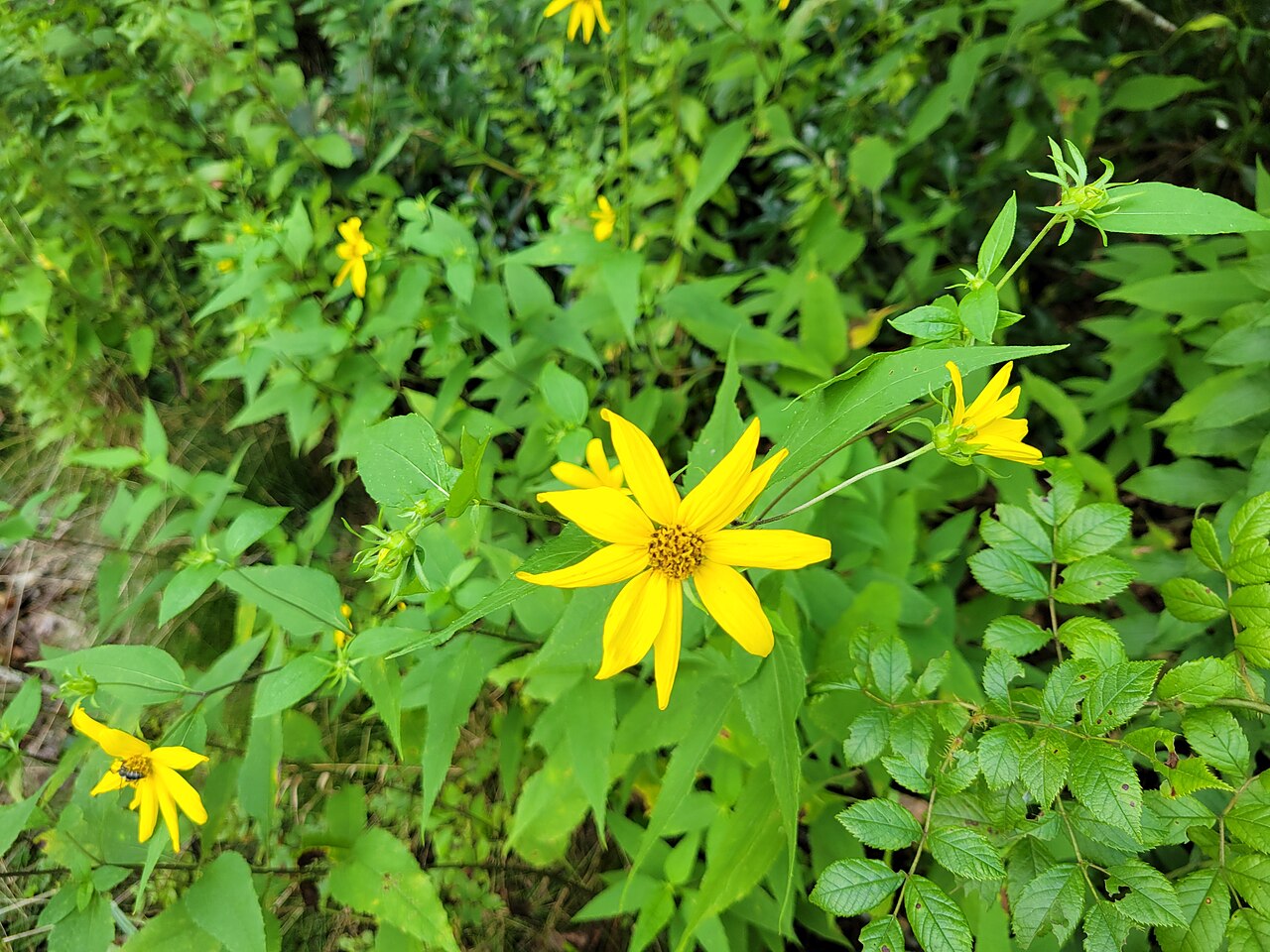
The plant typically stands 2½ to 6 feet tall on slender, often purple-tinged stems, with pairs of opposite, lance-shaped leaves that rotate 90 degrees at each node going up the stalk. Each stem branches near the top into several flowerheads, each with 8 to 15 narrow yellow rays surrounding a yellow disk — a simpler, more open look than the broad-faced garden sunflower. Because it spreads by long rhizomes, a single planting slowly forms a loose patch rather than staying a single clump.
Woodland sunflower is an easy, low-fuss choice for gardeners working with dry shade or part-sun woodland edges — a notoriously difficult site for many showy natives. It asks for little beyond reasonably drained soil, tolerates both drought and poor soil, and in return feeds a long list of specialist bees, butterflies and seed-eating birds through late summer.
Identification
Woodland sunflower is best recognized by the combination of opposite, sessile leaves in rotating pairs, a slender branching stem, and relatively small, simple-looking yellow flowerheads held well above the foliage on bare peduncles.
Stems
The central stem is slender and round in cross-section (terete), light green to dark purple, and ranges from smooth to sparsely covered in short stiff hairs; it is sometimes lightly glaucous (covered in a whitish bloom). It stays unbranched for most of its length, splitting into several secondary stems only near the top, where the flowerheads are produced.
Leaves
Leaves are arranged in opposite pairs along the stem, with each pair rotating about 90 degrees from the pair below it. Individual leaves are 2 to 6 inches long and ½ to 2 inches wide, lance-shaped to narrowly oval, with a rounded-to-truncate base and a long, gradually tapering tip. Margins are toothless or have widely spaced, shallow teeth with short cilia (hair-fringe). The upper surface is yellowish to medium green and feels rough to the touch from short stiff hairs; the paler underside is finely pubescent, especially along the three prominent veins that converge at the leaf base. Leaves are sessile or carry only a very short petiole.
Flowers & Fruit
Flowerheads are 1½ to 3 inches across and appear at the tips of the stem and its branches on bare, slightly hairy peduncles. Each head has 8 to 15 yellow ray florets surrounding a center of small, tubular yellow disk florets. Light green floral bracts (phyllaries) beneath the head are narrow and fringed with cilia, and the outer ones spread or curl back as the flower opens. Bloom runs from mid-summer into early fall, roughly July through September depending on latitude. Flowers are followed by small, flattened achenes about 1/12 inch long, each topped with a pair of thin, easily detached scales — not the stiff awns of some related sunflowers.
Quick Facts
| Scientific Name | Helianthus divaricatus |
| Family | Asteraceae (Aster/Sunflower) |
| Plant Type | Rhizomatous herbaceous perennial |
| Mature Height | 2½–6 ft |
| Mature Spread | Spreads by rhizomes into loose colonies over time |
| Growth Rate | Moderate to fast (spreads readily by rhizome) |
| Sun Exposure | Full Sun to Part Shade |
| Water Needs | Low to average; tolerates dry soil once established |
| Soil Type | Loamy, sandy or rocky; well-drained |
| Soil pH | Adaptable; roughly 5.5–7.5 |
| Bloom Time | July – September |
| Flower Color | Yellow rays and disk |
| Fall Color | Foliage yellows and dies back after frost |
| Fruit | Small flattened achenes, late summer–fall |
| Deer Resistant | Moderate (occasionally browsed, usually recovers) |
| USDA Hardiness Zones | 3–8 |
Native Range
Woodland sunflower is native to central and eastern North America, from Ontario and Quebec in the north, south through the Appalachians and Gulf Coastal Plain to Florida and Louisiana, and west to Iowa and eastern Oklahoma. Within the United States it occurs across New England, the Mid-Atlantic, the Southeast, the Ohio Valley, the upper Midwest and the mid-South.
Typical habitat is dry to medium-moisture upland ground: rocky or sandy open woodlands, thinly wooded bluffs, savannas, woodland borders, thickets and limestone glades. It is generally a plant of relatively dry, sun-dappled upland sites rather than wet ground, though it occasionally turns up in moist sandy habitats as well. Periodic fire, by holding back competing woody growth, tends to favor and expand populations where it occurs.
Because it is easy to grow and spreads readily from rhizomes, woodland sunflower is also planted as a garden perennial somewhat outside this core range; gardeners west and north of the mapped range should confirm local native status before planting into wild areas, and should expect it to spread assertively in cultivated beds.
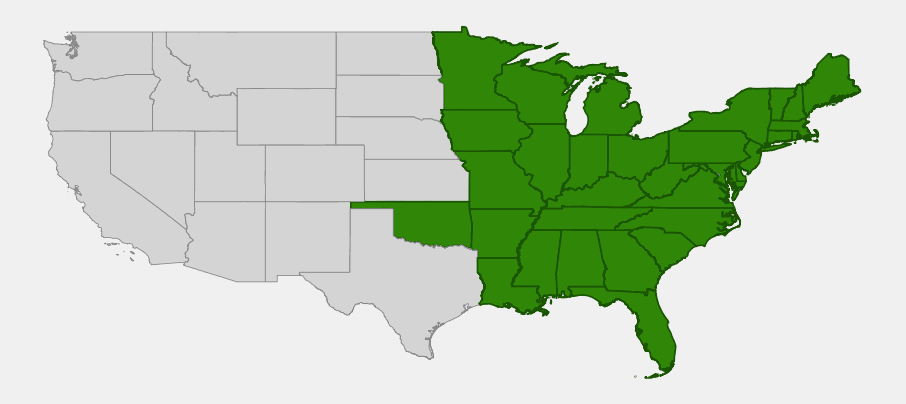
📋 Regional plant lists featuring Woodland Sunflower: New Hampshire, Maine & Vermont · Connecticut, Massachusetts & Rhode Island · New York, Pennsylvania & Northern New Jersey · Delaware, Southern New Jersey & Long Island · Maryland, Virginia & West Virginia · North Carolina & South Carolina · Georgia, Alabama & Mississippi · Arkansas, Louisiana, Eastern Oklahoma & Eastern Texas · Kentucky & Tennessee · Ohio & Indiana · Illinois, Iowa & Missouri · Michigan, Wisconsin & Eastern Minnesota
Growing & Care Guide
Woodland sunflower earns its keep in gardens that other sun-loving wildflowers struggle with: dry shade, woodland edges, and part-sun beds with lean soil. It is forgiving, long-blooming and self-sufficient, with the main chore being keeping its spread in check.
Light
This sunflower flowers well in full sun but is equally at home in part shade, which is where it is most often found in the wild — under an open oak or hickory canopy, or at the dappled edge of a woodland. More sun generally means denser growth and more flowerheads; in deeper shade, plants stretch taller and bloom a little more sparsely but still perform.
Soil & Water
Give it loamy, sandy or rocky soil that drains well; it is not a plant for heavy, wet clay or low spots that stay soggy. Once established, it is notably drought tolerant and thrives on the kind of lean, dry upland ground where fussier perennials fade. Supplemental water is rarely needed beyond the first season, and rich, overly fertile soil tends to produce floppy growth and overly vigorous spreading rather than better flowering.
Planting Tips
Plant in spring or fall from containers, spacing plants 18 to 24 inches apart to allow room for rhizome spread. Woodland sunflower is an excellent choice for naturalizing a dry woodland edge, a slope, or the base of established shade trees where turf struggles. Give it room from choice, slower-growing neighbors, since it will colonize nearby open ground within a few seasons.
Pruning & Maintenance
Little maintenance is required. Cut plants back in late fall or leave the dried stems and seedheads standing through winter for birds and overwintering insects, then clear the old growth in early spring. Because it spreads by rhizome, the main ongoing task in a small garden is pulling or dividing out unwanted runners each spring to keep the patch within bounds; in a naturalized area, let it run.
Propagation
The easiest method is division of the spreading rhizomes in spring or fall — dig a section with roots attached and replant immediately. Seed, collected once the achenes ripen and the heads dry in fall, can also be sown outdoors in autumn or cold-stratified before spring sowing, though division is faster and more reliable for garden use.
Landscape Uses
- Dry shade and woodland-edge gardens, a difficult niche few showy natives fill as well
- Naturalized colonies under open-canopy oaks and hickories
- Pollinator gardens, paired with little bluestem and wild bergamot
- Slope and bank plantings on lean, well-drained ground
- Restoration plantings in oak savanna and open-woodland projects
- Cut flowers — the long stems and simple yellow heads work well in informal arrangements
Wildlife & Ecological Value
Despite its modest size next to the garden sunflower, woodland sunflower is a workhorse for insects and birds through the heart of summer, when many spring wildflowers have already finished blooming.
For Pollinators
The flowers draw a wide range of bees and other insects. Several bee species are specialist pollinators of sunflowers generally, including species in the genera Andrena, Dufourea, Melissodes and Pseudopanurgus, alongside generalist visitors such as honeybees, bumblebees, leafcutter bees, Halictid bees, syrphid flies, bee flies, wasps, butterflies and skippers.
For Birds
The seeds that follow the flowers feed seed-eating birds including Eastern Goldfinch, Mourning Dove, Bobwhite, Tufted Titmouse and various sparrows. Standing seedheads left through fall and winter extend this food source well past the growing season.
For Mammals
Small mammals such as gray squirrels and other tree squirrels, thirteen-lined ground squirrels, meadow voles and white-footed mice occasionally eat the seeds, while deer will browse the foliage from time to time, though plants generally recover.
Ecosystem Role
As a rhizomatous colonizer of dry, open upland ground, woodland sunflower helps hold soil on slopes and bluffs and fills in gaps left by fire or disturbance in oak woodlands and savannas. Its caterpillar hosts include the Silvery Checkerspot and Gorgon Checkerspot butterflies, and the plant supports a long list of specialist sunflower-feeding insects that in turn feed birds and other wildlife.
Cultural & Historical Uses
Woodland sunflower has fewer recorded traditional uses than the cultivated common sunflower, since its smaller seeds made it a less practical food crop. Well-sourced historical records specific to this species are limited compared with its larger, widely cultivated relatives.
Its larger historical role has been ecological rather than cultural: as a long-blooming component of oak savanna and open-woodland plant communities that were shaped by periodic fire for thousands of years before fire suppression became widespread in the 20th century. Restoring fire or other disturbance to these communities today tends to bring woodland sunflower back along with its associated insects.
More recently, it has become a popular native-plant-garden perennial precisely because it tolerates the dry shade and lean soil that frustrate gardeners trying to establish other sun-loving prairie and meadow wildflowers in part-shade settings.
Frequently Asked Questions
Does woodland sunflower spread aggressively?
Yes, it spreads by rhizomes and can form sizeable colonies within a few seasons, especially in loose, well-drained soil. This makes it excellent for naturalizing a difficult dry-shade area but means it needs occasional dividing or edging to keep it out of neighboring beds.
Will woodland sunflower grow in shade?
It tolerates part shade well and is often found growing under an open tree canopy in the wild. Full sun generally produces denser, more floriferous plants, but part shade is where this species is most at home compared with other sunflowers.
How is woodland sunflower different from the common sunflower?
Common sunflower (Helianthus annuus) is a much larger-headed annual typically grown from seed each year, while woodland sunflower is a smaller-flowered, rhizomatous perennial of dry open woods that returns and spreads on its own. Woodland sunflower’s opposite, rotating leaf pairs and smaller flowerheads also distinguish it in the field.
Is woodland sunflower good for pollinators?
Yes. It supports several specialist sunflower-pollinating bees in addition to a wide range of generalist bees, flies, wasps and butterflies, and its seeds feed finches, sparrows and other birds into fall and winter.
When does woodland sunflower bloom?
Typically from July into September, blooming later than many spring woodland wildflowers and helping extend nectar and seed availability through the heart of summer.

Looking for a nursery that carries Woodland Sunflower?
Browse our native plant nursery directory: Alabama & Arkansas · Connecticut, Delaware, Florida & Georgia · Illinois, Indiana & Iowa · Kentucky, Louisiana, Maine, Maryland, Massachusetts, Michigan, Minnesota, Mississippi & Missouri · New Hampshire, New Jersey, New York, North Carolina, Ohio & Oklahoma · Pennsylvania, Rhode Island, South Carolina, Tennessee & Virginia · West Virginia & Wisconsin