Gray Pine (Pinus sabiniana)
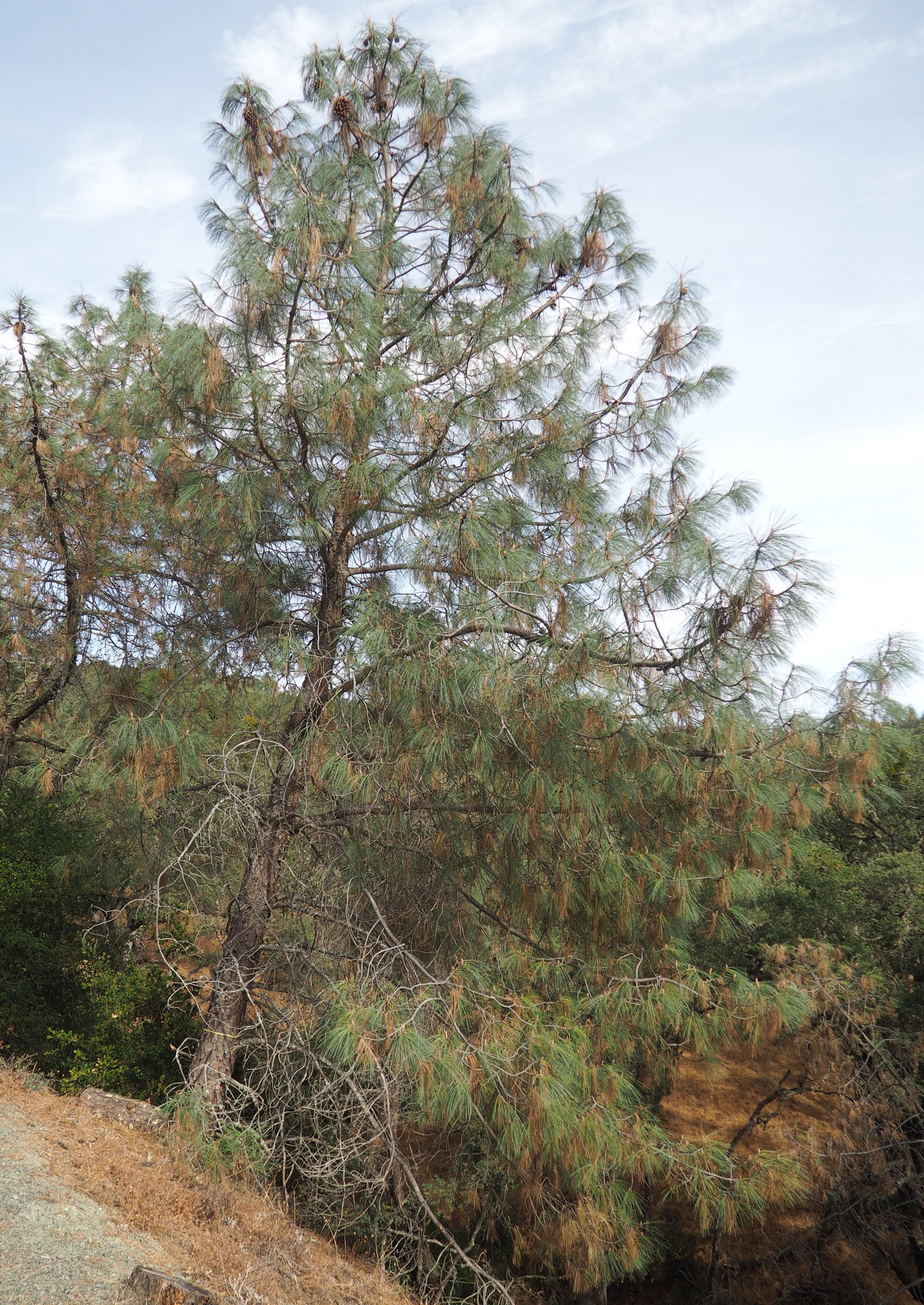
Pinus sabiniana, commonly known as Gray Pine or Foothill Pine, is a distinctive conifer endemic to California’s dry foothill woodlands. In the past it was often called “digger pine,” a name now considered an ethnic slur against California Indian peoples and no longer used. Gray Pine is instantly recognizable even from a distance: instead of the dense, pyramidal crown typical of most pines, it grows an open, airy, often forked or multi-trunked silhouette with sparse, drooping, blue-gray needles that let plenty of sunlight filter through to the ground below.
This is a tree of the hot, dry margins between California’s Central Valley and its surrounding mountains — the band of oak-studded foothill woodland and chaparral where summers are long, rainfall is scant, and soils are often thin and rocky. Gray Pine thrives in exactly these tough conditions, where many other conifers cannot compete. It commonly grows alongside Blue Oak, Interior Live Oak, and California Buckeye, forming an open woodland that is one of the most characteristic landscapes of inland California.
For native-plant gardeners in the foothill regions of California, Gray Pine offers something few ornamental trees can: extreme drought tolerance combined with real ecological value, from seeds that feed wildlife to habitat structure that supports foothill birds. It is not a tree for a small, tidy yard — mature specimens are large and their heavy cones are a genuine hazard underfoot — but for a large rural or semi-wild property in its native foothill range, it is a strikingly beautiful, low-water choice.
Identification
Gray Pine typically grows 40 to 70 feet tall, occasionally more, with a trunk 1 to 2 feet in diameter. Unlike most pines, which put most of their growth into a single dominant leader, Gray Pine frequently forks low on the trunk into two or more co-dominant stems, producing a broad, irregular, open crown that can look almost oak-like from a distance. This open form, combined with the pine’s pale, grayish-green foliage, is usually enough to identify the species on sight.
Bark & Stems
Young trees have smooth, gray bark that becomes deeply furrowed and plated with age, turning dark gray-brown to blackish, broken into irregular, somewhat rectangular plates. The branches are typically sparse and widely spaced, reinforcing the tree’s open, airy appearance.
Leaves
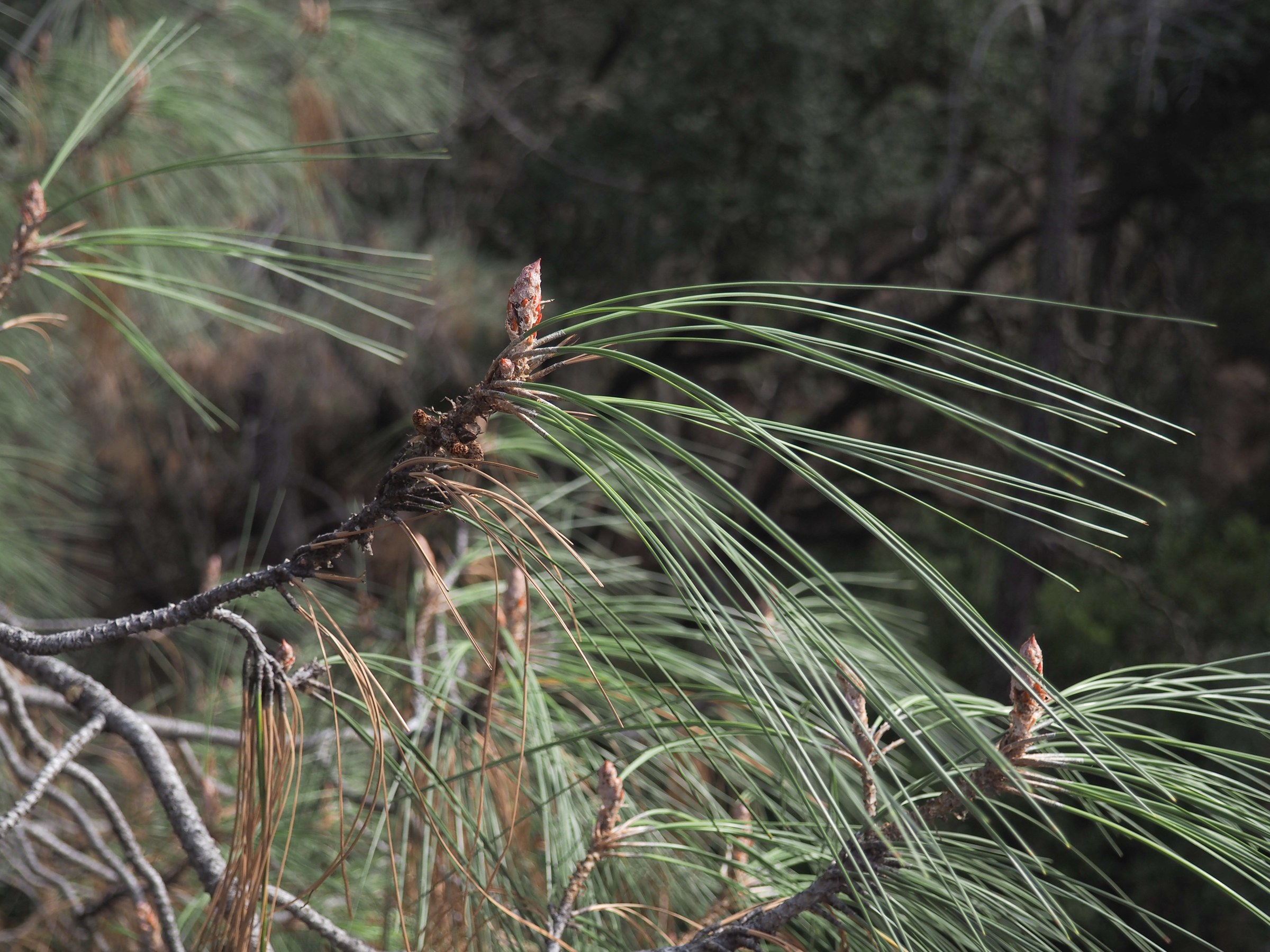
Needles are gray-green to blue-gray, 8 to 13 inches long, and borne in bundles (fascicles) of three. They are notably limp and drooping rather than stiff, hanging in loose, sparse tufts near the branch tips. This combination of length, color, and drooping habit is a reliable field mark that separates Gray Pine from Ponderosa Pine and ponderosa’s associates, which share some of the same foothill range but have shorter, stiffer, greener needles and a denser crown.
Flowers & Cones
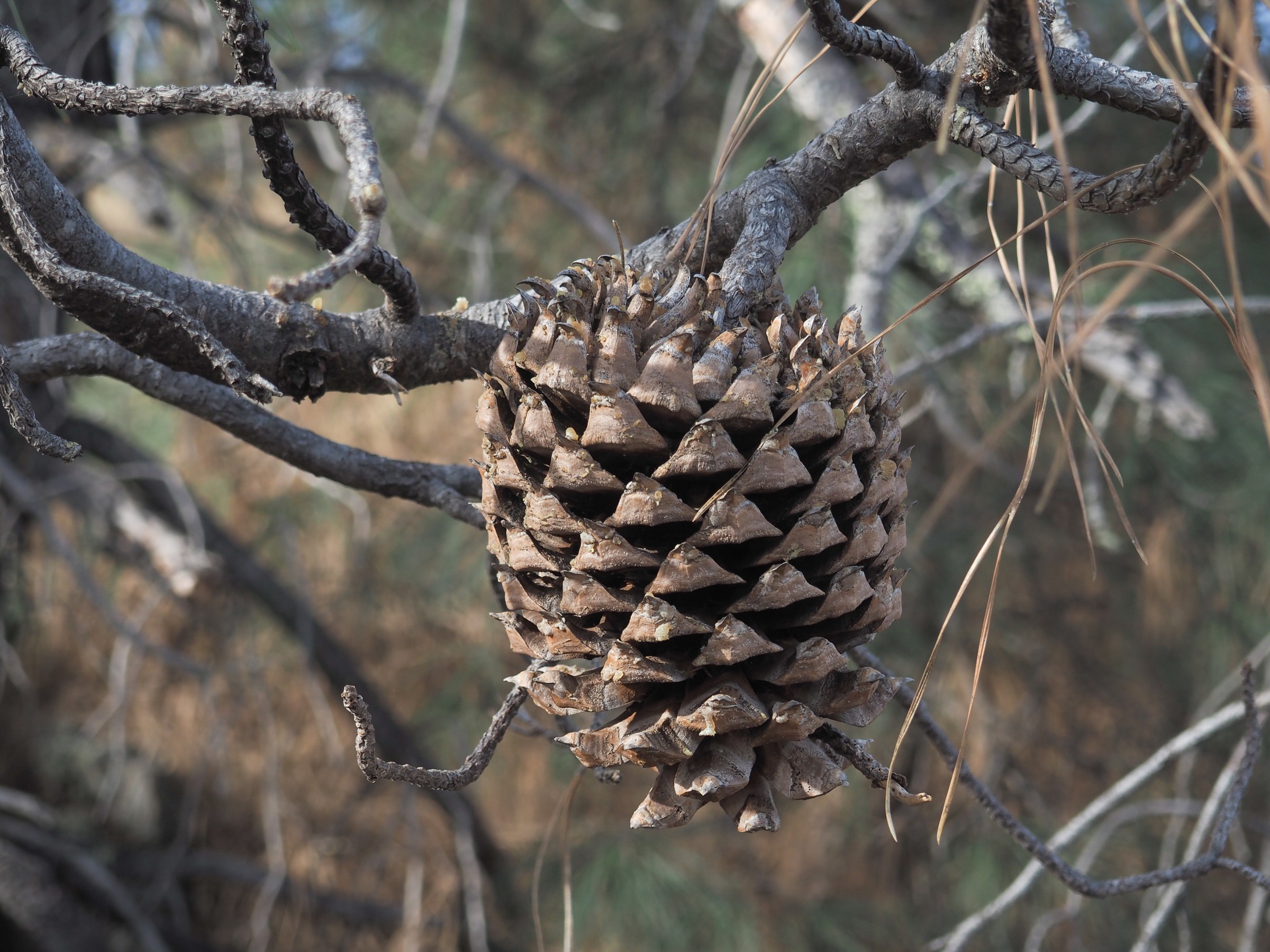
Like all pines, Gray Pine is wind-pollinated, with small yellow male (pollen) cones appearing in spring. The seed cones are the tree’s most dramatic feature: large, heavy, egg-shaped structures 6 to 10 inches long, armed with sharp, curved spines at the tip of each scale. A mature cone can weigh over a pound, and falling cones are a genuine hazard — avoid parking or placing seating directly beneath large trees. Cones mature over two seasons and release large, wingless or short-winged seeds that are an important food source for wildlife.
Quick Facts
| Scientific Name | Pinus sabiniana |
| Family | Pinaceae (Pine) |
| Plant Type | Evergreen Coniferous Tree |
| Mature Height | 40–70 ft (occasionally larger) |
| Mature Spread | 25–40 ft, open and irregular |
| Growth Rate | Moderate |
| Sun Exposure | Full Sun |
| Water Needs | Low once established |
| Soil Type | Rocky, well-drained; tolerates poor, shallow soils |
| Soil pH | 6.0–7.5 (slightly acidic to neutral) |
| Bloom Time | April – May (pollen cones) |
| Flower Color | Yellow (male cones) |
| Fall Color | Evergreen (no fall color change) |
| Fruit | Large, heavy, spined seed cones, 6–10 in |
| Deer Resistant | Yes |
| USDA Hardiness Zones | 7–10 |
Native Range
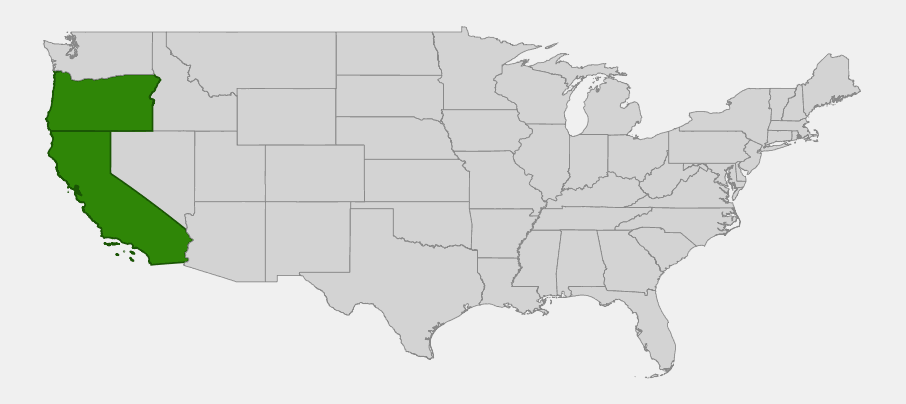
Gray Pine is endemic to California, where it forms a broad ring of open woodland around the Central Valley — through the Sierra Nevada and Coast Range foothills, the inner North Coast Ranges, and south into the Transverse and Peninsular Ranges. A limited extension of its range reaches across the state line into the Rogue Valley and Siskiyou foothills of southwestern Oregon.
Across this range, Gray Pine occupies the hot, dry foothill belt between the Central Valley floor and the higher, moister mixed-conifer forests above. It typically grows on rocky, shallow, nutrient-poor soils — including serpentine outcrops that few other trees can tolerate — in open woodland and chaparral-margin habitat from near sea level to around 4,500 feet.
Gray Pine is not rare or declining across its range, but it is also not widely planted outside it; its extreme drought tolerance and foothill adaptations make it poorly suited to irrigated garden settings outside its native climate zone. Note that Gray Pine is native only to California and this small corner of southwestern Oregon — it is not native to the rest of the Pacific Northwest, the Sierra high country, or the deserts further east.
📋 Regional plant lists featuring Gray Pine: Western Oregon & Western Washington
Growing & Care Guide
Gray Pine rewards gardeners who can give it room and let it alone. It is not a tree for formal, heavily irrigated landscapes — it is built for lean soil and dry summers, and too much kindness in the form of rich soil or regular watering can shorten its life or weaken its structure.
Light
Plant Gray Pine in full sun. It is intolerant of shade, and seedlings struggle under a closed canopy; in the wild it establishes in open ground and on disturbed, sunny slopes.
Soil & Water
Good drainage matters more than fertility. Gray Pine does best in rocky, gravelly, or sandy soils and is notably tolerant of serpentine and other poor soils that limit many other trees. Water young trees to establish a deep root system, then taper off; established trees need little to no supplemental irrigation in their native range and can suffer root disease if kept consistently moist, especially in heavier soils.
Planting Tips
Plant from a small container in fall, giving the taproot room to grow straight down without circling. Site it well away from structures, driveways, and seating areas — mature trees drop heavy, spine-tipped cones that can dent vehicles and injure people. Give it plenty of horizontal space, 30 feet or more from other large trees, to let its open crown develop naturally.
Pruning & Maintenance
Little pruning is needed beyond removing dead or damaged branches. Avoid heavy pruning or attempts to force a denser, more conventional pine shape — the open, forked habit is natural to the species. Rake and remove fallen cones regularly in areas where people walk.
Landscape Uses
Gray Pine fits best in large, naturalistic settings:
- Foothill and rural properties within its native climate zone
- Oak woodland restoration alongside Blue Oak and Interior Live Oak
- Fire-wise, low-water landscaping on large lots with defensible space planning
- Wildlife habitat plantings where its seeds and structure support foothill fauna
- Specimen tree for its distinctive, sculptural silhouette
Wildlife & Ecological Value
Gray Pine is a keystone resource in the dry foothill woodlands where it grows, providing food and structure that few other trees in its range can match.
For Birds
Acorn Woodpeckers, Steller’s Jays, and Western Scrub-Jays cache and feed on the large seeds, and the open, sparse crown gives raptors such as Red-tailed Hawks clear sightlines for hunting while still offering nesting sites.
For Mammals
Historically, the large, oily seeds were an important food source for California ground squirrels and other rodents, which in turn support predators throughout the foothill food web. Black-tailed deer browse young growth occasionally, though mature trees are generally left alone.
For Pollinators
As a wind-pollinated conifer, Gray Pine does not rely on insect pollinators, but its open structure allows understory wildflowers and shrubs — which do support bees and butterflies — to thrive beneath its canopy.
Ecosystem Role
Gray Pine’s open, light-admitting crown helps maintain the understory diversity of foothill woodland, allowing grasses, wildflowers, and shrubs to flourish beneath it in a way a denser canopy would not. Its deep taproot also helps stabilize rocky foothill slopes.
Cultural & Historical Uses
Gray Pine held major importance for California Indian peoples across its range, including the Miwok, Yokuts, and Pomo, among others. The large, nutritious seeds were a significant food source, gathered from cones in late summer and fall and eaten raw, roasted, or ground. The pitch was used as an adhesive and sealant, and the wood was used for tools and construction.
The tree’s history also carries a painful legacy: for much of the 19th and 20th centuries it was widely known by a name referencing a racial slur used against California Indian people, reflecting the deep prejudice settlers held toward the very communities who depended on the tree. That name has fallen out of use, and “Gray Pine” or “Foothill Pine” are now the accepted common names.
In more recent history, the tree’s conspicuous cones and sparse, sculptural form made it a recognizable feature of Gold Rush–era California landscapes, appearing in period illustrations of foothill mining country. Today it remains primarily valued for its ecological role and its striking, drought-adapted silhouette rather than for timber, as the wood is of limited commercial use.
Frequently Asked Questions
Why is Gray Pine sometimes called “digger pine,” and should I use that name?
“Digger pine” was a common historical name, but “digger” was a derogatory term used against California Indian peoples, and the name is considered offensive today. Use “Gray Pine” or “Foothill Pine” instead.
Is Gray Pine the same as Ponderosa Pine?
No. Though both grow in parts of California’s foothills and mountains, Gray Pine has an open, often forked crown with long, limp, gray-green needles, while Ponderosa Pine has a denser, more conical form with shorter, stiffer, greener needles and thick, puzzle-plated orange-brown bark.
Are Gray Pine cones dangerous?
The cones themselves aren’t toxic, but they are large, heavy, and armed with sharp spines, and falling cones can cause real injury or vehicle damage. Avoid siting the tree directly over driveways, patios, or paths.
How drought tolerant is Gray Pine?
Extremely. Once established, it needs little or no supplemental water in its native California climate and is one of the most drought-adapted large conifers available for foothill gardens.
Can Gray Pine be grown outside California?
It can be attempted in similarly dry, Mediterranean-type climates, but it is best suited to its native range in California and the adjoining corner of southwestern Oregon, where its deep-summer-drought adaptations match the local climate.

Looking for a nursery that carries Gray Pine?
Browse our native plant nursery directory: California · Oregon