
Heart-leaved Aster (Aster cordifolius)
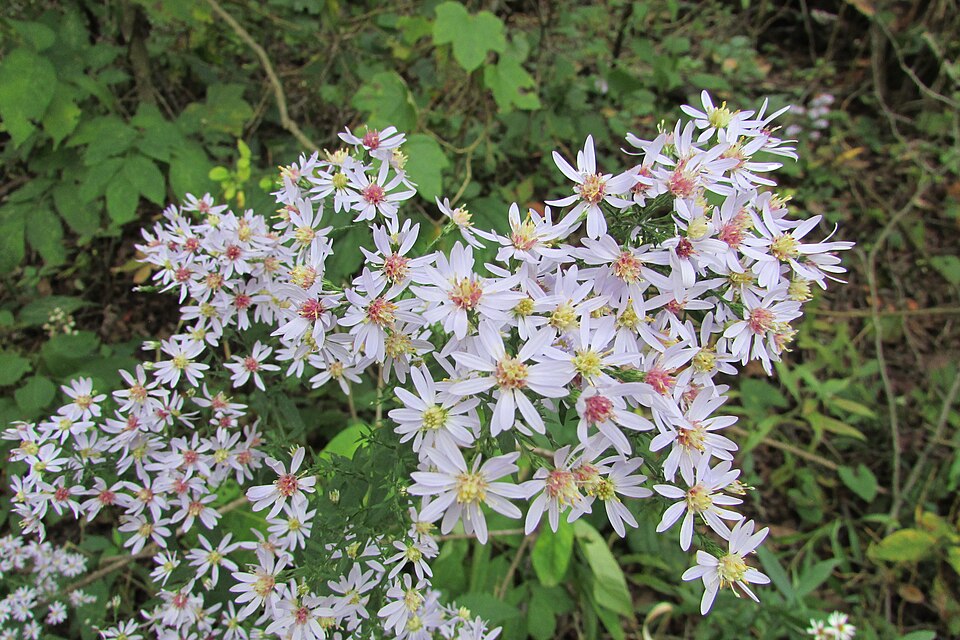
Symphyotrichum cordifolium (formerly Aster cordifolius), commonly called Heart-leaved Aster or Blue Wood Aster, is one of the most beloved and ecologically essential native wildflowers of the eastern woodland understory. Its name reflects the distinctive heart-shaped (cordate) base of its leaves — a reliable identification feature that sets it apart from the many other native asters. In September and October, Heart-leaved Aster transforms the filtered-light forest floor into a sea of pale blue-violet stars, producing one of the most stunning late-season wildflower displays in the eastern United States.
What makes Heart-leaved Aster particularly valuable to gardeners and ecologists alike is its ability to thrive in the light shade of deciduous forests where many other flowering plants cannot bloom. Most native wildflowers need significant sun to flower; Heart-leaved Aster performs magnificently in the dappled light of open woods and the dry, root-filled shade of mature trees — making it an irreplaceable component of the shade garden plant palette. Its late bloom time (September–October) fills the “aster gap” in the garden after most summer flowers have faded.
Ecologically, Heart-leaved Aster is one of the most critical late-season nectar plants for native pollinators. Monarch butterflies, bumble bees, native sweat bees, and dozens of specialist bee species depend on its flowers to fuel their autumn migrations and winter preparations. For gardeners committed to supporting native pollinators through the entire growing season, Heart-leaved Aster is an essential component of any naturalistic shade planting in New York, Pennsylvania, and New Jersey.
Identification
Heart-leaved Aster is an upright to arching, branched perennial herb growing 1–4 feet tall, often spreading to form loose colonies through rhizomes and self-seeding. The plant has a distinctly open, airy quality — many fine stems branching widely and bearing numerous small flower heads.
Leaves
The leaves are the most reliable identification feature. Basal and lower stem leaves are heart-shaped with a distinctive deep, open sinus (notch) where the blade meets the winged petiole (leaf stalk). The leaf surface is rough to the touch and sometimes hairy. Leaf margins are toothed. Upper stem leaves become progressively smaller and more lance-shaped, often sessile (lacking a stalk). The heart-shaped lower leaves distinguish this species from most other native asters, which have more oblong or lance-shaped foliage. Leaves typically measure 2–5 inches long and 1–3 inches wide on the lower stem.
Flowers
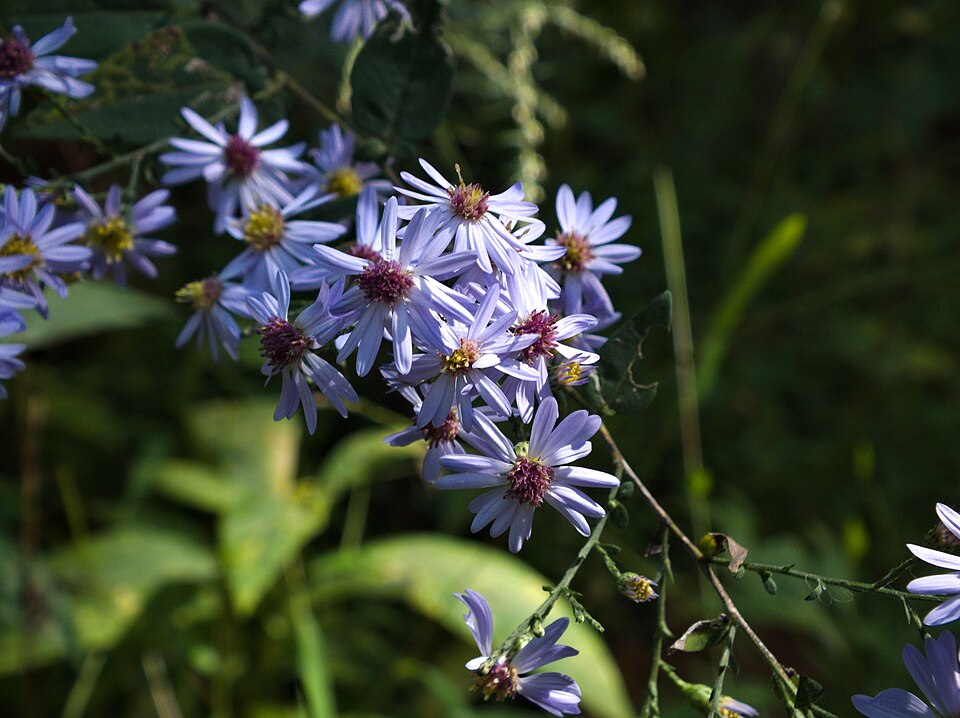
The flower heads are small — about ½ inch in diameter — but produced in tremendous profusion on widely branched stems. Each head has 10–20 pale blue-violet to lavender ray flowers surrounding a central yellow disc that turns reddish-purple as the flowers mature. The overall effect of hundreds of small flower heads on arching, branching stems is exceptionally attractive — a cloud of soft blue rising from the woodland floor. Blooms from September through frost, providing one of the latest reliable wildflower displays of the season.
Quick Facts
| Scientific Name | Symphyotrichum cordifolium (syn. Aster cordifolius) |
| Family | Asteraceae (Daisy) |
| Plant Type | Herbaceous Perennial |
| Mature Height | 1–4 ft |
| Sun Exposure | Full Sun to Part Shade |
| Water Needs | Moderate |
| Bloom Time | September – October |
| Flower Color | Pale blue-violet, lavender |
| USDA Hardiness Zones | 3–8 |
Native Range
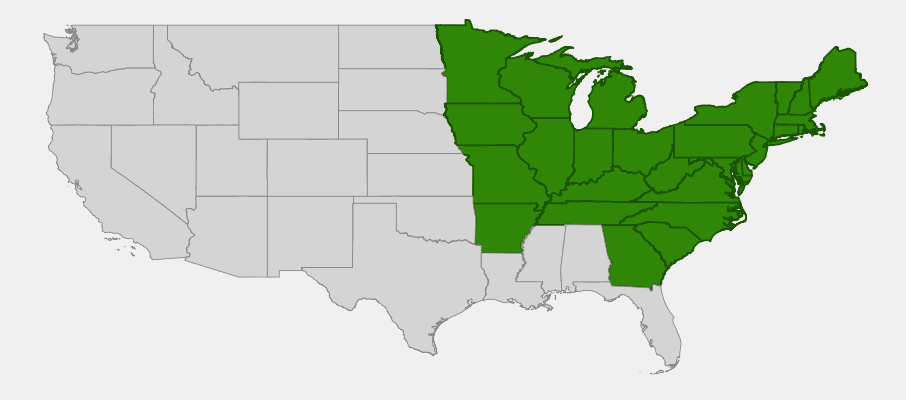
Heart-leaved Aster is native to the eastern deciduous forest region of North America, ranging from Nova Scotia and Quebec south to Georgia and Alabama, and west to Minnesota, Iowa, Missouri, and Arkansas. It is most abundant in the central Appalachians and the northern hardwood forest region, occurring from near sea level to over 5,000 feet elevation in the southern Appalachian highlands.
In New York, Pennsylvania, and New Jersey, Heart-leaved Aster is a common woodland wildflower, found in open deciduous forests, woodland edges, roadsides through forested areas, and disturbed woodland openings. It shows a preference for mesic (moderately moist) soils but can tolerate both drier and moister conditions. The species is particularly common in the oak-hickory and mixed mesophytic forest types that characterize much of the tri-state region.
Heart-leaved Aster typically grows in partial to full shade, though it flowers more profusely in woodland edges with more light. In deep forest, it may grow more vigorously as a foliage plant with fewer flowers. The plants often grow in loose colonies formed by rhizomes and seedlings, creating drifts of autumn color that can be strikingly beautiful in a naturalistic woodland setting.
📋 Regional plant lists featuring Heart-leaved Aster: New York, Pennsylvania & New Jersey
Growing & Care Guide
Heart-leaved Aster is one of the best-behaved and most reliable native plants for woodland gardens and shaded borders. Once established, it asks for little beyond adequate moisture and reasonable light.
Light
Heart-leaved Aster performs well in a wide range of light conditions, from full sun to part shade. In full sun with adequate moisture, it blooms profusely and grows compactly. In part shade — the dappled light of open deciduous woods — it grows more loosely and still flowers well. In deeper shade, foliage is lush but flowering is reduced. For the best balance of vigorous growth and prolific flowering in a garden setting, morning sun with afternoon shade is ideal.
Soil & Water
Heart-leaved Aster prefers moderately moist, well-drained soil with good organic content — conditions typical of a woodland floor. It tolerates both slightly drier and somewhat wetter conditions than the ideal. Heavy clay soils should be amended with compost to improve drainage. In garden settings, mulching with leaf litter (simulating the natural woodland floor) maintains soil moisture and temperature, suppresses weeds, and enriches soil as it decomposes. Water new plantings regularly during the first season; established plants typically need only supplemental watering during extended dry spells.
Planting Tips
Plant in spring or fall in a location with dappled light and organically rich soil. Space plants 18–24 inches apart in groups of 3–5 or more for the best visual effect. Heart-leaved Aster self-seeds readily where happy; if you prefer a tighter, more controlled colony, deadhead after flowering to reduce seedling spread. In naturalistic plantings, allow it to self-seed and spread — the resulting drifts of autumn-blue flowers are one of the most beautiful effects in the native shade garden.
Pruning & Maintenance
Cut stems back to 6–8 inches in late winter or early spring to remove old growth and encourage fresh, compact new shoots. Some gardeners cut the plants back by half in late June to promote more compact, multi-branched growth and delay bloom time slightly. Heart-leaved Aster is resistant to most pests and diseases. Some powdery mildew may occur in very humid conditions with poor air circulation — maintain good spacing to minimize this.
Landscape Uses
- Woodland garden — essential for autumn bloom in the shade
- Naturalistic shade borders under deciduous trees
- Pollinator gardens providing critical late-season nectar
- Native plant meadow edges and transition zones
- Riparian and moist woodland restoration plantings
- Mass planting for dramatic autumn blue-violet sweeps of color
- Cut flower garden — attractive as fresh-cut or dried arrangements
Wildlife & Ecological Value
Heart-leaved Aster is one of the most ecologically significant late-season wildflowers in the eastern forest region. Its timing — blooming when most other native plants have finished — makes it uniquely critical to autumn-migrating insects and birds.
For Birds
The mature seed heads of Heart-leaved Aster attract American Goldfinches, Dark-eyed Juncos, and various sparrow species in autumn and winter. The seeds are small and abundant, providing high-energy food for granivorous birds during the critical fall migration period. The stems and leaves support numerous caterpillars and other insects that become food for migrating warblers and thrushes during fall migration.
For Mammals
White-tailed Deer browse Heart-leaved Aster foliage, which can be challenging in high deer-pressure areas. Rabbits may also consume the foliage. In areas with significant deer browsing, it may be necessary to protect young plants until they are established. The root system is vigorous enough that plants usually recover from deer browse and resprout the following season.
For Pollinators
This is where Heart-leaved Aster truly shines. As a late-season bloomer, it provides nectar at a time when most other wildflowers have finished and pollinators face a critical food shortage before winter. Monarch butterflies stopping to fuel their southward migration depend on native asters for nectar. Specialist bees in the genus Andrena (particularly Andrena hirticincta and related species) depend entirely on aster and goldenrod pollen to provision their late-season nests. Bumblebee queens feeding in autumn on aster nectar determine the success of next year’s colonies. The ecological importance of this late-season bloom cannot be overstated.
Ecosystem Role
Heart-leaved Aster is a key component of the eastern deciduous forest understory plant community. Along with goldenrods and other native asters, it forms the critical autumn component of the wildflower succession from spring ephemerals through summer bloomers. Its presence in woodland gardens and natural areas extends the season of ecological productivity into late autumn, supporting the complex web of insects, birds, and mammals that depend on late-season resources.
Cultural & Historical Uses
Native asters, including Heart-leaved Aster, were used medicinally and ceremonially by many Indigenous peoples of the eastern woodlands. The Cherokee used preparations from Aster species as “smoked medicine” during ceremonies and medicinally to treat fevers and respiratory conditions. The Iroquois used various aster species as hunting medicine — the roots or smoke was believed to attract deer and game when hunters were present. The Ojibwe used aster species in steam baths to treat headaches and fever, and as a ceremonial plant in various traditions.
The common name “aster” comes from the Greek word for “star,” referring to the star-like appearance of the flower head. The genus Symphyotrichum — to which Heart-leaved Aster was reclassified from Aster in the late 20th century following molecular phylogenetic studies — is entirely North American, while the true Old World genus Aster is primarily Eurasian. This reclassification reflects the deep evolutionary distinctness of North American asters from their Eurasian relatives, despite their superficial similarity.
In folk medicine traditions of European settlers in North America, native asters were incorporated into remedies for a variety of conditions, reflecting both the practical knowledge transferred from Indigenous healers and the European humoral medical tradition’s interest in plants with similar appearances to known European medicinal species. Today, Heart-leaved Aster is primarily celebrated as an ornamental plant and ecological resource, though research continues into the phytochemical properties of various Symphyotrichum species.
Frequently Asked Questions
What is the difference between Aster cordifolius and Symphyotrichum cordifolium?
They are the same plant — Aster cordifolius is the older name, while Symphyotrichum cordifolium is the current accepted scientific name following a revision of the genus Aster in the 1990s based on DNA analysis. The genus Symphyotrichum contains most of the North American native asters.
Will Heart-leaved Aster spread aggressively?
It spreads moderately through rhizomes and self-seeding, eventually forming loose colonies. This is desirable in naturalistic plantings. If you want to limit spread, deadhead the flowers before seeds mature, and divide clumps every 2–3 years to keep them in bounds.
Can Heart-leaved Aster grow in deep shade?
It can survive in deep shade but will bloom less. For best flowering, provide at least a few hours of direct sun or consistent dappled light. Morning sun with afternoon shade is the ideal combination in the garden.
Is Heart-leaved Aster deer resistant?
No — deer browse it readily. In high-pressure deer areas, protect young plants with fencing or repellent spray in the first 1–2 seasons. Established plants usually recover from deer browsing and resprout vigorously.
When should I divide Heart-leaved Aster?
Divide in early spring as new growth emerges, or in early fall after flowering. Dig up clumps and separate into sections with healthy roots and shoots. Replant divisions immediately and water well. Division every 3–4 years keeps plants vigorous and prevents overcrowding.

Looking for a nursery that carries Heart-leaved Aster?
Browse our native plant nursery directory: New York · Pennsylvania