Heart-leaved Penstemon (Keckiella cordifolia)
Keckiella cordifolia, commonly called heart-leaved penstemon or heartleaf keckiella, is a sprawling, semi-woody evergreen shrub native to the chaparral and coastal sage scrub of Southern California. A member of the Plantaginaceae (plantain family) — it was split off from the genus Penstemon decades ago, though the old common name has stuck — it is one of the most reliable hummingbird plants in the southern California garden. Rather than standing upright like most of its penstemon relatives, heart-leaved penstemon scrambles and leans through the branches of neighboring shrubs, using them as a scaffold to lift its flowers into the light.
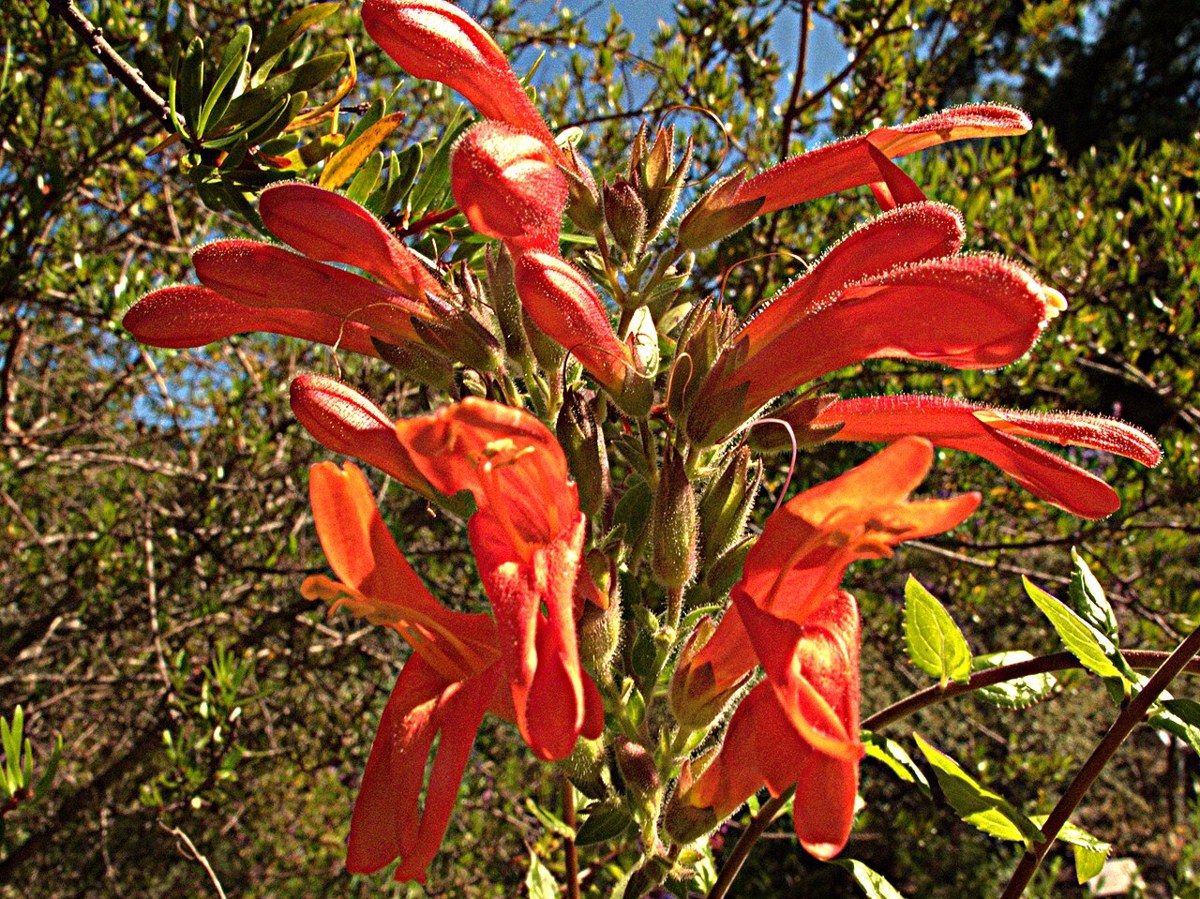
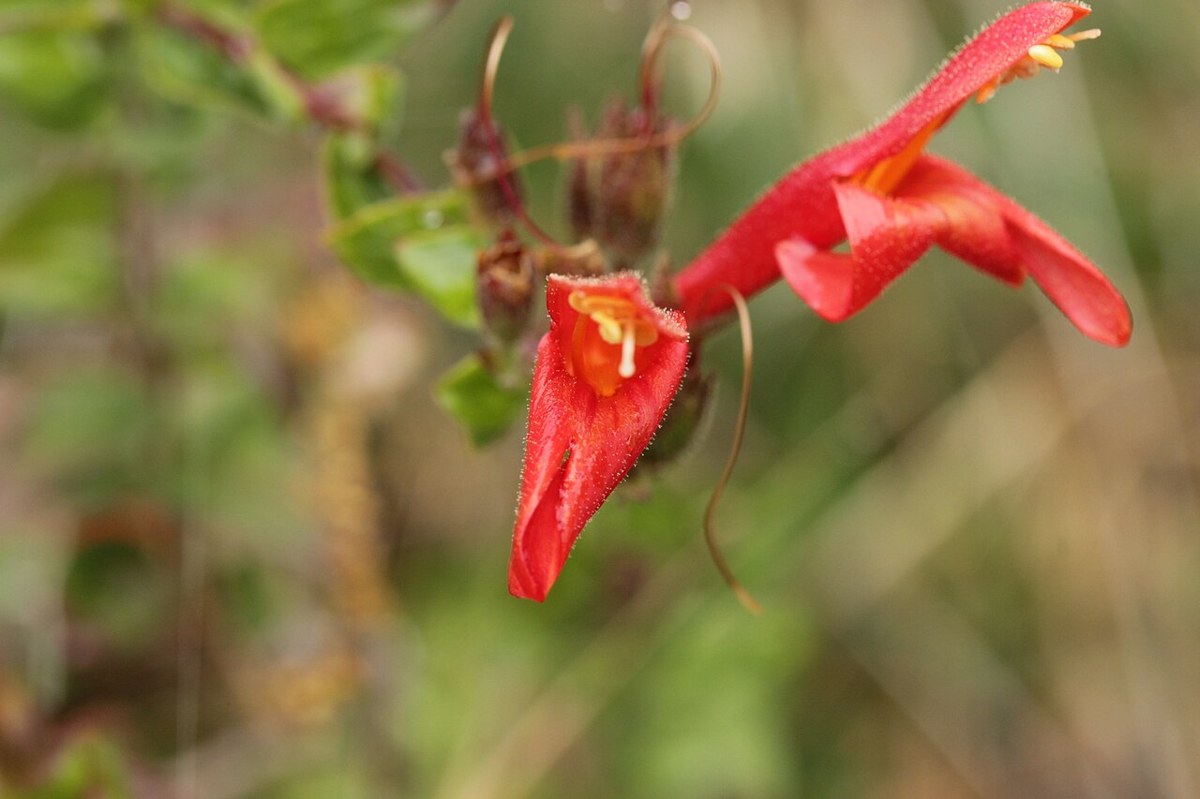
The plant earns its common name from its leaves: paired, coarsely toothed, and distinctly heart-shaped at the base, a feature that sets it apart from almost every other California chaparral shrub at a glance. From late spring into summer, the tips of its lax branches erupt in loose clusters of tubular, brick-red to orange-red flowers, each one lined inside with fine glandular hairs and shaped for a hummingbird’s bill. The resemblance to its close relatives in the genus Keckiella is obvious once you see the flower up close — the same narrow, two-lipped tube, the same exserted stamens dusted with pollen.
In the garden, heart-leaved penstemon is prized less for tidy form and more for toughness and wildlife value. It asks for almost nothing once established — no summer water, no fertilizer, no staking if you give it something to lean on — and in return it draws Anna’s and Allen’s hummingbirds through much of the warm season. It is best used the way nature uses it: tucked at the base of a larger shrub, where its scrambling habit becomes an asset rather than a problem to manage.
Identification
Heart-leaved penstemon is an evergreen, semi-woody shrub with long, lax, somewhat vine-like stems that typically sprawl 3 to 6 feet across but can scramble upward 10 feet or more through the branches of supporting shrubs such as chamise or scrub oak. Without support, it forms a loose, mounding tangle closer to the ground. The stems are slender, often reddish, and become woody toward the base with age.
Leaves
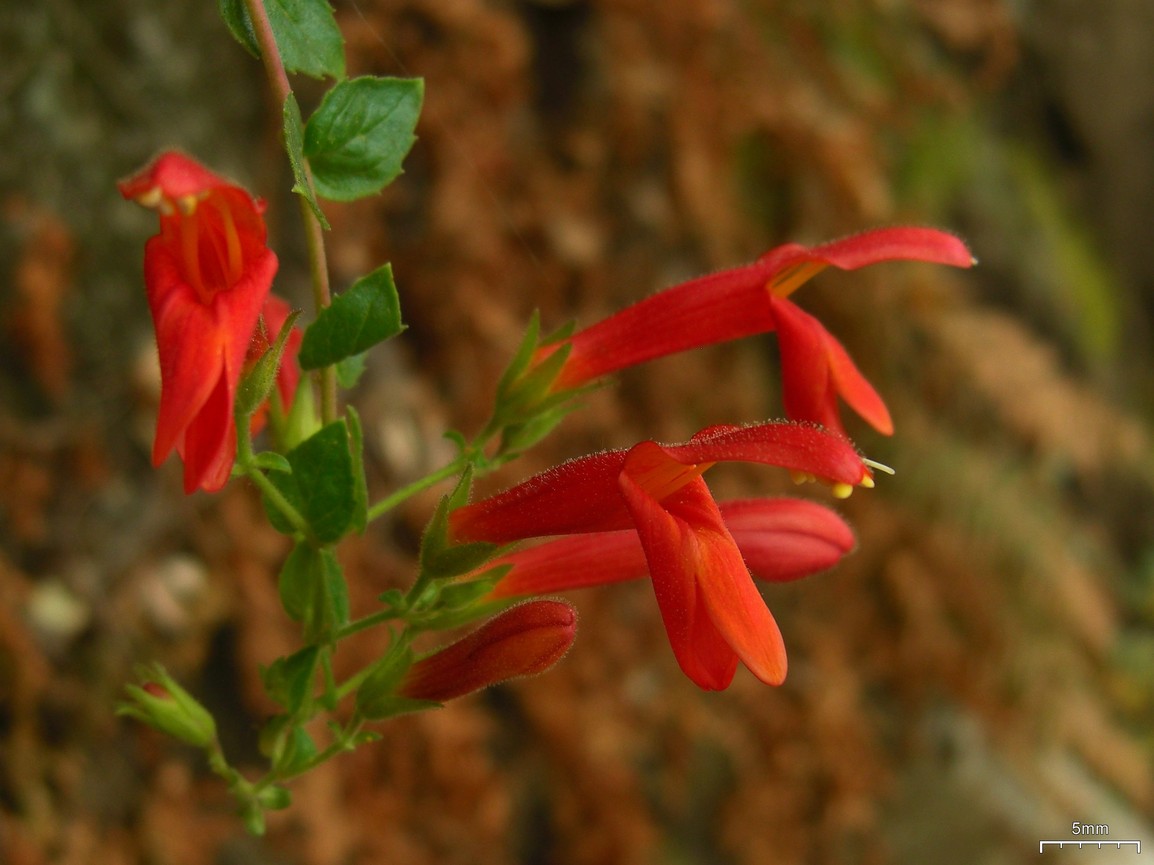
Leaves are opposite, simple, and ovate to heart-shaped (cordate), 1 to 3 inches long, with coarsely toothed or scalloped margins and a short petiole. The upper surface is dull to glossy green and mostly hairless; the base of the blade is distinctly notched where it meets the stem, the feature that gives the plant both its common name and one of the easiest field marks for distinguishing it from other chaparral shrubs with reddish, tubular flowers.
Flowers
Flowers are borne in loose, open clusters (cymes) toward the ends of the branches, each flower 1 to 1½ inches long, tubular and strongly two-lipped, in shades of brick-red to orange-red with a slightly paler, yellow-tinged throat. The outside of the tube is covered in fine glandular hairs that give it a slightly sticky texture. Four fertile stamens and one sterile, bearded staminode (the “beardtongue” of the common names used across the genus) sit inside the tube. Bloom runs from April into August, peaking in late spring, and individual plants often continue producing a trickle of flowers into early fall in mild years.
Fruit & Seeds
After pollination, flowers give way to small, woody, two-chambered capsules that split open at maturity to release numerous tiny seeds. The capsules are inconspicuous and persist on the plant through much of the dry season.
Quick Facts
| Scientific Name | Keckiella cordifolia |
| Family | Plantaginaceae (Plantain) |
| Plant Type | Evergreen, scrambling shrub |
| Mature Height | 3–6 ft mounding; to 10+ ft scrambling through host shrubs |
| Mature Spread | 3–6 ft |
| Growth Rate | Moderate to fast |
| Sun Exposure | Part Shade to Full Sun |
| Water Needs | Low once established |
| Soil Type | Well-drained; rocky, sandy or clay-loam |
| Soil pH | 6.0–7.5 (slightly acidic to neutral) |
| Bloom Time | April – August |
| Flower Color | Brick-red to orange-red |
| Fall Color | None (evergreen) |
| Fruit | Small woody capsules (inconspicuous) |
| Deer Resistant | Yes (generally unbrowsed) |
| USDA Hardiness Zones | 8–10 |
Native Range
Heart-leaved penstemon is native to Southern California, where county-level herbarium and survey records confirm it from the South Coast and Transverse Ranges south through San Diego County, with its range continuing into northern Baja California, Mexico. It is most frequent in the coastal and inland foothill counties of the Los Angeles Basin and San Diego area, generally below about 4,500 feet elevation.
Within this range it grows in chaparral and coastal sage scrub, usually on slopes and in canyons where it can lean into chamise, scrub oak, laurel sumac, or other shrubs for support. It also turns up along streamside thickets and the brushy margins of oak woodland, almost always in well-drained, rocky or gravelly soil.
Heart-leaved penstemon is not recorded as native outside California in the United States; plants offered under this name in nurseries elsewhere are garden-grown stock, not wild populations. Gardeners in true desert or high-elevation climates outside its native chaparral zone will find it far less at home than in coastal and inland Southern California gardens.
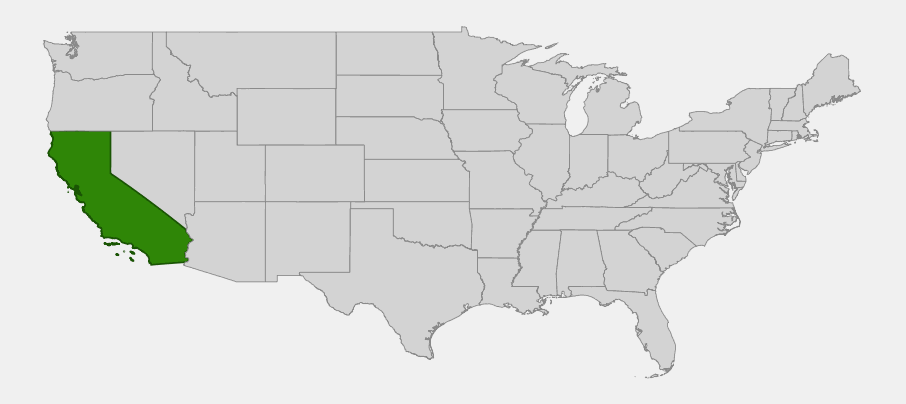
📋 Regional plant lists featuring Heart-leaved Penstemon: California & Nevada
Growing & Care Guide
Heart-leaved penstemon rewards gardeners who give it a little structure and then leave it alone. It is not a plant for a bare, open bed — it wants something to scramble through — but given that one condition, it is remarkably undemanding and long-lived.
Light
It performs best in full sun along the coast and in part shade (especially afternoon shade) in hotter inland and valley gardens. In too much shade it blooms sparsely and grows leggy; in intense inland summer sun without any relief it can scorch, so a position with high, open shade from a taller shrub or tree often suits it best.
Soil & Water
Good drainage matters more than soil type — heart-leaved penstemon tolerates sandy, rocky, or clay-loam soils as long as water does not pool around the roots. Established plants need little to no supplemental water during the dry California summer; a deep soak once or twice a month during the first year or two of establishment is usually enough, tapering off as the plant matures. Overwatering in summer is the most common way to lose this plant.
Planting Tips
Plant from containers in fall, when cooling temperatures and winter rain give roots time to establish before the dry season. Site it at the base of an existing shrub — chamise, toyon, or a large manzanita all work well — so the lax stems have something to climb through. Without support, simply allow it to mound and spread as a loose groundcover on a slope.
Pruning & Maintenance
Little pruning is needed. After the main bloom flush, lightly shearing spent flowering stems can tidy the plant and encourage a second round of flowers. Older plants can be cut back by up to a third in late winter to renew vigor, since the base does become woody and can thin out with age. Avoid heavy pruning during the heat of summer.
Landscape Uses
- Hummingbird gardens — one of the most reliable nectar sources in chaparral plantings
- Slope stabilization on dry banks, used as a sprawling groundcover
- Understory accent scrambling through larger native shrubs
- Chaparral restoration and fire-wise native landscaping
- Dry, low-water borders paired with other summer-dormant or evergreen natives
Wildlife & Ecological Value
Heart-leaved penstemon is a genuine wildlife magnet within its chaparral habitat, offering nectar during a long bloom window when many other shrubs have already finished flowering for the year.
For Pollinators
The long, narrow, glandular-hairy corolla is shaped for hummingbird pollination, though large-bodied native bees and carpenter bees will also work the flowers, sometimes by piercing the base of the tube to reach nectar they cannot access through the front opening.
For Birds
Anna’s and Allen’s hummingbirds are the primary visitors and the main pollinators, drawn to the abundant red flowers through spring and summer when few other chaparral shrubs are still blooming. The tangled growth habit also offers cover for small songbirds moving through brushy slopes.
For Mammals
The foliage is not a preferred browse for deer, which is part of why the species holds up well in chaparral gardens even where deer pressure is high.
Ecosystem Role
By scrambling through larger shrubs rather than competing with them directly for space, heart-leaved penstemon adds a nectar-rich layer to chaparral without displacing the structural shrubs it depends on, helping extend the overall flowering season of the plant community into the heat of summer.
Cultural & Historical Uses
Heart-leaved penstemon has not been documented as a significant food, fiber, or medicinal plant among California’s Indigenous peoples in the way that many of its chaparral neighbors were; it appears primarily in historical botanical records as a conspicuous, easily recognized component of the Southern California chaparral flora, noted for its distinctive leaf shape and showy flowers.
Its modern significance is largely horticultural. As California native plant gardening gained momentum in the second half of the 20th century, heart-leaved penstemon became a favorite among growers specializing in chaparral and coastal sage scrub species, valued specifically for its reliable hummingbird visitation and its usefulness for softening the base of larger evergreen shrubs in a garden setting.
The genus name Keckiella honors the American botanist David Daniels Keck, who studied California’s flora extensively in the twentieth century; the species was formerly classified within Penstemon, which is why “penstemon” persists in the common name even though taxonomists have since placed it in its own genus.
Frequently Asked Questions
Is heart-leaved penstemon the same as a true Penstemon?
No. It was once classified in the genus Penstemon and the old common name stuck, but botanists now place it in the separate genus Keckiella based on differences in flower and seed structure. It remains closely related and visually similar to true penstemons.
Does heart-leaved penstemon need something to climb?
Not strictly, but it looks and performs best with support. Left on open ground it forms a loose, sprawling mound; planted near a larger shrub it will scramble upward through the branches and display its flowers more prominently.
How much water does it need in a garden setting?
Very little once established — occasional deep watering during the first one to two years, then essentially none through a typical California dry season. It is one of the more drought-tolerant chaparral natives available in the nursery trade.
Will heart-leaved penstemon attract hummingbirds?
Yes, reliably. Its long bloom period from spring into late summer makes it one of the more dependable nectar sources for Anna’s and Allen’s hummingbirds in a Southern California native garden.
Can it be grown outside California?
It is only native to California (and adjacent Baja California), and performs best in a Mediterranean climate with dry summers and mild, wet winters. Gardeners in climates with humid or freezing winters typically have little success with it.

Looking for a nursery that carries Heart-leaved Penstemon?
Browse our native plant nursery directory: California