ʻIliahi (Santalum freycinetianum)
ʻIliahi (Santalum freycinetianum) is a Hawaiian sandalwood with an unusual requirement for the garden: it belongs in a planting community, not as an isolated tree in an otherwise empty bed. Its roots form connections with host plants that supply part of its needs. The tree has green leaves and photosynthesizes, so it is described as a root hemiparasite rather than a plant wholly dependent on a host for all its food.
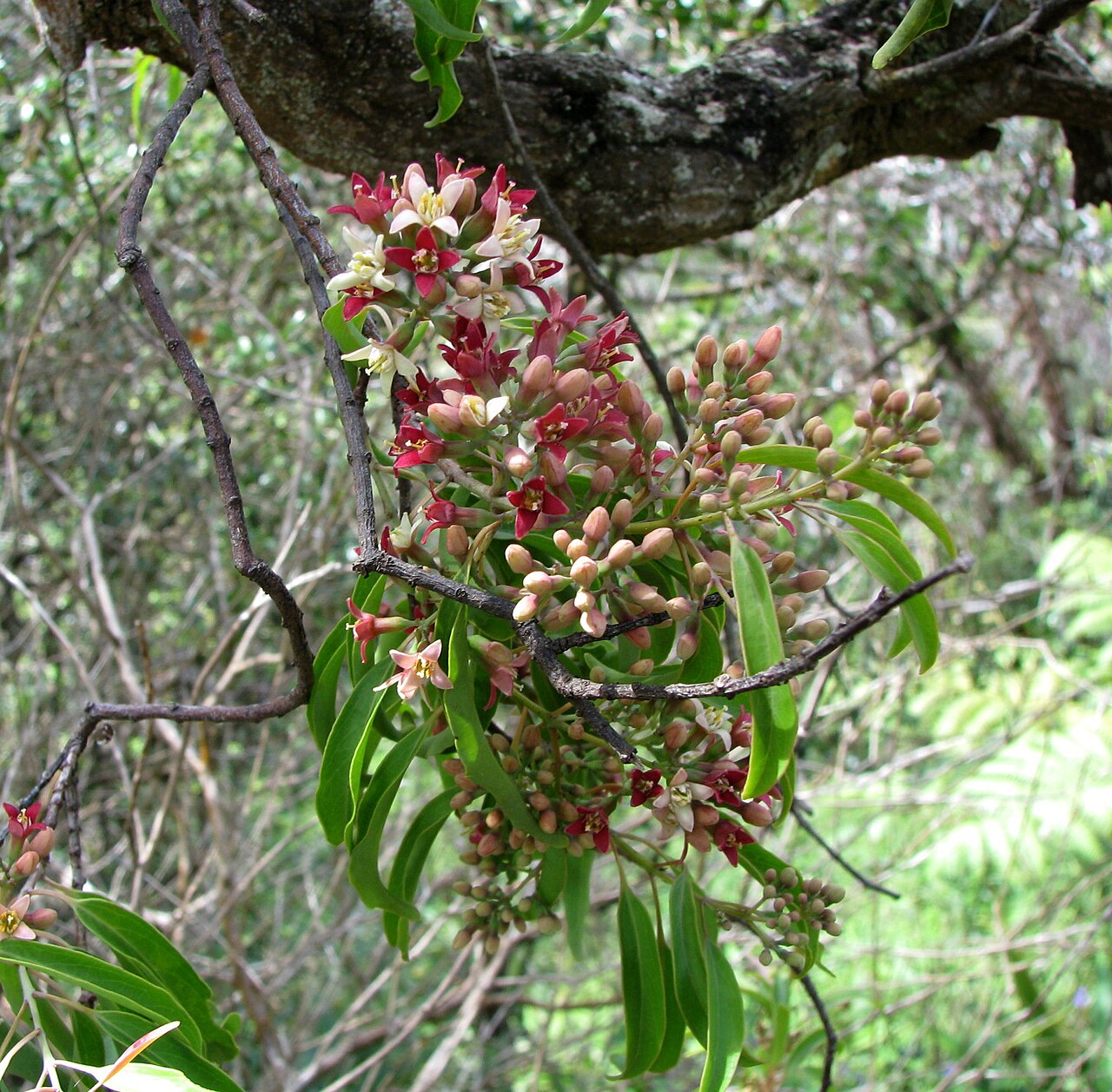
Several Hawaiian sandalwoods share the name ʻiliahi. This page follows the University of Hawaiʻi treatment of S. freycinetianum as the Oʻahu species, rather than using an older, broader grouping that included taxa from other islands. The photographs are documented from Oʻahu and illustrate that particular identity.
ʻIliahi can form a handsome shrub or tree, with clusters of small flowers and dark fruits. Its aromatic heartwood has made sandalwood famous, but a young living tree should be valued for its place in the landscape rather than treated as a source of fragrance to harvest. Plant with an appropriate host, good drainage, and space for the association to persist.
Identification
Bark & Stems
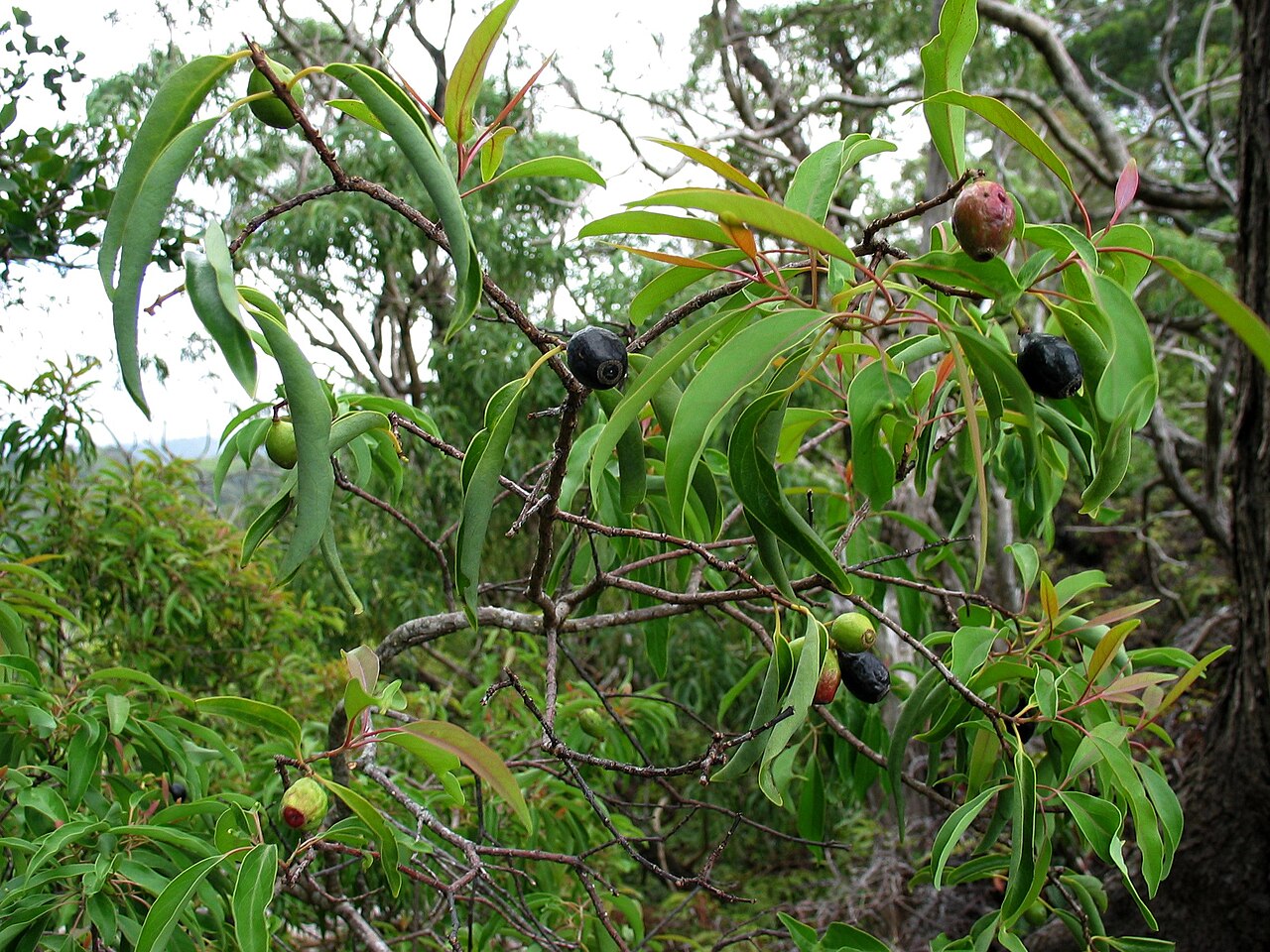
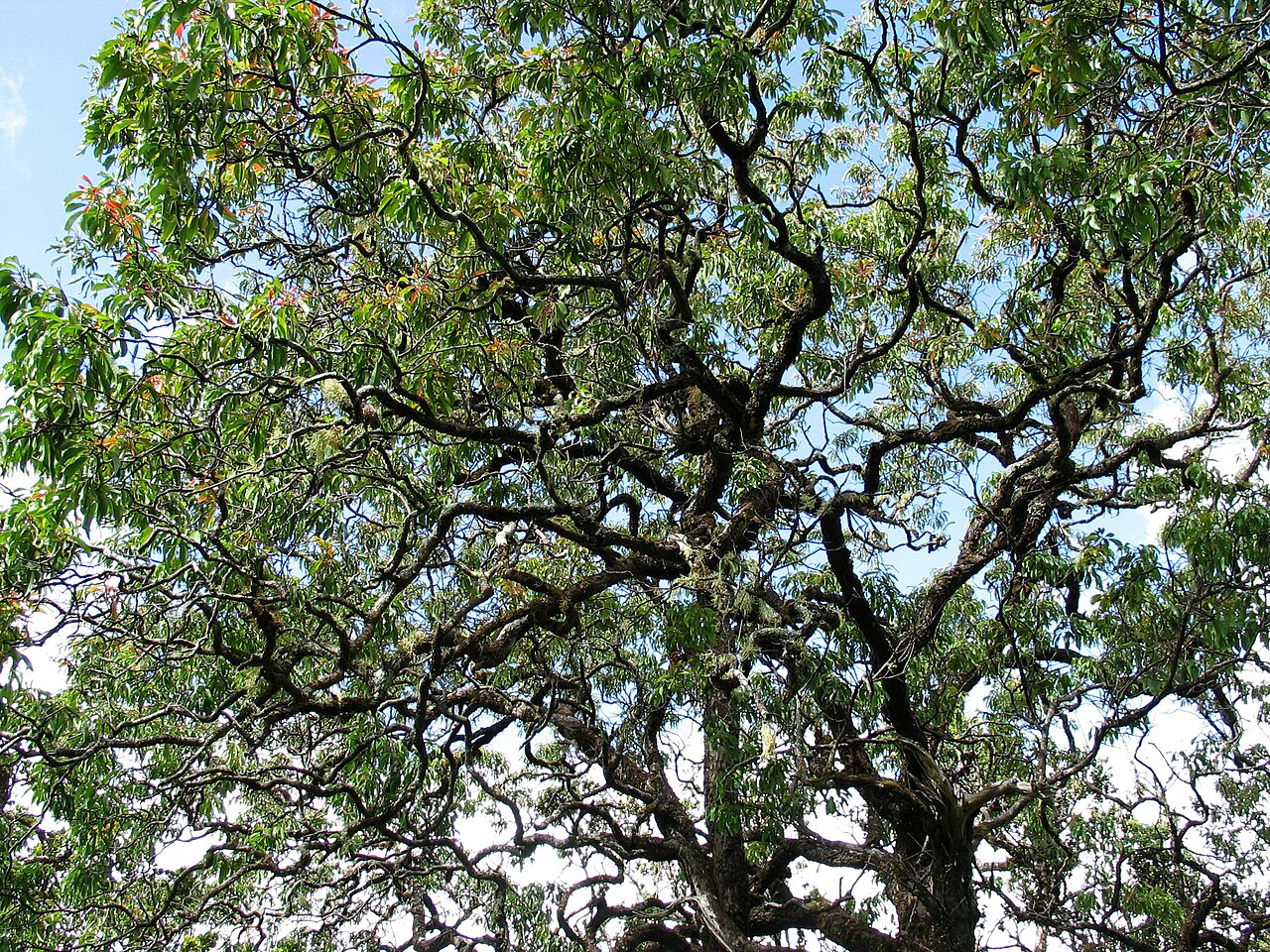
Growth form is variable, from relatively small, branching plants to trees with a substantial crown. The selected canopy photograph shows an older Oʻahu tree rather than promising that every nursery plant will take the same form. Bark and wood should not be cut to “test” for sandalwood scent; identification should use living botanical characters and documented provenance.
Leaves
Leaves occur in opposite pairs and vary noticeably in size and outline. Narrow-leaved forms occur alongside more typical foliage. A photograph of narrow leaves is therefore not sufficient reason to assign a different species, but neither should every narrow-leaved Hawaiian sandalwood be assumed to be S. freycinetianum.
Flowers
Small flowers occur in clusters near shoot ends. Pinkish, reddish, and pale tones can occur as buds open and age. Their scent is not always strong; the celebrated sandalwood fragrance is chiefly associated with mature heartwood, not a guarantee that a garden tree will perfume the surroundings continuously.
Fruit & Seeds
Fruits are fleshy drupes that become reddish to dark purple as they mature. A fruit photograph is helpful when comparing Hawaiian sandalwoods, but species determination should include flowers, foliage, and source. Keep seed collections labeled by parent and locality instead of combining material from several taxa under the shared common name.
Quick Facts
| Scientific Name | Santalum freycinetianum |
| Family | Santalaceae |
| Plant Type | Evergreen native tree |
| Mature Height | 15–40 ft; shrub forms also occur |
| Mature Spread | Usually 10–20 ft; can be wider |
| Growth Rate | Slow; depends on site and host relationships |
| Sun Exposure | Full sun to partial sun |
| Water Needs | Average moisture; established plants may need little supplementary water outside drought |
| Soil Type | Well-drained, site-appropriate soils; protect roots from compaction |
| Soil pH | Assess actual soil and local nursery performance; do not amend routinely |
| Bloom Time | Seasonal to sporadic; timing varies with source and conditions |
| Flower Color | Small pink, reddish, or pale flowers |
| Fall Color | Evergreen; new growth may provide seasonal contrast |
| Fruit | Reddish to dark-purple drupes |
| Deer Resistant | Protect young plants from introduced browsing animals |
| USDA Hardiness Zones | Hawaiian tropical to subtropical sites; match island, elevation, and exposure |
Native Range
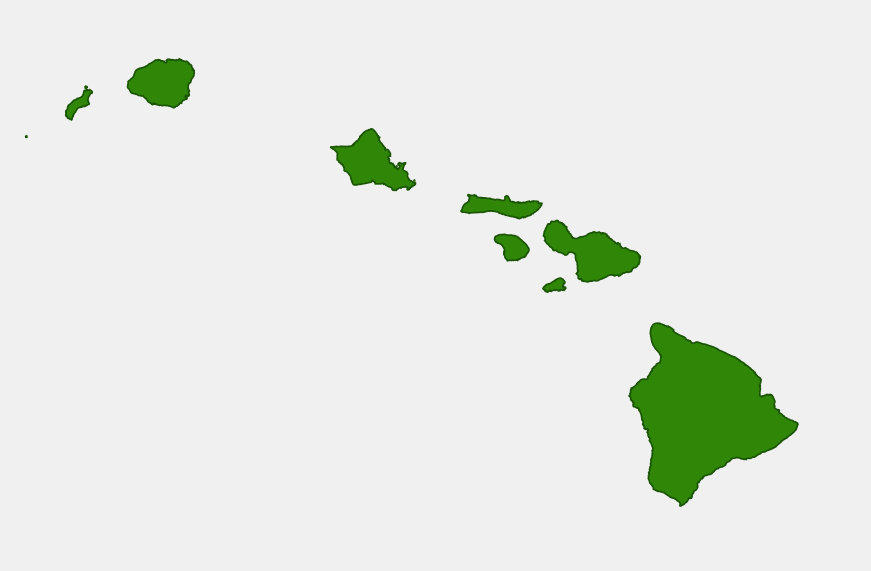
Under the University of Hawaiʻi profile’s current treatment, Santalum freycinetianum is endemic to Oʻahu, occurring in mesic-to-dry forest. Older books and labels may use this name more broadly. When a source refers to a different island, check whether it is using an older varietal classification or discussing another Hawaiian sandalwood.
Hawaiʻi’s sandalwoods are native plants, not merely introduced perfume trees. Their local histories and habitat relationships matter when choosing stock. For an Oʻahu restoration project, a generic label reading “Hawaiian sandalwood” is not enough: the project needs the correct taxon and an appropriate source.
The map indicates the native U.S. state, Hawaiʻi, and is not a claim that this species occurs naturally on every island shown. The written island range is the more precise guide. Cultivated trees outside that range should be identified as plantings rather than evidence of a natural population.
Native Range
| U.S. States | Hawaii |
| Hawaiian Islands | Oʻahu under the UH profile’s current species treatment |
| Mexico / Canadian Provinces | Not included in the verified native range used here |
| Ecoregion | Hawaiian tropical forest and woodland |
| Elevation Range | Lowland to upland forest; match local source |
| Habitat | Mesic to dry forest on Oʻahu |
| Common Associates | Locally appropriate native trees and understory matched to the same habitat |
USDA PLANTS profile (SAFR4). Species identity verified; this link is not a guarantee of county-level distribution data.
📋 Explore the Hawaii native plant list for other trees and potential companion plants suited to your site.
Growing & Care Guide
Light
ʻIliahi can grow in full or partial sun, with young plants benefiting from an appropriate transition out of nursery conditions. Once the root association and new growth are established, the plant can cope with a brighter position. Avoid letting a faster-growing neighbor overtop the sandalwood completely in the mistaken belief that any host relationship is beneficial regardless of light.
Soil & Water
Provide moisture during establishment and excellent drainage. Established plants may need little extra irrigation except during drought, but the host and sandalwood must both remain healthy. Do not set a calendar for one plant while ignoring the other member of the association.
Waterlogging is unsuitable. A bed that holds runoff around the roots should be corrected before planting, not compensated for with extra fertilizer. Check moisture in the nursery root ball and adjacent soil, particularly when several plants with different root systems share the same irrigation zone.
Planting Tips
Ask a knowledgeable native nursery to supply the plant with an appropriate host arrangement or a clear plan for establishing one. Hawaiian horticultural guidance identifies trees such as koa, koaiʻa, and naio as possible hosts, but their eventual size and suitability must also fit the site. A tiny yard cannot accommodate an oversized host merely because it helps a sandalwood seedling.
Keep the root ball intact and plant at its established depth. Avoid repeatedly digging around the pair after planting. The useful root connections are below ground, so an apparently harmless change such as removing a neighboring plant can affect the sandalwood later.
Plan maintenance around the community. Mark which plants are intentional hosts so they are not removed as weeds by someone unfamiliar with the planting. At the same time, prevent unwanted vegetation from crowding the slower-growing ʻiliahi. Host management is a continuing design task, not a one-time instruction to plant two pots side by side.
Pruning & Maintenance
Use restrained pruning and pay close attention to surrounding vegetation. A healthy host that completely shades the sandalwood is not a successful long-term arrangement. Make gradual, informed adjustments rather than abruptly removing major neighboring roots or cutting down the only established host.
If growth declines, inspect the whole planting: irrigation, host condition, competition, and drainage may all be relevant. Feeding only the sandalwood does not correct a failed root association or a dying host. Retain planting records so that a nursery or extension specialist can understand what changed.
Propagation
Propagation should preserve the species and locality information from the start. Seed-grown sandalwoods require more planning than an ordinary isolated ornamental seedling because a suitable host relationship must be established. Obtain a method from a grower experienced with the particular taxon rather than applying generic “sandalwood” instructions from another region.
Keep seed collections from different Hawaiian species separate. A shared common name, similar fragrance, or superficial leaf resemblance is not evidence that material can be mixed for restoration. Nursery plants intended for a home garden should also retain enough provenance information to be identified accurately later.
Landscape Uses
- Native mixed planting: integrate ʻiliahi with a suitable host and compatible understory.
- Educational garden: demonstrate the difference between photosynthesis and partial dependence through root connections.
- Cultural landscape: interpret sandalwood’s significance without treating a young tree as a harvest crop.
- Local restoration: use the correct Oʻahu taxon and documented material within a managed project.
Wildlife & Ecological Value
For Pollinators
Flowers contribute to the resources available within a native planting. Observe local visitors and avoid spraying blooming shoots. The value of the planting is enhanced by a varied community rather than by treating one fragrant species as a complete pollinator garden.
For Birds
The fleshy drupes can be taken by birds, and the branches add habitat structure. In an altered landscape, fruit consumption may involve introduced birds as well as native ecological relationships. Do not use a fruiting photograph to imply that a particular endangered bird will visit a home garden.
For Mammals
Protect young trees and their hosts where browsing or trampling is possible. Damage to the host can affect the sandalwood even when its own stem is untouched. A protection plan should therefore cover the functioning planting rather than only one labeled trunk.
Ecosystem Role
ʻIliahi illustrates that forest plants are linked below ground as well as above it. Its hemiparasitic relationships are part of its biology, not a gardening defect to eliminate. Maintaining appropriate neighbors and soil conditions supports the species more effectively than isolating it in a weed-free circle with no host roots nearby.
Cultural & Historical Uses
The fragrant wood and bark of Hawaiian sandalwoods were valued for scenting materials, including kapa. Those uses belong within a wider cultural history of plants and craftsmanship. They should not be reduced to a suggestion that visitors cut or scrape a living tree to smell the wood.
The sandalwood trade had major consequences in Hawaiian history. Its demand for valuable heartwood provides an important contrast with present-day stewardship of living native plants. A cultural planting can acknowledge that history while emphasizing responsible propagation and habitat care.
Several species are called ʻiliahi, so a historical account of Hawaiian sandalwood does not automatically establish a use unique to S. freycinetianum. Keep that distinction explicit in interpretation, and involve knowledgeable practitioners when developing educational material.
Frequently Asked Questions
Does ʻiliahi need a host plant?
Yes, an appropriate root-host relationship is an important part of successful cultivation. Obtain a planting plan from a nursery experienced with Hawaiian sandalwoods.
Does it make its own food?
It has green leaves and photosynthesizes, while also obtaining part of its resources through host-root connections. That is why it is called a hemiparasite.
Is every Hawaiian sandalwood this species?
No. Several taxa share the name ʻiliahi. This account follows the Oʻahu species treatment used by the University of Hawaiʻi profile.
Will a young tree have strongly fragrant wood?
Do not expect mature heartwood qualities from a young garden plant, and do not cut the tree to test its scent. Value it as a living native tree.
Can I remove the nearby host after the tree grows?
Not casually. The established below-ground relationship matters, and changes should be planned with an experienced grower rather than made abruptly.
Sources & Further Reading
Botanical range, identification, and cultural information are based on these sources. Garden-management advice should be adapted to local soil, exposure, and nursery provenance.
Find Native Plants Near You
Look for correctly identified, nursery-propagated plants with documented Hawaiian provenance. Visit our Hawaii native plant nursery directory and ask about stock suited to your island, elevation, and rainfall.