Yellow Lady’s Slipper (Cypripedium parviflorum)
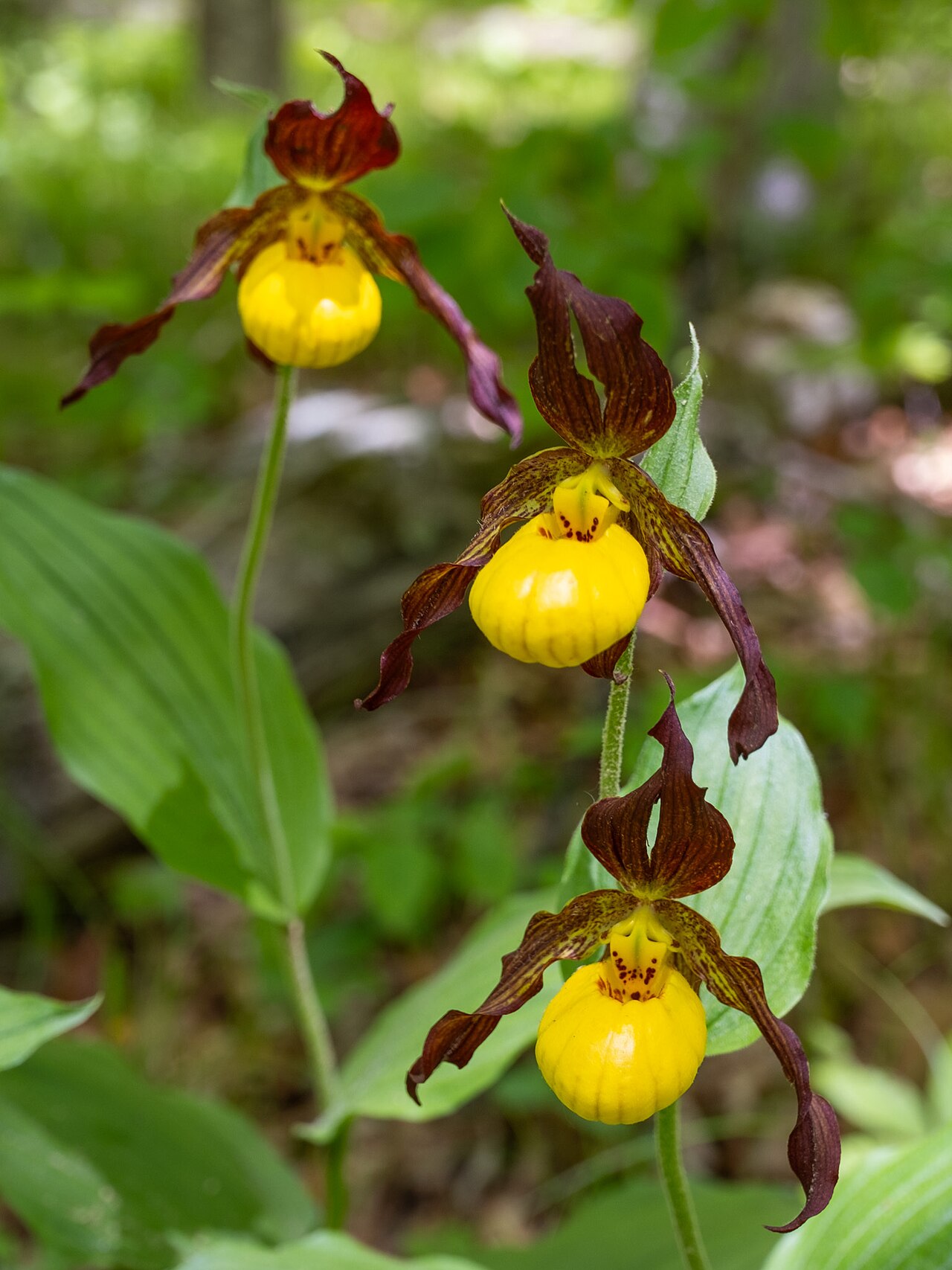
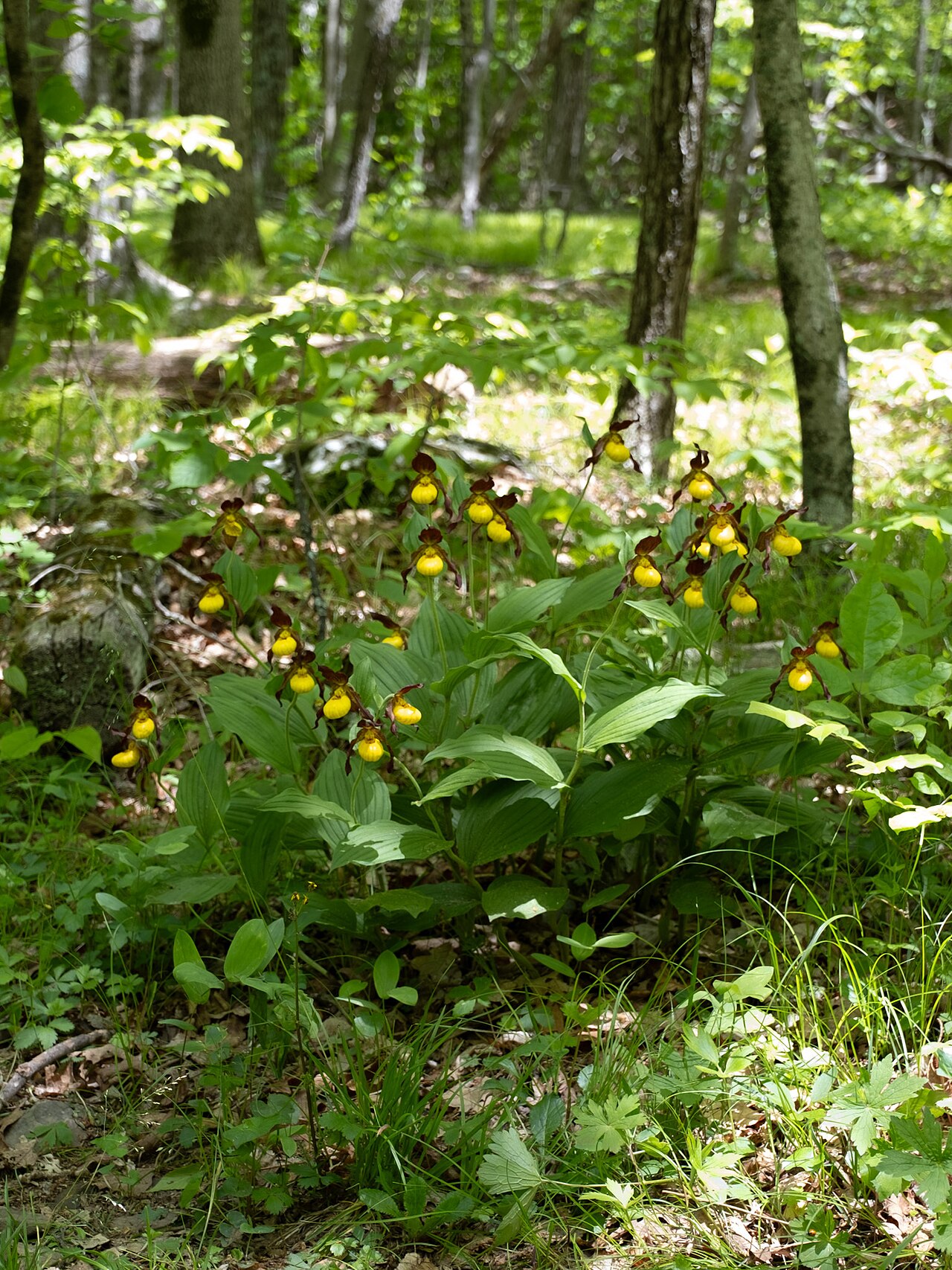
Yellow lady’s slipper (Cypripedium parviflorum) is a North American woodland orchid with a bright yellow pouch and long, often twisted side petals. Unlike pink lady’s slipper, it carries several conspicuously veined leaves along an upright stem. A flowering clump is a memorable feature of a native woodland garden, but it should begin with responsibly propagated stock, not plants dug from a wild population.
The species includes geographically and morphologically variable forms. Flower size, fragrance, hairiness, and habitat differ among varieties, so a single garden recipe cannot describe every population from Alaska to the eastern United States. The 18–24-inch height in the regional table is a useful typical value; larger plants may approach three feet.
Older North American references sometimes used Cypripedium calceolus broadly. The table’s old name has been corrected to C. parviflorum for the North American plant treated here. European lady’s slipper and nursery hybrids should not be substituted merely because they also have a yellow pouch.
Identification
Stems & Habit
The flowering stem is leafy and erect, with a terminal flower or sometimes more than one. This differs from the nearly leafless flowering stalk and two basal leaves of pink lady’s slipper. Established plants can develop into clumps, but growth is not comparable to a rapidly spreading ordinary groundcover.
The above-ground plant is seasonal. Mark a cultivated clump before it becomes dormant so later digging or mulching does not damage the underground growth. Absence of a flower in one season should not trigger immediate division or replanting; the plant’s condition must be assessed over time.
Leaves
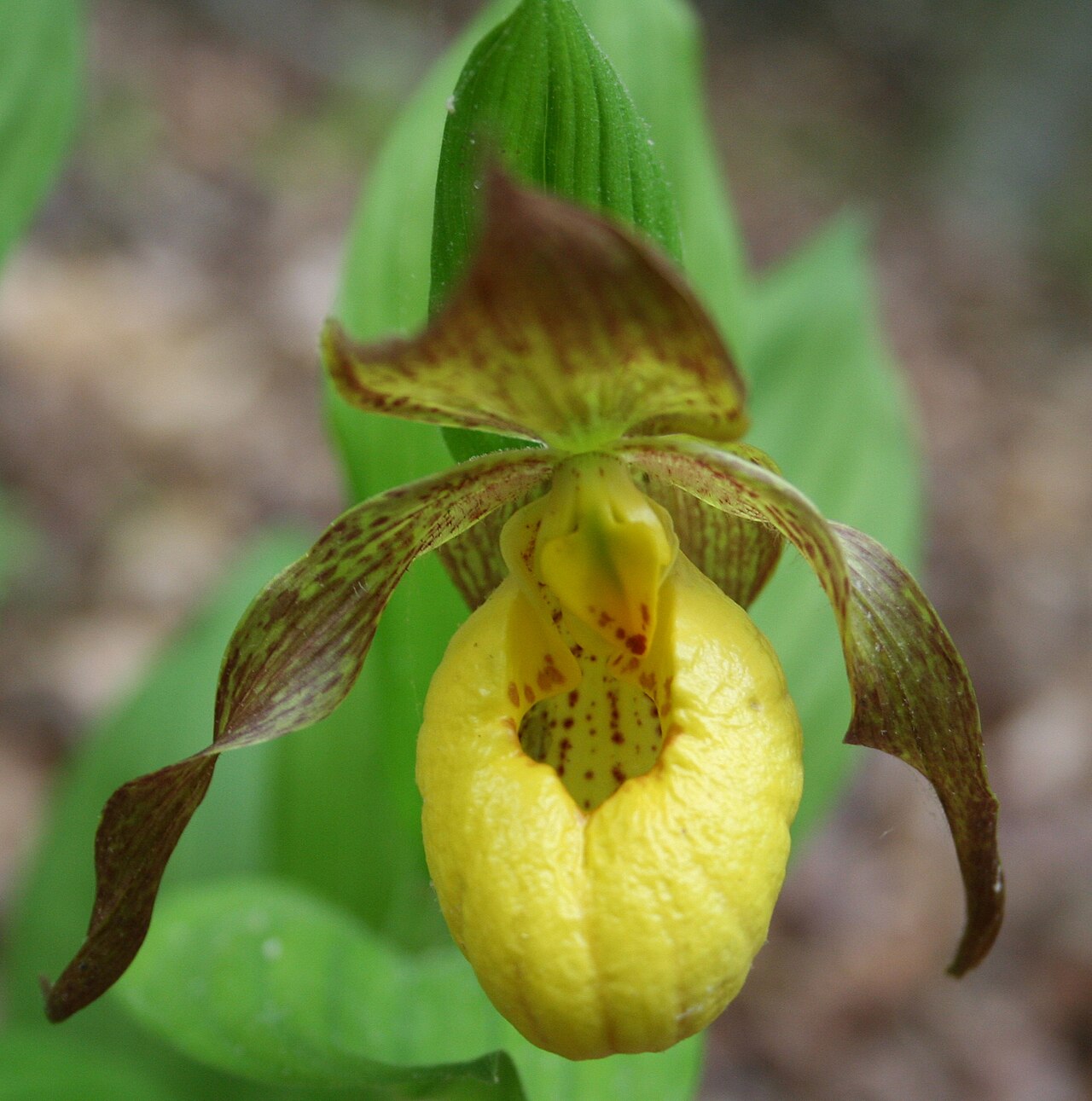
Leaves are broad, simple, and strongly veined, with a pleated appearance and varying amounts of hair. They sheath the stem rather than remaining as only a pair at ground level. Their arrangement is an important part of identification when comparing photographs or purchasing a nonflowering nursery plant.
Avoid handling foliage more than necessary. The Wildflower Center and NC State both note the potential for skin irritation associated with the plant’s hairs. Use gloves when working around cultivated plants, and leave wild specimens untouched for photography.
Flowers
The inflated yellow lip forms the familiar slipper. Darker spotting may be visible inside the opening. Long lateral petals can twist into narrow spirals, while a larger upper sepal arches above the pouch. Color outside the lip varies from greenish yellow to deep brown or burgundy, and should not be expected to match one reference photograph exactly.
Flowering usually falls in late spring to early summer, with a wider seasonal span across the entire North American range. Smaller-flowered and larger-flowered varieties are not interchangeable local ecotypes. If a nursery supplies a named variety, retain that information instead of reducing the label to a generic yellow orchid.
Fruit & Seeds
Pollinated flowers can develop seed capsules that eventually split and release very small seeds. A capsule does not make home propagation straightforward: orchid seed biology is different from that of common garden annuals. Keep seed collection within a lawful, documented propagation project rather than stripping capsules from a wild colony.
In a garden, leaving healthy stems and leaves after bloom allows the plant to finish its season. Do not cut a clump down simply because the attractive pouch has faded. Flowering, seed development, and underground growth are different parts of the annual cycle.
Quick Facts
| Scientific Name | Cypripedium parviflorum |
| Family | Orchidaceae (orchid family) |
| Plant Type | Herbaceous perennial woodland orchid |
| Mature Height | 18–24 inches in the regional list; larger plants can reach about 3 ft |
| Mature Spread | Expanding clump; allow space rather than crowding |
| Growth Rate | Slow; specialist cultivation |
| Sun Exposure | Partial shade / dappled sunlight |
| Water Needs | Moist, well-drained woodland soil |
| Soil Type | Organic-rich, well-drained soil appropriate to the variety |
| Soil pH | Variety and site dependent; do not apply pink lady’s slipper requirements universally |
| Bloom Time | Spring to early summer; timing varies with latitude |
| Flower Color | Yellow pouch; greenish to brown/burgundy other segments |
| Fall Color | Deciduous seasonal foliage |
| Fruit | Capsule with numerous minute seeds |
| Deer Resistant | No; deer damage is common |
| USDA Hardiness Zones | 3–8 in the NC State account; hardiness alone does not assure garden success |
Native Range
Yellow lady’s slipper has a broad North American distribution, including Alaska, much of Canada, and numerous states in the contiguous United States. The map here follows the U.S. list in the Wildflower Center account. It includes Alaska rather than cropping that part of the range out of the figure.
NC State provides a broader state list than the Wildflower Center, illustrating the need to distinguish a species-wide summary from local variety and occurrence records. The map is therefore identified with its source and is not presented as a complete county inventory. A regional native-plant decision should be checked against a current local flora.
The species occurs in forests, open meadows, and stream-associated sites, depending on variety and region. The Alabama and Georgia entries in the cited list support its inclusion in the combined regional guide, but that grouping does not establish every variety throughout Alabama, Georgia, and Mississippi. Local provenance and habitat fit remain important.
Native Range at a Glance
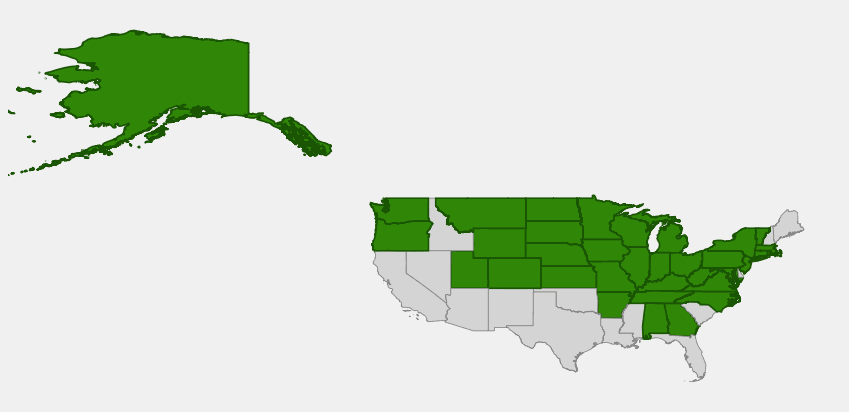
| U.S. States | AK, AL, AR, CO, CT, DC, GA, IA, IL, IN, KS, KY, MA, MD, MI, MN, MO, MT, NC, ND, NE, NJ, NY, OH, OR, PA, RI, SD, TN, UT, VA, VT, WA, WI, WV, WY |
| Canadian Provinces | Broad Canadian range; exact variety distribution should be checked locally |
| Ecoregion | North American woodland, meadow and stream-associated communities |
| Elevation Range | Varies across the continental range; no single numerical range adopted here |
| Habitat | Forests, open meadows and stream-associated sites, varying by variety |
| Common Associates | Locally appropriate woodland and meadow vegetation; community varies by variety |
| Range Source | Lady Bird Johnson Wildflower Center; USDA (County-Level Data) |
📋 Explore the Alabama, Georgia & Mississippi native plant list.
Growing & Care Guide
Light
Partial shade and dappled woodland light are the most useful garden recommendations. The regional table has been adjusted from part-to-full sun to partial shade, following the extension guidance. Some natural populations occupy more open settings, but those observations should not become a blanket recommendation for an exposed hot southern border.
Soil & Water
Choose moist, organic-rich soil with drainage. NC State describes spreading roots horizontally near the surface and covering them with an appropriate compost layer when planting cultivated stock. Follow the supplying specialist’s instructions for the particular variety, rather than burying a crown deeply as if it were a generic potted shrub.
Do not copy the very acidic-soil prescription for pink lady’s slipper onto all yellow lady’s slippers. These are different species, and the broad yellow complex includes different habitat associations. Ask about the source plant’s conditions and test the planting site before adding lime or acidifying material.
Keep moisture steady during establishment without creating a stagnant basin. The table’s average-moisture code is compatible with a moist, drained woodland bed, not a promise of drought tolerance. Avoid placing the plant where lawn irrigation, fertilizer, or herbicide routines dictate its care.
Planting Tips
Buy from a reputable specialist who can document propagation and identify the species or variety. A plant offered in flower may still have been recently dug, and an attractive bloom is not evidence of sustainable production. Ask direct provenance questions before selecting stock.
Choose the site before purchasing. Leave room for a clump and protect it from trampling, repeated digging, and aggressive neighboring groundcovers. Install it carefully at the recommended depth, retaining the root system without bending it into an unnecessarily small hole.
If an orchid already grows on your property, protect its existing setting instead of moving it to a more convenient viewing position. Alterations to canopy, drainage, or soil level can matter more than the apparent distance of a proposed move. A path placed beside the colony is safer than redesigning the colony around a path.
Pruning & Maintenance
No routine pruning is required. Leave healthy foliage until it finishes naturally, and avoid cutting flowering stems for indoor arrangements. Mark the position during dormancy and keep mulch from accumulating deeply over the crown.
Deer readily damage yellow lady’s slipper according to NC State. Where browsing is frequent, plan an appropriate protective barrier before the first flowering stem is lost. Position supports outside the root zone and ensure the barrier does not trap or shade the plant excessively.
Record flowering and leaf growth over several seasons. If a plant declines, review site conditions and contact the nursery or a knowledgeable orchid grower. Repeatedly lifting a stressed plant to inspect it can add further damage. Routine fertilizer escalation is not a diagnosis.
Propagation
NC State lists division as a garden propagation method for established cultivated plants. This should be done carefully, at an appropriate time, with adequate roots retained and guidance for the particular stock. It is not permission to divide wild colonies.
Seed propagation belongs with specialists familiar with orchid requirements. A packet containing many tiny seeds should not be represented as an easy substitute for a propagated plant. For conservation work, provenance, permissions, and appropriate expertise are as important as producing a seedling.
Landscape Uses
- A carefully maintained native woodland orchid collection using propagated plants.
- A small focal clump beside a shaded path, protected from trampling.
- An educational planting explaining orchid flowers, varieties, and conservation.
- Protection of an existing locally native population without changing its soil or drainage.
Wildlife & Ecological Value
For Pollinators
NC State identifies bees as pollinators. The flower’s pouch and narrow passages shape the route a visitor takes through it, making the orchid useful for observation and education. Do not disturb flowers to demonstrate the mechanism, and do not equate bee visitation with a claim of abundant nectar production.
For Birds
The plant is part of a larger woodland or meadow community rather than a major source of fleshy fruit or nesting structure. Conserving its surrounding vegetation and soil supports more ecological functions than focusing only on the conspicuous flower. Broader wildlife claims should be assigned to the habitat, not invented for the orchid alone.
For Mammals
Deer browsing is a practical concern and can remove both foliage and flowers. A cultivated collection may need exclusion rather than repeated replacement of damaged plants. The orchid is not offered here as food or medicine, and contact with its hairs can irritate human skin.
Ecosystem Role
Native orchids are part of the biological complexity of their local plant communities. A species-wide range map cannot capture the relationship between a particular population, its soil environment, and its neighbors. Keeping intact populations in place and supporting responsible propagation are more useful than treating every wild clump as potential garden stock.
Cultural & Historical Uses
The slipper-shaped lip is the source of the familiar name, while the twisting lateral petals have often been likened to ribbons. Those visual associations make the plant memorable, but the leafy stem and other structural characters are needed for identification.
Historical North American naming sometimes placed yellow lady’s slippers under a broader concept of Cypripedium calceolus. Modern nursery and botanical references commonly distinguish C. parviflorum and its varieties. Keeping both the current name and relevant older usage in a record helps prevent an unintended substitution.
Some historical sources describe medicinal uses of orchid roots. No such use is recommended here, and no preparation or dosage is provided. Root harvesting damages the plant, while a historical report is not evidence that a remedy is safe or effective. The modern garden value is the living orchid and the habitat it represents.
Frequently Asked Questions
Is yellow lady’s slipper easier than pink lady’s slipper?
NC State describes it as one of the more manageable garden orchids, but it remains a specialist perennial. Variety, provenance, moisture, drainage, and planting technique still matter. Easier does not mean suitable for every garden.
Why does the table no longer say Cypripedium calceolus?
That name has been used broadly in older references. The North American species intended here is treated as Cypripedium parviflorum, while the Eurasian plant and nursery hybrids should not be assumed equivalent.
Will deer leave it alone?
Do not rely on that. The extension account specifically notes deer damage. Protect cultivated plants where browsing pressure is high.
Can I divide a wild clump?
No. Use documented nursery-propagated stock. Division advice applies to established cultivated plants managed by their owner, not to collecting from natural populations.
Does every variety occur across the mapped states?
No. The map summarizes the species account, not the range of each variety. Consult a local flora and nursery provenance records when selecting material for a regional ecological planting.
Sources & Further Reading
- NC State Extension Plant Toolbox — Yellow Lady’s Slipper
- Lady Bird Johnson Wildflower Center — Cypripedium parviflorum
Find Native Plants Near You
Ask for nursery-propagated species stock. Browse native plant nurseries for Alabama, Georgia, and Mississippi.