
Jack Pine (Pinus banksiana)
Pinus banksiana, commonly known as Jack Pine, is a tough, tenacious native evergreen tree of the boreal forest and sandy barrens of northeastern and north-central North America. Among the hardiest pines on the continent, Jack Pine survives conditions that would kill most trees: acidic, nutrient-starved sandy soils; extreme winter cold (to Zone 2); intense summer heat on exposed sites; and frequent fire. Its iconic gnarled silhouette, often seen against the stark sky of a sandy plain or burned-over barrens, is one of the defining images of the boreal landscape.
Jack Pine holds a unique place in North American ecology as a fire-adapted pioneer species. Its serotinous cones — sealed shut with resin that only melts in intense heat — remain on the tree for years, waiting for wildfire before releasing their seeds onto the freshly cleared, ash-enriched soil. This fire-dependence has made Jack Pine a keystone species in fire-maintained ecosystems. It is the sole nesting tree for the Kirtland’s Warbler, a federally endangered songbird that requires young Jack Pine forest between 5 and 20 feet tall — one of the most specific habitat requirements of any North American bird.
For gardeners and land managers in New England, Jack Pine offers an excellent solution for the most challenging of sites: dry, sandy, infertile soils where other trees struggle. It makes an outstanding windbreak tree for coastal dunes and sandy outwash plains, provides year-round evergreen structure, and supports a range of wildlife in a habitat type — the pine barrens — that is increasingly rare and threatened across the Northeast. Its drought tolerance, sandy soil adaptability, and cold hardiness make it a valuable native tree for difficult conditions where standard landscape plants fail.
Identification
Jack Pine is a small to medium-sized evergreen tree, typically 30 to 70 feet (9–21 m) tall, though often shorter in the poorest sandy soils. The form is highly variable: in good growing conditions it develops a straight trunk and irregular, somewhat open crown; on exposed, dry, or fire-swept sites it becomes dramatically gnarled and twisted, with a broad, irregular crown. Even without cones or needles, the tree’s rugged, picturesque form is distinctive in the landscape.
Bark
The bark of young Jack Pine is reddish-brown to orange-brown, relatively thin, and scaly to slightly furrowed. On mature trees it becomes dark gray-brown to almost black, broken into small, irregular, scaly plates. The bark is notably thin compared to other pines — an adaptation to fire, where the fire kills the aboveground tree but leaves viable seeds in the serotinous cones. The bark has a slightly resinous odor, especially on warm days. The thin, reddish inner bark is visible where plates peel away, giving a layered, reptilian appearance to the trunk on older trees.
Needles
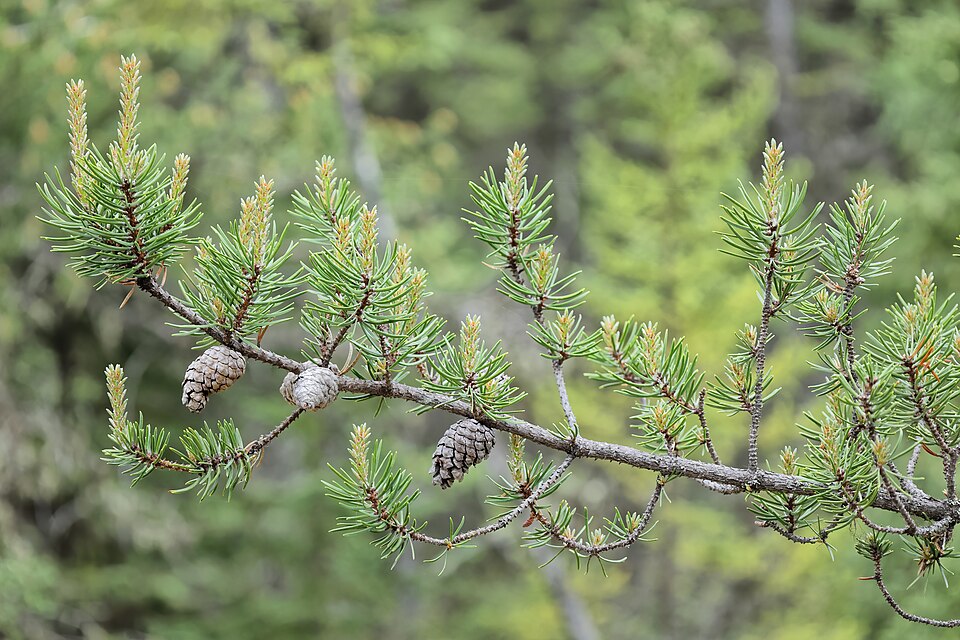
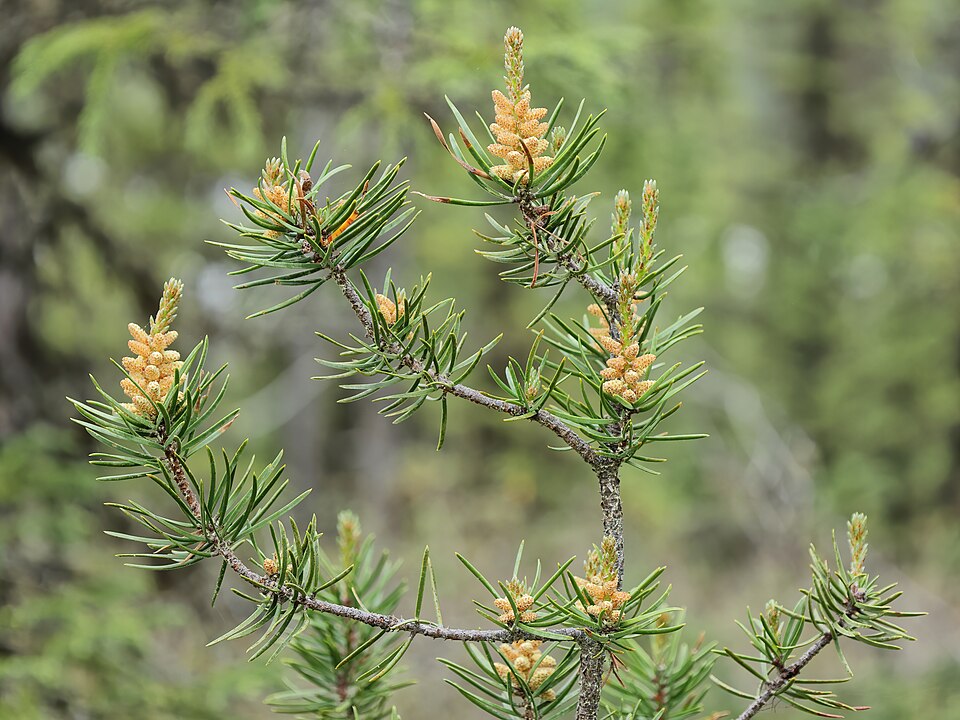
The needles are borne in bundles of 2 (fascicles of 2), which is characteristic for Jack Pine and helps distinguish it from other two-needled pines. They are short — only ¾ to 1½ inches (2–4 cm) long — stiff, often slightly twisted, and dark green to yellow-green. The short, stiff needles give the foliage a somewhat bristly or coarse texture compared to the softer needles of Eastern White Pine or Red Pine. The needles persist for 2–3 years before dropping. The needle bundles are inserted in spirally arranged sheaths along the branches.
Cones
The cones are Jack Pine’s most distinctive and ecologically important feature. They are small (1½ to 2 inches / 4–6 cm long), asymmetrical, and strongly curved — curved toward the branch tip, a unique characteristic that immediately distinguishes Jack Pine from other northeastern pines. Most cones are serotinous: sealed with resin and remaining closed on the tree for years, sometimes decades, until exposed to the heat of a wildfire (or artificially heated to 50°C / 122°F). After fire, the cones open rapidly and release their seeds onto the bare mineral soil. Some cones open without fire after several years, a characteristic that varies by population. Trees begin producing cones at a very young age — sometimes as young as 5–10 years.
Quick Facts
| Scientific Name | Pinus banksiana |
| Family | Pinaceae (Pine Family) |
| Plant Type | Evergreen Tree |
| Mature Height | 50 ft |
| Sun Exposure | Full Sun |
| Water Needs | Low (Drought Tolerant) |
| Soil Preference | Sandy, dry, acidic, nutrient-poor; pH 4.0–6.0 |
| Needles | Paired (2 per fascicle), short (¾–1½ in), stiff |
| Cones | Serotinous, curved, 1½–2 in |
| Special Notes | Useful for windbreaks in sandy soil; evergreen |
| Wildlife | Essential nesting tree for Kirtland’s Warbler |
| USDA Hardiness Zones | 2–6 |
Native Range
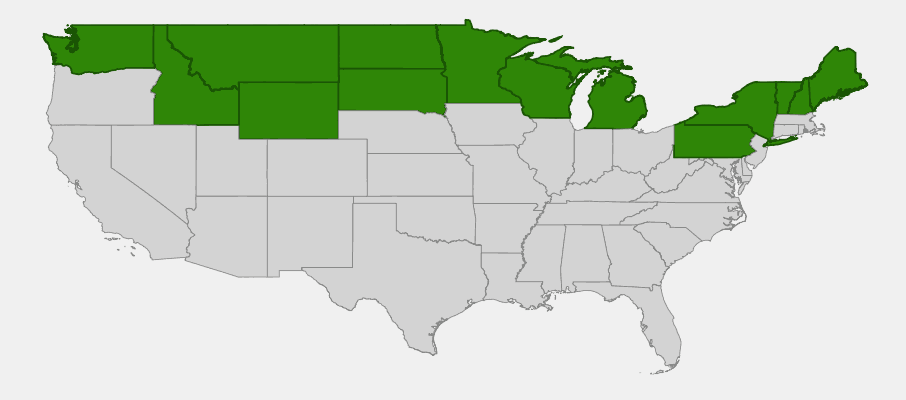
Jack Pine is the most widely distributed pine in Canada, ranging from Nova Scotia and New England west across the boreal forest of Ontario, Manitoba, Saskatchewan, Alberta, and British Columbia to the foothills of the Rocky Mountains and south into the northern United States. In New England, it occurs primarily in Maine, New Hampshire, and Vermont, where it grows on sandy outwash plains, lake plains, and rocky ridges left by glaciation. It is especially common in the Pine Barrens regions of the northeast, where sandy, fire-prone soils support distinctive open pine woodland communities.
In the United States, Jack Pine extends south through the Great Lakes states of Michigan, Wisconsin, and Minnesota — where large areas of sandy glacial outwash support extensive Jack Pine forests — and westward through North Dakota and South Dakota into the Black Hills of South Dakota and northeast Wyoming. The species rarely grows far south of the 45th parallel in the eastern United States, reflecting its strong preference for cool, northern climates.
Jack Pine is a fire-maintained species across much of its range, and its distribution closely mirrors the historical extent of fire-maintained pine barrens and open boreal woodland. In the absence of fire, it is gradually replaced by more shade-tolerant species such as Red Pine, Paper Birch, and Balsam Fir. The restoration and management of Jack Pine habitat through prescribed burning is essential for maintaining both the species and the specialized communities — including the Kirtland’s Warbler — that depend on it.
📋 Regional plant lists featuring Jack Pine: New England
Growing & Care Guide
Jack Pine is one of the easiest and most rewarding native trees to grow on difficult, dry, sandy sites. Once established, it requires almost no maintenance and will thrive for decades where other trees struggle.
Light
Jack Pine is a full-sun species and will not tolerate shade. It requires at least 6–8 hours of direct sunlight daily for healthy growth. In its natural habitat it grows in open, exposed conditions — sandy plains, rocky ridges, and post-fire clearings — where sunlight is abundant and competition from taller shade-producing trees is limited. Planting in shade will result in poor growth, sparse foliage, and eventual decline.
Soil & Water
Jack Pine is exceptionally drought-tolerant and thrives in the poorest, driest, most acidic soils available. Sandy, well-drained soil with pH 4.0–6.0 is ideal — the kind of soil that most people would consider too poor for gardening. Do not amend the soil with compost or fertilizer, as this can actually harm the tree and encourage weedy competition. Water young trees during their first one to two growing seasons while roots are establishing, then reduce or eliminate supplemental irrigation. Established Jack Pines are remarkably self-sufficient on well-drained sandy soils.
Planting Tips
Jack Pine transplants best as a young, small tree or from container stock. Bare-root nursery stock planted in early spring gives excellent results. Dig a hole only as deep as the root ball and twice as wide; backfill with the original sandy soil without amendments. Space trees 10–15 feet apart for a naturalistic grove or windbreak planting; 20–30 feet apart as specimen trees. Avoid planting in clay soils or sites with poor drainage — Jack Pine will not survive waterlogged conditions.
Pruning & Maintenance
Jack Pine requires minimal pruning. Remove dead or severely damaged branches as needed in late winter. The natural form — often irregular and somewhat asymmetrical — is part of the tree’s wild character and should be preserved rather than trained into an artificially symmetrical shape. Avoid heavy pruning, which can stimulate vigorous new growth susceptible to pine weevil. Mulching is generally not necessary given the species’ preference for bare, sandy, well-drained substrates.
Landscape Uses
- Windbreaks — excellent on exposed coastal and inland sandy sites
- Sandy soil specialists — thrives where other trees fail
- Erosion control on sandy slopes and dunes
- Wildlife habitat — essential in pine barrens ecosystems
- Naturalistic plantings — authentic character for pine barrens and boreal gardens
- Year-round screening — evergreen foliage provides winter cover and screening
- Reclamation planting on former agricultural or industrial sandy sites
Wildlife & Ecological Value
Jack Pine is a keystone species in the fire-maintained pine barrens and boreal forest ecosystems of northeastern North America. Its ecological value extends from its role as a post-fire pioneer to its critical importance as nesting habitat for endangered birds.
For Birds
No bird is more dependent on Jack Pine than the Kirtland’s Warbler (Setophaga kirtlandii), a federally endangered songbird that nests almost exclusively under the low branches of young Jack Pine trees 5 to 20 feet tall on sandy soil in Michigan, Wisconsin, and Ontario. The bird places its nest in the sandy soil beneath the low-sweeping branches of young Jack Pines — a microhabitat that effectively disappeared in the absence of regular fire. Intensive management of Jack Pine habitat through prescribed burning and clear-cutting has been essential to the recovery of this species. Beyond the Kirtland’s Warbler, Jack Pine supports numerous other birds including Common Nighthawk, Nashville Warbler, Chipping Sparrow, American Redstart, and Hermit Thrush. The seeds are consumed by Red Crossbills, Pine Siskins, and White-winged Crossbills, whose specialized bills are perfectly adapted to prying open cone scales.
For Mammals
White-tailed Deer and Moose browse Jack Pine twigs and foliage, particularly in winter when other food sources are scarce. Red squirrels harvest and cache Jack Pine seeds extensively. Black Bears use dense young Jack Pine stands for cover. Pine Marten — a forest carnivore associated with boreal forests — relies on Jack Pine habitats for hunting and denning. The dense, spreading lower branches of young Jack Pine stands provide critical thermal cover for wildlife during winter.
For Pollinators
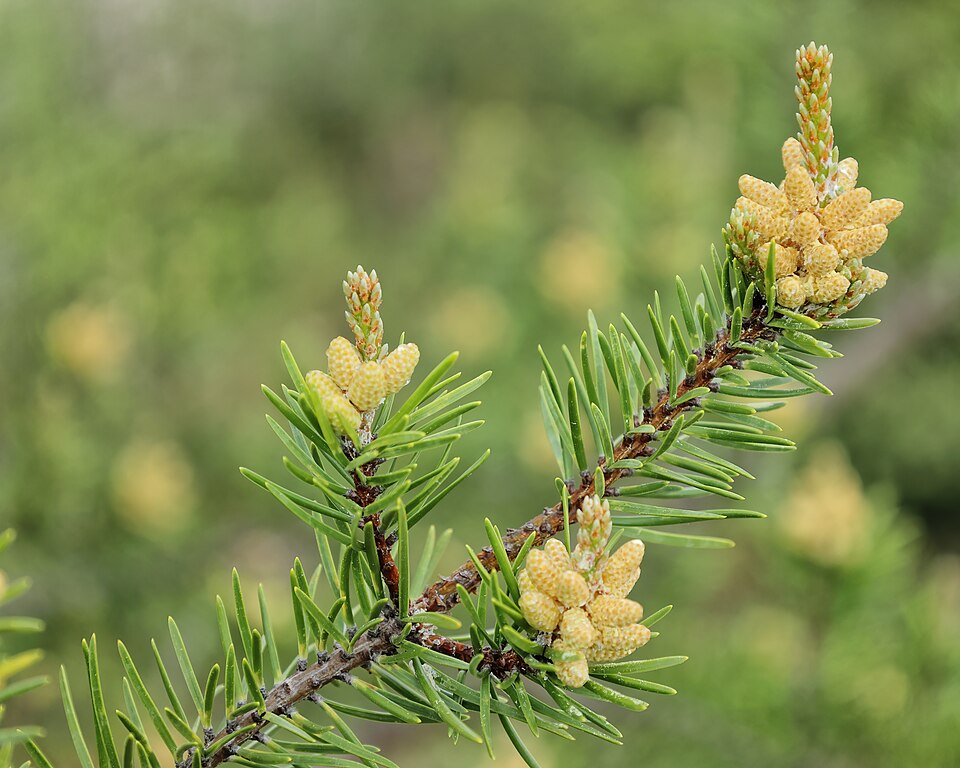
As a wind-pollinated conifer, Jack Pine does not produce nectar-bearing flowers. However, the tree plays an indirect role in supporting pollinators by helping to maintain the open, sun-drenched pine barrens habitat structure that supports diverse communities of native bees, butterflies, and other insects — particularly specialist species adapted to the dry, sandy, open pine barrens environment.
Ecosystem Role
Jack Pine is the archetypal fire-adapted pioneer. Its serotinous cones ensure that immediately following a wildfire, the bare mineral soil is blanketed with Jack Pine seeds from the now-open cones on standing dead trees. The species recolonizes burned areas rapidly and aggressively, forming dense young stands that — after 5–15 years — become ideal Kirtland’s Warbler habitat. As the stands mature, succession proceeds to more diverse boreal forest, until the next fire resets the cycle. This fire cycle, operating on a 50–80 year interval, is essential for maintaining the full range of boreal habitats that support the ecosystem’s biodiversity. By tolerating and even requiring fire, Jack Pine helps maintain a landscape mosaic of different forest ages and structures that supports far more species than any uniform old-growth forest would.
Cultural & Historical Uses
Jack Pine holds an important place in the cultural and economic history of the northern forest regions. Indigenous peoples across the boreal zone — including the Ojibwe, Cree, Anishinaabe, and others — used Jack Pine extensively. The inner bark was eaten as emergency food and used in medicinal preparations. The roots were used in basket-making and to sew birchbark canoes — the flexible roots could be split and woven into tight stitching that, sealed with pine pitch, made birchbark canoes watertight. Pine pitch from Jack Pine was a key material for waterproofing and adhesive use.
The wood of Jack Pine is moderately hard, strong, and light. It was historically used for railroad ties, mine timbers, pulpwood, and rough lumber. Jack Pine pulpwood has been a major source of paper and paper products in the boreal forest economy of Canada and the northern United States, particularly in areas like northern Ontario, Minnesota, and Michigan where the species grows in large enough volumes to support commercial harvest. The wood burns well and has been used extensively as firewood in northern communities.
For northern Indigenous and European settler communities, Jack Pine was a symbol of resilience — the tree that returns after devastation, that thrives where nothing else will, that locks its seeds against fire and then explodes into life from the ashes. This ecological narrative has made Jack Pine a cultural symbol of the boreal North: tough, tenacious, and indispensable. The species was named banksiana in honor of Sir Joseph Banks, the British botanist and naturalist who accompanied Captain Cook on his first voyage and later became president of the Royal Society.
Today, Jack Pine is increasingly recognized as a critical component of Kirtland’s Warbler recovery — one of the success stories of the Endangered Species Act. Active management of Jack Pine habitat in Michigan, Wisconsin, and Ontario through prescribed burning and mechanical clearing has contributed to the warbler’s recovery from near-extinction (a low of around 200 nesting pairs in 1974) to a current population of over 2,000 nesting pairs. This recovery has required close coordination between the US Fish and Wildlife Service, state agencies, the US Forest Service, and Canadian authorities — and it would not have been possible without careful management of Jack Pine.
Frequently Asked Questions
What makes Jack Pine’s cones “serotinous”?
Serotinous cones are sealed shut with resin that melts only at high temperatures — typically above 50°C (122°F) — releasing the seeds. This adaptation ensures seeds are held on the tree until wildfire creates the ideal germination conditions: bare mineral soil, reduced competition from other plants, and a flush of nutrients from ash. Not all Jack Pine cones are serotinous; the proportion of serotinous versus non-serotinous cones varies by population and increases in areas with more frequent fire.
Can Jack Pine grow in average garden soil?
Jack Pine can grow in average garden soil, but it performs best and lives longest in dry, sandy, acidic soil. In heavy clay or rich, moist soils, it is more susceptible to root rot and often grows poorly. For the best results, plant Jack Pine only on well-drained sandy or rocky sites. It is not a good choice for typical lawn or garden settings with irrigated, amended soil.
Is Jack Pine the same as Scrub Pine?
“Scrub Pine” is an informal name sometimes applied to Jack Pine, particularly when it grows in stunted form on especially poor soils. The same name is also applied to Virginia Pine (Pinus virginiana) and other pines growing in scrubby conditions. Jack Pine has a more northern distribution than Virginia Pine and can be distinguished by its curved, asymmetrical cones and very short needles.
How fast does Jack Pine grow?
Jack Pine grows moderately quickly, typically adding 1–2 feet per year under good conditions, though growth on the poorest soils may be slower. It is generally shorter-lived than other pines, with a typical lifespan of 100–150 years in northern forests, though some individuals live 200+ years. It begins producing cones at a very young age — sometimes as early as 5 years — which is an adaptation to its fire-dependent lifecycle.
Why is Jack Pine important for the Kirtland’s Warbler?
The Kirtland’s Warbler is one of the rarest songbirds in North America, and it nests almost exclusively under the low-hanging branches of young Jack Pine trees on sandy soil in Michigan, Wisconsin, and Ontario. The bird builds its nest on the ground beneath the protective canopy of young Jack Pines 5 to 20 feet tall. As Jack Pines grow older and the lower branches die and fall, the habitat becomes unsuitable and the warblers must move to younger stands. This dependence on a specific developmental stage of Jack Pine — itself dependent on fire — makes this one of the most dramatic examples of fire ecology and wildlife management in North America.

Looking for a nursery that carries Jack Pine?
Browse our native plant nursery directory: Maine · New Hampshire · Vermont · Connecticut