
Lowbush Blueberry (Vaccinium angustifolium)
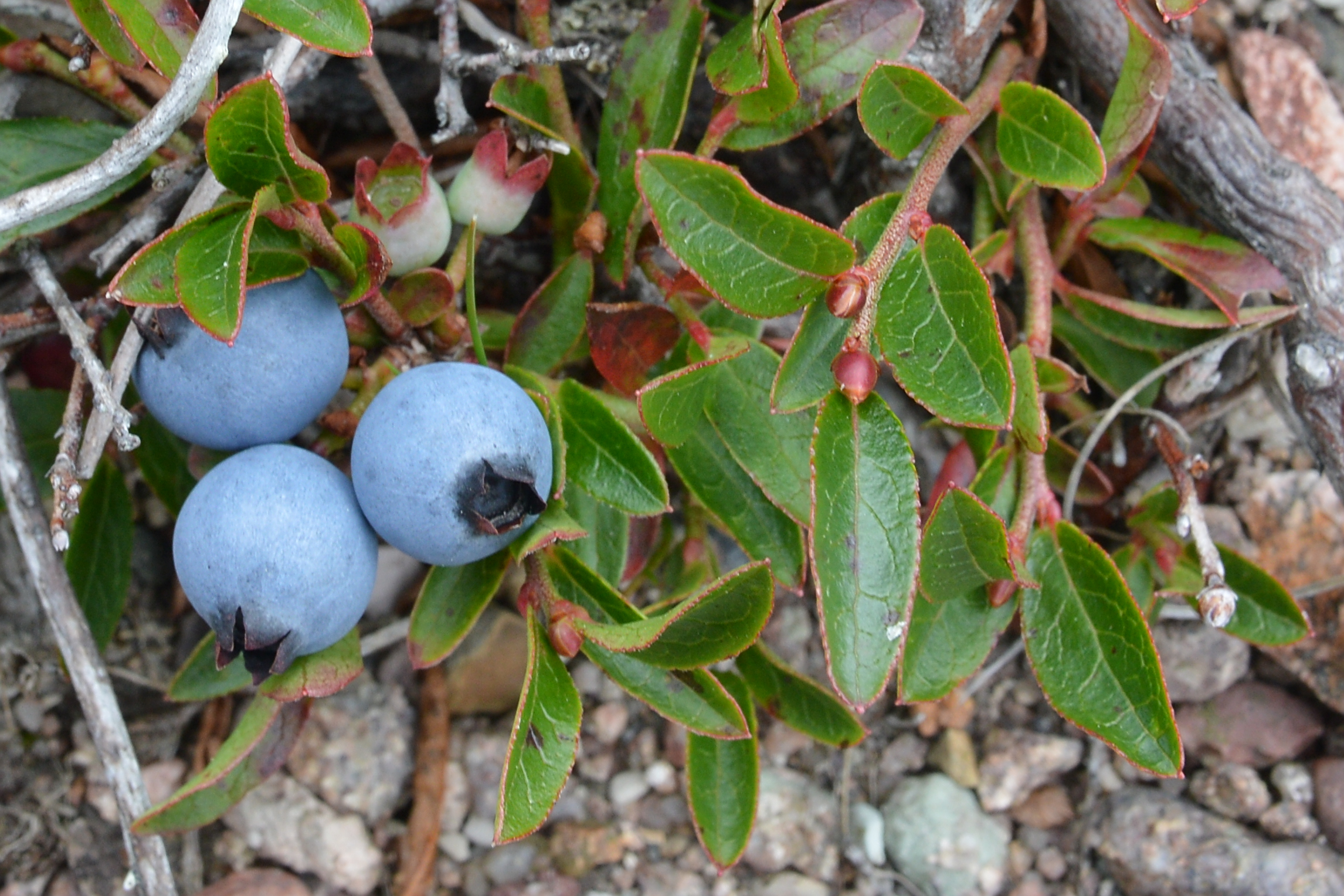
Vaccinium angustifolium, the Lowbush Blueberry, is one of North America’s most beloved and ecologically significant native plants — a low-growing, colony-forming shrub that produces the sweet, intensely flavored wild blueberries that are a culinary tradition throughout New England and the Maritime Provinces of Canada. Far better known as a food crop than as a garden plant, Lowbush Blueberry is actually a remarkable native shrub with exceptional ornamental, ecological, and edible value that deserves far wider use in home landscapes across its native range. A member of the Ericaceae (Heath) family, it is closely related to other native blueberries, cranberries, and huckleberries.
In the wild, Lowbush Blueberry forms spreading, low-growing colonies on acidic, rocky, or sandy soils in open sunny habitats — barrens, rocky hillsides, open oak and pine forests, burned-over areas, and coastal heathlands. Its spreading, rhizomatous growth allows it to colonize open ground and eventually form dense carpets of vegetation rarely exceeding 2 feet in height. The seasonal displays are extraordinary: delicate white urn-shaped flowers in spring, deep green foliage through summer, rich clusters of blue-black berries in late summer, and fiery crimson-red fall color that rivals any ornamental plant. It is, by any measure, a four-season plant of distinction.
The commercial Lowbush Blueberry industry in Maine — the largest in the world — is built entirely around this native species. Maine wild blueberry barrens, managed by burning every two years to rejuvenate the plants, produce tens of millions of pounds of blueberries annually. These barrens are also important conservation habitats, supporting specialized bee communities and wildlife assemblages. Growing Lowbush Blueberry in a home garden replicates this remarkable plant’s many benefits on a smaller scale: fresh berries for the table, exceptional wildlife habitat, beautiful seasonal displays, and a tough, low-maintenance ground cover for acidic, sunny sites.
Identification
Lowbush Blueberry is a low, spreading, colony-forming deciduous shrub typically growing 6–24 inches (15–60 cm) tall. It spreads by underground rhizomes to form dense patches that can extend for many feet. Individual stems are twiggy and multi-branched, with angled (not round) stems characteristic of the species. Fall color — turning from rich green through yellow-orange to brilliant crimson — is one of the finest of any native shrub.
Bark & Stems
Young stems are green and slightly hairy to smooth, becoming reddish-brown to gray-brown with age. The stems are distinctly angled or ridged — a characteristic that helps distinguish this species from related blueberries. Stems are wiry and flexible, arising from the spreading underground rhizome system that allows the plant to form extensive colonies. The branching pattern is dense and twiggy, producing a tight, mat-like overall form in open, exposed situations.
Leaves
The leaves are simple, alternate, elliptic to oblong, 3/4 to 1 1/4 inches (2–3 cm) long. The upper surface is bright green and smooth to slightly hairy; the lower surface is paler and may have fine hairs along the midrib. Leaf margins have fine teeth (crenate-serrulate). In autumn, the leaves turn a brilliant crimson to scarlet — one of the most spectacular fall colors of any low-growing native plant. The specific epithet angustifolium means “narrow-leaved,” reflecting the relatively narrow leaf shape compared to some related blueberries.
Flowers & Fruit
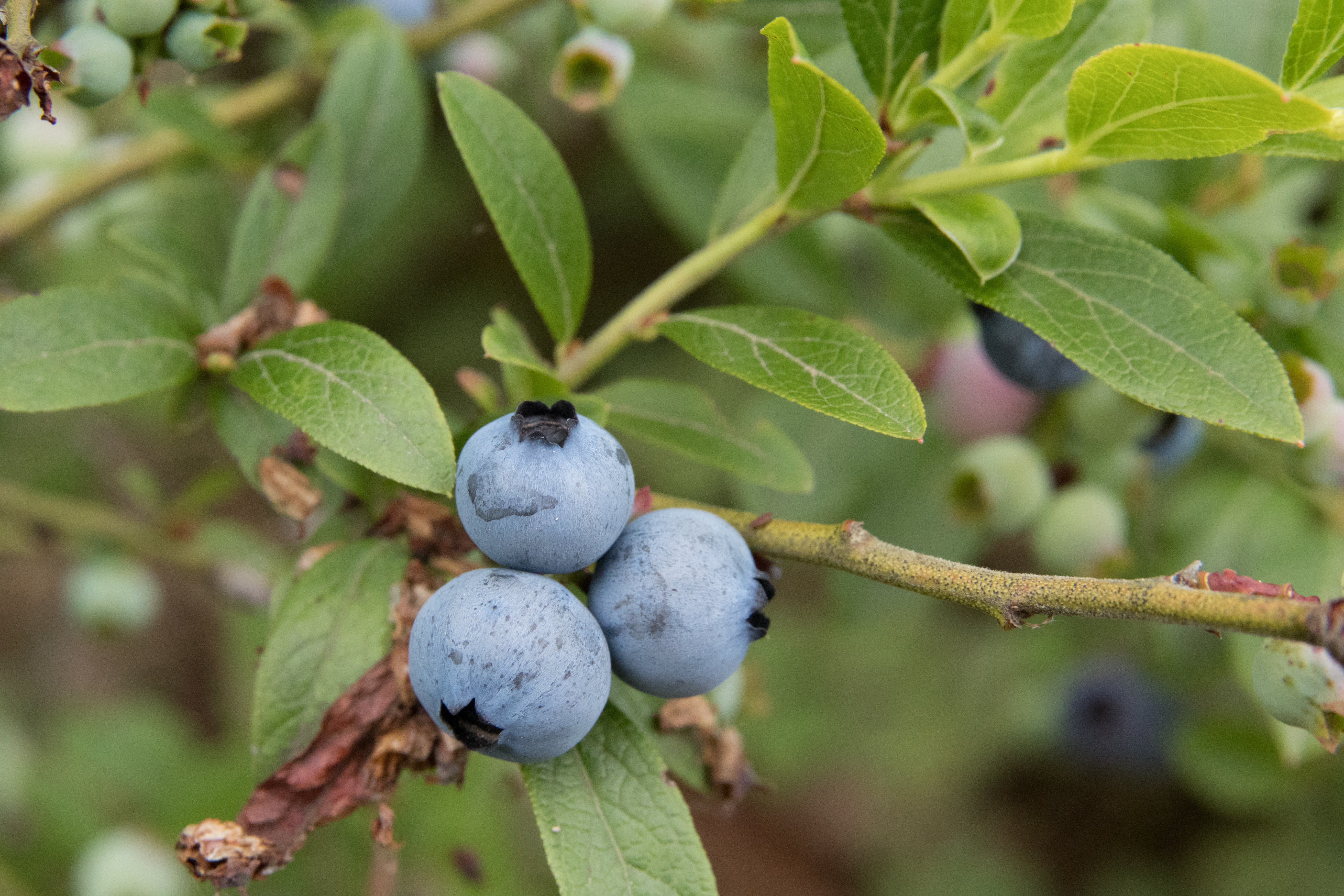
The flowers are the classic blueberry form: small, urn-shaped (urceolate) white to pale pink bells, 1/4 inch (6 mm) long, hanging in small clusters from the branches in May. The flowers are self-incompatible — different clones are needed for fruit set, and native bees are the primary pollinators. The fruit is the famous lowbush blueberry: a small (1/4 to 1/2 inch / 6–12 mm) round berry, ripening from green to a bloom-covered blue-black in July–August. The flavor is sweet-tart and more intense than commercial highbush blueberry cultivars. The berries are consumed eagerly by both wildlife and humans.
Quick Facts
| Scientific Name | Vaccinium angustifolium |
| Family | Ericaceae (Heath family) |
| Plant Type | Deciduous Shrub (colony-forming) |
| Mature Height | 2 ft |
| Sun Exposure | Full Sun |
| Water Needs | Moderate |
| Soil Type | Well-drained, sandy or rocky, acidic |
| Soil pH | 4.5–5.5 (strongly acidic) |
| Bloom Time | May |
| Flower Color | White to pale pink (urn-shaped) |
| Fruit | Blue-black berries, July – August |
| Fall Color | Brilliant crimson-scarlet |
| Special Notes | Edible/wildlife; acidic soil required; colony-forming |
| USDA Hardiness Zones | 3–6 |
Native Range
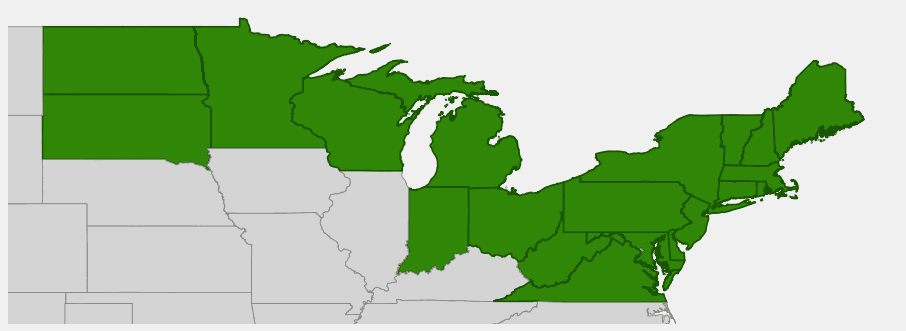
Lowbush Blueberry is native to northeastern North America, from Newfoundland and the Maritime Provinces of Canada west through Quebec and Ontario, and south through New England, the mid-Atlantic states, and the upper Midwest. It is most abundant and commercially significant in Maine, where the wild blueberry barrens of Downeast and Washington County represent the world’s largest commercial production area for this species. Throughout New England, it occurs abundantly wherever rocky, acidic, open soils exist — from coastal headlands and barrens to mountain ridges, open oak-pine forest floors, and recently burned or disturbed areas.
The species is also native throughout the Great Lakes states, ranging west to Minnesota and south to the mid-Atlantic states and Appalachian highlands. It often occurs in association with other Ericaceous plants: bearberry, sheep laurel, trailing arbutus, wintergreen, and various heathers. These plant communities — often called “heathland” or “barrens” — are distinctive ecosystems maintained by fire, poor soil, and harsh conditions that exclude more competitive plants.
Lowbush Blueberry is a generalist within its ecological tolerances but strictly requires acidic, well-drained soils and ample sunlight. It does not tolerate neutral or alkaline soils, shade, or competition from tall, aggressive plants. Management for commercial wild blueberry production typically involves burning every 2–3 years to remove taller competing vegetation and stimulate vigorous new growth from the extensive rhizome system.
📋 Regional plant lists featuring Lowbush Blueberry: New England
Growing & Care Guide
Lowbush Blueberry is a tough, rewarding native plant that produces edible fruit and exceptional ornamental value — but it demands acidic soil conditions. Get the soil right and it thrives with minimal care; ignore the soil pH and it will struggle no matter what else you do.
Light
Lowbush Blueberry requires full sun for best fruit production and most compact, attractive growth. It produces the most berries — and the most intense fall color — in sites with at least 6 hours of direct sun daily. Partial shade (4–6 hours of sun) will still support reasonable growth, but fruit production drops significantly. In full shade the plant is not productive and will decline over time. Site selection is critical: choose your sunniest, most open locations.
Soil & Water
Acidic soil (pH 4.5–5.5) is an absolute requirement for Lowbush Blueberry. In soils with higher pH, the plant cannot uptake iron and other micronutrients and will show yellowing leaves (chlorosis), poor growth, and eventually decline. Sandy, rocky, or well-drained loamy soils amended with abundant organic matter (peat moss, leaf compost, pine bark) work best. Avoid heavy clay soils. Water needs are moderate — the plant is somewhat drought tolerant once established on well-drained acidic soils, but performs better with consistent moisture. Mulching with pine bark, pine needles, or acidic wood chips maintains moisture, suppresses weeds, and helps keep soil pH low.
Planting Tips
Plant multiple clones (at least 2–3 different genetic individuals) to ensure cross-pollination and good fruit set. Container-grown specimens transplant easily. Spring planting is best for establishment. Amend planting areas thoroughly before planting — mix peat moss, sulfur, and aged pine bark throughout the planting area to create the right acidic conditions. Test soil pH before and after amendment; aim for 4.5–5.5. Space plants 2–3 feet apart for a dense mat planting; they will spread by rhizomes to fill in over several years.
Pruning & Maintenance
Lowbush Blueberry benefits from rejuvenation pruning every 2–3 years, mimicking the natural fire disturbance that stimulates vigorous new growth. Cut all stems to 2–4 inches above the ground in late winter using hand shears. The plant will regenerate vigorously from its rhizome system, producing abundant new stems that fruit heavily the following year. This “mowing” technique is used commercially on Maine’s wild blueberry barrens and works equally well on a garden scale. On years when you don’t prune, remove only dead or damaged stems.
Landscape Uses
- Edible landscape — the best native fruiting ground cover for acidic soils
- Ground cover — low, spreading mat for sunny, acidic sites
- Rock gardens — excellent on rocky slopes and outcroppings
- Native heathland gardens — combine with bearberry, sheep laurel, and wintergreen
- Wildlife habitat — berries attract over 40 bird species; essential for bears and small mammals
- Slope stabilization — spreading rhizomes hold soil on sunny slopes
- Fall color display — brilliant crimson carpets in autumn
- Naturalistic plantings on sandy barrens or open rocky areas
Wildlife & Ecological Value
Lowbush Blueberry is one of the most ecologically important native plants in the northeastern United States, providing food and habitat for an exceptional diversity of wildlife across all seasons.
For Birds
Blueberries are among the most sought-after wild fruits for birds. American Robins, Hermit Thrushes, Gray Catbirds, Eastern Towhees, and numerous warbler species consume the berries enthusiastically. Wild turkeys eat large quantities of berries and also scratch for invertebrates in the blueberry barrens. Ruffed Grouse eat the berries, buds, and stems. The dense, low growth provides nesting habitat for ground-nesting birds including Vesper Sparrows, Grasshopper Sparrows, and Savannah Sparrows. Cedar Waxwings and Northern Mockingbirds visit repeatedly during fruiting season. Bluebird Trail operators note that bluebirds are among the most frequent visitors to garden blueberry patches.
For Mammals
Black Bears are major consumers of wild blueberries — the berries are a critical food source for bears building fat reserves before hibernation. In Maine, bears are frequently observed foraging in blueberry barrens in late summer. White-tailed Deer graze on the foliage and twigs, particularly in winter. Chipmunks, red squirrels, and field mice eat the berries. Red and gray foxes also consume blueberries when available. The dense mat growth provides shelter for meadow voles and other small mammals.
For Pollinators
Lowbush Blueberry is critically dependent on — and highly valuable for — native pollinators. The urn-shaped flowers can only be effectively pollinated by bees using “buzz pollination” (sonication), where the bee vibrates its flight muscles to shake loose pollen from the anthers. Honeybees cannot perform buzz pollination effectively; native bumblebees (especially Bombus species) are the primary pollinators. Several specialist native bee species forage almost exclusively on blueberries during their bloom period, including the blueberry bee (Habropoda laboriosa) and mining bees (Andrena species). A large planting of Lowbush Blueberry is an exceptional resource for native bee conservation.
Ecosystem Role
Wild blueberry barrens — the dominant ecosystem where Lowbush Blueberry thrives — are among the most distinctive and ecologically significant habitats in the northeastern United States. These heathland ecosystems support highly specialized plant and animal communities found nowhere else. The loss of blueberry barrens to forest succession and development has significantly reduced habitat for grassland and heathland bird species, specialized bees, and other heathland-dependent wildlife. Maintaining and restoring Lowbush Blueberry habitat is a conservation priority in Maine and throughout New England.
Cultural & Historical Uses
Wild blueberries have been gathered and consumed by Indigenous peoples of northeastern North America for thousands of years. The Wabanaki Confederacy (Penobscot, Passamaquoddy, Maliseet, Mi’kmaq, and Abenaki peoples) has harvested wild blueberries in Maine and the Maritime Provinces since time immemorial. In Mi’kmaq tradition, the blueberry was one of the sacred foods given to the people to sustain them through the harvest season. Blueberries were eaten fresh, dried for winter storage, incorporated into pemmican (a preserved food mixture of dried meat and berries), and used in medicinal preparations. The bark was also used medicinally as an astringent and for treating childbirth-related conditions.
European settlers quickly adopted wild blueberry gathering, and by the 1800s a commercial wild blueberry harvest was underway in Maine. The first commercial blueberry canning operation was established in Cherryfield, Maine in 1866. The industry expanded dramatically through the 19th and 20th centuries, and today Maine produces approximately 80–100 million pounds of wild blueberries annually — more than any other region in the world. The wild blueberry is the official state berry of Maine and holds an important place in the state’s cultural identity and agricultural economy.
Nutritionally, wild blueberries have been intensively studied for their high concentrations of anthocyanins — the pigments that give the berries their blue-black color and serve as potent antioxidants. Research has suggested potential benefits for cardiovascular health, cognitive function, and anti-inflammatory effects, though most clinical evidence remains preliminary. The small size and intense flavor of wild (lowbush) blueberries mean that they contain higher concentrations of anthocyanins per gram than commercial highbush blueberries, making them of significant interest to health food markets. Today, wild Maine blueberries are exported worldwide and are increasingly sought after for both their flavor and perceived health benefits.
Frequently Asked Questions
How are Lowbush Blueberries different from regular blueberries?
The blueberries sold in grocery stores are primarily Highbush Blueberry (Vaccinium corymbosum), a different species that grows 6–12 feet tall and produces larger berries. Lowbush Blueberries are smaller plants (under 2 feet) that produce smaller, more intensely flavored berries with higher concentrations of anthocyanins. Wild blueberries (lowbush) have a more complex, tart-sweet flavor compared to the milder, larger highbush berries.
Why do my blueberries not produce fruit?
The most common reasons for poor fruit production are: (1) Insufficient sun — blueberries need at least 6 hours of direct sun; (2) Wrong soil pH — must be 4.5–5.5, not above 6.0; (3) Only one clone planted — need at least 2 different genetic individuals for cross-pollination; (4) Lack of native bee pollinators — encourage native bumblebees by reducing pesticide use and providing pollinator habitat nearby.
Is Lowbush Blueberry the same as wild blueberry?
“Wild blueberry” is the common commercial and marketing term for Lowbush Blueberry (Vaccinium angustifolium) and the closely related velvet-leaf blueberry (V. myrtilloides). Both species grow wild in Maine’s blueberry barrens and are harvested commercially. Most wild blueberry products sold in stores contain primarily V. angustifolium.
Can I grow Lowbush Blueberry if my soil is not acidic?
You can acidify your soil with elemental sulfur, peat moss, and acidifying fertilizers, but it requires effort and ongoing maintenance. Add elemental sulfur to lower pH — follow soil test recommendations for your specific situation. Retest annually and add more sulfur as needed, since soil naturally buffers toward its original pH over time. In areas with naturally alkaline soil, raised beds filled with acidic growing mix may be the most reliable approach.
How long until Lowbush Blueberry produces berries?
Plants begin producing some fruit in their first or second year, but full, abundant production typically develops in 3–5 years as the rhizome network establishes and spreads. Production improves further when plants are pruned back periodically (every 2–3 years) to stimulate vigorous new fruiting canes from the rhizome system.

Looking for a nursery that carries Lowbush Blueberry?
Browse our native plant nursery directory: Maine · New Hampshire · Vermont · Connecticut