Joint Fir (Ephedra trifurca)
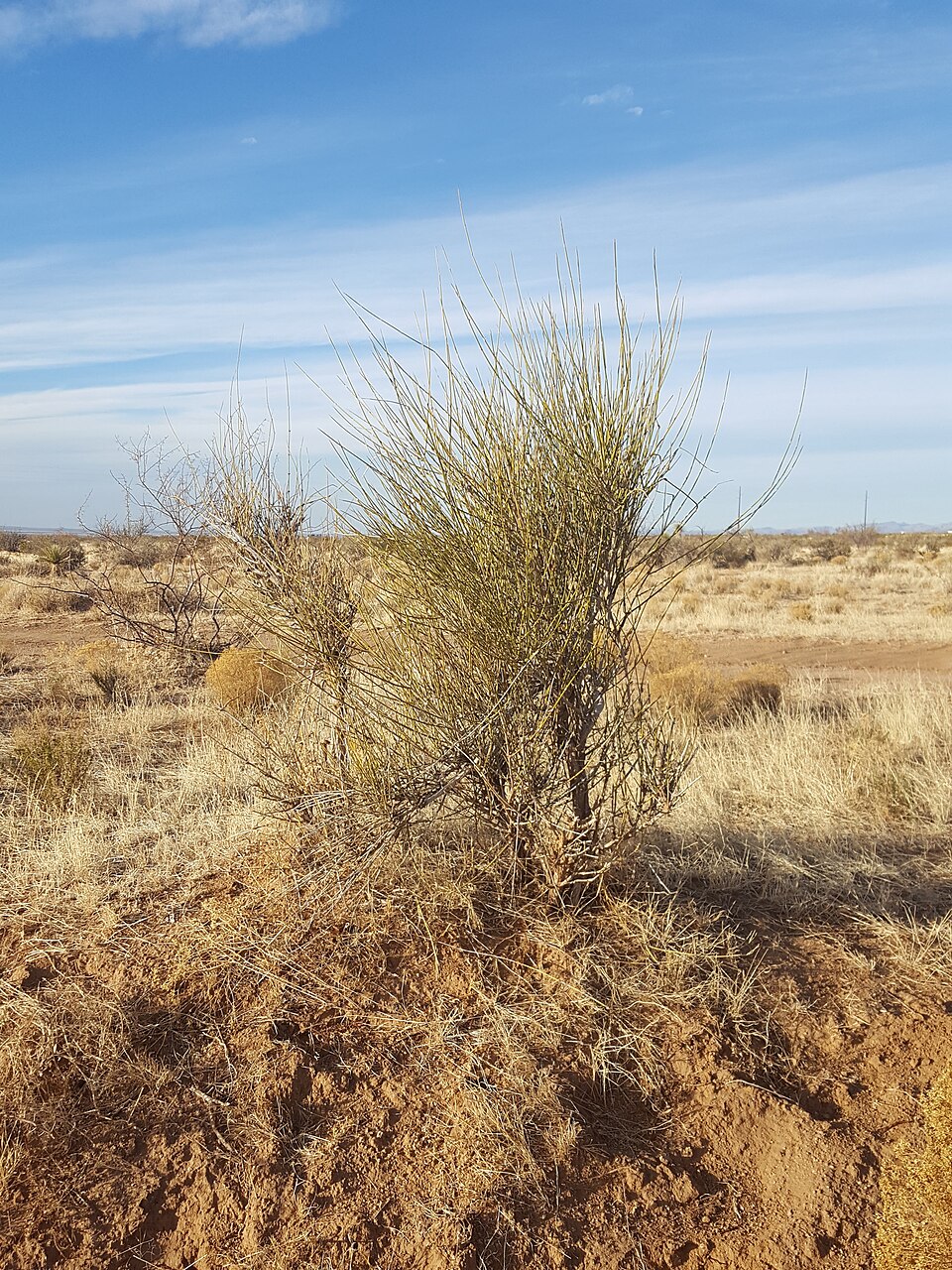
Ephedra trifurca, commonly known as Joint Fir or Longleaf Ephedra, is a fascinating and ancient native shrub of the Sonoran and Chihuahuan deserts — a living representative of one of the oldest plant lineages on Earth, predating the flowering plants by hundreds of millions of years. Growing 4 to 6 feet tall as a dense, green, many-branched shrub, Joint Fir is immediately recognizable by its distinctive jointed, photosynthetic stems and its lack of obvious leaves — a feature that gives it a striking, other-worldly appearance unlike any other native plant in the Arizona desert landscape.
Unlike flowering plants, Joint Fir is a gymnosperm — a seed plant that reproduces through cones rather than flowers. Its photosynthesis occurs primarily through the green, jointed stems rather than through leaves (which are reduced to tiny, inconspicuous scales at each stem node). This architecture is remarkably efficient in a hot, dry climate, as the slender stems present minimal surface area to the intense desert sun while maintaining photosynthetic capacity year-round. The plant produces small, papery cones in spring — yellow pollen-bearing cones on male plants and seed-bearing cones on female plants — representing an ancient reproductive strategy that predates the evolution of flowers.
In the landscape, Joint Fir creates a distinctive textural element unlike anything else available for Arizona gardens. Its dense, broom-like mass of green stems maintains its color year-round, providing reliable evergreen structure in a desert landscape that can become quite brown and dormant during dry periods. The plant is among the most drought-tolerant native shrubs available, thriving in the hottest, most exposed desert conditions on the most challenging rocky and sandy soils. Its historical importance as a source of the alkaloid ephedrine — a powerful medicinal compound — adds a compelling cultural dimension to its ecological story.
Identification
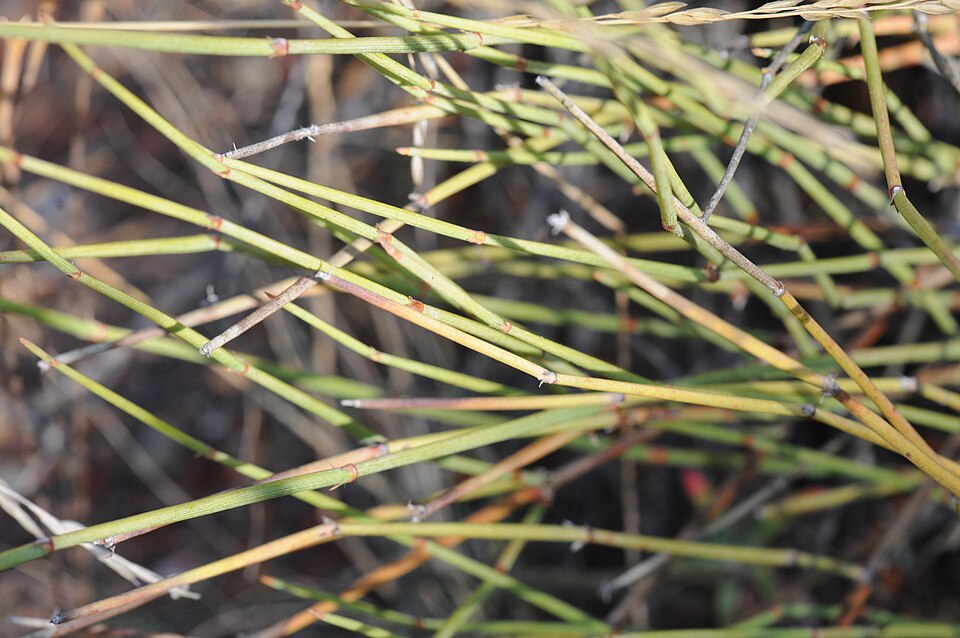
Joint Fir is unmistakable among Arizona native plants — its dense mass of green, jointed, rush-like stems, the complete absence of obvious leaves, and its ancient gymnosperm biology set it apart from all other desert shrubs. The species name trifurca refers to the characteristic branching pattern where stems fork into three at each node (though whorls of two are also common).
Stems
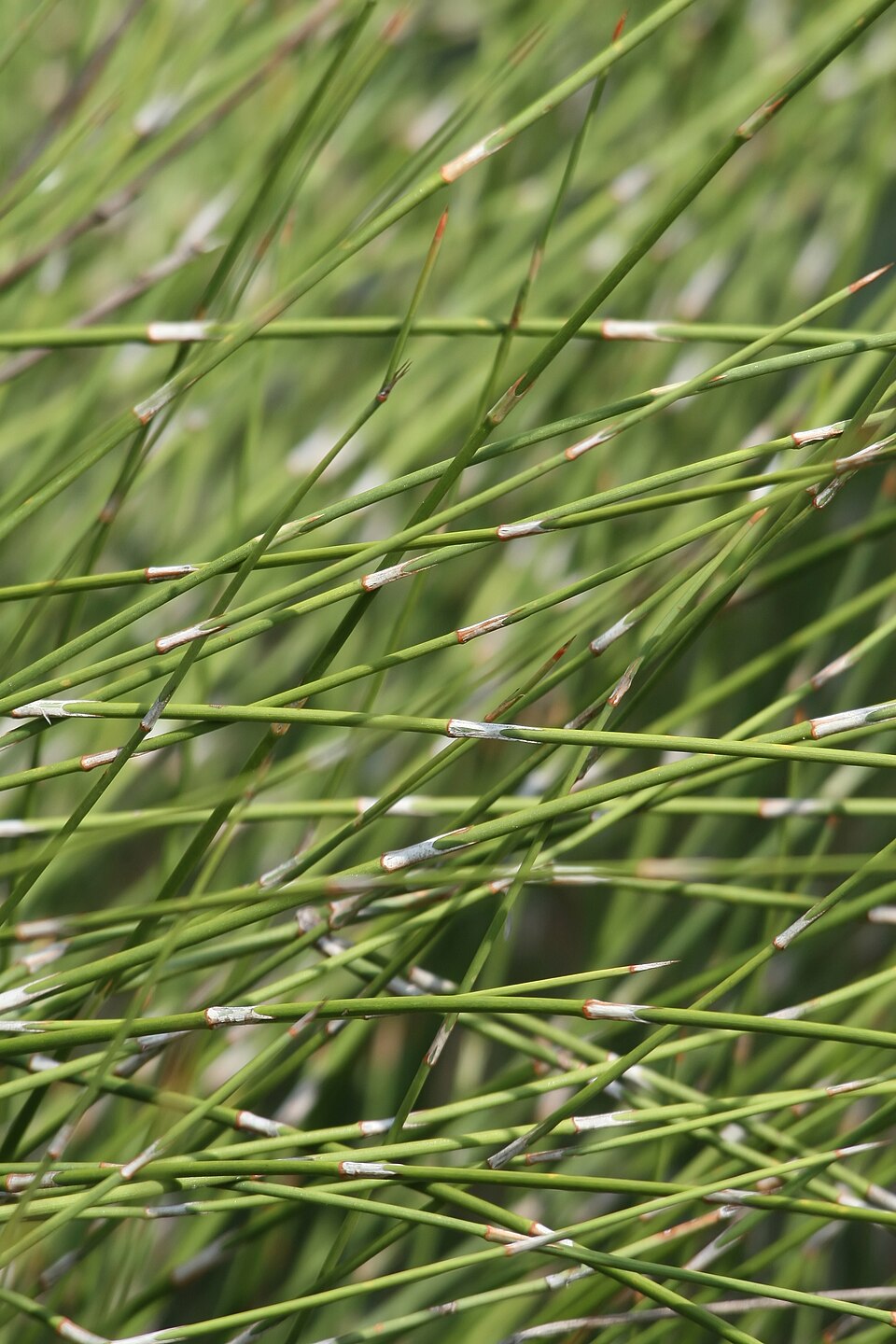
The stems are the plant’s most distinctive feature: green, slender (1/8 to 1/4 inch diameter), jointed at distinct nodes, and covered with fine longitudinal grooves. They are round in cross-section and feel slightly rough or ribbed to the touch. The photosynthetic green color of the stems allows the plant to carry out photosynthesis without functional leaves. At each node, the stems are slightly swollen, and tiny scale-like leaf sheaths (the vestigial leaves) clasp the stem. The branching at each node typically involves 3 branches (hence trifurca), though 2-branch whorls also occur. Individual stems can be quite long — up to 1 to 2 feet — giving established plants a dense, broom-like appearance. Stems are flexible but somewhat brittle at the nodes.
Cones
Ephedra trifurca is dioecious — individual plants are either male or female. Male plants produce small, yellow, pollen-bearing cones at the stem nodes in late winter and early spring (February to April). The pollen cones are oval, about 1/4 to 1/2 inch long, and appear in clusters of 2 to 5 at each node; they release abundant yellow pollen that is visible as a golden dust cloud when disturbed. Female plants produce seed-bearing cones that are slightly larger and fleshy when young, ripening to papery, brown, oval structures about 1/2 to 3/4 inch long containing 1 to 2 seeds. The seeds are the plant’s dispersal unit — they are wind-dispersed or carried short distances by water. A single male plant can fertilize many female plants in the vicinity through wind pollination.
Root System
Joint Fir develops a deep, extensive, woody taproot and lateral root system that allows it to access deep soil moisture and anchor firmly in sandy and rocky desert soils. The root system is crucial to the plant’s extreme drought tolerance — it can access water far below the surface during dry periods. Joint Fir has an ancient, well-evolved partnership with mycorrhizal fungi that enhance its water and nutrient acquisition in nutrient-poor desert soils.
Quick Facts
| Scientific Name | Ephedra trifurca |
| Family | Ephedraceae |
| Plant Type | Evergreen Shrub (Gymnosperm) |
| Mature Height | 6 ft |
| Sun Exposure | Full Sun |
| Water Needs | Low (Drought Tolerant) |
| Bloom Time | February – April (male pollen cones) |
| Flower Color | Yellow (male pollen cones) |
| USDA Hardiness Zones | 7–11 |
Native Range
Ephedra trifurca is native to the Chihuahuan and Sonoran deserts of the American Southwest and northern Mexico. In the United States, it occurs in southern Arizona, southern New Mexico, and the Trans-Pecos region of western Texas, with outlying populations in parts of California, Nevada, and Utah. The species is most common in the Chihuahuan Desert grassland and desert scrub communities of southern Arizona and New Mexico, where it grows on sandy plains, sandy washes, and gravelly desert flats.
Within its range, Joint Fir typically occupies the sandy or gravelly soils of desert plains, dunes, sandy washes, and alluvial fans between sea level and about 5,000 feet elevation. It is particularly common in the more sandy-soiled portions of the Chihuahuan Desert, where it often forms conspicuous colonies covering large areas of open desert. Associated plants include Creosote Bush, Desert Grasses, Soaptree Yucca, various cacti, and other desert scrub species. Joint Fir is typically found in open, sun-exposed habitats with minimal competition from larger shrubs or trees.
The North American genus Ephedra contains several species that overlap in range and habitat, and they can be challenging to distinguish. Ephedra trifurca (Longleaf Ephedra or Joint Fir) is distinguished from the more widespread E. viridis (Mormon Tea) by its tendency toward 3-branched nodes, generally longer stems, and its occurrence in the more southern, hotter desert regions. Where ranges overlap, the two species may hybridize. Both are sometimes collectively called “Joint Fir” or “Mormon Tea” in casual use.
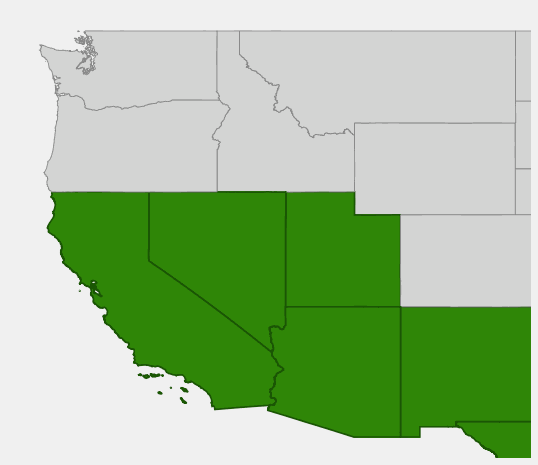
📋 Regional plant lists featuring Joint Fir: Arizona
Growing & Care Guide
Joint Fir is an excellent choice for the most challenging desert landscape situations — extreme heat, poor sandy or rocky soils, minimal water, and full sun exposure. Its unique architectural appearance, year-round evergreen color, and historical interest make it a distinctive addition to native plant gardens and restoration plantings.
Light
Joint Fir is strictly a full-sun plant, adapted to the most intensely sunny and hot desert conditions. It will not tolerate shade and may decline or die in positions with reduced sun. Choose the most open, exposed location available. It handles south-facing slopes with intense reflected heat and full-day sun without difficulty — conditions that would be too harsh for most other plants.
Soil & Water
Sandy, gravelly, or rocky soils with excellent drainage are ideal. Joint Fir is one of the most drought-tolerant native plants available — established specimens often survive on as little as 3 to 5 inches of annual rainfall. During the establishment period (first year), water monthly in summer. After that, most plants in the Arizona desert need no supplemental irrigation. The deep taproot allows the plant to access sub-surface moisture even during severe droughts. Avoid clay soils or any situation where water might pool.
Planting Tips
Plant in fall or early spring in sandy or gravelly, well-drained soil. Joint Fir grows slowly in its first few years as it develops its deep root system, then accelerates. Do not over-water — excess moisture is the most common cause of plant decline. The plant is available from native plant nurseries specializing in Sonoran and Chihuahuan desert species. If possible, source plants from local seed stock for the best adaptation to your specific location.
Pruning & Maintenance
Joint Fir requires virtually no maintenance. The natural, dense, many-stemmed form is the most attractive. You can remove dead stems if they develop, and thin overly dense growth if necessary. Avoid heavy pruning — the plant recovers slowly from major cuts. Joint Fir is essentially pest- and disease-free in appropriate desert conditions. It is also rabbit and deer resistant, as the bitter taste of the alkaloid-containing stems deters most browsers.
Landscape Uses
Joint Fir works well in:
- Desert accent plantings — unique architectural form unlike any other plant
- Rock and sand gardens
- Slope and erosion control on sandy desert soils
- Xeriscape plantings requiring extreme drought tolerance
- Restoration seedings of disturbed Chihuahuan Desert sites
- Windbreaks and screening in the most challenging desert conditions
- Educational gardens illustrating ancient plant lineages
Wildlife & Ecological Value
While not as broadly important to wildlife as many flowering shrubs, Joint Fir provides unique habitat value in the desert landscape and has specialized ecological relationships with several animal groups.
For Birds
The seeds of Joint Fir are eaten by several desert seed-eating birds, particularly sparrows and finches that forage in open desert habitats. The dense, thorny-stemmed growth provides some roosting cover, particularly for sparrows and small songbirds during cold nights or windstorms. The pollen cones produce abundant yellow pollen in spring that supports emerging native bees and other early-season insects, which in turn are an important food source for insectivorous birds.
For Mammals
While Joint Fir is not a preferred browse plant (the alkaloids in the stems and seeds are bitter and can be toxic in large quantities), small desert mammals including Kangaroo Rats and Ground Squirrels may collect and cache the seeds. Jackrabbits occasionally nibble the stems, though less enthusiastically than other native shrubs. The deep root system supports mycorrhizal fungi that are part of the broader soil food web supporting desert invertebrates and the animals that feed on them.
For Insects
The yellow pollen cones of male Joint Fir plants are visited by early-season native bees collecting pollen in late winter and early spring — a valuable early-season pollen resource when few other plants are blooming. Various small insects including beetles, true bugs, and thrips visit the cones. The stems harbor specialized scale insects and other invertebrates that form part of the desert food chain.
Ecosystem Role
In desert ecosystems, Joint Fir plays a unique role as a relict gymnosperm in a landscape otherwise dominated by flowering plants. Its dense, evergreen stem structure creates microhabitats and wind protection for desert annual plants and invertebrates growing beneath it. The root system of established plants supports important mycorrhizal networks in sandy desert soils. As a very long-lived, slow-growing species, established Joint Fir plants can be important anchor points of ecological continuity in desert landscapes.
Cultural & Historical Uses
The genus Ephedra holds one of the most remarkable positions in the history of medicine and pharmacology of any plant group. The Asian species Ephedra sinica (Ma Huang) has been used in Chinese traditional medicine for over 5,000 years, and the alkaloid ephedrine isolated from its stems became one of the most widely used pharmaceutical compounds of the 20th century, employed as a decongestant, bronchodilator, and stimulant. North American Ephedra species including E. trifurca contain lower concentrations of ephedrine and related alkaloids (pseudoephedrine, norephedrine) than Asian species, but they have been used medicinally by Indigenous peoples and early settlers throughout the Southwest.
Indigenous peoples of the Southwest have used Joint Fir and related Ephedra species medicinally for centuries. The Navajo used Ephedra tea to treat kidney and bladder problems. Pima and Papago peoples brewed the stems as a remedy for venereal diseases. Various groups across the Southwest drank Ephedra stem tea for colds, coughs, and respiratory conditions — uses supported by the bronchodilatory effects of the ephedrine alkaloids. The brew was also used as a general tonic and energy drink, earning the plant its common name “Mormon Tea” from the early Latter-day Saint settlers who, prohibited from drinking coffee or conventional tea, adopted the Native American practice of brewing Ephedra stems.
In the early 20th century, North American Ephedra species were commercially harvested as a source of ephedrine for pharmaceutical production before synthetic manufacturing made commercial collection uneconomical. The FDA banned ephedra-containing dietary supplements in 2004 following reports of serious cardiovascular side effects, though the botanical (non-concentrated) form of the plant tea remains legal. Today, Joint Fir is primarily valued as a landscape and restoration plant rather than for medicinal use. Its extraordinary evolutionary age — the genus Ephedra first appears in the fossil record over 50 million years ago, and its predecessors date back to the Permian period — gives it a unique educational value in native plant gardens that celebrate the deep history of desert life.
Frequently Asked Questions
Is Joint Fir the same as Mormon Tea?
Joint Fir (Ephedra trifurca) and Mormon Tea (Ephedra viridis) are closely related but distinct species within the same genus. Both are called “Mormon Tea” colloquially, and both were used to make the traditional Southwest tea from the jointed green stems. E. trifurca tends to have longer stems and a 3-branched node pattern, while E. viridis typically branches in pairs. Their natural ranges overlap in parts of the Southwest.
Does Joint Fir contain ephedrine?
North American Ephedra species including E. trifurca do contain ephedrine and related alkaloids, but at much lower concentrations than the Asian species (E. sinica) used pharmaceutically. The traditional stem tea contains only mild amounts of these compounds. However, concentrated ephedra supplements made from North American species were involved in health incidents before being banned. The plant as a landscape specimen poses no risk.
How do I tell if my Joint Fir is male or female?
You can only distinguish male from female plants when they are in cone. Male plants produce yellow, oval pollen cones (typically in February to April) that appear in clusters at the stem nodes. Female plants produce slightly larger cones that develop from green and fleshy to papery and brown as seeds mature. If your plant has not yet coned, you cannot tell the sex. Male plants reportedly produce the most dramatic yellow pollen display in spring.
How fast does Joint Fir grow?
Joint Fir is slow to establish and slow-growing in its early years, as it focuses on developing its deep root system. Expect 6 to 12 inches of growth per year after establishment. In very dry conditions, growth may be even slower. The plant is long-lived once established — old specimens in desert environments may be decades old. Patience is required, but the reward is a uniquely textured, maintenance-free desert shrub.
Is Joint Fir deer resistant?
Yes — Joint Fir is generally deer resistant. The alkaloids in the stems and cones give the plant a bitter, unpleasant taste that deters most browsing animals. Jackrabbits may occasionally nibble on young stems, but established plants are typically left alone. This makes Joint Fir a good choice for desert landscapes where deer browsing is a problem.

Looking for a nursery that carries Joint Fir?
Browse our native plant nursery directory: Arizona