Palmer Agave (Agave palmeri)
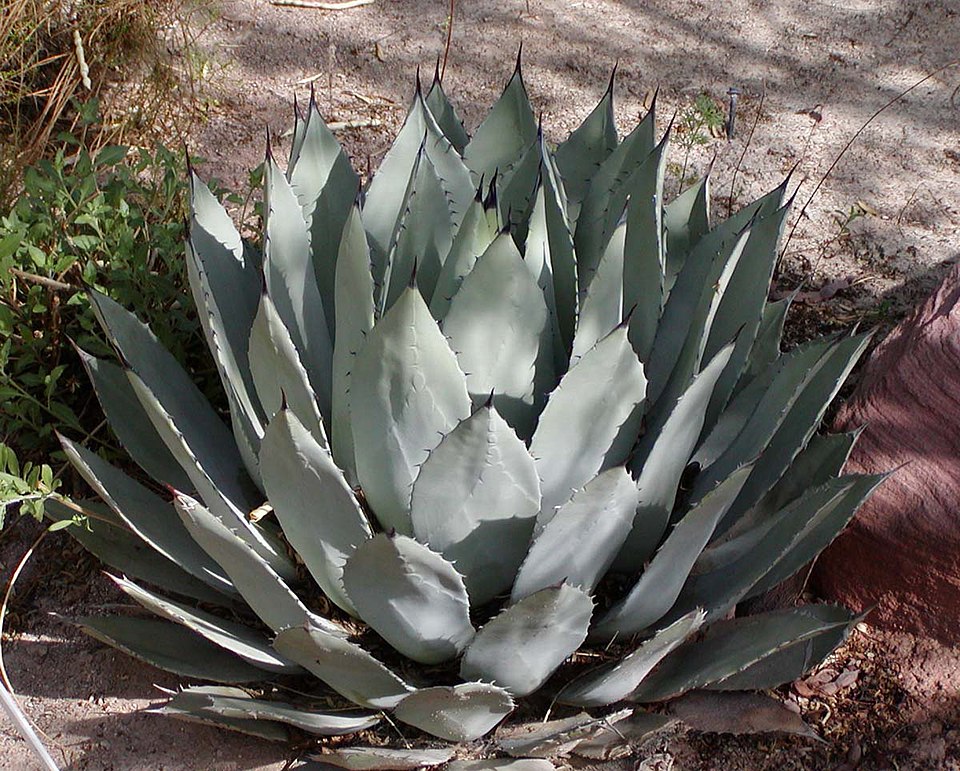
Agave palmeri, the Palmer Agave, is one of the most spectacular and ecologically significant native plants of the Arizona sky island mountain ranges — a stately succulent perennial that spends most of its life as an elegant, compact rosette of blue-gray leaves before culminating in a once-in-a-lifetime blooming event of extraordinary drama and ecological importance. The rosette typically grows to 3 feet tall and 4 to 5 feet wide over a period of 15 to 25 years, then sends up a towering flower stalk that can reach 12 to 15 feet in just a few weeks — one of the most dramatic growth spurts in the plant kingdom — before producing thousands of flowers and dying.
Native to the grasslands, oak woodlands, and canyon slopes of southeastern Arizona and adjacent New Mexico at elevations of 3,500 to 7,000 feet, Palmer Agave is the characteristic “century plant” of the Madrean sky island landscape. Unlike some agave species that produce offsets (pups) freely, Palmer Agave reproduces primarily through its towering flower stalk — both through the thousands of seeds produced and through bulbils (small plantlets) that form on the flower stalk and drop to the ground to root nearby. The entire above-ground plant dies after blooming, having devoted its accumulated resources to this singular reproductive event.
Palmer Agave holds a position of paramount importance in the ecology of the sky island mountain ranges. It is the primary nectar source for one of North America’s most remarkable migratory pollinators — the Lesser Long-nosed Bat (Leptonycteris yerbabuenae), a federally threatened species that migrates from Mexico to Arizona each spring specifically to follow the northward progression of blooming agaves. The bats’ pollination of Palmer Agave (and their dispersal of agave seeds through bat guano) represents one of the most compelling examples of plant-animal co-evolution in North America.
Identification
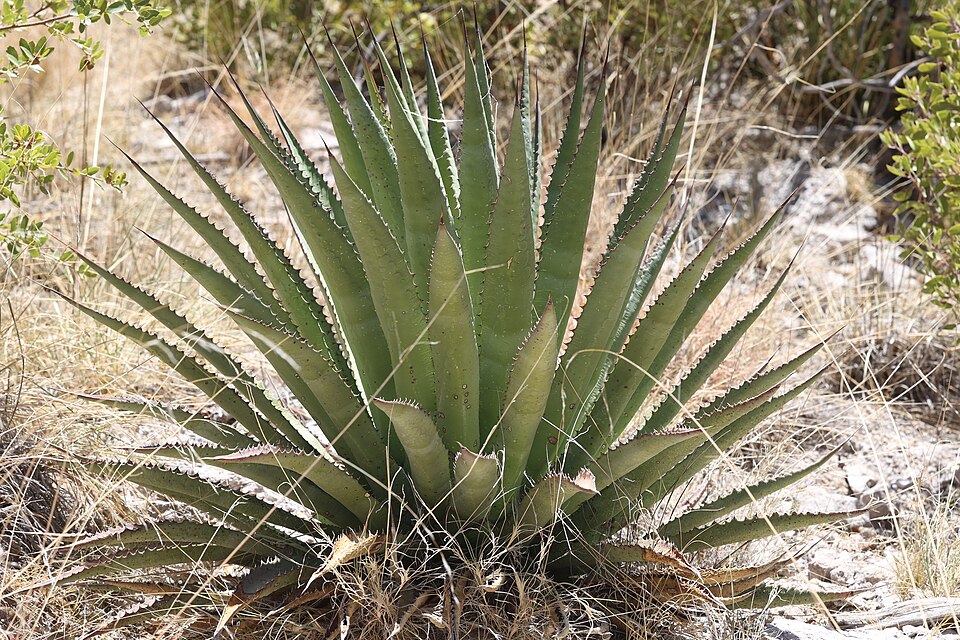
Palmer Agave is one of the larger native agave species in Arizona, forming substantial rosettes of rigid, succulent leaves with terminal spines and serrated margins. It is distinguished from other Arizona agave species by its relatively large size, its blue-gray to glaucous leaf color, its grassland and oak woodland habitat, and its geographic range in the southeastern Arizona mountains.
Rosette & Leaves
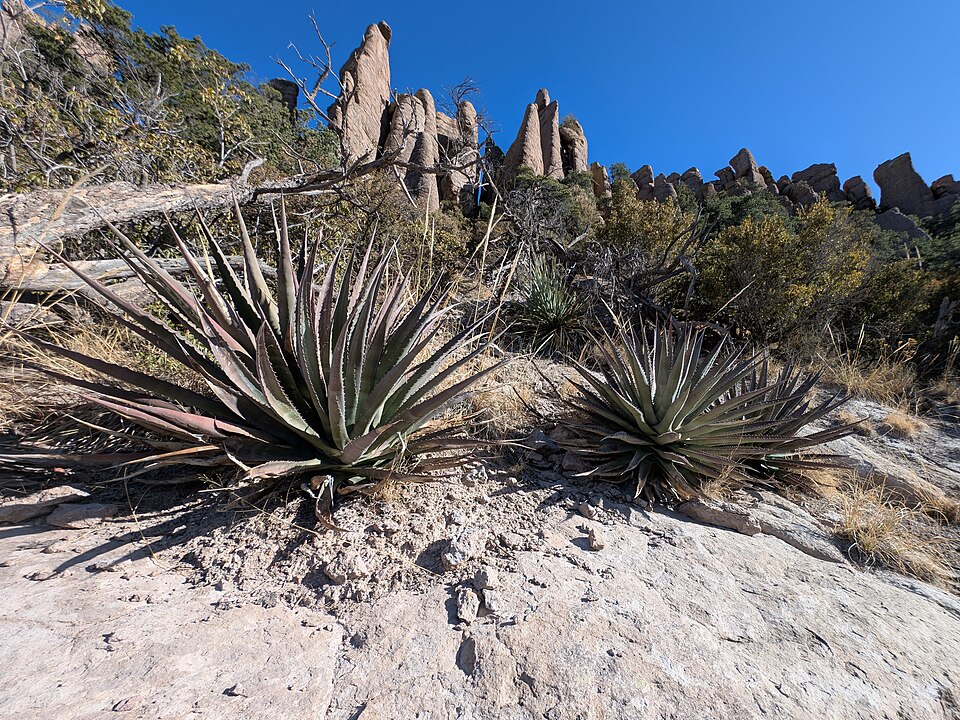
The rosette typically grows 2.5 to 4 feet tall and 4 to 6 feet wide, composed of 20 to 40 individual leaves arranged in a dense, symmetrical spiral. Individual leaves are 12 to 24 inches long and 2 to 4 inches wide at the widest point, thick, succulent, and rigid — they are among the strongest natural fibers in the plant kingdom. The leaf color is blue-gray to glaucous (with a whitish, waxy bloom), turning more green in shadier conditions. The leaf margins have distinctive, regularly spaced, brown to grayish teeth (serrations) typically ½ to 1 inch long, and each leaf terminates in a sharp, rigid, gray-brown terminal spine that can be 1 to 2 inches long and is capable of penetrating leather. The leaf surfaces often show distinctive cross-banding patterns from the impressions of adjacent leaves during the bud stage (called “bud prints”). The rosette bases may slowly expand over many years and sometimes produce a few offset rosettes (pups), particularly if the parent rosette is damaged.
Flower Stalk & Flowers
After 15 to 25 years of rosette growth, Palmer Agave enters its terminal flowering phase. The flower stalk (quiote) emerges from the center of the rosette and elongates with remarkable speed — sometimes adding 6 to 12 inches of height per day during its peak growth phase — reaching a final height of 10 to 15 feet in 4 to 6 weeks. The stalk is stout, pale green, and branched only in the upper one-third to one-half, where it bears numerous lateral branches (panicle branches) each bearing dense clusters of flowers. Individual flowers are yellow to yellow-green, tubular, about 1.5 to 2.5 inches long, with 6 perianth segments and 6 long, protruding stamens that give the flowers a brush-like appearance. The thousands of flowers open progressively from bottom to top of the panicle over 4 to 6 weeks, providing an extended nectar bonanza for bats, hummingbirds, and other pollinators.
After Blooming
Following the completion of flowering and seed set, the entire above-ground rosette dies — a reproductive strategy called monocarpy. The dead stalk and rosette persist for 1 to 3 years before decomposing, serving as important perching and nesting structure for birds during that period. Seeds are flat, black, and wind-dispersed. Bulbils (small plantlets that are genetically identical clones of the parent) often develop on the flower stalk branches before or after the main seeds develop, dropping to the ground and rooting to produce new plants nearby. In favorable conditions, a dying parent plant may leave behind dozens of seedlings and bulbil-derived plants in the immediate vicinity.
Quick Facts
| Scientific Name | Agave palmeri |
| Family | Asparagaceae (Agave) |
| Plant Type | Succulent Perennial (Monocarpic) |
| Mature Height | 3 ft |
| Sun Exposure | Full Sun to Part Shade |
| Water Needs | Low (Drought Tolerant) |
| Bloom Time | June – August (once per lifetime) |
| Flower Color | Yellow to yellow-green |
| USDA Hardiness Zones | 7–11 |
Native Range
Palmer Agave is native to the sky island mountain ranges of southeastern Arizona and adjacent Hidalgo County, New Mexico, with the main range extending south through Sonora and Chihuahua, Mexico. In the United States, it occurs in the Huachuca, Rincon, Santa Rita, Chiricahua, Dragoon, and other mountain ranges of southeastern Arizona, typically in the grassland and oak woodland zones between 3,500 and 7,000 feet elevation. It is one of the characteristic plants of the Madrean oak woodland — the distinctive plant community of the sky island mountain ranges that bridges the Sonoran Desert and the high-elevation pine-oak forests.
Within its range, Palmer Agave grows on rocky or gravelly slopes, canyon margins, and open grasslands on thin, well-drained soils. It occurs in a wide range of aspects but tends to be most abundant on south- and west-facing slopes in grassland-woodland transition zones. Associated plants include Emory Oak (Quercus emoryi), Mexican Blue Oak (Q. oblongifolia), Beargrass (Nolina microcarpa), various native grasses, Manzanita, and other agave species including Agave schottii (Shin-dagger Agave).
Fire plays a complex role in Palmer Agave populations. The green rosettes can withstand moderate fire intensities, as the growing point is protected within the dense leaf base. However, intense fires that top-kill the above-ground rosette can eliminate plants before they have had the opportunity to reproduce. Historically, periodic low-intensity grassland fires in the sky island ranges created open habitat conditions that limited shrub encroachment and maintained the diverse grassland mosaic that Palmer Agave and other grassland species depend on. Fire suppression during the 20th century has contributed to shrub encroachment in many historic agave habitats.
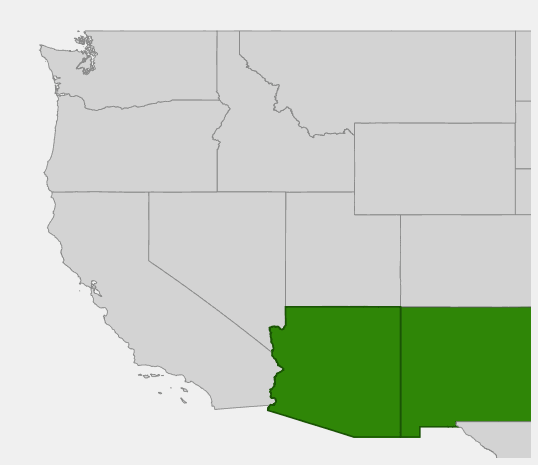
📋 Regional plant lists featuring Palmer Agave: Arizona
Growing & Care Guide
Palmer Agave is a magnificent landscape plant for southwestern gardens with adequate space and well-drained soil. Its bold, architectural rosette form is stunning year-round, and the once-in-a-lifetime flower stalk is an event gardeners remember for years. Once established, it requires virtually no care and thrives on neglect.
Light
Palmer Agave grows best in full sun to light partial shade. It naturally occurs at forest and woodland margins where it receives some light shade from trees. In the landscape, full sun produces the most compact, symmetrical rosettes and the most characteristic blue-gray leaf color. Some afternoon shade is acceptable and can reduce heat stress in the hottest low-desert locations below 2,500 feet, where Palmer Agave is somewhat near the edge of its preferred elevation range. Above 3,000 feet, full sun is ideal.
Soil & Water
Excellent drainage is absolutely critical — Palmer Agave will rot at the crown in wet or poorly drained soils. Plant on slopes, in raised beds, or in sandy or gravelly native soil. The plant is very drought tolerant once established, thriving in areas with 12 to 20 inches of annual rainfall (primarily in summer) without supplemental irrigation. During the establishment period (first 1 to 2 years), water monthly in summer. After establishment, water only during extended droughts of more than 8 to 10 weeks during the summer growing season. Avoid any irrigation in winter, as this period should be relatively dry. Overwatering is the most common cause of Palmer Agave death in cultivation.
Planting Tips
Plant in spring or fall, never in midsummer when heat stress is greatest. Wear heavy leather gloves and use thick cardboard to handle the plant — the terminal leaf spines are extremely sharp and can cause serious injury. Allow ample space: 5 to 6 feet in all directions for the mature rosette plus room for the flower stalk to fall. Avoid planting near walkways, play areas, or pet runs due to the hazardous leaf spines. The leaf tips can be blunted with a knife if safety is a concern, though this is somewhat unsightly. Plant at grade or very slightly raised to ensure excellent drainage.
Pruning & Maintenance
Remove dead or damaged leaves from the base of the rosette annually using heavy loppers. Beyond this, Palmer Agave needs no maintenance. Do not attempt to cut back the rosette — this can damage or kill the plant. When the flower stalk emerges, enjoy the spectacular show! After blooming and after the parent plant dies, remove the dead rosette (a significant task requiring tools and heavy gloves) and harvest any bulbils from the stalk for propagation. Seedlings from the previous season may appear nearby and can be potted up or left to colonize naturally.
Landscape Uses
Palmer Agave is outstanding for:
- Focal specimen — the bold rosette form demands attention in any planting
- Rock garden and desert landscape accent
- Bat and hummingbird garden — the flower stalk is a premier nectar source
- Slope plantings — excellent erosion control
- Xeriscape plantings requiring extreme drought tolerance
- Educational gardens illustrating sky island ecology and bat pollination
- Restoration plantings in degraded sky island grasslands
Wildlife & Ecological Value
Palmer Agave is one of the most ecologically important plants in the sky island mountain ranges of the Southwest, playing a central role in the survival of several threatened and sensitive wildlife species including the Lesser Long-nosed Bat.
For Bats
Palmer Agave is the cornerstone food plant for the federally threatened Lesser Long-nosed Bat (Leptonycteris yerbabuenae), which migrates from Mexico to Arizona each spring specifically to feed on the nectar and pollen of blooming agaves. The bats are specialized “trap-line” feeders, visiting multiple blooming agave stalks each night and covering dozens of miles in their nightly foraging routes through the sky island ranges. Palmer Agave is perfectly adapted for bat pollination — its large, tubular, night-blooming flowers with large amounts of nectar and abundant pollen match the feeding anatomy of long-nosed bats precisely. Without bat pollination, Palmer Agave seed set would be dramatically reduced, making the plant-bat mutualism one of the most important ecological relationships in sky island biodiversity conservation.
For Hummingbirds
During the day, the open flowers of Palmer Agave are visited by hummingbirds — particularly Scott’s Orioles, Broad-billed Hummingbirds, Black-chinned Hummingbirds, and Magnificent Hummingbirds — that are attracted by the abundant nectar. Though hummingbirds are less efficient pollinators of agave than bats (due to flower shape), they contribute to cross-pollination and benefit substantially from the enormous nectar supply the flower stalk provides. The flowering period of Palmer Agave (June through August) coincides with the peak summer residency of many hummingbird species in the sky island ranges.
For Birds & Invertebrates
The dense fibrous leaves of Palmer Agave provide nesting sites for several bird species including Scott’s Oriole, which weaves its pendant nest among the stiff leaf tips. Various insectivorous birds forage in the leaf bases for invertebrates. The abundant insects attracted to the flowers during the blooming period support flycatchers, warblers, and other insectivorous birds. After the plant dies, the persistent stalk and dead rosette provide perching sites and potential cavity-nesting opportunities for birds over 1 to 3 years.
Ecosystem Role
Palmer Agave functions as a keystone species in the Madrean sky island ecosystem. Its extraordinary nectar production during the summer monsoon season fuels the migration and reproduction of bat species that pollinate dozens of other plant species in addition to agave. The plant’s physical structure — large rosettes on open slopes, towering flower stalks visible from great distances — creates landmark landscape features that bats and birds use for orientation in the mountainous terrain. The decomposing rosette provides nutrients to rocky, nutrient-poor soils, and the bat guano deposited near flowering agaves represents a significant nutrient input to these otherwise oligotrophic ecosystems.
Cultural & Historical Uses
Palmer Agave was one of the most important food plants for the Indigenous peoples of the sky island mountain ranges. The Tohono O’odham, Akimel O’odham, Apache, and Yavapai peoples all utilized agave hearts as a major food source, using roasting pits to transform the otherwise inedible raw agave hearts into a sweet, fibrous food with the consistency of cooked sweet potato. The preparation involved harvesting the agave shortly before it would bolt (send up its flower stalk) — the moment when the rosette’s stored carbohydrates are at their maximum concentration — then roasting the heart (the cut base of the rosette) in large communal earth ovens (hornos) lined with rocks for 24 to 48 hours. The roasted agave was eaten fresh or dried and pounded into cakes for long-term storage.
Beyond food, every part of Palmer Agave was utilized by Indigenous peoples. The long, tough leaf fibers were processed into rope, cord, nets, sandals, baskets, and clothing. The sharp leaf spines were used as needles and pins. The quiote (flower stalk) was eaten as a vegetable when young and tender — roasted like asparagus. The flowers were eaten raw or cooked. The sap was fermented into a mildly alcoholic beverage known in Sonora as “mescal” (distinct from the mescal liquor made from distilled agave sap). Apache groups made extensive use of Palmer Agave, using the fibers for bowstring material and the leaf sap as a soap substitute.
The distilled agave spirit known as mezcal (and its cousin tequila, made specifically from Blue Agave) has become one of the world’s most celebrated artisanal spirits — a cultural legacy of the Indigenous agave-roasting tradition combined with Spanish distillation technology introduced in the colonial period. While Palmer Agave itself is not commercially used for mezcal production (which focuses primarily on Agave angustifolia and related species), it is the wild cousin of these cultivated agave species. Conservation of wild Palmer Agave populations is important for maintaining the genetic diversity of the agave genus, which underpins the enormous cultural and economic importance of agave spirits worldwide.
Frequently Asked Questions
How long does it take Palmer Agave to bloom?
Palmer Agave is monocarpic — it blooms once in its lifetime, typically after 15 to 25 years of vegetative growth. The flower stalk emerges in late spring and grows rapidly, sometimes adding 6 to 12 inches of height per day, reaching 10 to 15 feet in 4 to 6 weeks. After blooming and seed set, the parent plant dies. The term “century plant” (often applied to agaves) is a misnomer — most plants bloom well before 100 years of age.
Will Palmer Agave die after blooming?
Yes — Palmer Agave is monocarpic, meaning it flowers and dies. After the flower stalk completes its growth and seeds mature, the entire above-ground rosette dies over the following months. However, the plant may leave behind offspring in the form of seeds, bulbils (plantlets that form on the flower stalk), and occasionally offset rosettes (pups) at the base. These ensure the next generation of plants.
Is Palmer Agave safe to plant near people?
Palmer Agave has very sharp leaf tips and serrated edges that can cause serious puncture wounds. Plant at least 6 to 8 feet away from walkways, driveways, play areas, and pet runs. If safety is a concern, the sharp leaf tips can be blunted with a knife or small saw. The plant is best situated as a specimen in an open garden area where it can be admired from a safe distance.
Does Palmer Agave attract bats?
Yes — Palmer Agave is a primary food source for the federally threatened Lesser Long-nosed Bat, which migrates from Mexico specifically to feed on blooming agaves in Arizona’s sky island mountain ranges. If you live near these mountain ranges, a blooming Palmer Agave may attract bat visitation at night during its blooming period (June through August). This is a spectacular wildlife event worth staying up late to observe.
How do I propagate Palmer Agave?
Palmer Agave can be propagated from seeds (collect from the ripening seed capsules on the stalk in late summer/fall), from bulbils (the small plantlets that form on the flower stalk after blooming), or from offset rosettes (pups) if the parent plant produces them. Seeds germinate readily in warm, well-drained soil. Bulbils can be planted directly or potted up. Pups can be carefully separated from the parent and replanted.

Looking for a nursery that carries Palmer Agave?
Browse our native plant nursery directory: Arizona