Quail Brush (Atriplex lentiformis)
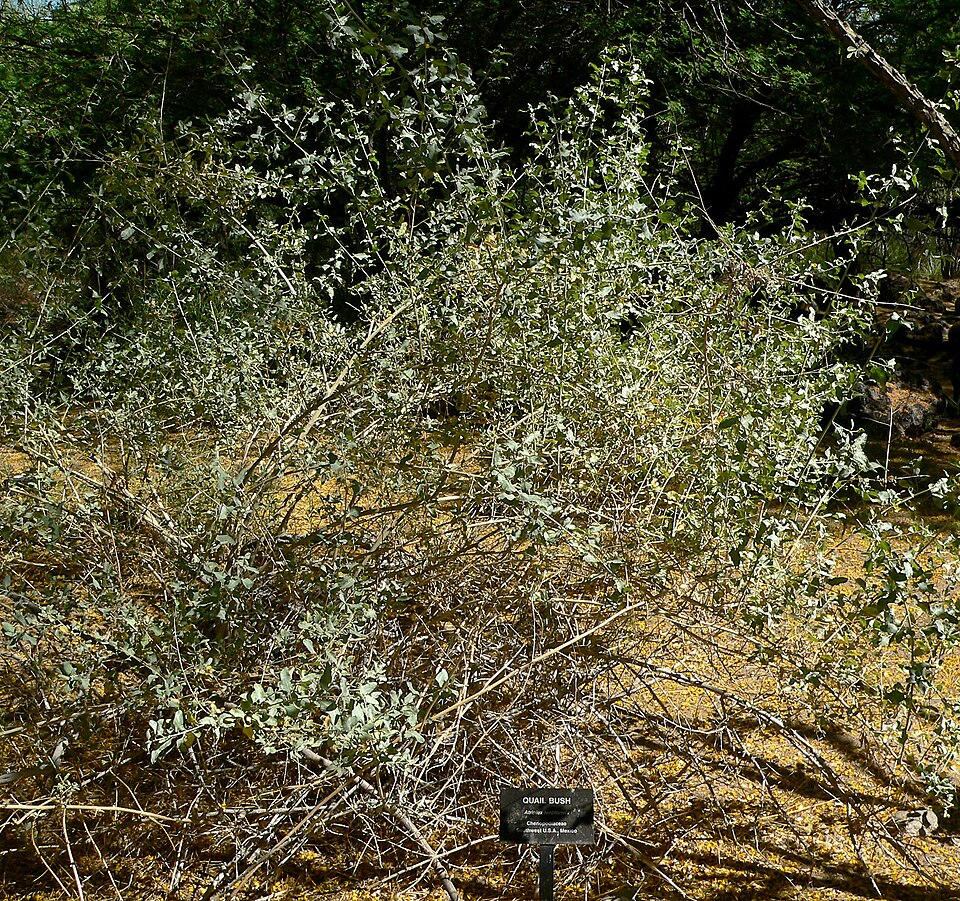
Atriplex lentiformis, commonly known as Quail Brush, Big Saltbush, or Lens-scale Saltbush, is a large, vigorous, fast-growing native shrub of the Sonoran and Mojave deserts that earns its name as one of the most consistently bird-rich plants available for Arizona native gardens. Growing rapidly to 6 to 10 feet tall and 8 to 15 feet wide, Quail Brush forms a broad, dense, many-branched mound of silver-gray foliage that provides outstanding year-round cover and nesting habitat for Gambel’s Quail and a remarkable diversity of other desert birds.
Native to desert washes, alkali flats, and saline lowlands throughout the Southwest and Great Basin, Quail Brush is supremely adapted to conditions that few other native shrubs can tolerate — heavy alkaline soils, periodic flooding, high soil salinity, and the most intense summer heat. Its silvery-gray leaves are covered in tiny water-filled bladders (epidermal bladder cells) that reflect solar radiation and help regulate leaf temperature — the same adaptation that gives the Saltbush family its characteristic pale, silvery color and extraordinary heat tolerance. The plant is also notable for its remarkable salt tolerance, being able to excrete excess sodium from its leaves — a strategy that allows it to grow on saline soils that poison most other plants.
From a wildlife standpoint, Quail Brush justifies its name: the dense, leafy growth provides year-round cover and nesting habitat for Gambel’s Quail, Mourning Doves, Verdins, House Finches, and many other birds. The abundant seeds are a primary food source for quail and numerous seed-eating species throughout fall and winter. The plant is also an important host for butterfly larvae and is visited by a variety of native bees and insects during its late-summer bloom period.
Identification
Quail Brush is a large, robust, broadly mounding shrub immediately recognizable by its distinctive silver-gray to pale gray-green foliage. The silvery color comes from a dense covering of tiny epidermal bladder cells on the leaf surfaces that reflect light — a characteristic of the Atriplex genus. The plant is somewhat similar to other saltbush species but is notably larger and has distinctively lens-shaped (lentiform) fruiting bracts — the feature referenced in its species name.
Stems & Habit
Quail Brush is a multi-stemmed, deciduous to semi-evergreen shrub with a rounded, broadly spreading crown. Stems are light gray to whitish, somewhat woody at the base and more herbaceous toward the tips. The growth is fast — established plants can put on 2 to 3 feet of new growth per season under favorable conditions — and the overall effect is of a large, informal, somewhat billowy shrub with a soft, silver-gray color. New growth emerges green-tinged and becomes silvery-gray as it matures.
Leaves
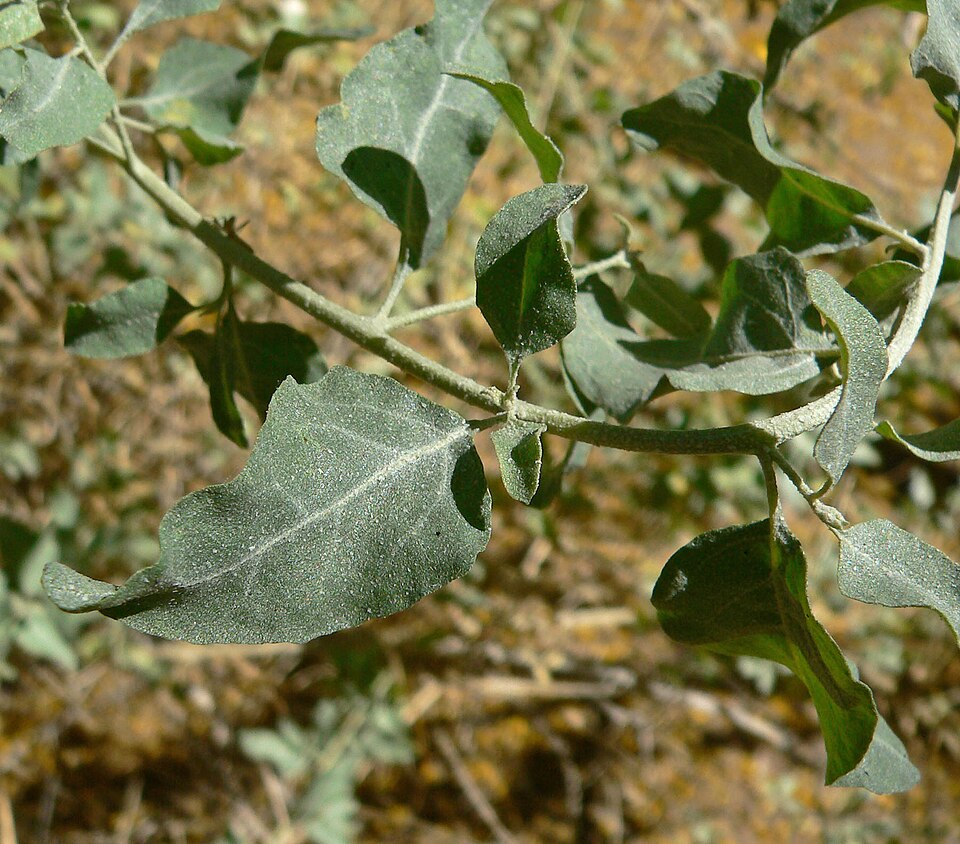
Leaves are alternately arranged, 0.8 to 2 inches long and about as wide, ovate to triangular with slightly lobed to entire margins, and distinctively silvery-gray to pale green on both surfaces due to the covering of tiny bladder-like cells (salt glands) that function in osmoregulation. The leaf surface has a slightly grainy or powdery texture from these cells. Leaves are drought-deciduous under extreme stress conditions but typically remain on the plant through most of the growing season. The plant uses a C4 photosynthetic pathway — highly efficient in hot, high-light environments — which contributes to its exceptional heat and drought tolerance.
Flowers & Fruit
Quail Brush is monoecious (male and female flowers on the same plant). Flowers are tiny, inconspicuous, and produced in late summer (July through September) in branched clusters at stem tips. Male flowers are yellow-green; female flowers are enclosed in two flat, disc-like bracts (the lens-shaped fruiting bracts that give the species its name lentiformis). The bracts enlarge as seeds mature, turning from green to brown, and are the primary fruit dispersal unit. The seed-containing bracts are eaten by seed-eating birds and small mammals from late summer through winter, providing an extended and abundant food resource.
Quick Facts
| Scientific Name | Atriplex lentiformis |
| Family | Chenopodiaceae (Goosefoot) / Amaranthaceae |
| Plant Type | Deciduous Shrub |
| Mature Height | 8 ft |
| Sun Exposure | Full Sun |
| Water Needs | Low (Drought Tolerant) |
| Bloom Time | July – September |
| Flower Color | Pale yellow-green to cream (inconspicuous) |
| USDA Hardiness Zones | 7–11 |
Native Range
Quail Brush (Atriplex lentiformis) is native to the desert Southwest and portions of the Great Basin and California, ranging from the Mojave and Sonoran deserts east through southern Nevada and Utah, southern Arizona, and into southern New Mexico and western Texas. It also occurs widely in the California Central Valley and coastal lowlands, and extends south into Baja California and Sonora, Mexico. The species tolerates an unusually wide range of soil and moisture conditions within this broad geographic range.
Within the arid Southwest, Quail Brush is most characteristic of alkali flats, desert dry lake margins, saline soil areas, alluvial fan margins, and desert washes where periodic flooding deposits mineral-rich sediments. It commonly colonizes disturbed areas and roadsides and is a typical component of the plant community bordering dry lake beds (playas) in the Sonoran and Mojave deserts. It is associated with other salt-tolerant species including Four-wing Saltbush, Alkali Sacaton grass, and various other halophytes.
The remarkable salinity tolerance of Quail Brush — it can accumulate sodium chloride in its leaf bladder cells and then excrete the excess — allows it to grow in soils with electrical conductivity far above the threshold where most plants fail. This adaptation makes it one of the most useful native shrubs for revegetating alkali flats, mine spoils, and other saline-disturbed areas in the arid Southwest.
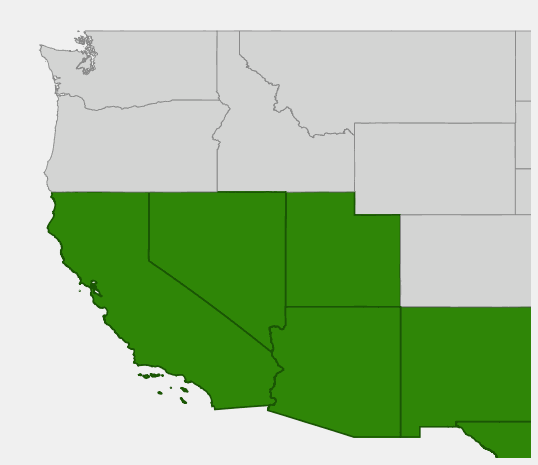
📋 Regional plant lists featuring Quail Brush: Arizona
Growing & Care Guide
Quail Brush is one of the fastest-growing, toughest, and most wildlife-productive native shrubs for Arizona gardens. If you have space for a large, informal shrub and want to maximize bird activity, Quail Brush is an outstanding choice. It establishes quickly, tolerates challenging soils, and provides year-round habitat value with virtually no maintenance.
Light
Quail Brush requires full sun. It is adapted to the most intense desert sun and will not thrive in shade. The silvery foliage reflects excess solar radiation — allowing the plant to avoid overheating in full desert sun — making shade both unnecessary and undesirable. Plant in the most open, sunny location available.
Soil & Water
Quail Brush is exceptionally tolerant of poor soils including heavy alkaline clay, saline soils, and compacted substrates that would be inhospitable to most other native plants. It grows in virtually any well-drained to moderately drained desert soil and will even tolerate periodic flooding. Once established, it is quite drought tolerant; however, it benefits from occasional deep watering (monthly in summer) to support its large, fast-growing canopy. Established plants in areas receiving summer monsoon rainfall typically need little supplemental irrigation.
Planting Tips
Plant in fall or early spring. Quail Brush grows quickly — be sure to allow adequate space. A mature plant can be 10 to 15 feet wide, so plan accordingly. Space plants 12 to 15 feet apart for a wildlife hedge. Quail Brush from container stock establishes rapidly and often puts on 2 to 3 feet of growth in its first summer. Water weekly for the first month, then taper to monthly deep watering after establishment.
Pruning & Maintenance
Quail Brush can be pruned to shape or to control size, but its natural form is the most ecologically valuable. It can be cut back moderately in late winter to rejuvenate older plants or control size. Heavy shearing creates a dense, formal hedge that reduces its value as wildlife habitat. The plant is essentially maintenance-free beyond occasional shaping. It is very wind-tolerant and salt spray-tolerant, making it useful in exposed desert locations.
Landscape Uses
Quail Brush excels in:
- Quail habitat gardens — the quintessential cover and food plant for Gambel’s Quail
- Large wildlife hedge
- Windbreak for challenging desert exposures
- Erosion control on alkali flats and disturbed soils
- Revegetation of saline or alkaline soils where other plants fail
- Desert wash planting
- Bird garden anchor plant
Wildlife & Ecological Value
Quail Brush earns its common name by providing outstanding habitat and food for Gambel’s Quail and a wide range of other desert birds throughout the year.
For Birds
Gambel’s Quail use Quail Brush extensively for nesting (broods are often raised within the dense interior of mature shrubs), foraging (for seeds and insects), and escape cover. The abundant seeds are eaten by numerous other species including Mourning Doves, White-winged Doves, House Finches, various sparrows, and migrating warblers. Curve-billed Thrashers, Cactus Wrens, and Verdins regularly nest within the dense canopy. In winter, the seed crop provides an important food resource when other seeds are exhausted. The large, dense canopy also provides thermal cover for birds on cold winter nights.
For Mammals
Jackrabbits, Cottontail Rabbits, and Kangaroo Rats consume the seeds and browse the leaves. Coyotes and Desert Foxes may hunt small mammals sheltering within the dense shrubs. Various small mammals use the dense growth as refuge from predators. The shrub’s association with alkali flat habitats means it often co-occurs with the specialized small mammal communities of these areas.
For Insects
The late-summer flowers attract various native bees, particularly sweat bees and other small native bee species adapted to late-season blooming. Caterpillars of several moth species feed on the foliage. Beneficial predatory insects including lacewings and assassin bugs use the plant as a hunting ground for pest insects attracted to the foliage.
Ecosystem Role
In desert wash and alkali flat ecosystems, Quail Brush provides important structural complexity in otherwise relatively open habitats. Its large canopy creates a sheltered microclimate beneath the shrub where soil moisture, temperature, and wind conditions differ significantly from the surrounding open desert — conditions that support a diverse community of invertebrates, annual plants, and small vertebrates. The plant’s extraordinary salinity tolerance makes it a pioneer species in revegetating saline disturbed soils, creating the first habitat structure that allows other species to colonize.
Cultural & Historical Uses
Various Atriplex (saltbush) species have been important food plants for Indigenous peoples of the arid West for thousands of years. The Mojave, Chemehuevi, Paiute, Shoshone, and various other Great Basin and desert peoples ate the seeds of saltbush species ground into flour, mixed with other seeds, or boiled as a mush. The seeds are nutritious, high in protein and fat, and available from late summer through winter — a critical period when other food sources might be scarce. Saltbush leaves were also eaten as a cooked green, boiled to reduce their saltiness, in various Indigenous culinary traditions.
The Tohono O’odham and related Sonoran Desert peoples used Quail Brush and related saltbush species in their material culture. The dense, fast-growing stems were used for fuel, and the plant was recognized as an important habitat plant that attracted Gambel’s Quail — a major game bird for desert peoples. The cultural association of saltbush with quail habitat is deep enough to be encoded in the plant’s very common name, reflecting centuries of human observation of this plant-wildlife relationship.
In the modern era, Quail Brush has become an increasingly important plant in Arizona’s habitat restoration toolkit. It is widely used by wildlife management agencies, quail hunting organizations, and conservation groups to restore quail habitat in degraded desert landscapes. The Arizona Game and Fish Department recommends it as a priority species for Gambel’s Quail habitat improvement projects. Its exceptional tolerance of alkaline, compacted, and saline soils makes it particularly valuable for restoring native habitat on disturbed industrial sites, roadsides, and other challenging locations.
Frequently Asked Questions
How big does Quail Brush get?
Quail Brush is a large shrub, typically reaching 6 to 10 feet tall and 8 to 15 feet wide when fully established. It is one of the larger native shrubs available for Arizona landscapes. Growth is fast — established plants can put on 2 to 3 feet per season under favorable conditions. Allow ample space when planting.
Is Quail Brush evergreen?
Quail Brush is primarily deciduous, typically losing most of its leaves in winter or during extended dry periods. In mild winters with adequate soil moisture, it may retain some foliage and be semi-evergreen. The deciduous period is usually brief, and the plant leafs out quickly with warming spring temperatures or with the onset of summer monsoon rains.
Does Quail Brush really attract quail?
Yes — Gambel’s Quail are very strongly attracted to Quail Brush. The dense, low growth provides ideal nesting cover (quail are ground-nesters), escape cover from predators, and roosting habitat. The abundant seeds are a primary food source. If quail are present anywhere in your area, planting Quail Brush is one of the most reliable ways to attract them to your property.
Can Quail Brush grow in saline soil?
Yes — Quail Brush is one of the most salinity-tolerant native shrubs available. It can grow in soils with electrical conductivity far above the threshold where most other plants fail. This makes it exceptionally valuable for revegetating alkali flats, mine spoils, and other saline-disturbed desert soils.
How much water does Quail Brush need?
Quail Brush is moderately drought tolerant once established. In areas that receive summer monsoon rainfall (8 to 12 inches July through September), established plants typically need little supplemental irrigation. Monthly deep watering in summer will support faster growth and a lusher canopy. During establishment (first season), water every 2 weeks in summer.

Looking for a nursery that carries Quail Brush?
Browse our native plant nursery directory: Arizona