Kidneywood (Eysenhardtia orthocarpa)
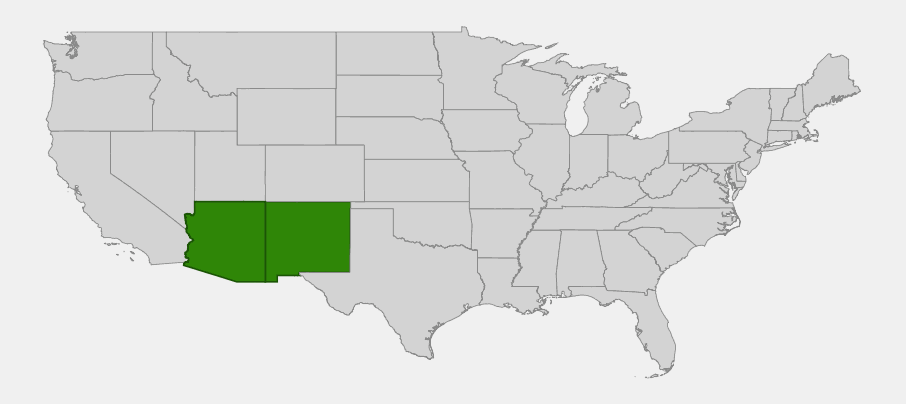
No wild-photographed, verifiably identified images of Eysenhardtia orthocarpa were available from Wikimedia Commons at the time this page was written; most “kidneywood” photos online show the related Mexican species Eysenhardtia polystachya or Texas kidneywood (E. texana). This page uses the native range map in place of a photo gallery; see the Identification section below for how to recognize the true species.
Eysenhardtia orthocarpa, commonly known as Kidneywood (also called Tahitian Kidneywood or Desert Kidneywood, and palo dulce in Spanish), is a drought- and cold-deciduous shrub or small tree in the pea family (Fabaceae). In the United States it is a true specialty plant, found naturally in only a narrow slice of the country — the sky-island mountains and canyons of southeastern Arizona and the extreme bootheel of southwestern New Mexico — before its range continues south into the Sierra Madre Occidental of Sonora, Mexico.
Kidneywood’s claim to fame is its flowers. From late spring into fall, the ends of its branches erupt in narrow, spike-like clusters of tiny white blooms with a sweet, honey-like fragrance that can scent an entire hillside after a summer rain. Bees and butterflies find it irresistible, and beekeepers in its native range prize it as an excellent honey plant. The rest of the year it is a modest, airy, gray-barked shrub with fine, fern-like pinnately compound leaves that cast light, dappled shade.
For gardeners in the low and middle elevations of southern Arizona and southwestern New Mexico, kidneywood is a rewarding native choice for a sunny, well-drained spot: a drought-tolerant, wildlife-friendly shrub or small patio tree that asks for very little once established and rewards you with fragrant flowers for months at a stretch.
Identification
Kidneywood grows as a many-stemmed shrub or, with some pruning, a small single- or multi-trunked tree, typically 6 to 15 feet tall but occasionally reaching 20 feet in favorable sites. The overall form is open and airy rather than dense, with slender, erect to spreading woody stems and no thorns.
Bark & Stems
The bark is gray and smooth on young growth, becoming fissured and shredding in thin strips as the plant ages, which gives older specimens a shaggy, textured trunk. Twigs are slender and finely hairy when young.
Leaves
Leaves are once-pinnately compound, 2 to 4 inches long, made up of 13 to 47 small, narrow leaflets arranged in pairs along a central stalk. The foliage is green to grayish-green and has a light, lacy texture that filters rather than blocks sunlight. The crushed foliage is pleasantly aromatic. Kidneywood is drought-deciduous, dropping its leaves during extended dry spells or hard freezes and releafing quickly once moisture returns.
Flowers & Fruit
Flowers are borne in narrow, upright, spike-like racemes at the tips of the branches, each spike packed with dozens of tiny, showy white pea-type flowers. The blooms carry a strong, sweet, vanilla-like fragrance and open over a long season, typically from April or May into August or September, often flushing heaviest after summer rains. Flowers are followed by small, flat, oblong seed pods, each containing a single kidney-shaped, red-brown seed — the detail that gives the plant its common name.
Quick Facts
| Scientific Name | Eysenhardtia orthocarpa |
| Family | Fabaceae (Pea/Legume) |
| Plant Type | Drought-deciduous shrub or small tree |
| Mature Height | 6–15 ft, occasionally to 20 ft |
| Mature Spread | 6–12 ft, multi-stemmed and spreading |
| Growth Rate | Moderate to fast with occasional irrigation; slower on dry sites |
| Sun Exposure | Full Sun |
| Water Needs | Low once established; occasional deep watering encourages more bloom |
| Soil Type | Rocky, gravelly, or sandy; must be well-drained |
| Soil pH | Neutral to alkaline, typical of desert soils |
| Bloom Time | April/May – August/September, often flushing after rain |
| Flower Color | White, fragrant |
| Fall Color | None notable; drought/cold deciduous, drops leaves in dry or cold spells |
| Fruit | Small flat pod with one kidney-shaped red-brown seed |
| Deer Resistant | No; foliage is browsed by deer, livestock, and other wildlife |
| USDA Hardiness Zones | 8–10 (hardy to about 16°F / -9°C) |
Native Range
In the United States, kidneywood is a true rarity, native only to southeastern Arizona and the extreme southwestern bootheel of New Mexico. It occupies the Madrean sky islands — the chain of isolated mountain ranges where the Sierra Madre Occidental of Mexico reaches into the borderlands — and is far more common and widespread to the south, where its range continues through eastern Sonora into central Mexico as far as Jalisco.
Within this range, kidneywood grows at middle elevations of roughly 3,500 to 5,500 feet, on rocky hillsides, gravelly ridges, in canyons, and along arroyos and watercourses. Typical plant communities include semi-desert grassland, oak woodland, thornscrub, and the upper margins of the Sonoran and Chihuahuan deserts, often alongside other Madrean species adapted to the region’s biseasonal rainfall pattern of winter and summer (monsoon) moisture.
Because its U.S. range is so limited, kidneywood should be considered a true specialty native restricted to the warmer, drier basins and foothills of southeastern Arizona and adjacent New Mexico. Gardeners elsewhere in the Southwest, including most of Arizona outside the southeast corner, should not treat it as locally native, though it performs well in cultivation at low and middle desert elevations with similar climate.
📋 Regional plant lists featuring Kidneywood: Arizona & New Mexico
Growing & Care Guide
Kidneywood is an easy, low-water shrub for gardeners within or near its native elevation range in the warmer parts of the Southwest. Give it sun, sharp drainage, and a little patience between flushes of bloom, and it needs almost nothing else.
Light
Plant kidneywood in full sun. It is naturally a plant of open, rocky slopes and grassland margins, and it flowers most heavily with maximum sun exposure. In light shade it survives but blooms less and grows looser and leggier.
Soil & Water
Good drainage is essential; kidneywood grows naturally on rocky, gravelly, and sandy soils and will not tolerate soggy or heavy clay ground. It is drought-tolerant once established and can be grown with little supplemental water, but occasional deep irrigation during the growing season encourages more vigorous growth and heavier, longer-lasting bloom flushes. In cultivation it responds well to the same irregular deep-soak-and-dry cycle that desert monsoon rains provide in the wild.
Planting Tips
Set out container-grown plants in spring or fall, when temperatures are moderate, and avoid planting right before a hard freeze while roots are still shallow. Choose a site with excellent drainage, such as a raised bed, slope, or native decomposed-granite soil. Kidneywood tolerates the reflected heat of walls and paving well, which makes it a good choice for patios and courtyards where its fragrance can be fully appreciated.
Pruning & Maintenance
Kidneywood can be left as a loose, naturalistic multi-stemmed shrub or trained into a small single- or multi-trunked tree by selectively removing lower branches. Prune in late winter before new spring growth to shape the plant and remove dead or crossing wood; it tolerates fairly hard pruning and responds with fresh growth. Litter is minimal, and the plant has few pest or disease problems in its preferred dry, well-drained conditions.
Landscape Uses
- Patio and courtyard specimen, prized for fragrance near seating areas and entries
- Pollinator and wildlife gardens, where its long bloom season supports bees and butterflies
- Xeriscape and low-water plantings in southern Arizona and New Mexico landscapes
- Informal hedges or screens when planted in groups and allowed to grow naturally
- Honey bee forage plantings, reflecting its regional reputation as a strong nectar source
Wildlife & Ecological Value
Kidneywood’s long, fragrant bloom season makes it a disproportionately important nectar source in the dry foothill habitats where it grows.
For Pollinators
The abundant, sweet-scented white flowers are highly attractive to native bees and honeybees — so much so that kidneywood has a long-standing reputation among beekeepers in its native range as an excellent honey plant. Butterflies, moths, and a variety of other nectar-seeking insects also visit the flower spikes regularly through the long bloom season.
For Birds & Mammals
Hummingbirds visit the flowers for nectar, and small mammals and granivorous birds make use of the seeds and the cover the shrub provides. The foliage is palatable and is browsed by deer, javelina, and livestock where the plant grows within reach, which is part of why it can be slow to establish in areas with heavy grazing pressure.
Ecosystem Role
As a nitrogen-fixing member of the pea family, kidneywood contributes to soil fertility in the rocky, nutrient-poor slopes and canyons where it grows, alongside other legume shrubs typical of Madrean grassland and oak woodland. Its light, airy canopy allows grasses and wildflowers to grow beneath it rather than shading them out, so it fits into open grassland and savanna settings without dominating the ground layer.
Cultural & Historical Uses
Across its range in Mexico and the borderlands, people have long called this group of plants palo dulce (“sweet wood”) for the pleasant fragrance of the flowers and wood. The wood itself has been put to a variety of practical uses locally, including small construction and tool-handle work, where its density and durability are valued.
A related, better-known species, Eysenhardtia polystachya (Mexican kidneywood), has a documented traditional use in Mexico: cups and vessels carved from its wood were used to treat water for kidney and urinary complaints, a practice tied to the genus’s common name across the Americas. This historical use belongs to that related species and to folk tradition rather than established medicine, and it should be understood as history, not a guide to using kidneywood today.
In the modern Southwest, kidneywood’s main role is horticultural rather than historical: it has become an increasingly popular low-water native for xeriscape gardens, valued for its fragrance, its long bloom season, and the support it offers to native bees and honeybees in a region where water-wise, wildlife-friendly landscaping is increasingly the standard.
Frequently Asked Questions
Is kidneywood native to all of Arizona?
No. In the United States, kidneywood is native only to southeastern Arizona and the extreme southwestern corner (bootheel) of New Mexico. It does not occur naturally in central, northern, or western Arizona, so gardeners elsewhere in the state should check local native plant resources for alternatives suited to their area.
How fragrant are kidneywood flowers?
Very. The tiny white flowers carry a sweet, vanilla-like scent that can perfume an entire patio or hillside, especially after summer rain triggers a fresh flush of bloom. This fragrance is a major reason the plant is grown ornamentally near outdoor living spaces.
Does kidneywood lose its leaves?
Yes. Kidneywood is drought- and cold-deciduous, meaning it drops some or all of its leaves during extended dry periods or hard freezes and releafs once favorable conditions return. This is a normal adaptation to its semi-arid native climate, not a sign of a sick plant.
How much water does kidneywood need?
Very little once established — it survives on rainfall alone in much of its native range. Occasional deep watering during the growing season will produce faster growth and more abundant flowering, but established plants are genuinely drought-tolerant and should not be kept in constantly moist soil.
Can kidneywood be grown as a small tree?
Yes. Although it naturally grows as a multi-stemmed shrub, kidneywood can be trained into a small single- or multi-trunked tree by selectively pruning out lower branches while the plant is young, making it a good choice for patios and other tight spaces.

Looking for a nursery that carries Kidneywood?
Browse our native plant nursery directory: Arizona · New Mexico