Climbing False Buckwheat (Fallopia scandens)
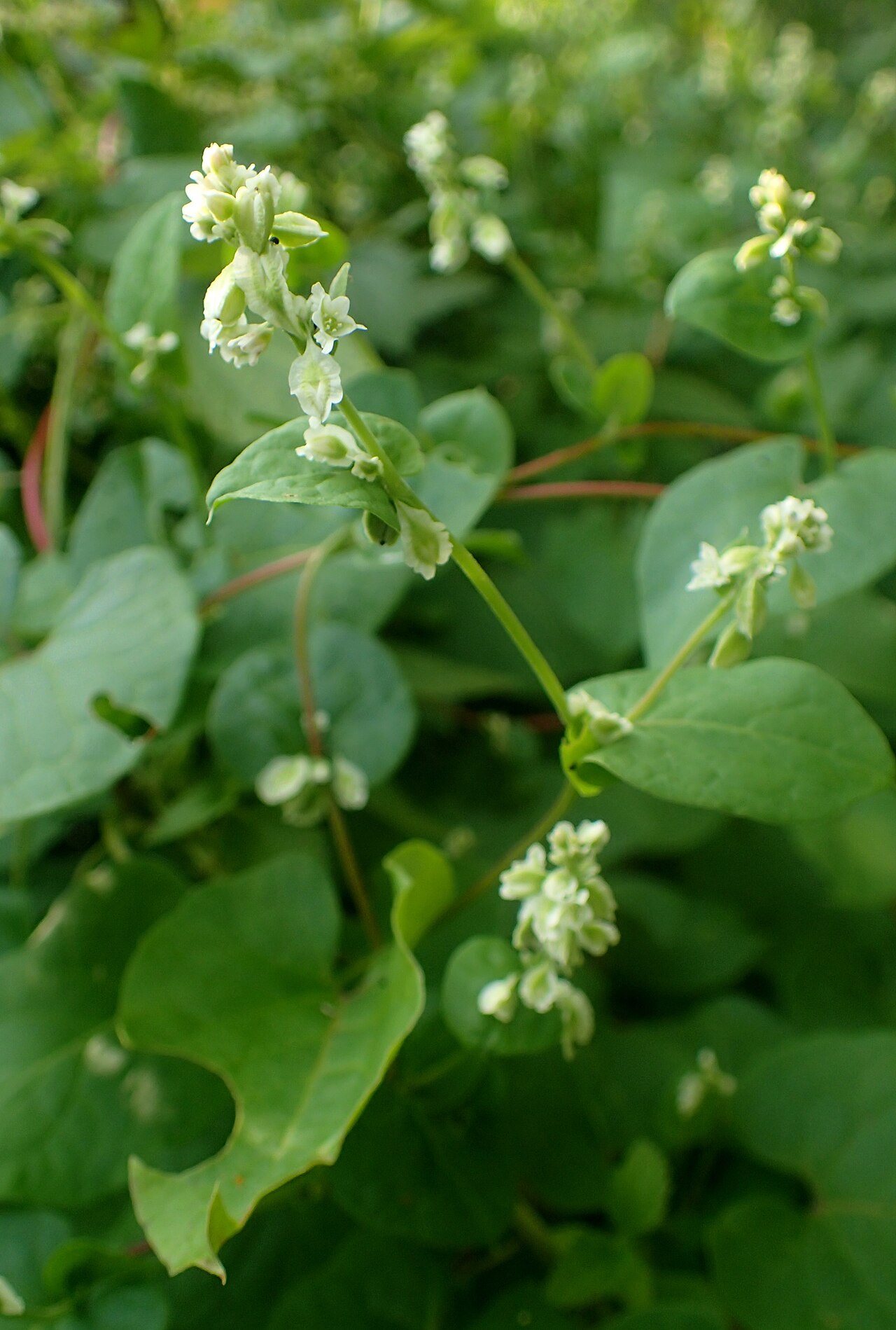
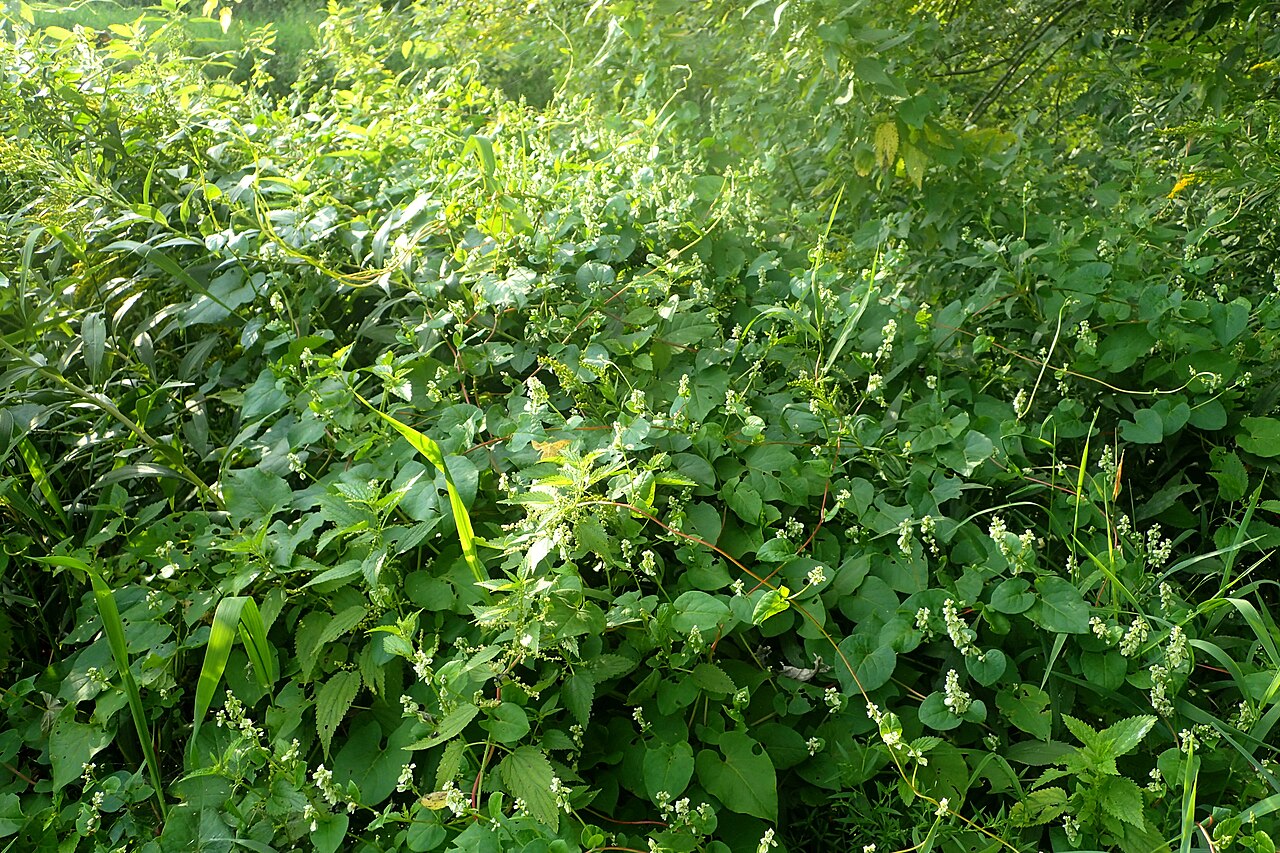
Fallopia scandens (syn. Polygonum scandens), commonly known as Climbing False Buckwheat or Climbing Buckwheat, is a fast-growing native vine in the knotweed family (Polygonaceae) found across most of the eastern and central United States. It is a true twining vine, wrapping its slender stems around fences, shrubs, and taller herbaceous plants as it climbs, and it can also sprawl along the ground where nothing is available to climb. By late summer it is covered in loose, airy racemes of small greenish-white flowers that mature into papery, three-winged fruits — a feature that quickly separates it from the invasive Asian knotweeds it is sometimes confused with by name alone.
This is not a showy specimen vine for a trellis near the front door; it is a vigorous, somewhat weedy native that thrives on disturbance. In the wild it colonizes woodland edges, fence rows, ditches, and streambanks, where it can scramble 10 to 20 feet in a single season and smother small shrubs if left unchecked. That same toughness makes it valuable in restoration plantings, naturalized hedgerows, and wildlife gardens where a fast-covering native vine is wanted more than a tidy one.
Climbing false buckwheat earns its keep ecologically. Its flowers are visited by a wide range of small bees, wasps, and flies, its foliage hosts several specialist moths and beetles, and its abundant winged seeds are an important food source for upland gamebirds, songbirds, and small mammals through fall and winter. For a native plant garden with room for a vigorous grower — along a fence, over a brush pile, or on a slope that needs quick cover — it is an easy, reliable choice.
Identification
Climbing false buckwheat is a herbaceous, twining perennial vine that dies back to the ground each winter and regrows from its base each spring. A single plant can reach 10 to 20 feet in length over a growing season, climbing by twining its stems counterclockwise around supports rather than using tendrils or holdfasts. Where there is nothing to climb, it sprawls across the ground or over low vegetation, forming tangled mats.
Stems
The stems are slender, round to slightly angled, and light green to reddish, often turning more red with age or in sunnier spots. They are largely smooth, though fine, stiff hairs can be felt along the low ridges running their length. At each leaf node the stem is slightly swollen, with a short papery sheath (an ocrea, typical of the buckwheat family) wrapped around the base of the petiole; this sheath lacks bristles and is shed as the stem matures.
Leaves
Leaves are simple, alternate, and heart- to arrowhead-shaped, typically 2 to 5½ inches long and 1 to 3 inches wide, tapering to a sharp point with a concave taper near the tip. The base is distinctly notched (cordate), and the margins are smooth, though the surface has a slightly rough, sandpapery texture from tiny stiff hairs along the veins and edges. Lower leaves have long petioles; upper leaves are smaller and nearly stalkless.
Flowers
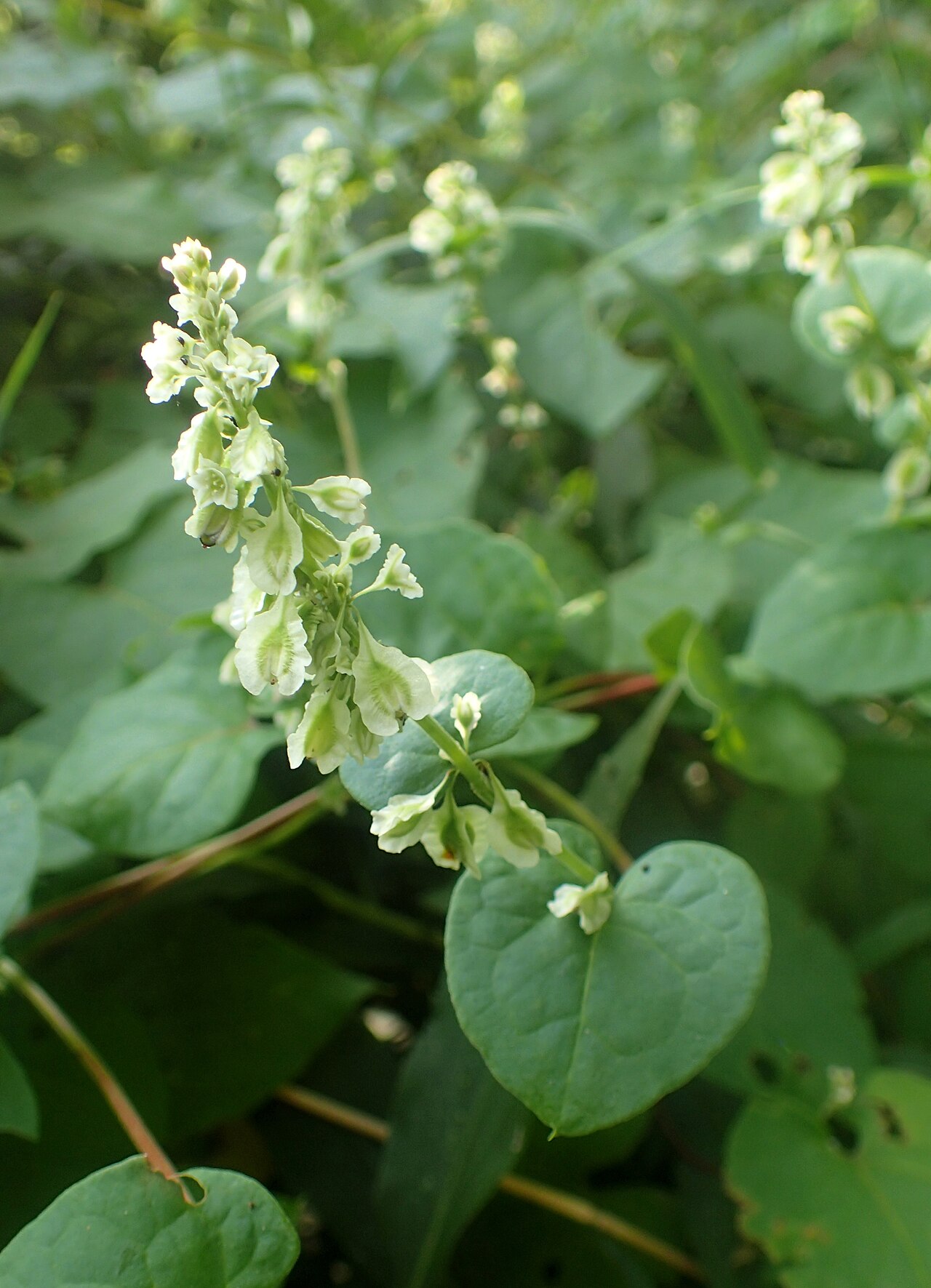
From midsummer into early fall, loose, erect racemes 2 to 8 inches long emerge from the leaf axils, each carrying many small flowers in loose whorls. Individual flowers are about 1/8 inch (4 mm) long with five greenish-white (occasionally faintly pink-tinged) tepals, eight stamens, and a three-parted style. The three outer tepals are conspicuously winged with a pale, often ruffled margin — the single best field mark for this species. Flowers open briefly held semi-erect, then droop downward on their pedicels as the fruit develops.
Fruit & Seeds
Each flower matures into a winged, papery fruit about 1/3 inch (8 mm) long, formed from the three enlarged, ruffled outer tepals enclosing a single three-angled achene. The fruit starts greenish-white and turns brown as it dries. The shiny, dark brown to black achenes inside are light enough to be carried by wind or to float on water, which helps the species colonize streambanks and disturbed ground.
Quick Facts
| Scientific Name | Fallopia scandens (syn. Polygonum scandens) |
| Family | Polygonaceae (Buckwheat/Knotweed) |
| Plant Type | Herbaceous perennial twining vine |
| Mature Height | Climbs or sprawls 3–20 ft in a season (dies back each winter) |
| Mature Spread | Several feet wide where it sprawls; spreads by reseeding |
| Growth Rate | Fast; can cover a fence or shrub in one growing season |
| Sun Exposure | Full Sun to Part Shade |
| Water Needs | Average to moist; tolerates drier soil once established |
| Soil Type | Adaptable; best in fertile loam, tolerates rocky or gravelly soil |
| Soil pH | Adaptable; roughly 5.5–7.5 |
| Bloom Time | July – September |
| Flower Color | Greenish-white, occasionally pink-tinged |
| Fall Color | Foliage yellows and dies back; winged brown fruit persists |
| Fruit | Papery, three-winged achene, about 1/3 in, brown at maturity |
| Deer Resistant | Moderate; not a preferred browse but can be nibbled |
| USDA Hardiness Zones | 3–9 |
Native Range
Climbing false buckwheat has one of the broadest native ranges of any twining vine in North America, stretching from the Great Plains to the Atlantic coast and from the Gulf states north into southern Canada. It is native across essentially the entire eastern half of the continental United States, from Maine and the Great Lakes states south to Florida and the Gulf Coast, and west through the Mississippi Valley and the Plains states as far as Wyoming and eastern Texas.
Within that range, it is a common and often overlooked plant, equally at home in moist bottomland forests and drier upland edges. Typical habitats include open woodland borders, floodplain forests, thickets, fence rows, streambanks, roadside ditches, and other disturbed, semi-open ground. It tolerates both consistently moist soil near water and drier, rockier sites inland, which partly explains why it turns up almost everywhere within its range.
This is a plant of edges and disturbance rather than deep forest interior. It thrives where some sunlight reaches the ground — along a tree line, beside a trail, or at the margin of a field — and it spreads readily into any open or lightly disturbed soil nearby. Gardeners in the western and southwestern states where it does not occur natively (most of the Rocky Mountain and Pacific states) should treat it as outside its native range and choose a regionally native vine instead.
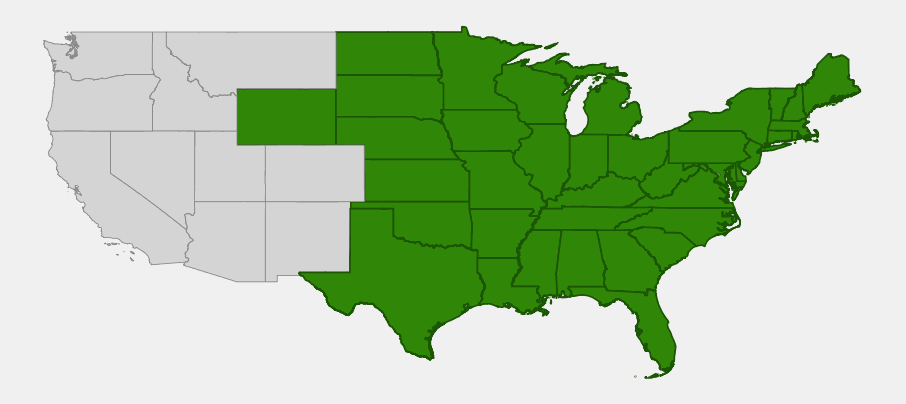
📋 Regional plant lists featuring Climbing False Buckwheat: Georgia, Alabama & Mississippi · Arkansas, Louisiana, Eastern Oklahoma & Eastern Texas · Illinois, Iowa & Missouri · Ohio & Indiana · Nebraska, Kansas & Eastern Colorado · Kentucky & Tennessee · New Hampshire, Maine & Vermont · Connecticut, Massachusetts & Rhode Island · Maryland, Virginia & West Virginia · Michigan, Wisconsin & Eastern Minnesota · North Dakota, South Dakota & Western Minnesota · North Carolina & South Carolina · New York, Pennsylvania & Northern New Jersey · Delaware, Southern New Jersey & Long Island · Montana & Wyoming
Growing & Care Guide
Climbing false buckwheat is about as easy to grow as a native vine gets — so easy that the main challenge is giving it a spot where its vigor is an asset rather than a nuisance.
Light
This vine flowers most heavily in full sun to light shade. It tolerates part shade well, flowering a bit less but still growing vigorously, which makes it useful along a partly shaded fence line or woodland edge. Deep shade slows it considerably and reduces bloom.
Soil & Water
It is not particular about soil. Fertile, moist loam near a stream or ditch produces the largest, fastest-growing plants, but it also does fine in average garden soil and tolerates rocky or gravelly ground once established. It prefers average to moist conditions but handles short dry spells without trouble. Good drainage is helpful but not essential; it is also found growing in low, periodically wet ground.
Planting Tips
Give climbing false buckwheat something sturdy to climb — a fence, a chain-link panel, a brush pile, or an established shrub or small tree that can take some cover without being smothered. Plant it where its spread is welcome: along a back fence, on a slope that needs fast cover, or as part of a naturalized hedgerow. Keep it well away from small shrubs, perennials, or anything you don’t want engulfed, since it can grow 10 feet or more in a single season.
Pruning & Maintenance
The vine dies back to the ground each winter in most of its range, so little pruning is needed beyond clearing away the dead top growth in late winter if you want a tidier look. During the growing season, cut it back hard if it starts climbing over something you want to keep clear; it resprouts readily from the base. Because it reseeds freely, pull unwanted seedlings while they are small if you want to keep it contained to one area.
Landscape Uses
- Fast cover for fences and chain-link where a tidy ornamental vine is not the goal
- Naturalized hedgerows and brush piles, where it adds structure and winter seed for wildlife
- Erosion control on slopes and streambanks, helped by its tolerance of periodic flooding
- Wildlife and pollinator gardens, for its late-season flowers and abundant winter seed
- Restoration plantings along woodland edges and disturbed ground
Wildlife & Ecological Value
Despite its unassuming reputation as a “weedy” vine, climbing false buckwheat supports a surprising amount of wildlife through the growing season and into winter.
For Pollinators
The small flowers attract a wide range of short-tongued insects, mostly in search of nectar: halictid (sweat) bees, masked bees, andrenid bees, various small wasps, and syrphid and muscid flies. Butterflies visit less often. Several specialist insects also feed on the foliage and stems, including the brassy flea beetle, the knotweed leaf beetle, a leaf-mining beetle, and the larvae of a case-bearer moth and a geometer moth called the cross-lined wave.
For Birds
The abundant winged seeds are an important fall and winter food source for upland gamebirds and a variety of songbirds, which forage through the dried racemes well into the cold months. The dense tangle of foliage also provides cover for nesting and roosting birds along the woodland edges where this vine typically grows.
For Mammals
Small mammals such as the white-footed mouse and deer mouse eat the seeds, and American black bears have been documented feeding on them as well. The dense cover created by a sprawling or climbing patch of this vine offers useful concealment for small mammals moving along forest edges and fence rows.
Ecosystem Role
As an early colonizer of disturbed, semi-open ground, climbing false buckwheat helps stabilize soil on streambanks and slopes while other, slower-growing natives establish nearby. Its wind- and water-dispersed seeds let it move quickly into fresh disturbance, filling a niche similar to other pioneer vines before woodier plants take over the site.
Cultural & Historical Uses
Climbing false buckwheat has no significant documented history as a food, fiber, or medicinal plant among Indigenous peoples or early settlers, unlike some of its showier buckwheat-family relatives. Its common name reflects its resemblance, in flower and fruit structure, to true buckwheat (Fagopyrum esculentum), an unrelated Eurasian crop plant in the same family — hence “false buckwheat” rather than an edible grain crop.
Historically, botanists have spent more energy sorting out this species’ taxonomy than its uses. It has been shuffled between the genera Polygonum, Bilderdykia, Tiniaria, and Fallopia over the past two centuries, and some older floras split it into two or three closely related species based on subtle differences in the width of the fruit wings. Most current treatments, including Flora of North America, recognize a single variable species.
In more recent decades, climbing false buckwheat has drawn attention mainly from native-plant gardeners and restoration ecologists looking for a fast, tough native vine to replace non-native, often invasive climbers like Oriental bittersweet or Japanese honeysuckle on fences and disturbed ground. Its vigor, once seen only as weediness, is now valued as a quick, no-fuss way to add native vertical cover and wildlife food to a planting.
Frequently Asked Questions
Is climbing false buckwheat invasive?
No — it is native to most of the eastern and central United States and southern Canada. It can be aggressive and spread readily by seed within its native range, so give it room and keep it away from small plants you don’t want smothered, but it is not an introduced or invasive species where it occurs naturally.
Is climbing false buckwheat the same as Japanese knotweed?
No. Despite the similar common names and family (Polygonaceae), Japanese knotweed (Reynoutria japonica) is an unrelated, non-native, rhizomatous shrub-like plant that is seriously invasive. Climbing false buckwheat is a native herbaceous twining vine that dies back to the ground each winter and spreads by seed, not spreading rhizomes.
Can you eat climbing false buckwheat?
It is not a food plant. “False buckwheat” refers to its resemblance to true buckwheat, not to an edible grain or vegetable use, and there is no established record of it being eaten by people. Leave the seeds for the birds and small mammals that rely on them.
How fast does climbing false buckwheat grow?
Very fast. A single plant can climb or sprawl 10 to 20 feet in one growing season under good conditions, reaching full size well before its midsummer bloom period.
Will climbing false buckwheat kill my shrubs?
It can smother small shrubs if left unchecked, since it twines over whatever is nearby and grows quickly. It is best planted on a fence, a sturdy structure, or a larger, well-established shrub or small tree that can tolerate the extra cover, and cut back if it starts to overwhelm something you want to protect.

Looking for a nursery that carries Climbing False Buckwheat?
Browse our native plant nursery directory: Alabama & Arkansas · Connecticut, Delaware, Florida & Georgia · Illinois, Indiana, Iowa & Kansas · Kentucky, Louisiana, Maine, Maryland, Massachusetts, Michigan, Minnesota, Mississippi & Missouri · Nebraska, New Hampshire, New Jersey, New York, North Carolina, North Dakota, Ohio & Oklahoma · Pennsylvania, Rhode Island, South Carolina, South Dakota, Tennessee, Texas, Vermont & Virginia · West Virginia, Wisconsin & Wyoming