White Trout Lily (Erythronium albidum)
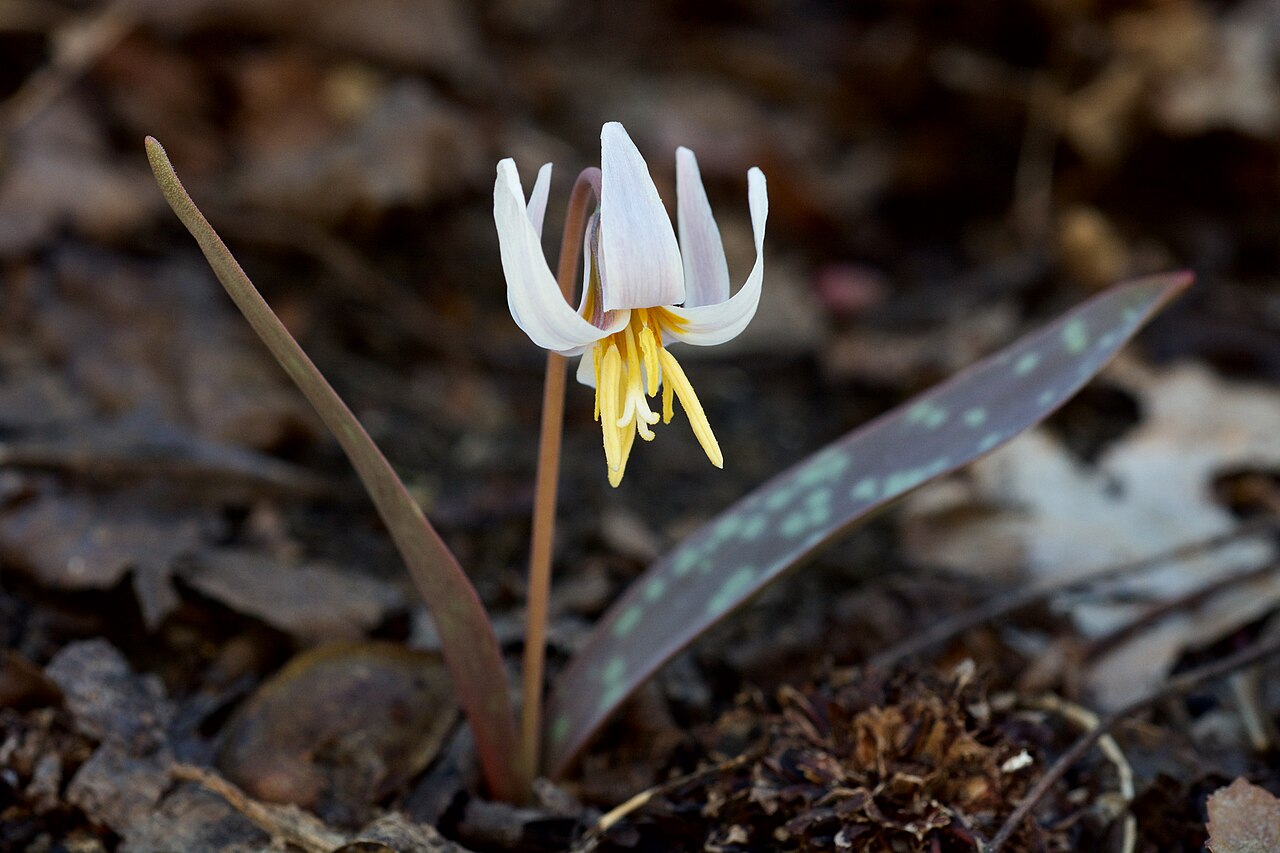
Erythronium albidum, commonly called White Trout Lily or White Fawnlily, is a small spring-ephemeral wildflower of eastern and central North American woodlands. It belongs to the lily family (Liliaceae) and is named for its mottled, brownish-green leaves, said to resemble the markings on a brook trout’s side. Other common names you may hear locally include white dog-tooth violet, adder’s tongue, and serpent’s tongue, all references to the pointed, tongue-like leaf shape.
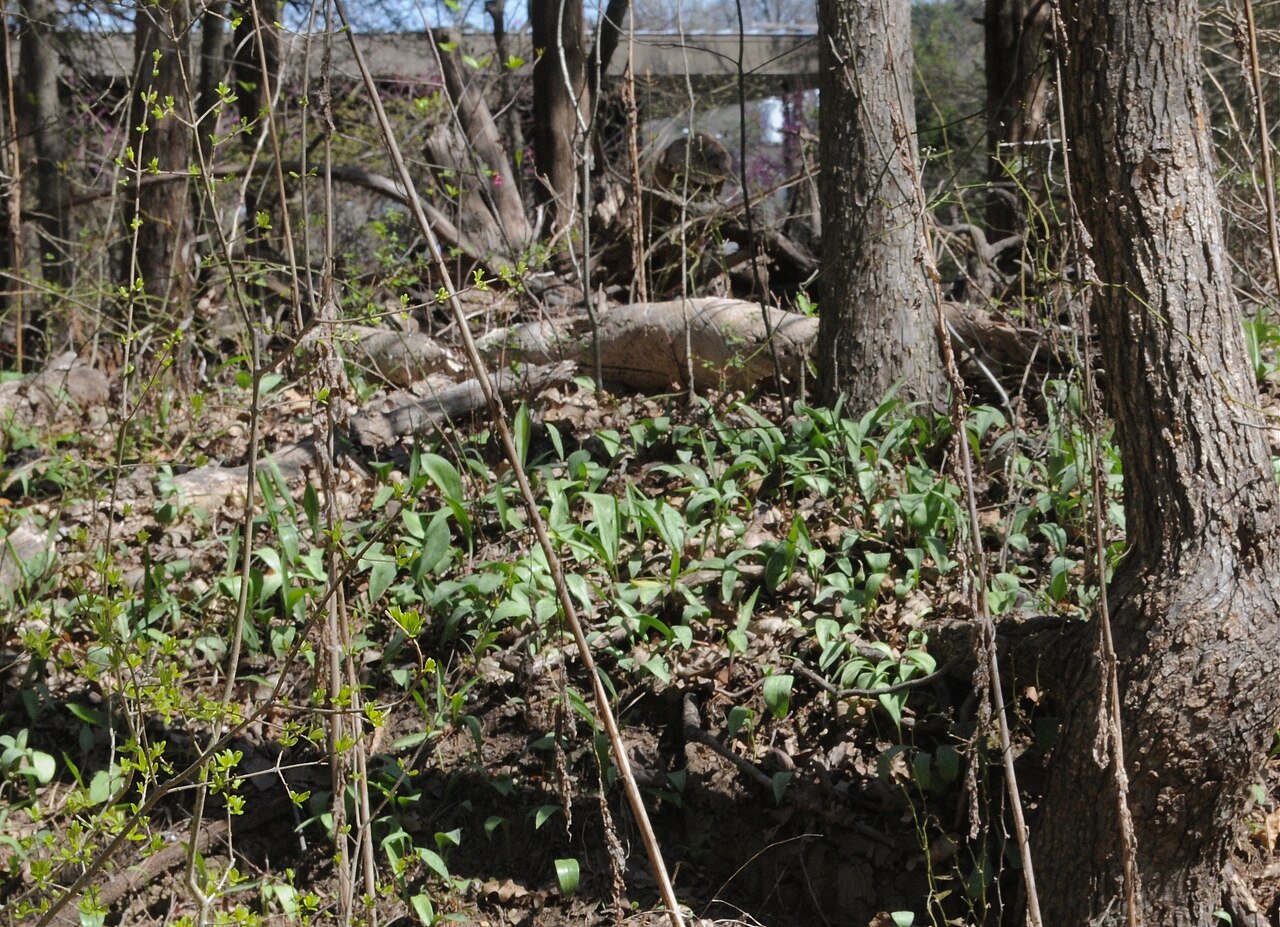
Each spring, white trout lily carpets the floor of rich deciduous woods with pairs of dappled leaves and nodding, lily-shaped white flowers before the forest canopy fully leafs out. The plant is a true ephemeral: its entire above-ground growth appears, blooms, sets seed, and withers away within about two months, all before summer shade shuts down the woodland floor. What looks like a single plant is usually part of a much larger colony connected underground by a deep corm and slender stolons, many of which are young, single-leaved plants that are still years away from blooming.
White trout lily is an excellent, low-maintenance choice for a shaded native woodland garden, but it rewards patience rather than quick results. Colonies increase very slowly, and a corm grown from seed may take four to seven years to reach flowering size. Because of this slow pace, it is important to buy nursery-propagated plants and never dig corms from wild populations, which can take decades to recover from collecting and are already under pressure from habitat loss across much of their range.
Identification
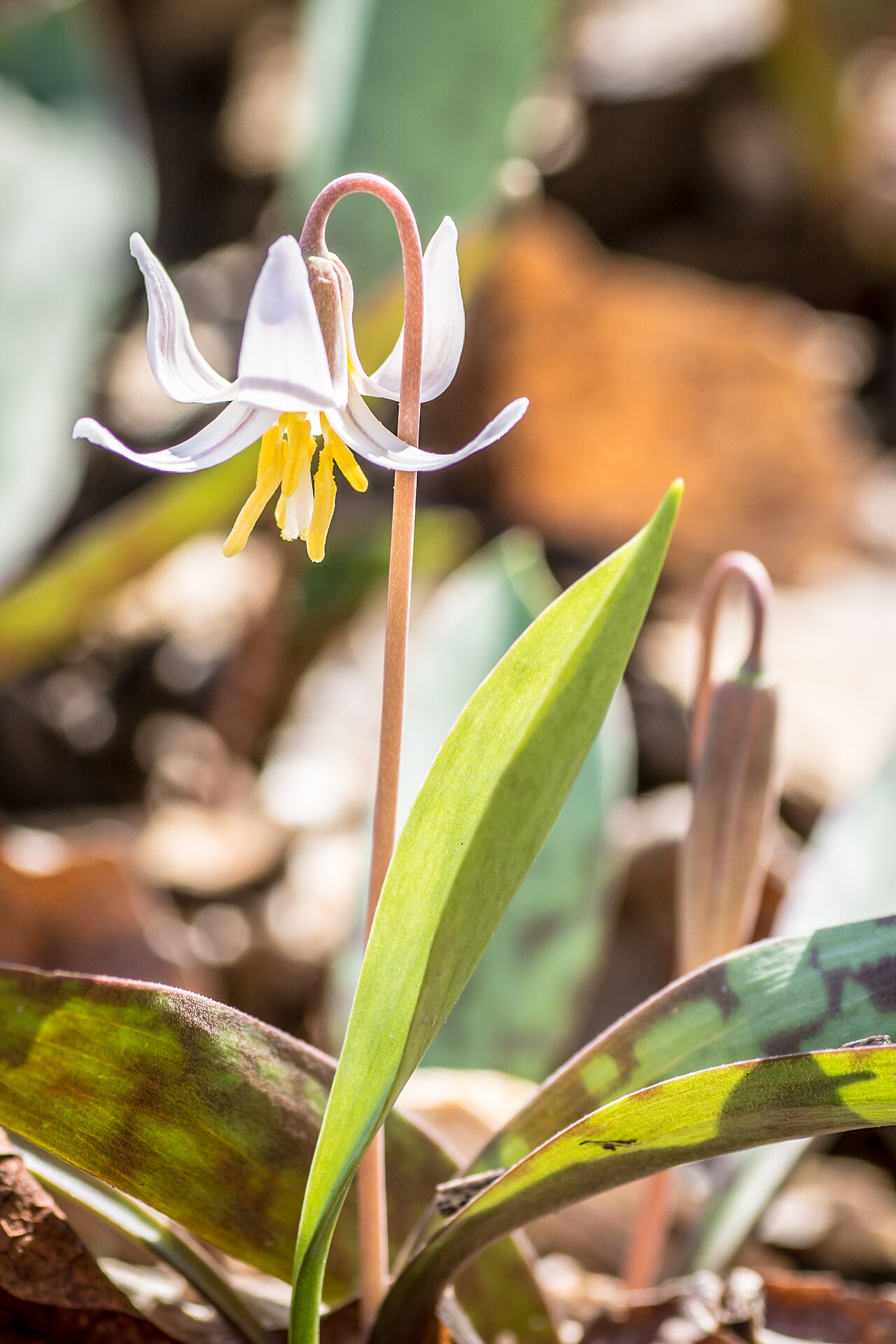
White trout lily grows low to the ground, typically 4 to 10 inches tall when in flower, from a deep, tooth-shaped corm often compared to a small dog’s tooth (the source of one of its common names). A mature flowering plant produces exactly two basal leaves; the many single-leaved shoots scattered around it in a colony are immature, non-flowering offsets that have not yet built up enough reserves to bloom.
Corm & Leaves
The corm sits several inches deep in the soil and sends up slender stolons that allow the colony to creep outward over many years, eventually forming dense patches. The paired leaves are lance-shaped to elliptical, 3 to 6 inches long and roughly 1 to 1½ inches wide, smooth-edged, and mottled with irregular brown or maroon blotches over a pale green ground color. This mottling fades somewhat as the season progresses. By early to mid-summer the foliage yellows and dies back completely, and the plant disappears from view until the following spring.
Flowers
A single flower nods atop a slender, leafless stalk (scape) that rises between the two leaves. The flower opens white to very pale lavender, often with a yellow base and a violet or purplish wash on the outside of the petals near the stem. Six tepals (three petals and three petal-like sepals) curve sharply backward as the bloom matures, and six stamens with yellow to brownish anthers hang beneath the flower. Flowers close at night and on cloudy days and reopen in sun, a trait shared with many spring ephemerals that conserves pollen for the short window when pollinators are active. Bloom time runs from March in the southern part of the range to May farther north.
Fruit & Seeds
After pollination the flower stalk straightens and a three-chambered seed capsule develops close to the ground, ripening by late spring. Each capsule splits to release numerous small seeds, each bearing a fleshy, nutrient-rich appendage called an elaiosome. Ants collect the seeds for this food reward and carry them back to their nests, eating the elaiosome and discarding the seed underground — a dispersal strategy called myrmecochory that is common among spring woodland wildflowers.
Quick Facts
| Scientific Name | Erythronium albidum |
| Family | Liliaceae (Lily) |
| Plant Type | Perennial spring-ephemeral wildflower (corm) |
| Mature Height | 4–10 in (10–25 cm) in flower |
| Mature Spread | Individual plant 3–4 in; colonies widen slowly over decades |
| Growth Rate | Very slow (4–7 years from seed to first bloom) |
| Sun Exposure | Part Shade to Full Shade |
| Water Needs | Average; moist in spring, tolerates dry summer dormancy |
| Soil Type | Rich, moist, well-drained woodland humus |
| Soil pH | 5.5–7.0 (slightly acidic to neutral) |
| Bloom Time | March – May, depending on latitude |
| Flower Color | White, often tinged lavender or violet |
| Fall Color | None (foliage withers in early summer) |
| Fruit | Small 3-parted capsule; seeds dispersed by ants |
| Deer Resistant | Moderately (not a preferred browse) |
| USDA Hardiness Zones | 3–8 |
Native Range
White trout lily is native to a broad swath of the eastern and central United States, from the upper Midwest and mid-Atlantic south to the Gulf Coast states and west to the eastern Great Plains. It reaches its northern limit around the Great Lakes and into southern Ontario and Quebec, and its western limit in the eastern Dakotas, Nebraska, Kansas, and eastern Texas. It is absent from New England, where a single historical, naturalized population in Connecticut is the only record — this species should not be planted as though it were native there.
Within this range, white trout lily is a plant of rich, mesic deciduous and mixed hardwood forests: floodplain terraces, lower slopes, and ravines with deep, well-drained loam that stays consistently moist through late winter and spring. It is especially characteristic of maple-basswood and oak-hickory woodlands with a well-developed spring wildflower layer, and it often grows in large, long-established colonies that signal a woodland has never been plowed, grazed heavily, or compacted by machinery.
Because the species spreads mainly by slow-growing stolons and ant-dispersed seed, existing colonies can be centuries old, and new colonies establish very slowly even under ideal conditions. Habitat loss from clearing and development, along with illegal collecting of wild corms for the nursery trade, has reduced populations in parts of its range, so protecting existing woodland colonies matters as much as planting new ones.
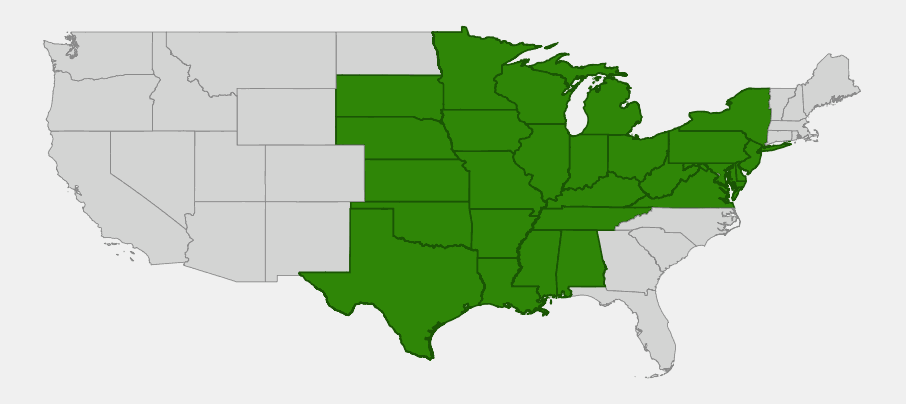
📋 Regional plant lists featuring White Trout Lily: Michigan, Wisconsin & Eastern Minnesota · North Dakota, South Dakota & Western Minnesota · Illinois, Iowa & Missouri · Ohio and Indiana · Kentucky and Tennessee · Georgia, Alabama & Mississippi · Arkansas, Louisiana, Eastern Oklahoma & Eastern Texas · Maryland, Virginia & West Virginia · New York, Pennsylvania & Northern New Jersey · Nebraska, Kansas & Eastern Colorado · Delaware, Southern New Jersey & Long Island, New York
Growing & Care Guide
White trout lily is easy to please once it has the right site, but it is not a fast or showy addition to the garden — think of it as a long-term investment in a woodland planting rather than an instant result.
Light
Give it the dappled light of a deciduous woodland: full sun in very early spring before trees leaf out, followed by part to full shade through the rest of the growing season. Under deciduous trees or tall shrubs is ideal. It does not need, and will not tolerate, exposed full-sun sites through the summer.
Soil & Water
Plant it in rich, humus-heavy loam that drains well but holds moisture through late winter and spring, when the plant is actively growing. A slightly acidic to neutral pH (around 5.5–7.0) matches its native woodland soils. Once the foliage dies back in early summer, the corm goes dormant and tolerates the drier conditions typical of a shaded forest floor in summer; it does not want to sit in soggy soil year-round.
Planting Tips
Always start with nursery-propagated corms or potted plants grown from cultivated stock — never dig corms from wild colonies. Wild populations are slow to recover from collecting, and a disturbed colony may take decades to rebuild itself. Plant corms in fall, about 3 inches deep, in drifts rather than single specimens, since the effect of a handful of corms scattered thinly is underwhelming. Mulch with shredded leaves to mimic the natural leaf litter of a woodland floor. Expect slow results: newly planted corms may take a few years to settle in and begin spreading, and seed-grown plants take even longer to flower.
Pruning & Maintenance
None needed. Let the foliage yellow and wither naturally after bloom; this is how the corm stores energy for next year, so resist the urge to tidy it up early. Leave fallen leaves in place over the colony each autumn as a natural mulch.
Propagation
In the garden, established colonies slowly multiply on their own by stolons and by self-sown, ant-dispersed seed. Gardeners can speed this along a little by lifting and separating offset corms from an already well-established, nursery-sourced planting once it is large enough to divide without harming it, replanting them immediately at the same depth. Growing from seed is possible but slow, typically taking four to seven years to reach flowering size, so most gardeners rely on nursery-propagated corms instead.
Landscape Uses
- Woodland gardens under deciduous trees, paired with other spring ephemerals
- Naturalized drifts along shaded paths and the edges of wooded lots
- Companion planting with Virginia bluebells, mayapple, bloodroot, and white trillium
- Shade gardens that need early-season color before the tree canopy fills in
- Restoration plantings in rich, undisturbed woodland soils
Wildlife & Ecological Value
Though small and short-lived above ground, white trout lily plays a real role in the early-spring woodland food web, at a time of year when few other flowering plants are active.
For Pollinators
The flowers are visited by small native bees, including mining bees in the genus Andrena that specialize on Erythronium pollen, as well as early-emerging queen bumblebees and some flies. Because the blooms open only in sunny conditions and close at night and in cold or cloudy weather, they offer a brief but valuable nectar and pollen source during the narrow window between snowmelt and full canopy leaf-out.
For Birds
White trout lily is not a major food plant for birds, but the dense leaf-litter colonies it grows in provide foraging habitat for ground-feeding species such as thrushes and towhees, which turn over leaves in search of insects and other invertebrates sheltering among the plants.
For Mammals
Eastern chipmunks, white-footed mice, and squirrels occasionally dig and eat the corms, and wild turkeys are known to scratch up and consume them as well. White-tailed deer may nibble the foliage, though it is not a preferred browse and is generally considered only lightly affected by deer pressure.
Ecosystem Role
As a spring ephemeral, white trout lily helps capture and cycle nutrients on the forest floor before the tree canopy closes and shades out ground-layer photosynthesis for the rest of the year. Its ant-dispersed seeds (myrmecochory) tie it into the local ant community, and large, undisturbed colonies are a strong indicator of long-term forest integrity, since the species spreads too slowly to recolonize land that has been cleared, plowed, or heavily disturbed within living memory.
Cultural & Historical Uses
Several Indigenous nations within the plant’s range, including peoples of the Iroquoian and Algonquian language families, used the corms of Erythronium species as a cooked food, typically boiling or roasting them to reduce their raw, emetic (vomit-inducing) properties before eating. The young leaves were also eaten in some areas. These uses are documented as historical ethnobotanical practice, not as a modern foraging recommendation; the corms require specific preparation to be palatable, and modern gardeners should leave wild colonies undisturbed.
Historical herbal traditions in North America also applied crushed trout lily leaves externally as a poultice for minor skin irritations and bruises. As with the food uses, this is a matter of historical record rather than a current medicinal recommendation, and no part of the plant should be treated as a home remedy.
In more recent horticultural history, white trout lily and its relatives have become prized subjects for woodland and rock gardeners drawn to spring ephemerals, and the plant appears frequently in field guides and wildflower walks as one of the signature early bloomers of the eastern hardwood forest, often noted alongside trilliums and spring beauties as a sign that the woodland spring has truly begun.
Frequently Asked Questions
Why do most of the leaves in a trout lily colony never flower?
A colony is made up of corms at many different ages. Only corms that have stored enough energy over several years produce two leaves and a flower; younger corms send up just a single leaf and spend that year building reserves. In most colonies, non-flowering single-leaved plants far outnumber the flowering ones.
Can I dig up trout lily corms from the woods to plant in my garden?
No. Wild colonies grow and spread extremely slowly, often over many decades, so removing corms can set a population back for generations. Buy nursery-propagated plants instead, which lets you enjoy the species without harming wild populations.
How long does it take for white trout lily to bloom from seed?
Typically four to seven years. The plant spends its early years as a single-leaved, non-flowering corm before it has enough stored energy to produce two leaves and a flower.
Is white trout lily the same as yellow trout lily?
No, they are two distinct species. White trout lily (Erythronium albidum) has white to pale lavender flowers, while yellow trout lily (Erythronium americanum) has yellow flowers; the two often grow in similar habitats and can even be found together.
What happens to white trout lily after it blooms?
The foliage continues photosynthesizing for a few weeks after flowering, storing energy in the corm, then yellows and dies back completely by early summer. The plant then stays dormant underground until the following spring, so don’t be alarmed when it disappears from the garden in June.

Looking for a nursery that carries White Trout Lily?
Browse our native plant nursery directory: Alabama & Arkansas · Delaware · Iowa, Illinois, Indiana & Kansas · Kentucky, Louisiana, Maryland, Michigan, Minnesota, Mississippi & Missouri · Nebraska, New Jersey, New York, Ohio & Oklahoma · Pennsylvania, South Dakota, Tennessee, Texas & Virginia · West Virginia & Wisconsin