Scouring Rush (Equisetum hyemale)
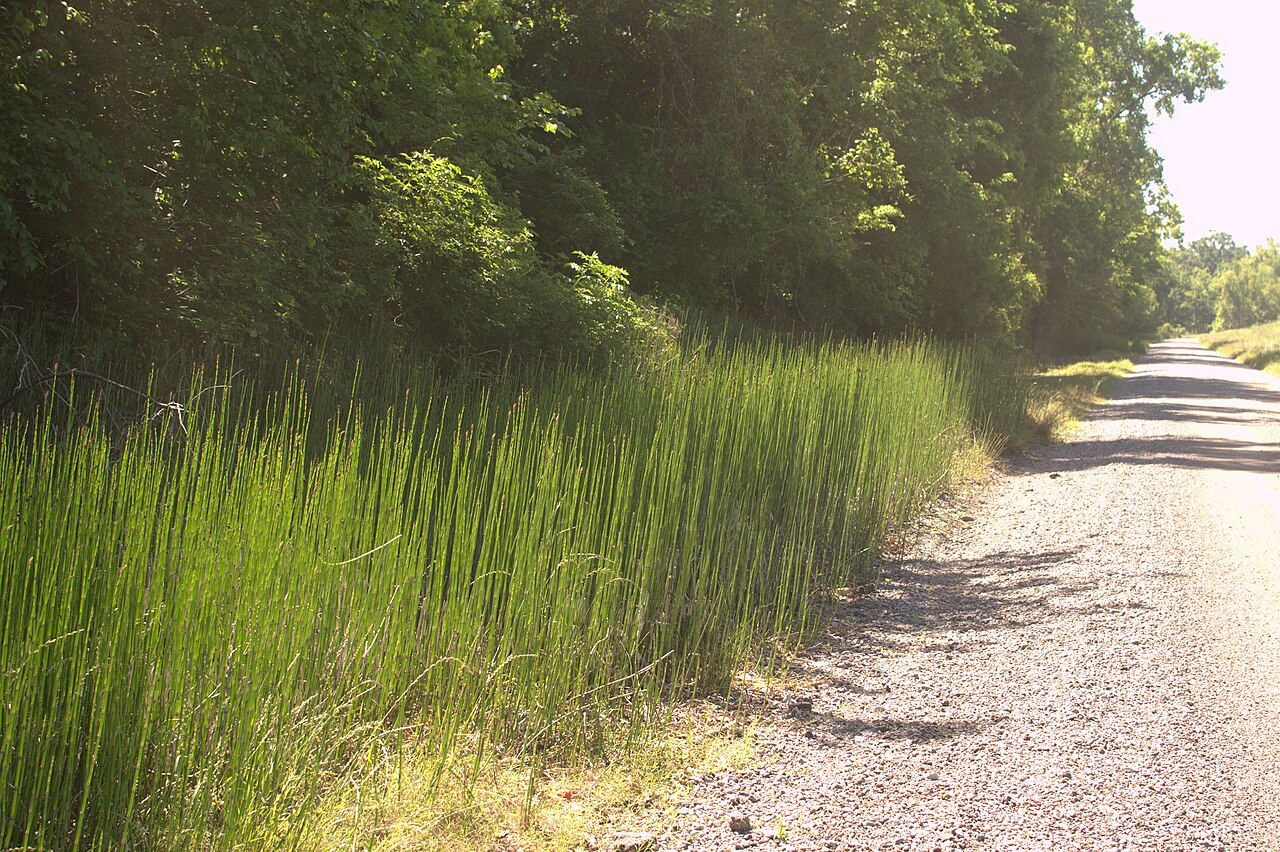
Equisetum hyemale, commonly called Scouring Rush or Rough Horsetail, is an evergreen, leafless perennial unlike almost anything else in the native flora. It belongs to the horsetails (Equisetaceae), an ancient lineage of spore-bearing plants whose ancestors towered over Carboniferous swamps 300 million years ago. What you see today is a humbler descendant: hollow, jointed, rush-like stems packed with silica, standing stiffly upright in wet ground from Alaska to the Gulf Coast.
The common name comes directly from use: the silica-impregnated stems were, for generations, the go-to natural scouring pad for cleaning pots, polishing wood, and even shaping reed instruments. In the garden, Scouring Rush reads as a strikingly architectural, almost bamboo-like accent — the kind of plant landscape designers reach for when they want crisp verticals next to a pond or along a modern walkway. It asks for very little once sited correctly: consistent moisture and room to run.
That last point is the plant’s defining feature and its biggest caveat. Scouring Rush spreads by tough, deep-running rhizomes and will colonize a moist bed with real determination, so it is best used in a contained spot — a pot, a bed bordered by pavement, or a spot where its colonizing habit is actually the goal, such as erosion control on a wet bank. It is also worth knowing before planting near pasture or livestock: the stems contain thiaminase and are toxic if browsed in quantity, a detail covered fully below.
Identification
Scouring Rush is leafless in the ordinary sense — what looks like a straight, unbranched green cane is actually the photosynthetic stem itself. There is no showy flower and no seed; like ferns, it reproduces by spores.
Stems
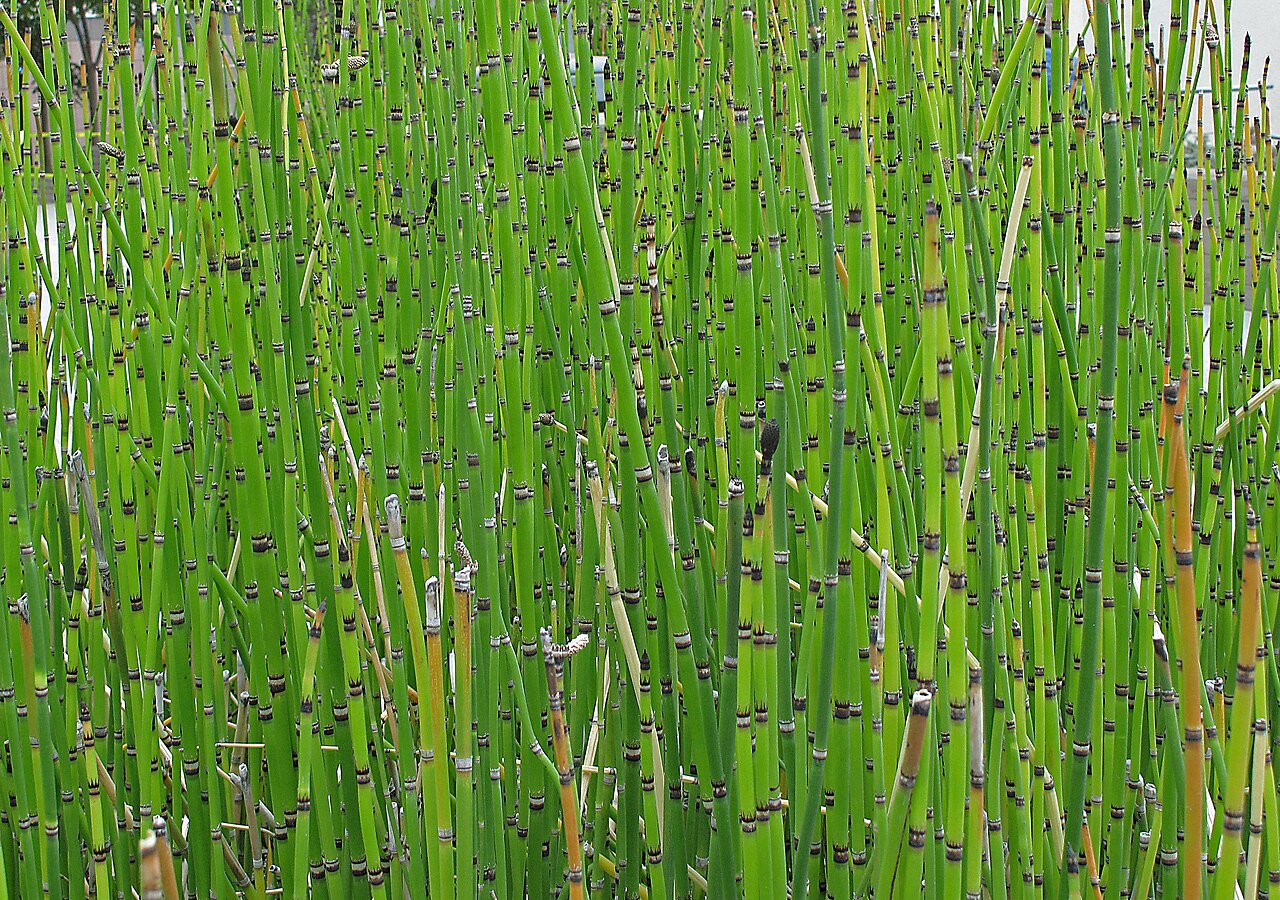
The hollow, jointed stems stand 2 to 5 feet tall and about ¼ to ½ inch thick, rarely branching except where damaged. They are ridged lengthwise with 10 to 30 fine, rough ribs impregnated with silica, which is what gives the plant its gritty, sandpaper-like texture and its old use as a natural abrasive. The stems stay medium to dark green year-round in mild climates, dying back to the rhizome only where winters are severe.
Joints & Sheaths
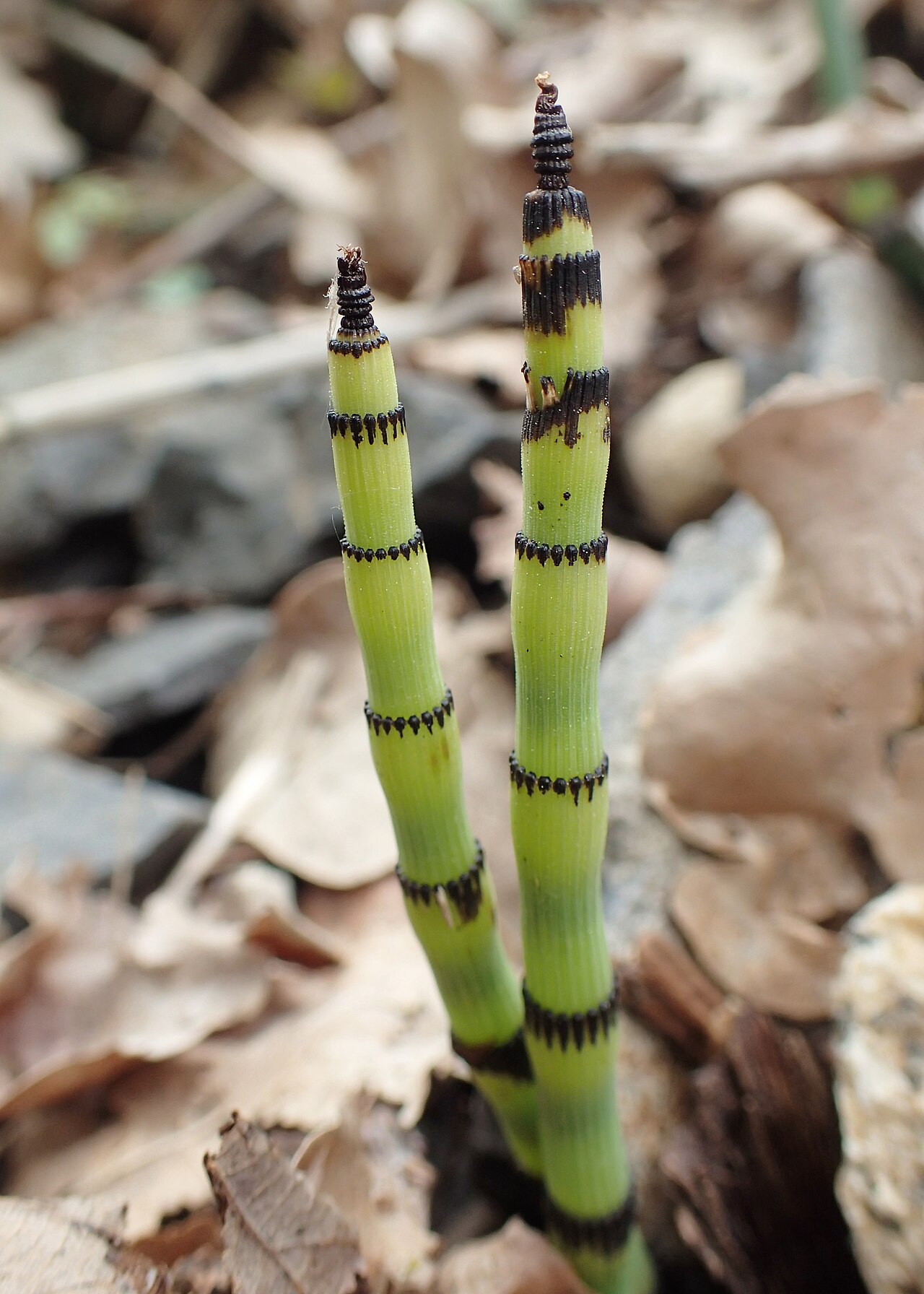
Each stem is divided into segments by regularly spaced joints. At every joint a narrow black-and-white (or black-and-gray) banded sheath wraps the stem — this banding is the single most reliable field mark for telling Scouring Rush apart from the many other, usually shorter and more branched, horsetail species.
Reproductive Cones
Fertile stems terminate in a small, pointed, cone-like structure (a strobilus) about ½ to 1 inch long, which releases spores rather than seeds. Cones can appear on the same stems used for photosynthesis, usually in late spring to summer.
Roots & Spread
Below ground, Scouring Rush relies on a system of deep, tough, black rhizomes that can run many feet from the parent clump. This is how the plant forms the dense, even-textured colonies it is known for — and why gardeners need a planting strategy that accounts for it from day one.
Quick Facts
| Scientific Name | Equisetum hyemale |
| Family | Equisetaceae (Horsetail) |
| Plant Type | Evergreen perennial fern ally (spore-bearing) |
| Mature Height | 2–5 ft |
| Mature Spread | Indefinite — spreads by rhizome; contain the roots |
| Growth Rate | Fast, by rhizome |
| Sun Exposure | Full sun to part shade |
| Water Needs | Wet to consistently moist; not drought tolerant |
| Soil Type | Clay, sand or loam; tolerates poor drainage |
| Soil pH | Neutral to alkaline preferred |
| Bloom Time | No flowers; spore cones late spring–summer |
| Flower Color | None (reproduces by spores) |
| Fall Color | Evergreen in mild climates; green stems persist |
| Fruit | None; spores released from terminal cones |
| Deer Resistant | Yes |
| USDA Hardiness Zones | 3–9 |
Native Range
Scouring Rush has one of the broadest native ranges of any plant profiled on this site, occurring in suitable wet ground across nearly the entire continental United States and into Alaska and Canada. It favors riverbanks, pond and lake margins, ditches, wet meadows, seeps, and low spots in open woods — anywhere soil stays consistently moist to wet for most of the growing season.
Because the species is so widespread, local abundance varies a great deal. In much of its range it grows scattered along streambanks and in forest wetlands; in the right conditions — a ditch, a pond edge, a disturbed wet spot — it can form the dense, pure colonies for which it’s known. It is absent from very dry regions and does not naturally occur in Hawaii.
A note on the name: some modern floras split North American plants once lumped under Equisetum hyemale into a separate species, Equisetum praealtum, reserving E. hyemale in the strict sense for Eurasia. USDA PLANTS, the reference used throughout this site, still treats the North American populations under Equisetum hyemale (symbol EQHY), and that is the name used here.

📋 Regional plant lists featuring Scouring Rush: Alaska · Georgia, Alabama & Mississippi · Arkansas, Louisiana, Eastern Oklahoma & Eastern Texas · Arizona & New Mexico · North Dakota, South Dakota & Western Minnesota · Delaware, Southern New Jersey & Long Island · Illinois, Iowa & Missouri · Idaho, Eastern Oregon & Eastern Washington · Ohio & Indiana · Kentucky & Tennessee · Maryland, Virginia & West Virginia · Michigan, Wisconsin & Eastern Minnesota · Montana & Wyoming · North Carolina & South Carolina · Nebraska, Kansas & Eastern Colorado · New Hampshire, Maine & Vermont · Connecticut, Massachusetts & Rhode Island · New York, Pennsylvania & Northern New Jersey · Western Oregon & Western Washington · Utah & Western Colorado
Growing & Care Guide
Scouring Rush rewards gardeners who respect its two non-negotiables — steady moisture and a plan for containment — and is otherwise nearly carefree.
Light
Plants grow well in full sun to part shade. Full sun produces the densest, most upright stands; in shadier spots stems are often taller and slightly more lax, reaching for light.
Soil & Water
This is a wetland-edge plant at heart. It wants consistently moist to wet soil and will even grow with its base in shallow standing water, making it a popular choice for pond margins planted in submerged pots. It is not drought tolerant; in dry soil the stands thin out and stems can brown. Soil texture matters less than moisture — Scouring Rush grows in clay, sand or loam as long as water is reliable.
Planting Tips — Containment First
Decide how you’ll contain the rhizomes before you plant. The most common approach is a bottomless nursery pot or a sturdy buried barrier sunk at least 18–24 inches deep, since rhizomes can slip under shallow edging. An above-ground container — even a large half-barrel kept wet — is the simplest way to enjoy the plant’s vertical form without it colonizing the rest of the bed. Where it has room to run, such as a wet ditch bank meant for erosion control, no containment is needed and the spreading habit becomes an asset.
Pruning & Maintenance
Established clumps need little upkeep beyond cutting out stems that brown or flop, and thinning dense stands occasionally to keep air moving through them. Where the species is deciduous in cold winters, cut the stand back to the ground in late winter before new growth emerges.
Landscape Uses
- Pond and water-feature edges, planted in submerged pots
- Architectural accent in modern or Asian-inspired garden design
- Erosion control on wet banks and ditches where spreading is wanted
- Rain garden or bioswale plantings in the consistently wet zone
- Narrow courtyard or container plantings where roots are naturally confined
Toxicity & Invasiveness — Read Before Planting Near Livestock
Scouring Rush contains thiaminase, an enzyme that breaks down thiamine (vitamin B1). Horses are especially vulnerable: eating the plant in quantity, including in contaminated hay, can cause thiamine deficiency with symptoms ranging from weight loss and weakness to staggering and, in severe cases, death. Cattle and other livestock are also susceptible, though generally less so than horses. Keep stands away from pastures, hay fields, and grazing animals, and don’t let cut stems end up in animal bedding or feed.
The plant is not considered a food source for people and is not eaten. Its risk to home gardeners is mainly about garden behavior, not toxicity: the rhizomes are tough and far-reaching, and an uncontained planting can spread into lawns, neighboring beds, and cracks in pavement. Because of this, Scouring Rush is best treated as a plant to site deliberately and contain, not one to tuck into a mixed perennial bed and forget.
Wildlife & Ecological Value
Scouring Rush’s ecological role is understated compared to flowering natives, but real. Its dense, evergreen stands offer year-round cover for small wildlife along waterways, and the clumps help stabilize wet soil and streambanks, reducing erosion where other plants struggle to establish. As a non-flowering, wind-dispersed spore plant, it offers no nectar or fruit, so its wildlife value is structural rather than food-based — think shelter and soil-holding rather than forage.
Ecosystem Role
In wetlands and along streams, Scouring Rush’s rhizome mat helps bind soil in place, and the stiff, upright stems can buffer water flow at the edges of ponds and slow-moving streams. Because the species tolerates both flooding and periodic drying, it often persists in seasonal wetlands where plant diversity is otherwise limited by fluctuating water levels.
Cultural & Historical Uses
The common name “scouring rush” refers directly to a practical use spanning centuries: the stems’ silica-rich surface made them an effective natural abrasive for scrubbing pots and pans, sanding wood, and polishing metal, long before manufactured sandpaper was widely available. Indigenous peoples across the plant’s range used the stems this way, and the practice persisted into the era of European settlement as a household staple.
Musicians have historically used dried Scouring Rush stems to shape and smooth the reeds of clarinets, saxophones, and other reed instruments — a niche but genuine use that continues among some reed-makers today. The plant has also long been grown as an ornamental, prized for its strong vertical lines in pond and courtyard plantings well before “architectural plant” became a design term.
This is a history of utility and ornament, not medicine or food — historical herbal uses of horsetails exist in some traditions, but given the thiaminase content and silica load, this site does not recommend internal use of any kind.
Frequently Asked Questions
Will Scouring Rush take over my garden?
It can, if planted directly in moist, unconstrained soil — the rhizomes spread steadily and are hard to remove once established. Grow it in a buried barrier, a bottomless pot, or a naturally confined spot like a courtyard bed to keep it in bounds.
Is Scouring Rush the same plant as common horsetail?
No. “Common horsetail” usually refers to Equisetum arvense, a shorter, branched, deciduous species. Scouring Rush (E. hyemale) is taller, unbranched, and evergreen in mild climates, with the distinctive black-banded joints.
Is it safe to have around pets and livestock?
It is toxic to horses and other livestock due to thiaminase, which interferes with thiamine absorption; keep it out of pastures and away from hay. Risk to typical house pets from incidental nibbling is low, but it’s not a plant to encourage animals to graze.
Can Scouring Rush grow in a container with no drainage, like a pond pot?
Yes — this is one of its best uses. Plant it in a submerged pot at a pond or water feature edge; the constant moisture suits it well and the pot keeps the rhizomes from spreading into the surrounding bed.
Does Scouring Rush need full sun?
No. It tolerates full sun to part shade equally well, as long as the soil stays consistently moist; light levels matter far less to this species than water availability.