
Mojave Desertstar (Monoptilon bellioides)
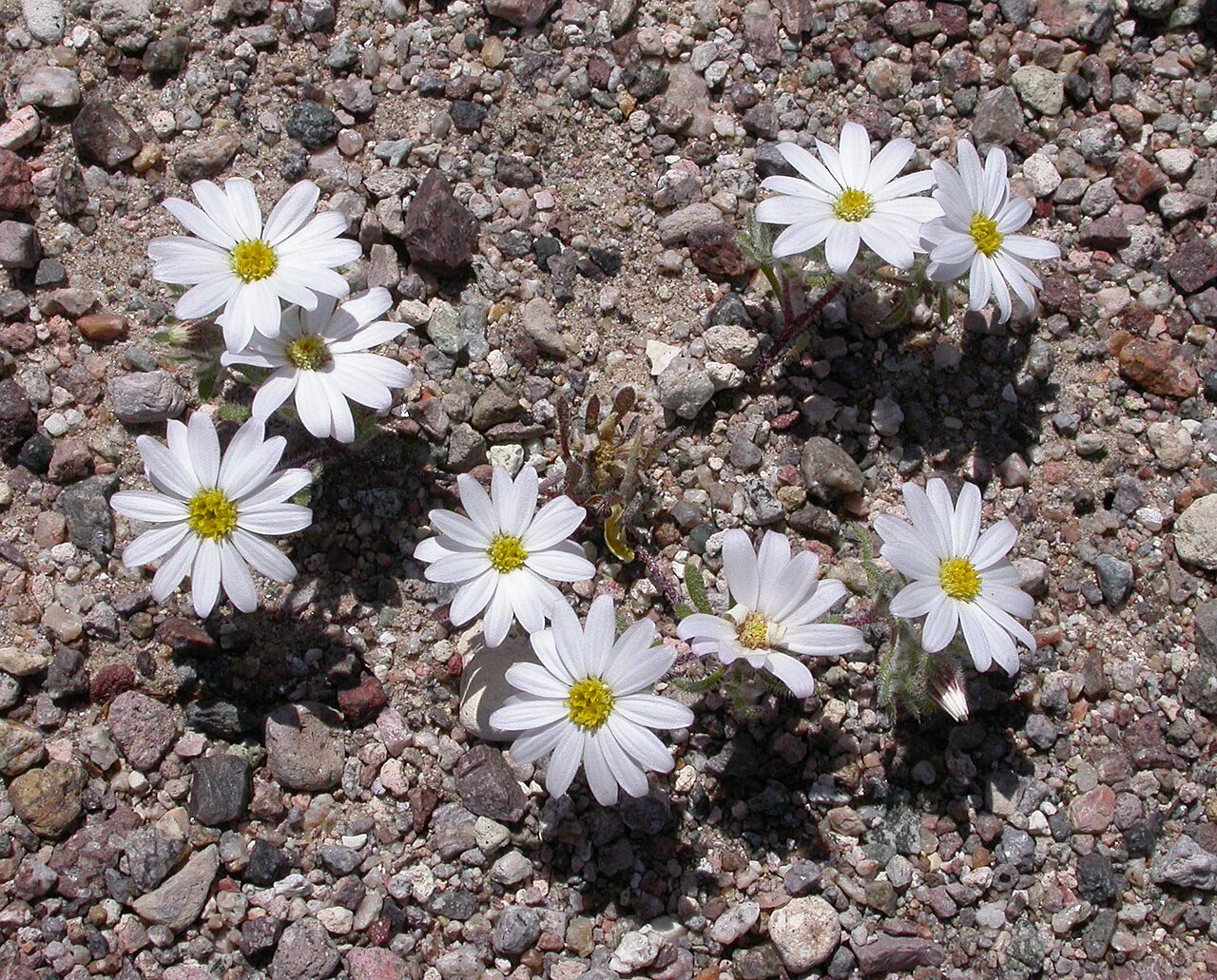
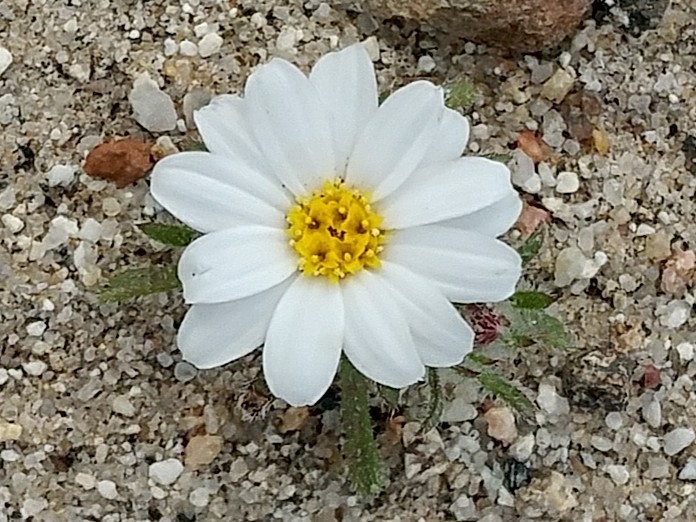
Monoptilon bellioides, known as Mojave Desertstar or desert star, is a tiny spring annual of the Mojave and Sonoran deserts. It hugs the ground, often just an inch or two tall, yet each plant can carry several daisy-like flower heads about 3/4 inch across, with white rays (often tinged pink or rose underneath) around a bright yellow center. On sandy and gravelly desert flats after a wet winter, thousands of these little white stars can dot the ground.
It is a member of the aster or sunflower family (Asteraceae). Its size depends almost entirely on rainfall: in a dry year plants may produce a single flower head barely above the soil, or not germinate at all, while in wet years they can form small, spreading mats several inches across. Because the plants are so low, desert botanists often call them “belly flowers”: you have to lie on your belly to see them well.
Mojave desertstar is not a garden plant in the usual sense, but it is a delight to find on a desert wildflower trip, and seed is occasionally included in desert wildflower mixes. It can be sown on sandy, open ground in low desert gardens, where it may appear in years with good winter rain.
Identification
Look on open sandy or gravelly desert flats in early spring for very low, hairy annuals with tiny narrow leaves and white daisy-like flower heads that seem to sit right on the ground.
Growth Habit
A tiny annual, usually 1/2 to 3 inches tall, branching from the base. In wet years the branches spread along the ground and the plant forms a small mat up to about 6 inches across; in dry years it may be a single stem with one flower head. The stems are covered with stiff, spreading hairs.
Leaves
The leaves are alternate, linear to narrowly spoon-shaped, about 1/4 to 1/2 inch long, with stiff, bristly hairs. They are often crowded just below the flower heads.
Flowers
The flower heads are about 1/2 to 1 inch across, with roughly 15 to 25 white ray flowers that are often pink or rose on the underside or as they age, surrounding a yellow center of disk flowers. Heads are borne singly at the branch tips and open in sun, closing in late afternoon and in cloudy weather. Plants bloom mainly from February to May, depending on rain.
Fruit
The fruit is a small achene topped by a pappus that includes a crown of short scales and bristles. The pappus is the main way to tell it from its close relative, which has a single plume-like bristle.
Look-alikes
Daisy desertstar (Monoptilon bellidiforme) is very similar and grows in the same deserts, but its achenes have a single plumose bristle (the name Monoptilon means “one feather”); in M. bellioides the pappus is more varied, with scales and several bristles. The two are hard to separate without a hand lens. Desert fleabanes and Emory’s rock daisy are larger, taller plants.
Quick Facts
| Scientific Name | Monoptilon bellioides |
| Family | Asteraceae (aster or sunflower family) |
| Plant Type | Annual wildflower (winter annual) |
| Mature Height | 1/2–3 in |
| Mature Spread | 1–6 in |
| Growth Rate | Fast after winter rain |
| Sun Exposure | Full sun |
| Water Needs | Very low; depends on winter rain |
| Soil Type | Sandy or gravelly desert soils |
| Soil pH | Neutral to alkaline (about 7.0–8.5) |
| Bloom Time | February–May, depending on rainfall |
| Flower Color | White rays, often pink-tinged, with a yellow center |
| Fall Color | None; annual |
| Fruit | Small achene with a pappus of scales and bristles |
| Deer Resistant | Not applicable; rarely browsed |
| USDA Hardiness Zones | Annual; grows where native (about zones 8–11) |
Native Range
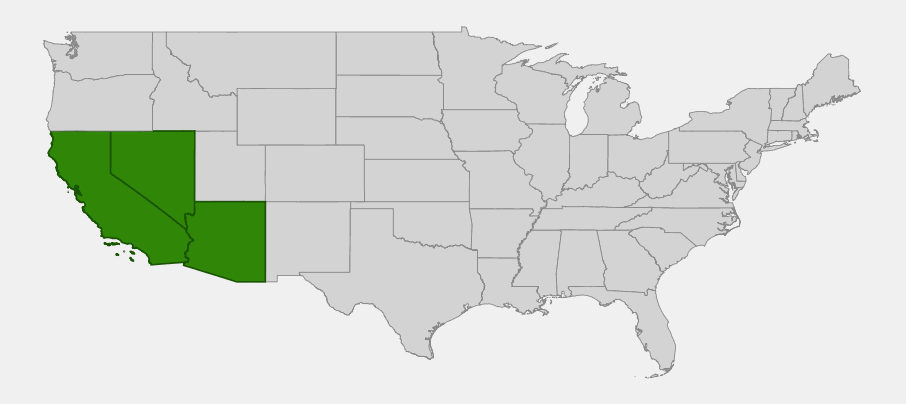
Mojave desertstar grows in the Mojave and Sonoran deserts of the southwestern United States and northwestern Mexico. USDA PLANTS lists it as native in Arizona, California and Nevada. In California it is widespread in the Mojave Desert, including Death Valley, and in the Colorado Desert, including Anza-Borrego and Joshua Tree. In Nevada it grows in the southern part of the state, in Clark and Nye counties. In Arizona it is common in the western and southern deserts, east to the Tucson area.
In Mexico it grows in the deserts of northeastern Baja California and northwestern Sonora.
It is a plant of low elevations, usually below about 3,500 feet, growing on open, sandy or gravelly flats, washes, bajadas and desert pavement, often among creosote bush and bursage. Like other desert annuals, it may not appear at all in dry years and then bloom by the thousands after a wet winter.
📋 Regional plant lists featuring Mojave Desertstar: Arizona & New Mexico · California & Nevada
Growing & Care Guide
Mojave desertstar is a true desert annual. It can be grown only where conditions resemble its home: full sun, sandy or gravelly soil and winter rain followed by a hot, dry summer.
Light
Full sun. The flower heads open only in bright light.
Soil & Water
Use sandy or gravelly, fast-draining soil with no added compost or fertilizer. Seeds germinate after soaking rains in fall or winter. In a dry winter, an occasional deep watering can help a planting, but no water is needed after flowering.
Planting Tips
Scatter seed in fall on bare, open ground or desert pavement-like gravel, and press it in lightly. Avoid mulch and dense plantings, which shade out such a tiny plant. It looks best in drifts with other low desert annuals such as purple mat and desert dandelion.
Pruning & Maintenance
None needed. Leave the dry plants in place so their seed can fall and build up a seed bank in the soil.
Propagation
Grows only from seed. Like many desert annuals, some of the seed stays dormant in the soil for several years, so plants may come and go with the rains. Collect only small amounts of seed, and never on protected lands such as national parks.
Landscape Uses
- Low desert gardens: a tiny spring annual for sandy, open ground
- Desert wildflower mixes: adds white to displays of desert annuals
- Rock and gravel gardens: fits gaps in gravel and desert pavement
- Pollinator gardens: early nectar and pollen for small native bees
- Nature study: a classic desert “belly flower”
Wildlife & Ecological Value
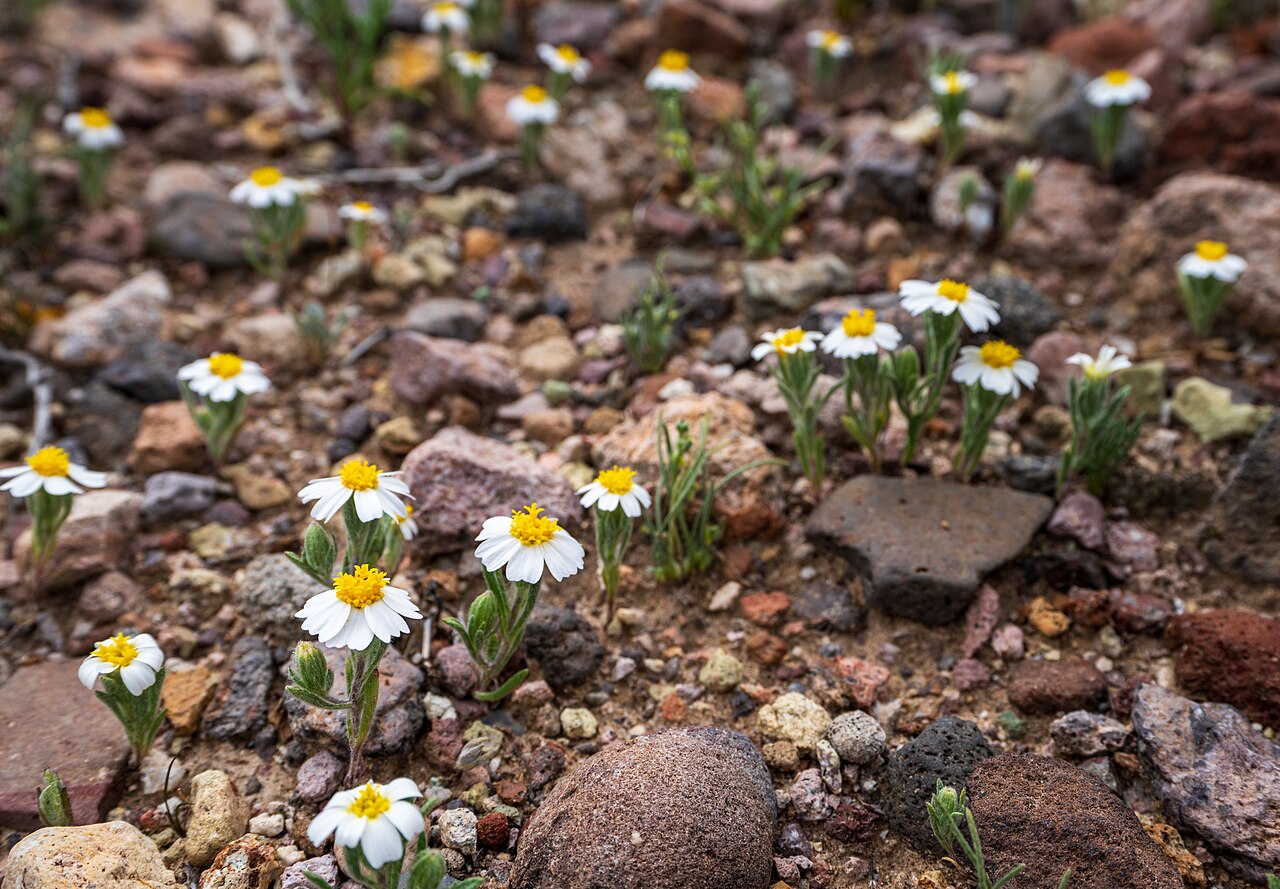
Mojave desertstar is part of the brief, spectacular spring bloom of desert annuals, which feeds many desert insects and animals.
For Pollinators
The flower heads are visited by small native bees, flies and beetles, which collect pollen and nectar during the short spring bloom.
For Birds
Seed-eating desert birds such as sparrows and quail feed on the seeds of desert annuals, including desertstar.
For Mammals
Small rodents such as kangaroo rats and pocket mice gather the seeds of desert annuals, and desert tortoises and jackrabbits graze on spring annuals.
Ecosystem Role
Its seeds become part of the desert soil seed bank, which carries annual plant populations through drought years and feeds seed-eating animals. Annuals like this one also help stabilize sandy soils in spring.
Cultural & Historical Uses
The genus name Monoptilon comes from Greek words meaning one feather, referring to the single plume-like bristle on the fruits of its close relative. The species name bellioides means resembling Bellis, the English daisy, which its flower heads resemble in miniature.
Desert botanists use the term “belly flowers” for tiny desert annuals like this one, because the best way to appreciate them is to lie on the ground. Mojave desertstar is one of the best-known belly flowers of the California and Arizona deserts.
The species is a regular feature of desert wildflower reports in parks such as Death Valley, Joshua Tree and Anza-Borrego Desert State Park, where its abundance in a given spring reflects how much rain fell the previous fall and winter.
Frequently Asked Questions
How big is Mojave desertstar?
Tiny. Plants are usually only 1/2 to 3 inches tall, though in wet years they can spread to about 6 inches across.
When does Mojave desertstar bloom?
Mainly from February to May, after good winter rains. In dry years it may not appear at all.
How is it different from daisy desertstar?
Daisy desertstar (Monoptilon bellidiforme) has a single feathery bristle on each fruit, while Mojave desertstar has a pappus of scales and several bristles. They are hard to tell apart without a hand lens.
Can I grow desertstar in my garden?
Yes, in low desert gardens with sandy, open soil. Sow seed in fall and let winter rains do the rest.
Where can I see Mojave desertstar?
Look on sandy and gravelly flats in Death Valley, Joshua Tree, Anza-Borrego and the Arizona deserts in early spring after a wet winter.

Looking for a nursery that carries Mojave Desertstar?
Browse our native plant nursery directory: Arizona · California · Nevada