
Myrtleleaf St. John’s-Wort (Hypericum myrtifolium)
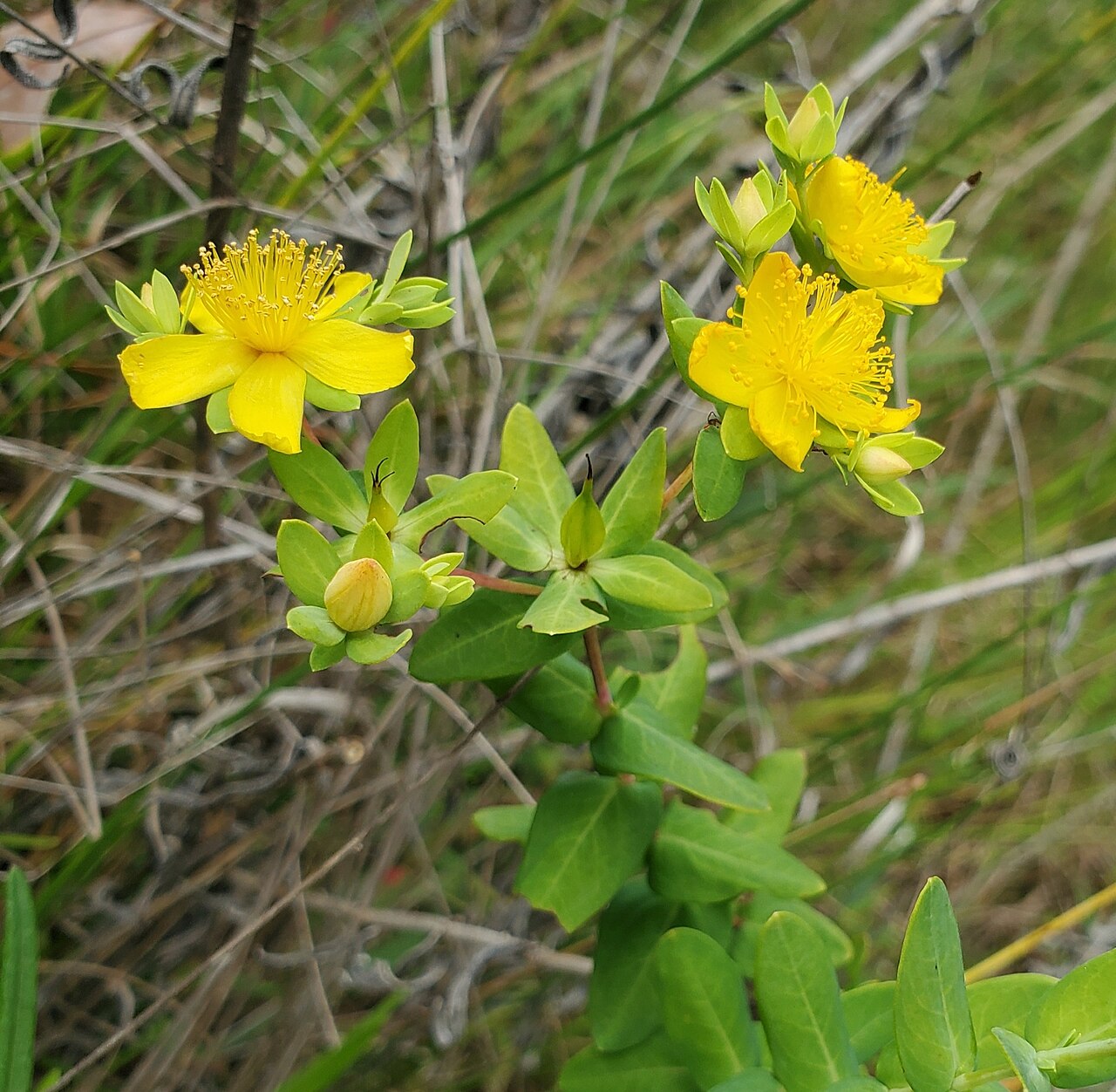
Hypericum myrtifolium, known as Myrtleleaf St. John’s-Wort (USDA: myrtleleaf St. Johnswort), is a small, upright shrub of wet pine flatwoods, savannas and pond margins on the southeastern Coastal Plain. Its stems carry neat pairs of blue-green leaves that wrap around the stem at their base, and from late spring into summer it is covered with bright yellow, five-petaled flowers about an inch across, each with a showy brush of golden stamens.
It belongs to the St. John’s-wort family (Hypericaceae; some sources, including USDA PLANTS and the Atlas of Florida Plants, place it in the broader Clusiaceae). The southeastern United States is a center of diversity for shrubby St. John’s-worts, and more than two dozen species grow in Florida alone. Myrtleleaf St. John’s-wort is one of the easiest to recognize, thanks to its clasping, myrtle-like leaves, the source of its name.
It is native to the Coastal Plain from South Carolina to Florida and west to Mississippi. It is a fire-adapted plant of sunny, seasonally wet ground, and in gardens it is a tidy small shrub for rain gardens, pond edges and wet meadows. This guide covers how to identify it, where it grows, and how to grow it.
Identification
Shrubby St. John’s-worts can be confusing, but myrtleleaf St. John’s-wort stands out. Look for a low shrub with stiff, upright stems, opposite pairs of broad-based, blue-green leaves clasping the stem, and relatively large yellow flowers at the tips of the branches.
Growth Form
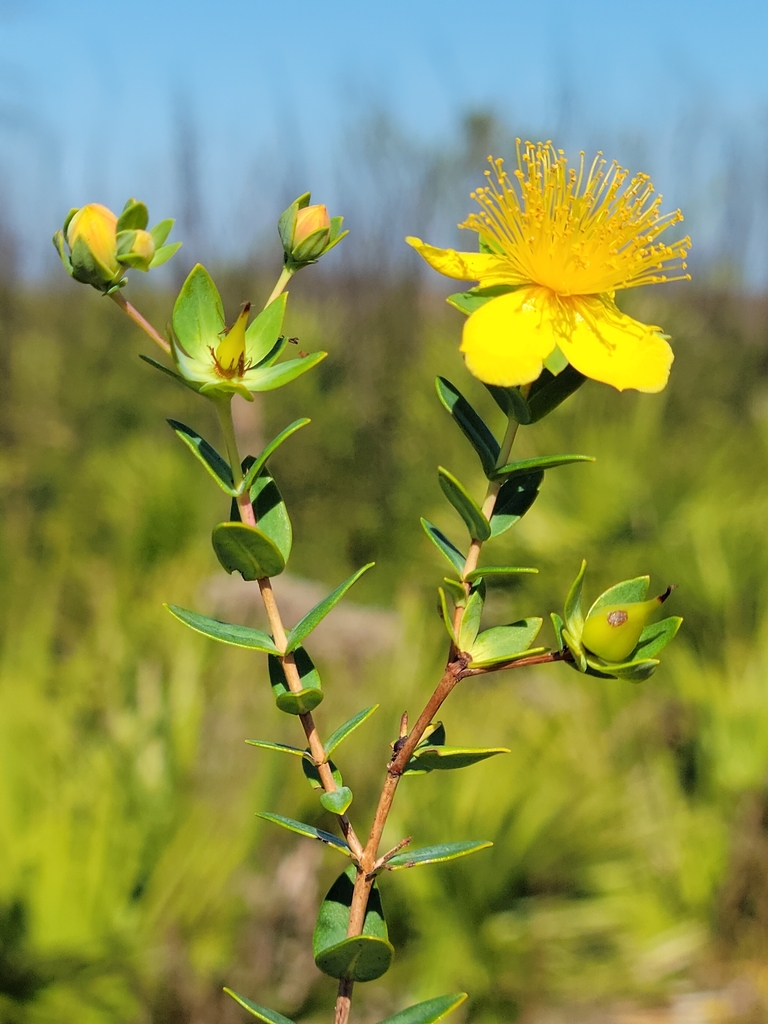
It is a small, few-branched shrub, usually 1 to 3 feet tall, with stiff, erect, reddish-brown stems that become woody at the base. The bark on older stems peels in thin, papery strips. Plants are evergreen or semi-evergreen in mild winters.
Leaves
The leaves are opposite, stalkless, and broadly oval to triangular, about ½ to 1 inch long, with a heart-shaped or squared base that clasps the stem. They are thick, leathery and distinctly blue-green to gray-green, and they are held stiffly, sometimes angled upward against the stem. Tiny translucent dots, visible when a leaf is held up to the light, are typical of the genus.
Flowers
The flowers are bright yellow, about ¾ to 1¼ inches across, with five spreading petals, five sepals that resemble small leaves, a dense brush of many golden stamens, and three styles. They are borne singly or in small clusters at the ends of the branches. In Florida bloom begins in April or May and peaks in late spring and early summer, with scattered flowers later in the season.
Fruit
The fruit is a small, egg-shaped capsule about ¼ inch long that turns reddish brown and splits to release many tiny seeds. The dry capsules often remain on the plant into winter.
Quick Facts
| Scientific Name | Hypericum myrtifolium Lam. |
| Family | Hypericaceae (St. John’s-wort family); Clusiaceae in USDA PLANTS |
| Plant Type | Small evergreen to semi-evergreen shrub |
| Mature Height | 1–3 ft |
| Mature Spread | 1–2 ft |
| Growth Rate | Moderate |
| Sun Exposure | Full sun |
| Water Needs | Medium to high; moist to seasonally wet soil |
| Soil Type | Acidic sand or peaty sand |
| Soil pH | Acidic, about 4.5–6.0 |
| Bloom Time | April–July (peak May–June) |
| Flower Color | Bright yellow |
| Fall Color | Leaves sometimes tinged red-purple in winter |
| Fruit | Small reddish-brown capsule |
| Deer Resistant | Yes; rarely browsed |
| USDA Hardiness Zones | 8–10 |
Native Range
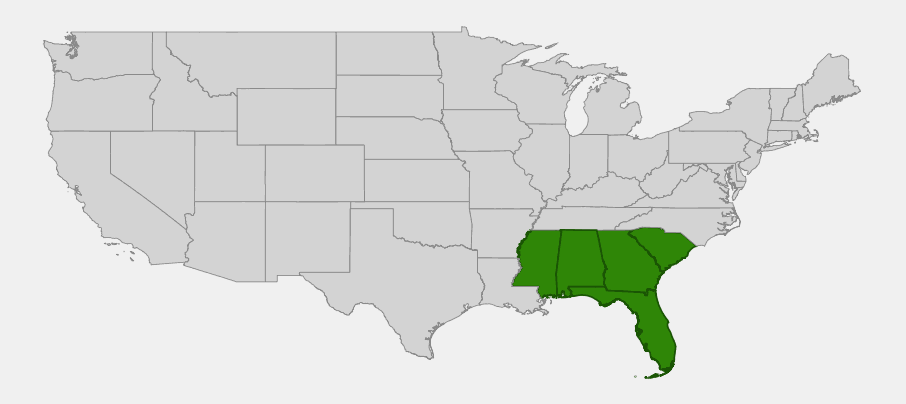
Myrtleleaf St. John’s-wort is native to the lower Coastal Plain of the Southeast. USDA PLANTS and the Lady Bird Johnson Wildflower Center record it from five states: South Carolina, Georgia, Florida, Alabama and Mississippi.
In Florida, the Atlas of Florida Plants maps it through most of the northern and central parts of the state, from the Panhandle south through the central peninsula to about Lake Okeechobee. It is most common in the wet flatwoods and prairies of north and central Florida, such as those of the Osceola and Kissimmee River region.
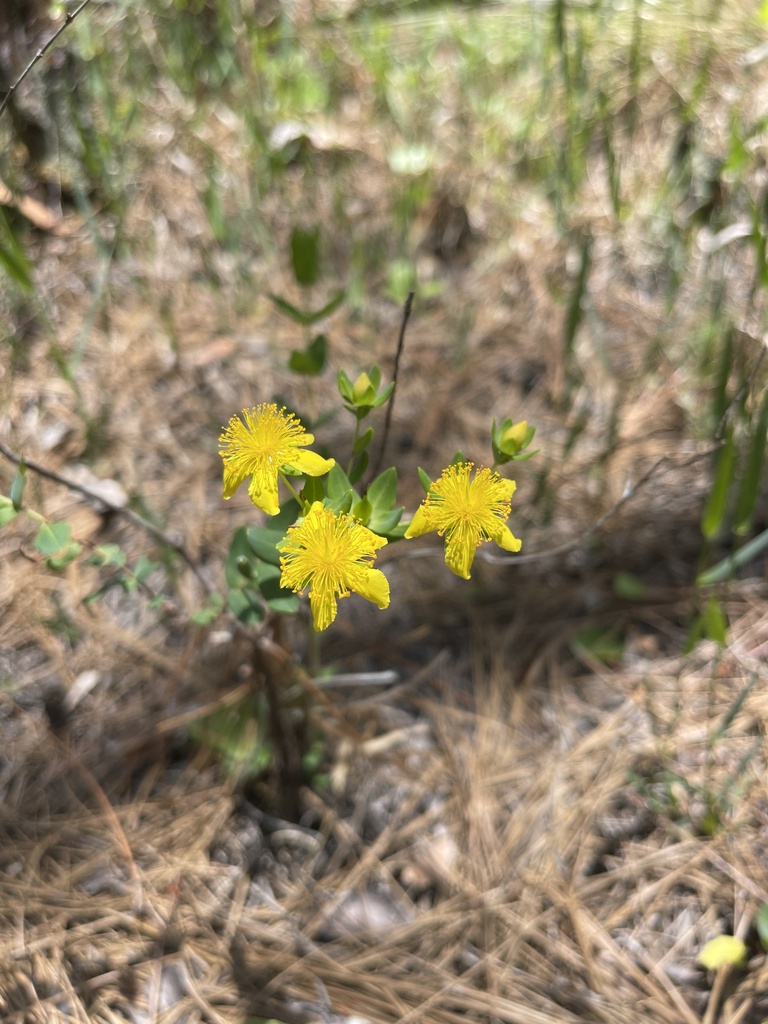
Typical habitats are wet pine flatwoods and savannas, the margins of ponds, cypress domes and depression marshes, wet prairies, and wet roadside ditches. It is classified as a facultative wetland plant (FACW), meaning it usually occurs in wetlands but sometimes in moist uplands.
📋 Regional plant lists featuring Myrtleleaf St. John’s-Wort: North & South Florida · Alabama, Georgia & Mississippi · North & South Carolina
Growing & Care Guide
Myrtleleaf St. John’s-wort is an attractive, compact shrub for moist, sunny native gardens in the Southeast and is available from a number of Florida native plant nurseries. Always buy nursery-grown plants rather than digging them from the wild.
Light
Plant in full sun. It tolerates light shade for part of the day, but flowering is much reduced and plants become sparse in shade.
Soil & Water
It grows best in acidic, sandy or peaty soil that is moist to wet, especially in spring and summer. It is at home in rain gardens, the edges of ponds and retention areas, and low, seasonally wet parts of the yard. Once established it tolerates short dry periods, but it should not be planted in dry, well-drained sand without irrigation. No fertilizer is needed.
Planting Tips
Plant in fall through spring, spacing plants 18 to 24 inches apart. Plant in groups for a stronger display. Its blue-green foliage contrasts well with grasses and sedges and with darker-leaved shrubs such as gallberry and fetterbush.
Pruning & Maintenance
Little maintenance is required. Cut back older plants by about a third in late winter if they become leggy, which encourages bushier growth and more flowers. In naturalistic plantings, periodic burning or late-winter cutting imitates natural fire. Plants are generally free of pests.
Propagation
Propagate from seed, which is produced in abundance, by sowing on the surface of moist, acidic seed mix in spring; light helps germination. Softwood cuttings taken in late spring or early summer also root readily.
Landscape Uses
- Rain gardens: compact shrub for the moist zones of a sunny rain garden
- Pond and retention-area edges: tolerates seasonal flooding and acidic soil
- Wet meadow and flatwoods restoration: within its Coastal Plain range
- Pollinator gardens: abundant pollen for native bees
- Small-space plantings: neat, upright form and blue-green foliage
Wildlife & Ecological Value
Like other St. John’s-worts, myrtleleaf St. John’s-wort is an important pollen plant in Southeastern wetlands, and it is part of the diverse shrub layer of fire-maintained flatwoods.
For Pollinators
Hypericum flowers produce no nectar but offer large quantities of pollen. They are visited by bumble bees, sweat bees and other native bees, which gather pollen from the brush of stamens, sometimes by vibrating the flowers (buzz pollination). Flower flies and beetles also feed on the pollen.
For Birds
The tiny seeds are eaten occasionally by small seed-eating birds. The shrubs give low cover to ground-nesting and ground-feeding birds of the flatwoods.
For Mammals
The foliage contains compounds that make it unpalatable, and deer rarely browse it.
Ecosystem Role
Myrtleleaf St. John’s-wort is adapted to frequent fire. Fire kills the stems, but plants resprout from the base and flower well within a year or two. It is a characteristic shrub of wet flatwoods and pond margins where the water table fluctuates through the year.
Cultural & Historical Uses
The French naturalist Jean-Baptiste Lamarck described Hypericum myrtifolium in 1797, from specimens collected in the southeastern United States. The genus name Hypericum comes from an ancient Greek name for these plants.
The common name St. John’s-wort comes from the European Hypericum perforatum, which traditionally blooms around the feast of St. John the Baptist in late June and was used in European folk medicine. There is no well-documented medicinal use of myrtleleaf St. John’s-wort, and it should not be used as a substitute for the European plant.
Today the species is valued by native plant gardeners in Florida and the Southeast for its neat habit and bright flowers. Shrubby native St. John’s-worts are increasingly recommended as alternatives to non-native flowering shrubs in moist, sunny landscapes.
Frequently Asked Questions
How do I identify myrtleleaf St. John’s-wort?
Look for a small shrub with opposite, blue-green leaves whose broad bases clasp the stem, and bright yellow flowers about an inch across with a brush of stamens. The clasping leaves are the best field mark.
Does myrtleleaf St. John’s-wort need wet soil?
It prefers moist to wet, acidic soil and is ideal for rain gardens and pond edges. It tolerates short dry spells once established but is not suited to dry sand without irrigation.
When does myrtleleaf St. John’s-wort bloom?
Mainly from April through July, with peak bloom in late spring and early summer.
Is myrtleleaf St. John’s-wort used medicinally?
No. The medicinal St. John’s-wort is the European Hypericum perforatum. Do not use native species as a substitute.
How big does myrtleleaf St. John’s-wort get?
Usually 1 to 3 feet tall and 1 to 2 feet wide, making it a good small shrub for compact spaces.

Looking for a nursery that carries Myrtleleaf St. John’s-Wort?
Browse our native plant nursery directory: Alabama · Florida & Georgia · Mississippi · South Carolina