
Pāʻū o Hiʻiaka (Jacquemontia sandwicensis)
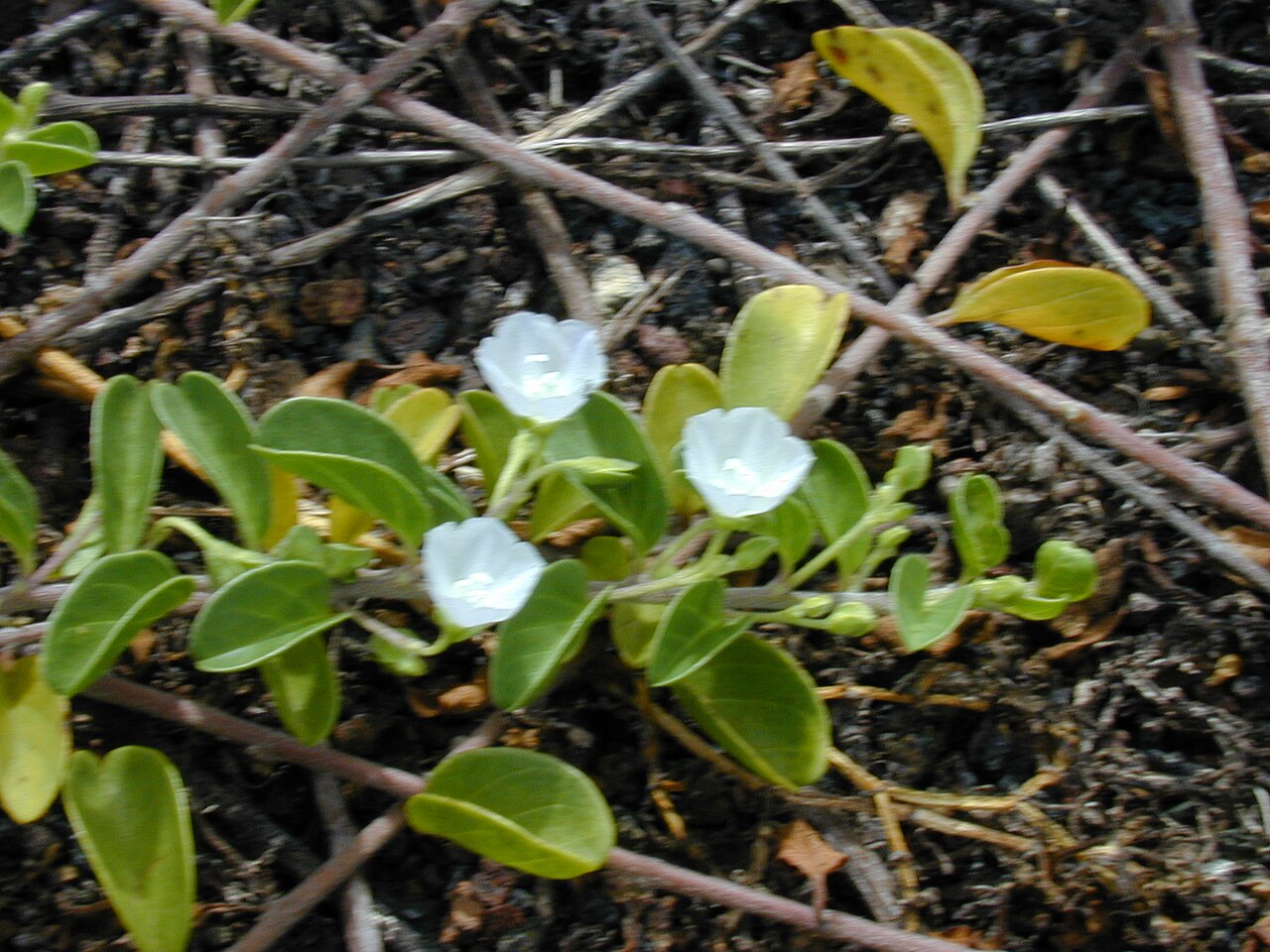
Jacquemontia sandwicensis, known in Hawaiian as pāʻū o Hiʻiaka (“skirt of Hiʻiaka”), is a native trailing vine of the morning glory family (Convolvulaceae). It forms low mats of small, oval, slightly fleshy leaves, often silvery with fine hairs, dotted with pale blue to white, funnel-shaped flowers about an inch across. USDA PLANTS lists it as Jacquemontia ovalifolia ssp. sandwicensis; many botanists now treat the Hawaiian plant as its own species, J. sandwicensis.
Pāʻū o Hiʻiaka is endemic to Hawaiʻi. It grows on all the main islands and on several of the Northwestern Hawaiian Islands, mostly on coastal strand: sandy beaches and dunes, rocky shorelines and coastal flats, usually near sea level, and occasionally a little inland in dry, open places. It is not federally listed and is still common in many coastal areas.
It is also one of the most popular native groundcovers in Hawaiian landscaping: fast, tough, salt- and drought-tolerant and almost always in bloom. This guide covers how to identify it, where it grows, how to grow it, and the legend behind its name. As with all natives, buy plants from Hawaiʻi native plant nurseries rather than collecting from the wild.
Identification
Pāʻū o Hiʻiaka is easy to spot on a sunny Hawaiian shoreline: a flat mat of small, gray-green to bright green oval leaves on long trailing stems, with soft blue or white morning glory-like flowers sitting just above the foliage.
Growth Habit
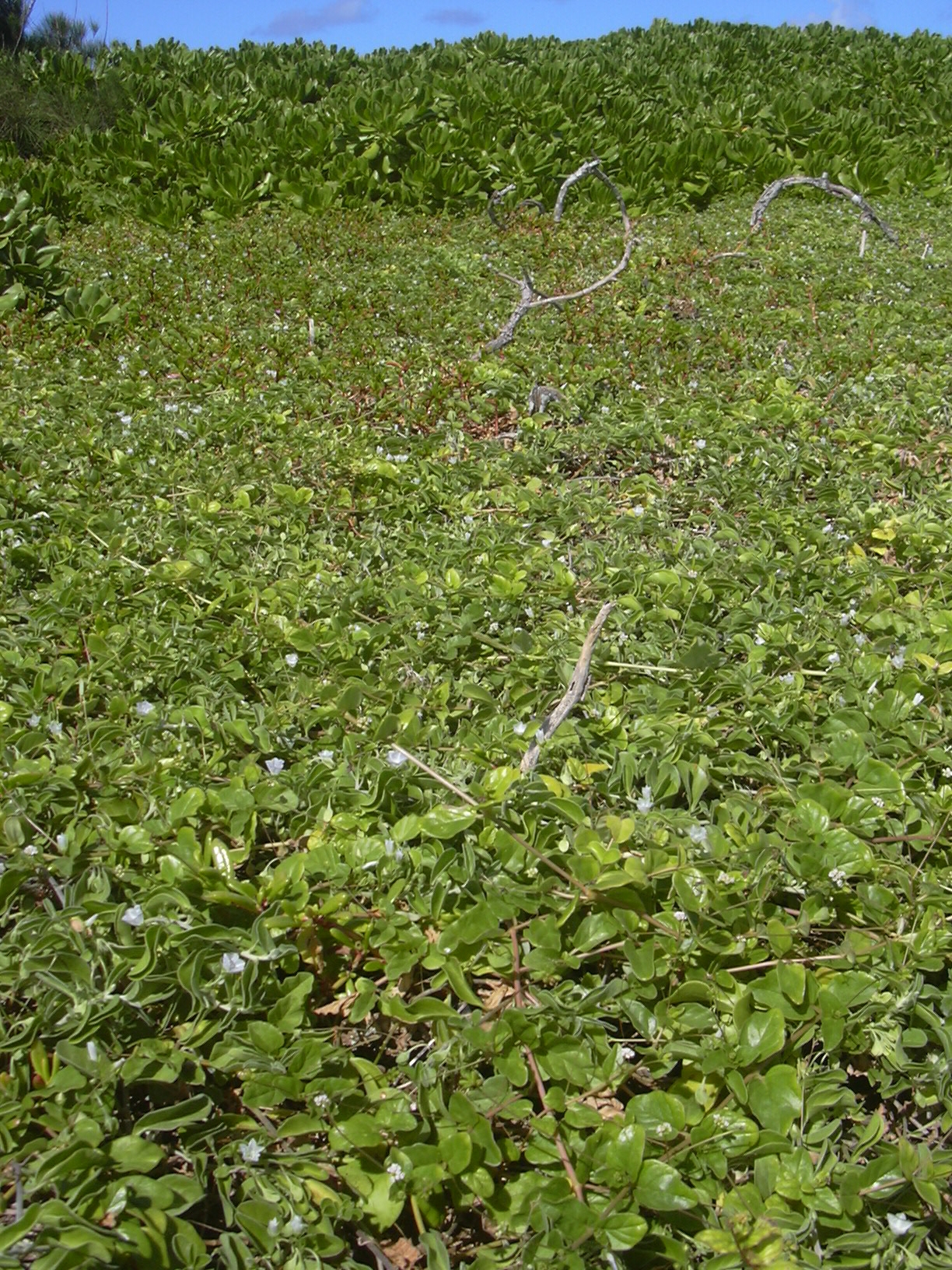
A perennial vine with trailing stems that spread flat over the ground and root lightly where they touch, forming mats up to about 10 feet across and usually less than a foot tall. It rarely climbs, though it will scramble over low shrubs and rocks.
Leaves
Leaves are alternate, oval to nearly round, about ½ to 1½ inches long, thick and somewhat succulent. Plants from exposed coasts are often covered with fine, silky hairs that give them a silvery look, while plants in more sheltered or watered spots are greener and smoother.
Flowers
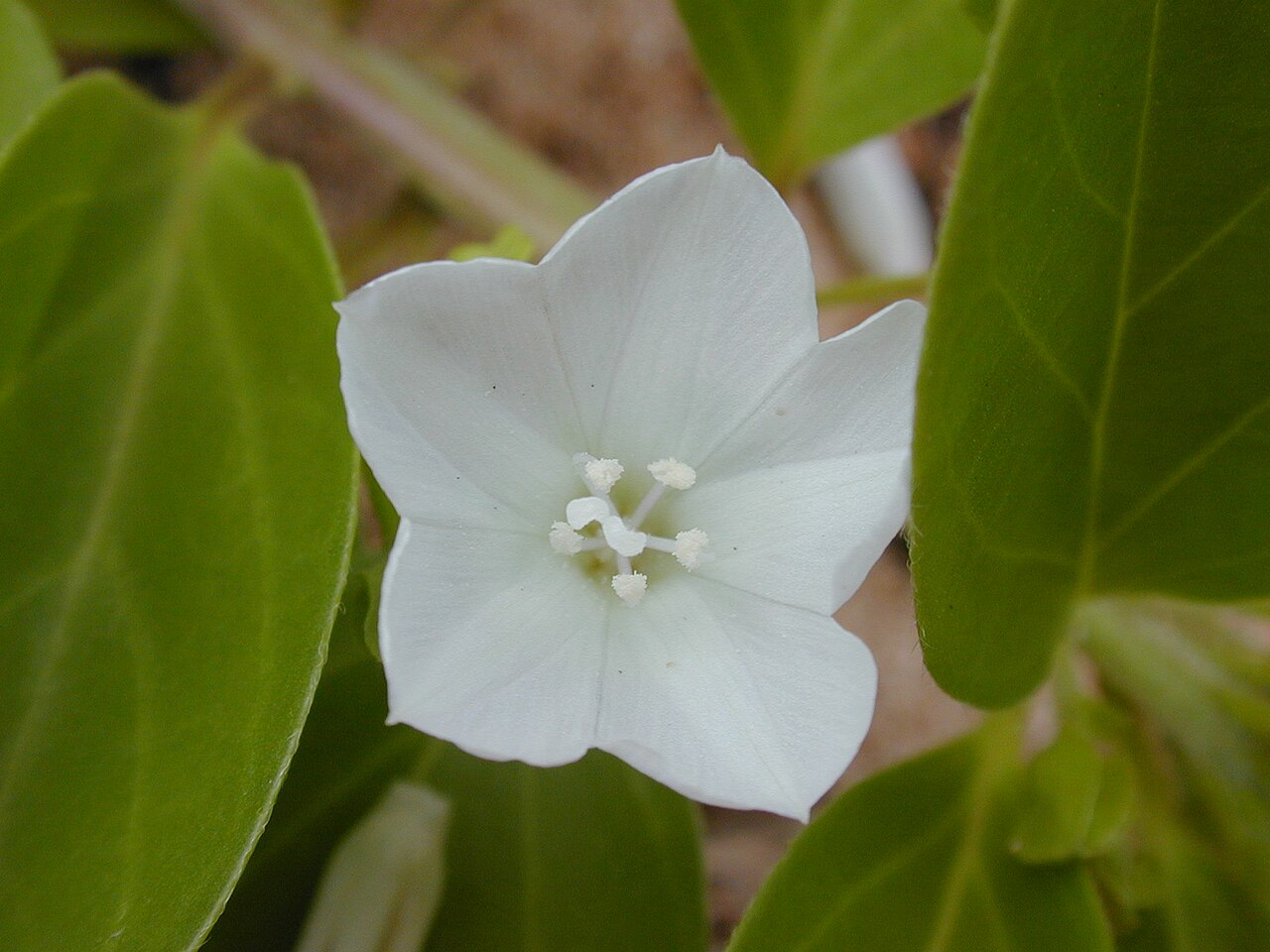
Flowers grow singly or in small clusters from the leaf axils. Each is about ¾ to 1 inch across, funnel- to saucer-shaped with five shallow lobes, pale blue to white, sometimes with a faint lavender tint. Each flower lasts about a day. Plants bloom throughout the year.
Fruit & Look-alikes
The fruit is a small, rounded capsule that splits to release a few smooth seeds. Pōhuehue (Ipomoea pes-caprae), another native beach vine, has much larger, notched leaves and bright pink to purple flowers. Hinahina kū kahakai (Heliotropium anomalum) also has silvery leaves but forms upright rosettes with tiny white flowers in coiled clusters.
Quick Facts
| Scientific Name | Jacquemontia sandwicensis A. Gray (syn. J. ovalifolia ssp. sandwicensis) |
| Family | Convolvulaceae (morning glory family) |
| Plant Type | Trailing perennial vine and groundcover; Hawaiian endemic |
| Mature Height | 2–12 in |
| Mature Spread | 3–10 ft |
| Growth Rate | Fast |
| Sun Exposure | Full sun |
| Water Needs | Low; drought and salt tolerant |
| Soil Type | Sand, coral rubble, cinder or other well-drained soil |
| Soil pH | Neutral to alkaline |
| Bloom Time | Year-round |
| Flower Color | Pale blue to white |
| Fall Color | None; evergreen silvery to green foliage |
| Fruit | Small round capsule |
| Deer Resistant | Moderately; occasionally browsed by deer and goats |
| USDA Hardiness Zones | 10–12 |
Native Range
Pāʻū o Hiʻiaka is endemic to the Hawaiian Islands, and USDA PLANTS lists it as native only in Hawaiʻi. It grows on all of the main islands, including Kahoʻolawe, on offshore islets such as Molokini and Mokuʻauia, and on several of the Northwestern Hawaiian Islands. Its closest relatives, the other forms of Jacquemontia ovalifolia, grow on tropical shores of Africa and the Americas, and its ancestors likely reached Hawaiʻi by sea.
It is a plant of the coastal strand, the zone just above the beach. It grows on sand dunes and beaches, coral rubble, rocky lava shorelines and coastal flats, and sometimes a short way inland in dry, open lowland shrubland. It thrives in full sun, salt spray, wind and poor, sandy soil.
Coastal development, off-road vehicles, trampling and invasive plants such as buffelgrass and kiawe have reduced many coastal plant communities, but pāʻū o Hiʻiaka remains fairly common and is often used in dune restoration. It even helped revegetate eroded hardpan on Kahoʻolawe, where it was among the native plants that came back after grazing ended.
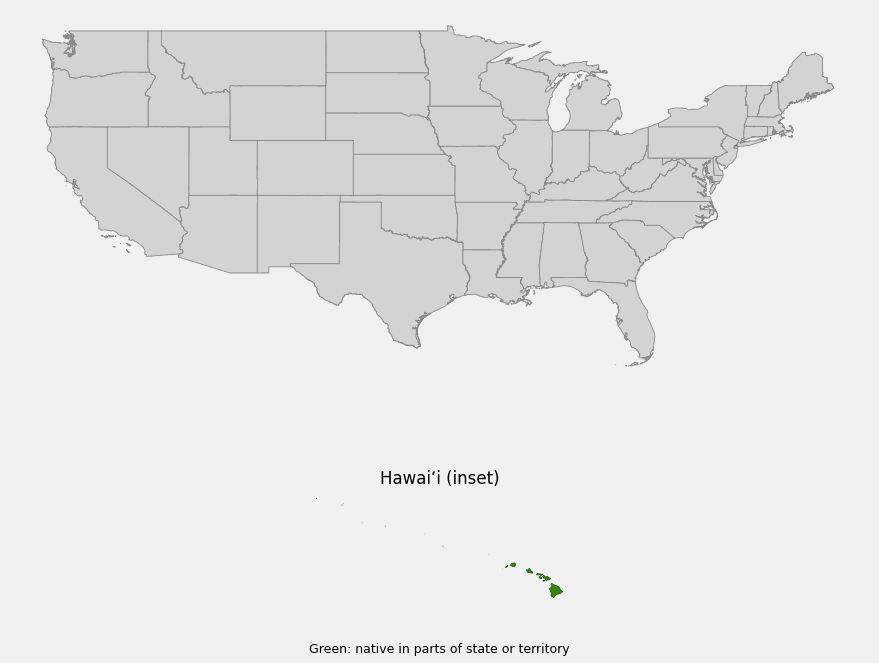
📋 Regional plant lists featuring Pāʻū o Hiʻiaka: Hawaii
Growing & Care Guide
Pāʻū o Hiʻiaka is one of the easiest native plants to grow in sunny Hawaiian gardens, especially near the coast. It grows outdoors only in frost-free climates (about USDA zones 10–12). Buy plants from Hawaiʻi native plant nurseries, many of which sell it in flats or pots, and don’t dig plants from beaches or other wild sites. Hawaiʻi restricts bringing plants in from other states, so source it locally.
Light
Full sun. In shade it becomes sparse and leggy and flowers poorly.
Soil & Water
Sandy, rocky or cinder soil with excellent drainage; it does not need rich soil. Water regularly for the first few weeks, then sparingly. Once established it is very drought tolerant, and overwatering makes it lush, green and prone to rot and pests.
Planting Tips
Use it as a groundcover on sunny slopes and banks, in coastal gardens, in parking strips, rock gardens and hanging baskets, or spilling over walls. Space plants about 2 to 3 feet apart for quick cover. It handles salt spray and wind well. It is not a walk-on lawn substitute, although it tolerates light foot traffic at the edges.
Pruning & Maintenance
Trim back long runners to keep it in bounds and encourage denser growth; it can be sheared lightly. Keep weedy grasses out while it establishes. Watch for mealybugs, whiteflies and aphids, especially on overwatered plants; reducing water often solves the problem.
Propagation
Very easy from stem cuttings, which root quickly in a sandy mix, and from seed. Seeds have a hard coat; nick them or soak them in warm water before sowing. Gardeners can also root pieces of runners that have touched the ground.
Landscape Uses
- Coastal groundcover: tolerates sun, salt spray, wind and sandy soil
- Slopes and banks: fast-spreading mats help hold soil
- Hanging baskets and containers: trailing stems spill attractively over edges
- Dune and coastal restoration: a reliable native for revegetating sandy and rocky shores
Wildlife & Ecological Value
Pāʻū o Hiʻiaka is a key part of the low native vegetation on Hawaiian shorelines.
For Pollinators
The open, pale flowers attract bees, including native yellow-faced bees (Hylaeus), which depend on coastal native plants, as well as introduced honeybees, butterflies and moths.
For Birds
In coastal areas and on offshore islets its mats provide cover and nesting habitat for ground-nesting seabirds, and the insects it supports feed shorebirds and other birds.
For Mammals
Hawaiʻi’s only native land mammal, the Hawaiian hoary bat (ʻōpeʻapeʻa), forages for insects over open coastal areas. Introduced goats and deer browse it lightly.
Ecosystem Role
Its spreading mats stabilize sand and rocky soil against wind and water erosion, and it is one of the first natives to recolonize bare coastal ground. It helps restore native strand communities where invasive plants have been removed.
Cultural & Historical Uses
The Hawaiian name pāʻū o Hiʻiaka means “skirt of Hiʻiaka.” In a well-known story, the volcano goddess Pele left her youngest sister, Hiʻiaka, as a baby on the beach while she went fishing or surfing. When Pele returned, a vine had grown over the child, shielding her from the hot sun like a skirt. The vine was named for her.
Hiʻiaka is associated with healing, hula and the native forest in Hawaiian tradition, and pāʻū o Hiʻiaka is a favorite in gardens planted for hula and Hawaiian cultural education. The genus Jacquemontia honors Victor Jacquemont, a French naturalist of the early 19th century.
Botanists have treated the Hawaiian plant in different ways. It was described by Asa Gray as Jacquemontia sandwicensis, later reduced to a subspecies of the widespread J. ovalifolia, which is the name USDA PLANTS still uses (J. ovalifolia ssp. sandwicensis). Many current references, including Plants of the World Online and iNaturalist, again treat it as a species endemic to Hawaiʻi.
Frequently Asked Questions
What does pāʻū o Hiʻiaka mean?
“Skirt of Hiʻiaka.” In legend, the vine grew over the infant Hiʻiaka on a beach to shade her while her sister Pele was away.
Is it the same as Jacquemontia ovalifolia?
USDA PLANTS lists it as Jacquemontia ovalifolia ssp. sandwicensis. Many botanists now treat the Hawaiian plant as a separate species, Jacquemontia sandwicensis, endemic to Hawaiʻi.
Is it easy to grow?
Yes. It needs full sun and well-drained, sandy or rocky soil, and once established it is very drought and salt tolerant. Overwatering is the most common problem.
Is it endangered?
No. It is not federally listed and is still common on many Hawaiian coasts, although coastal habitat loss has reduced it in places.
Can I use it as a lawn replacement?
It makes an excellent groundcover for sunny, low-traffic areas, slopes and coastal gardens, but it does not tolerate regular foot traffic like turf.

Looking for a nursery that carries Pāʻū o Hiʻiaka?
Browse our native plant nursery directory: Hawaii

