Roemer’s Acacia (Senegalia roemeriana)
Senegalia roemeriana (long known as Acacia roemeriana), commonly called Roemer’s Acacia, is a thorny, round-topped shrub of the Texas Hill Country, the Trans-Pecos, and adjacent New Mexico. It also goes by Roemer Acacia, Roundflower Catclaw, Round-flowered Catclaw, and simply Catclaw — a nod to the small, hooked prickles that line its branches and snag at clothing and hide alike. Gardeners who want a tough, drought-proof native for rocky, sun-baked ground will find it a reliable, low-fuss choice.
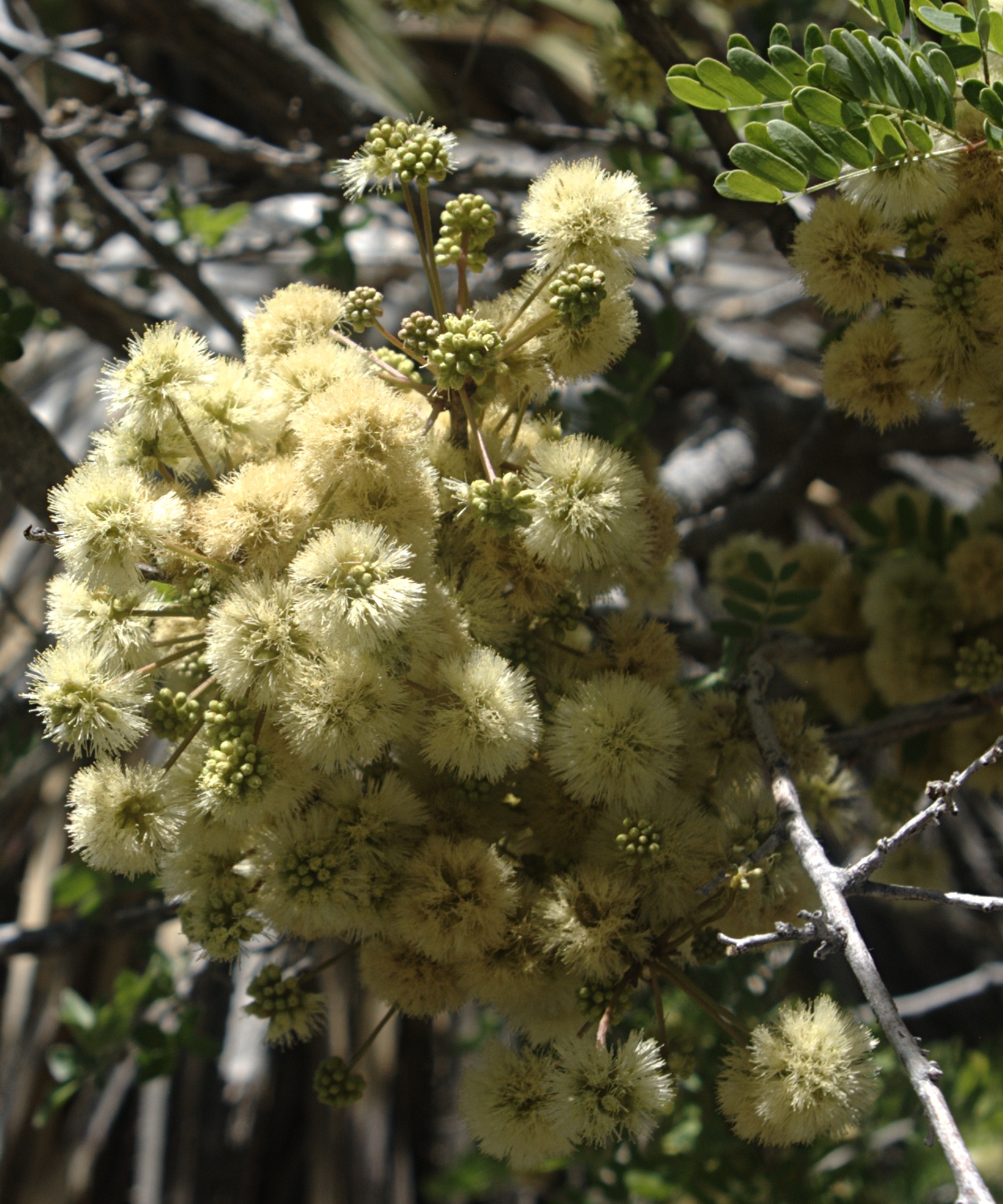
This member of the pea family (Fabaceae) usually grows as a dense, rounded shrub 3 to 7 feet tall, though old plants on favorable sites can become small trees to about 20 feet. In late spring the whole shrub can disappear under clusters of fragrant, cream to pale greenish-white flower puffs, each a tight ball of stamens rather than a showy petaled bloom. Bees find them irresistible, and the species has a long reputation among Texas Hill Country beekeepers as a dependable honey plant.
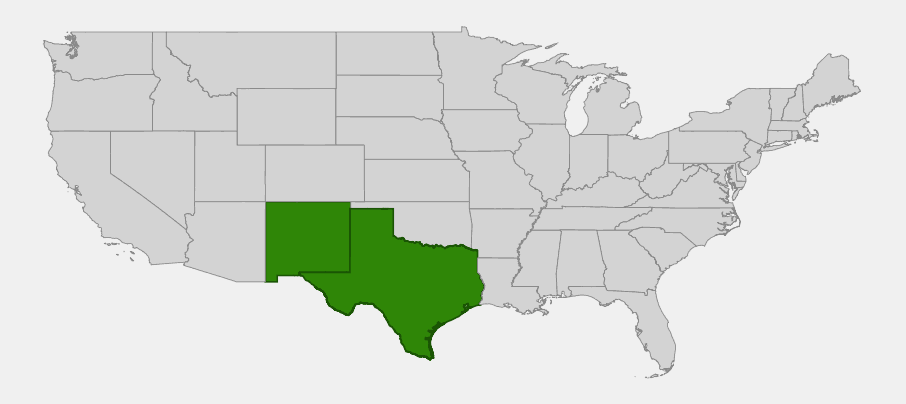
Roemer’s acacia is a true limestone-country native, most at home on caliche hillsides, canyon slopes, and brushy uplands from the Edwards Plateau west through the Trans-Pecos and into the Chihuahuan Desert borderlands of southeastern New Mexico and northeastern Mexico. It is not native to Arizona, California, Nevada, or Utah, though it is sometimes offered by nurseries outside its range; plant it only where it belongs to keep the regional flora honest. In a home landscape it earns its keep as a wildlife shrub, a living barrier, and a low-water filler for xeric beds.
Identification
Roemer’s acacia is most easily told apart from other Texas acacias by its combination of small size, curved (not straight) prickles, and distinctly round flower heads rather than elongated flower spikes. It typically forms a many-branched, rounded shrub with an open, airy look when not in leaf, filling in densely once the fine foliage emerges each spring.
Bark & Stems
Young stems and trunks are smooth and gray to reddish-brown, becoming scaly and furrowed with age on the oldest, tree-form specimens. The branchlets are armed with scattered, short, broad-based prickles that curve backward like a cat’s claw — the source of both the “catclaw” common name and some painful snags for anyone who brushes past carelessly. Unlike the straight paired spines of some related legumes, these prickles are not paired and are easily distinguished on close inspection.
Leaves
The leaves are bipinnately compound, alternate along the stem, and finely divided into numerous small leaflets, each generally a half inch long or less. The overall effect is soft and fern-like, giving the plant a delicate texture that contrasts with its thorny stems. Leaves are drought-deciduous, dropping in dry spells or hard freezes and flushing back quickly once conditions improve.
Flowers
Flowers appear from April into August, peaking in spring, in small, round, powderpuff-like heads about three-eighths of an inch across, clustered from the leaf axils. Each head is made up of many tiny individual flowers whose long stamens give the puff its fuzzy look; color ranges from cream to pale greenish-white. The blooms carry a sweet fragrance that draws honeybees, native bees, and butterflies in large numbers whenever the shrub is in flower.
Fruit & Seeds
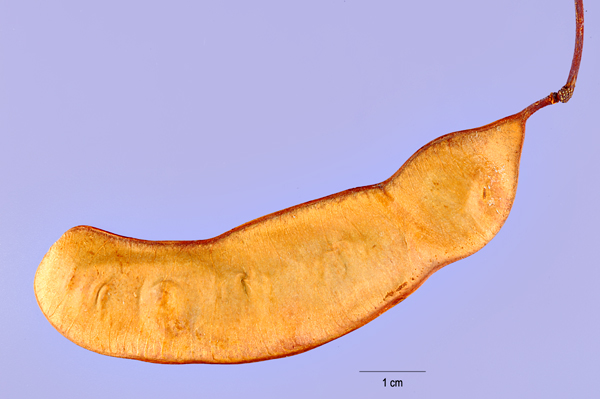
The fruit is a flat, curved, leathery legume pod, brown to reddish in color, up to about 4 inches long and 1⅛ inches wide, narrowing to a short stalk at the base. Pods ripen from late summer into fall and split open to release hard, flattened seeds. Seed coats are tough, and germination in cultivation is improved by soaking seed overnight in water that has been brought to a boil and allowed to cool.
Quick Facts
| Scientific Name | Senegalia roemeriana (syn. Acacia roemeriana) |
| Family | Fabaceae (Pea/Legume) |
| Plant Type | Deciduous shrub, occasionally a small tree |
| Mature Height | 3–7 ft (rarely to 20 ft as a small tree) |
| Mature Spread | 4–8 ft, rounded form |
| Growth Rate | Slow to moderate |
| Sun Exposure | Full Sun |
| Water Needs | Low once established |
| Soil Type | Gravelly, sandy or clay loam over limestone/caliche; rocky soils |
| Soil pH | Neutral to alkaline (limestone-based) |
| Bloom Time | April – August, heaviest in spring |
| Flower Color | Cream to pale greenish-white |
| Fall Color | None notable (leaflets simply drop) |
| Fruit | Flat, curved brown legume pod to 4 in, late summer–fall |
| Deer Resistant | Yes (prickly stems discourage browsing) |
| USDA Hardiness Zones | 7b – 10a |
Native Range
Roemer’s acacia is native to a fairly compact range: central and southern Texas (notably the Edwards Plateau, South Texas Plains, and Rio Grande Plains), west through the southern Trans-Pecos, with a small extension into the bootheel area of southeastern New Mexico around the Guadalupe and Sacramento Mountains foothills. Its range continues south into adjacent northeastern Mexico. It is not native farther west or north; records sometimes listing it broadly across the Southwest reflect cultivated plantings or confusion with other prickly acacias, not wild populations.
Within that range, Roemer’s acacia favors dry, rocky hillsides, limestone bluffs, canyon slopes, and brushy caliche uplands, usually below about 5,000 feet elevation. It is a characteristic shrub of Hill Country chaparral and Chihuahuan desert-scrub transition zones, often growing alongside other thorny, drought-adapted natives on thin, well-drained soils where few other woody plants compete.
The species is not rare or protected, and it remains common within its range, but it is worth noting where it does not naturally occur. Gardeners in Arizona, California, Nevada, or Utah who want a similar-looking plant should look to locally native catclaw species such as Senegalia greggii rather than planting Roemer’s acacia outside its natural footprint.
📋 Regional plant lists featuring Roemer’s Acacia: Arizona & New Mexico
Growing & Care Guide
Roemer’s acacia is a forgiving, low-water shrub once it gets established, and it asks for very little beyond good drainage and plenty of sun. It is an excellent pick for xeriscapes, caliche soils, and other tough spots where many landscape plants struggle.
Light
Give Roemer’s acacia full sun. In the wild it grows on open, exposed hillsides, and it flowers and fills out best with at least six to eight hours of direct sun a day. Plants grown in too much shade become leggy and bloom poorly.
Soil & Water
This shrub thrives in gravelly, rocky, or clay loam soils over limestone or caliche, and it tolerates alkaline conditions that frustrate many other landscape shrubs. Good drainage matters more than soil fertility; heavy, poorly drained clay that stays wet will shorten its life. Established plants need little supplemental water and handle long dry spells with ease — water only during extended drought or the first one to two growing seasons after planting.
Planting Tips
Plant container-grown Roemer’s acacia in fall or early spring so roots can establish before the heat of summer. Choose a site with excellent drainage, such as a slope or raised bed, especially on heavier soils. Because of the prickly branches, keep it back from walkways, patios, and play areas, and consider gloves when pruning or working nearby.
Pruning & Maintenance
Little pruning is needed beyond removing dead or crossing branches in late winter. Older plants can be shaped to a small single-trunk tree form by selectively removing lower branches, which also makes the thorny growth less of a hazard at knee and ankle height. The plant resprouts readily if frozen back in a hard winter, so do not be quick to remove apparently dead wood until new growth shows in spring.
Propagation
Roemer’s acacia is propagated from seed. Collect pods in late summer to early fall once they have turned brown and dry, then extract and store the seeds. Because the seed coat is hard, soak seeds overnight in water that has been heated to boiling and allowed to cool before sowing to improve germination.
Landscape Uses
Roemer’s acacia fits naturally into several garden roles:
- Xeriscaping — a genuinely low-water shrub for hot, dry sites
- Wildlife hedgerow — dense, thorny growth makes excellent cover and nesting habitat
- Pollinator garden — spring flower flush draws bees and butterflies in numbers
- Caliche and rocky slopes — thrives where little else will grow
- Barrier or screening planting — prickly stems discourage foot traffic
- Honey bee forage — long valued by Hill Country beekeepers
Wildlife & Ecological Value
Despite its thorny reputation, Roemer’s acacia is a genuinely valuable wildlife plant across the brush country it calls home.
For Pollinators
The fragrant spring flowers are a magnet for honeybees and native bees, and the species has long been prized by Hill Country beekeepers as a reliable nectar source that produces a well-regarded honey. Butterflies and other nectar-seeking insects also visit the blooms heavily during peak flowering.
For Birds
The dense, thorny branching provides excellent protected nesting sites and escape cover for brush-country birds such as painted buntings, cactus wrens, and various sparrows, which favor thorny shrubs precisely because the prickles keep out larger predators.
For Mammals
Deer generally avoid browsing the prickly stems, which makes Roemer’s acacia a useful deer-resistant choice in areas with heavy deer pressure. Small mammals use the dense thickets for cover, and the legume pods are eaten by some rodents once they fall and split open.
Ecosystem Role
As a nitrogen-fixing legume, Roemer’s acacia helps enrich thin, rocky soils in the brush country where it grows, benefiting neighboring plants over time. Its dense branching structure also helps stabilize caliche slopes and provides a nurse-plant microhabitat where more tender seedlings can establish in its partial shade and protection.
Cultural & Historical Uses
Roemer’s acacia carries the species name honoring Ferdinand von Roemer, a German geologist and naturalist who traveled through Texas in the 1840s and documented much of the region’s natural history, including many plants new to science at the time.
Among the thorny Texas acacias, Roemer’s acacia has never been as economically important as mesquite or some of its relatives, but it has long been recognized by Hill Country ranchers and beekeepers for the quality of the honey its flowers produce. Its dense, prickly growth also made it useful historically as a natural livestock barrier along fence lines and field edges, planted or encouraged where a living hedge was wanted.
Today the plant’s main audience is native-plant gardeners and xeriscape designers in its home range, who value it for exactly the same qualities that made it useful a century ago: toughness, drought tolerance, and reliable flowers for pollinators in a landscape where water is scarce.
Frequently Asked Questions
Is Roemer’s acacia the same plant as catclaw acacia?
“Catclaw” is used loosely for several thorny Southwestern acacias, including Roemer’s acacia (Senegalia roemeriana) and the more widespread Senegalia greggii. They are related but distinct species with overlapping but different native ranges, so check the scientific name before buying.
Are the thorns on Roemer’s acacia dangerous?
The curved prickles are sharp enough to scratch skin and snag clothing, and a deep puncture should be cleaned well, but they are not venomous or otherwise toxic. Plant it away from paths and wear gloves when pruning.
How much water does Roemer’s acacia need?
Very little once established. It is adapted to dry, rocky Hill Country and Trans-Pecos hillsides and needs regular water only during its first one to two seasons in the ground; after that, rainfall alone is usually enough except in severe drought.
Can I grow Roemer’s acacia outside Texas and New Mexico?
It can be grown in similar hot, dry, alkaline-soil climates, but it is not native outside south-central Texas, the Trans-Pecos, and adjacent southeastern New Mexico. Gardeners elsewhere in the Southwest are better served by a locally native catclaw species for wildlife value.
Does Roemer’s acacia make good honey?
Yes — it has a long-standing reputation in the Texas Hill Country as a good honey plant, and beekeepers value stands of it for the nectar flow it provides during its spring bloom.

Looking for a nursery that carries Roemer’s Acacia?
Browse our native plant nursery directory: Texas · New Mexico