
Rush Milkweed (Asclepias subulata)
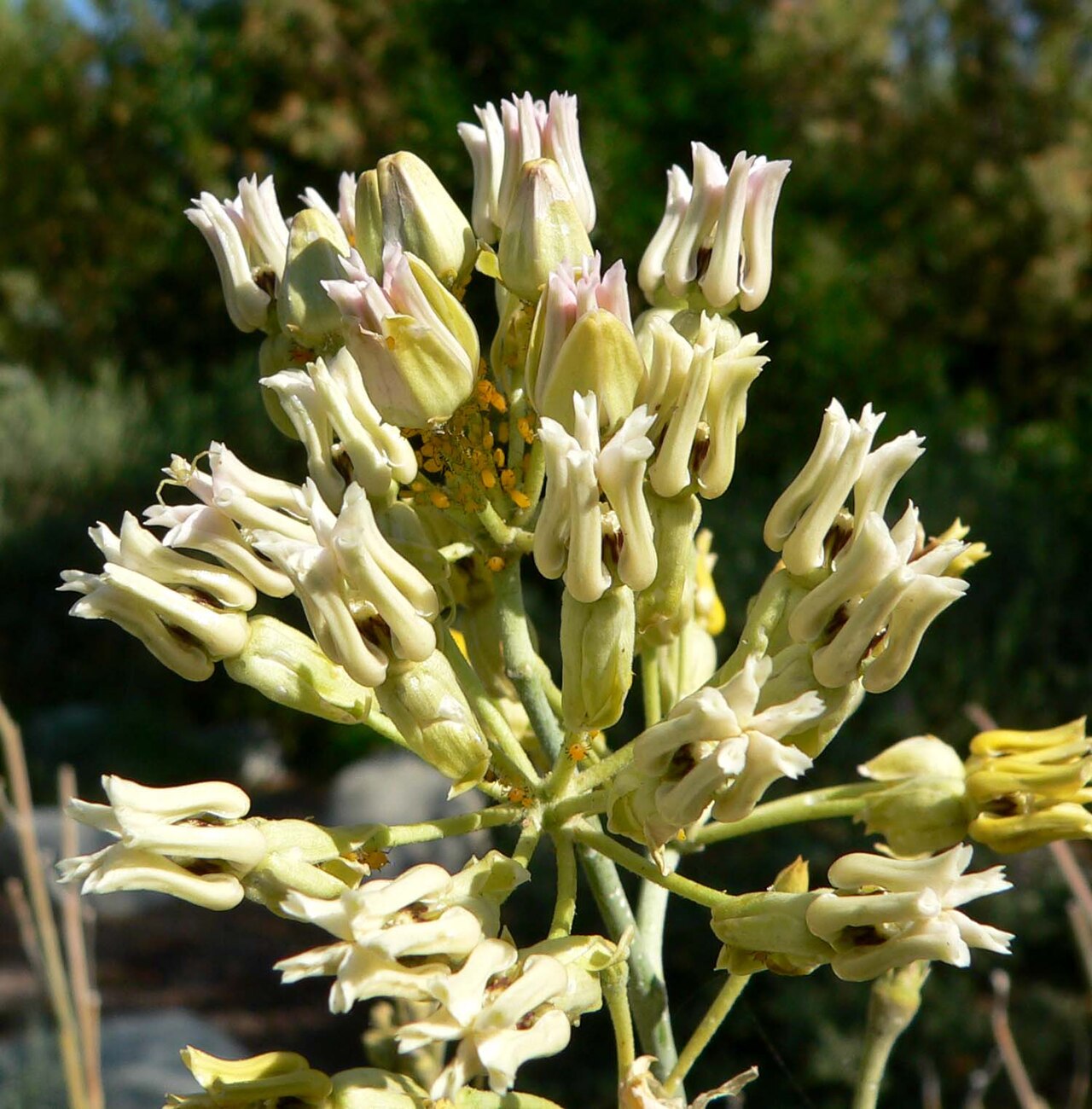
Asclepias subulata, known as Rush Milkweed, desert milkweed or ajamete, is a striking milkweed of the hottest deserts of the American Southwest and northwestern Mexico. It belongs to the dogbane family (Apocynaceae), which now includes the former milkweed family.
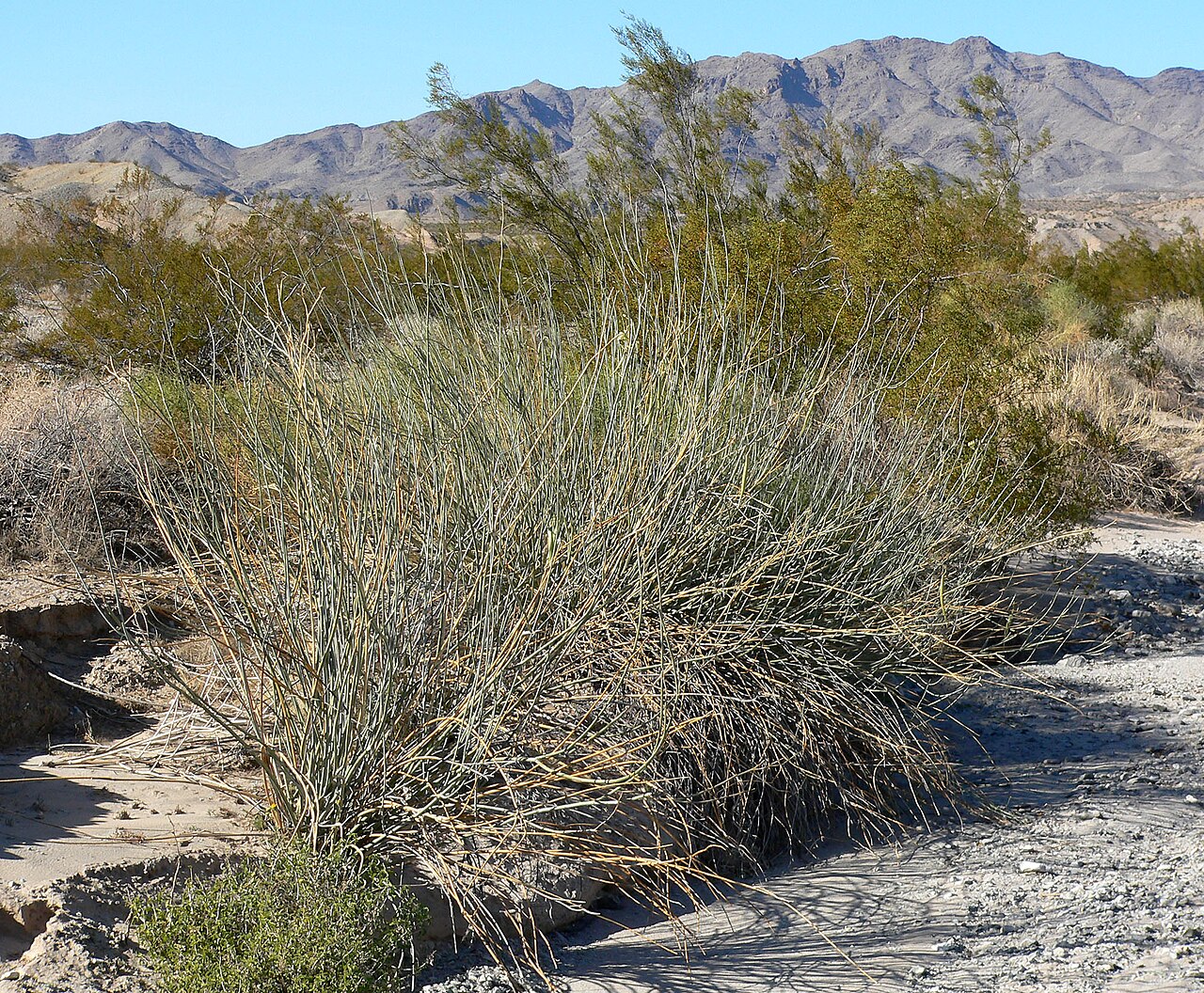
Mature plants look nothing like eastern milkweeds. Dozens of smooth, gray-green, pencil-thin stems rise 3 to 5 feet from a single woody base, so the plant resembles a giant clump of rushes or horsetails. Small, narrow leaves appear only briefly after rain and soon drop, leaving the stems to do the work of photosynthesis. At the stem tips it bears rounded clusters of creamy white to pale yellow flowers, followed by slender pods full of silky-plumed seeds.
Rush milkweed grows in sandy and gravelly desert washes, on dry slopes and on desert plains in Arizona, southeastern California and the southern tip of Nevada. It is one of the most drought-tolerant milkweeds and an important host plant for monarch and queen butterflies in the desert. Like all milkweeds, it contains toxic compounds; see the safety note below.
Identification
Look for a large, broom-like clump of bare, gray-green, rush-like stems in a desert wash, topped in season by clusters of creamy, swept-back milkweed flowers.
Growth Habit
Rush milkweed is a perennial subshrub that grows from a deep, woody root crown. It produces many erect, unbranched or sparsely branched stems that are round, smooth and waxy, often with a whitish bloom, and usually 3 to 5 feet tall. A broken stem leaks white, milky sap. Old clumps can be several feet across.
Leaves
The leaves are opposite, very narrow and thread-like, about 1 to 2 inches long. They appear only on new growth after rains and fall off quickly, so for most of the year the plant is effectively leafless. The green stems carry out photosynthesis instead.
Flowers
Flowers can appear in almost any month after enough rain, with peaks in spring and again after summer or fall rains. They are borne in rounded clusters (umbels) of several to about 15 flowers near the stem tips. Each flower is about 1/2 inch long, with five pale yellow to greenish-cream petals bent sharply back and a crown of five creamy, upright hoods, each with a small horn curving over the center.
Fruit & Seeds
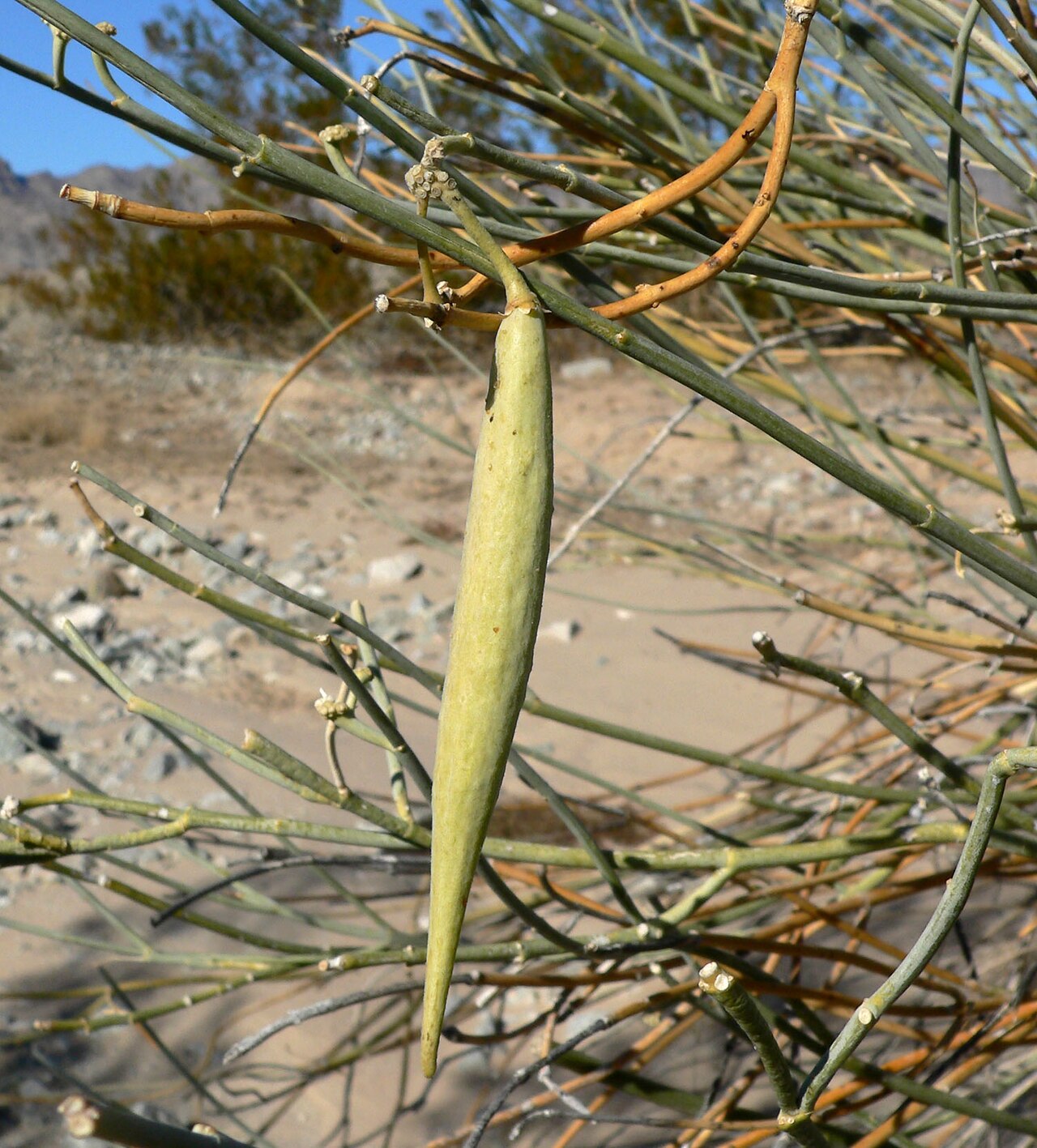
The fruit is a narrow, spindle-shaped pod (follicle) about 3 to 5 inches long, smooth and green, turning tan as it dries. When ripe it splits along one side to release many flat, brown, oval seeds, each with a tuft of long, silky white hairs that carries it on the wind.
Look-alikes
Leafless milkweed (Asclepias albicans) of the same deserts is very similar but has fewer, stouter, chalky-white stems and flowers tinged with pink or brown; it grows mainly on rocky slopes rather than sandy washes. Mormon tea (Ephedra) also has clumps of jointed green stems, but its stems are jointed with tiny scale leaves, it has no milky sap, and it bears small cones rather than flowers. Desert broom (Baccharis sarothroides) has broom-like stems but bears small white fluffy flower heads and has no milky sap.
Safety Notes
Like all milkweeds, rush milkweed contains cardiac glycosides (cardenolides) that are toxic if eaten by people, pets or livestock. Do not eat any part of the plant. The milky sap can irritate skin and is dangerous in the eyes, so wear gloves when cutting stems and wash your hands afterward. Plant it where livestock cannot graze it.
Quick Facts
| Scientific Name | Asclepias subulata |
| Family | Apocynaceae (dogbane family; milkweed subfamily) |
| Plant Type | Perennial subshrub; nearly leafless |
| Mature Height | 3–5 ft |
| Mature Spread | 2–4 ft |
| Growth Rate | Moderate |
| Sun Exposure | Full sun |
| Water Needs | Very low; dry, well-drained soil |
| Soil Type | Sandy, gravelly or rocky desert soils |
| Soil pH | About 7.0–8.5 |
| Bloom Time | March–November after rain; peaks in spring |
| Flower Color | Creamy white to pale yellow |
| Fall Color | None; gray-green stems all year |
| Fruit | Slender pods with silky-plumed seeds |
| Deer Resistant | Yes; toxic milky sap |
| USDA Hardiness Zones | 8–11 |
Native Range
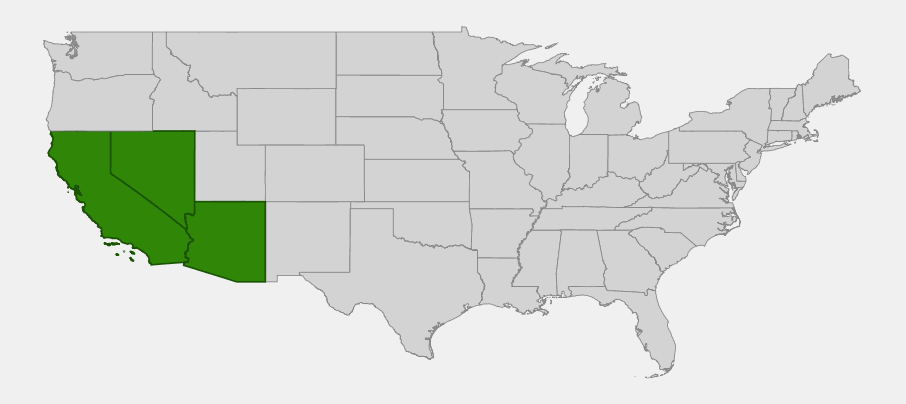
Rush milkweed is native to the Sonoran and Mojave deserts of the southwestern United States and northwestern Mexico. USDA PLANTS lists it as native in Arizona, California and Nevada. In Mexico it grows in Sonora and on the Baja California peninsula, south to the Cape region, where it is known as jumete or ajamete.
In Arizona it is most common in the western and southern deserts, from the lower Colorado River across the Phoenix and Tucson basins. In California it grows in the Colorado Desert and eastern Mojave Desert of Imperial, Riverside, San Bernardino and San Diego counties, and in Nevada it reaches only the far south, near the Colorado River.
Typical habitats are sandy and gravelly washes, desert flats, bajadas and dry rocky slopes, usually below about 3,000 feet, alongside creosote bush, bursage, palo verde and smoke tree. It often grows where runoff collects after storms, which lets its deep roots tap occasional moisture.
📋 Regional plant lists featuring Rush Milkweed: Arizona & New Mexico · California & Nevada
Growing & Care Guide
Rush milkweed is widely grown in desert landscapes in Phoenix, Tucson, Las Vegas and Palm Springs, and nurseries in the Southwest often carry it. It is an easy, sculptural plant for hot, dry gardens and one of the best milkweeds for low-desert butterfly gardens.
Light
Plant it in full sun. It tolerates reflected heat from walls and pavement, and in the low desert it also accepts light afternoon shade, but too much shade makes it sparse and floppy.
Soil & Water
It needs fast-draining sandy, gravelly or rocky soil and will rot in heavy, wet clay. Water regularly through its first summer to establish the deep root. After that, a deep soak every two to four weeks in the hottest months keeps it greener and blooming more; it can survive on rainfall alone but will be more dormant. Do not water it frequently in winter.
Planting Tips
Use it as a vertical accent among boulders, in a wash-style garden, along a dry streambed, or in a butterfly garden with desert marigold, globemallow and penstemons. Give it room so its stems can spread, and place it away from where children or pets might chew on it.
Pruning & Maintenance
Little pruning is needed. Remove old, dead or woody stems at the base in late winter to renew the clump; wear gloves because of the sap. Expect yellow oleander aphids on new growth; they rarely harm the plant and can be hosed off. Avoid insecticides, which would also kill monarch and queen caterpillars.
Propagation
Grow it from fresh seed, which does not usually need cold stratification. Sow in warm soil in spring or early summer, barely covering the seed, and keep it lightly moist until the seedlings are established. It can also be started from stem cuttings in warm weather. Plants grown in deep containers transplant best, because the taproot dislikes disturbance.
Landscape Uses
- Desert butterfly gardens: host plant for monarch and queen caterpillars
- Xeriscapes: sculptural, nearly leafless stems for hot, dry sites
- Wash and dry-streambed plantings: mimics its natural habitat
- Pollinator gardens: nectar for wasps, bees and butterflies
- Revegetation: desert washes and disturbed sandy sites in its range
Wildlife & Ecological Value
Rush milkweed is one of the few milkweeds that thrive in the low desert, and it supports a whole community of milkweed specialists there.
For Pollinators
The flowers are visited by many wasps, including large tarantula hawk wasps (Pepsis), as well as bees, flies and butterflies. Like other milkweeds, the pollen is packed in pairs of sacs (pollinia) that clip onto the legs of visiting insects. Rush milkweed is a larval host plant for the monarch and the queen butterfly, which lay eggs on the stems and new growth, and its toxins help make the caterpillars distasteful to predators.
For Birds
It is not a major bird food, but birds such as verdins and orioles pick insects from the plants, and some birds use the silky seed fluff in their nests.
For Mammals
The toxic, milky sap discourages most browsing animals, so the plant is rarely eaten by deer, rabbits or livestock.
Ecosystem Role
Rush milkweed supports milkweed specialist insects, including milkweed bugs, milkweed beetles and aphids, as well as monarchs and queens. Its deep roots and dense stem clumps help hold sand and gravel in washes.
Cultural & Historical Uses
The species was described by the French botanist Joseph Decaisne in 1844. The name subulata means “awl-shaped,” referring to the narrow, pointed leaves.
During the 1930s, when the United States looked for domestic sources of natural rubber, rush milkweed was among the desert plants tested for latex, including trials near Bard, California. It never became a commercial crop.
In Baja California and Sonora the plant is known as jumete or ajamete. Today it is valued mainly by gardeners in the desert Southwest as a low-water butterfly plant, and it is often recommended in local monarch conservation efforts.
Frequently Asked Questions
Why doesn’t rush milkweed have leaves?
It produces small, narrow leaves only after rain and drops them quickly to save water. Its green stems carry out photosynthesis instead, an adaptation to extreme desert heat and drought.
Is rush milkweed good for monarchs?
Yes. It is a larval host plant for both monarch and queen butterflies, and one of the best milkweeds for low-desert gardens in Arizona, southern California and southern Nevada.
Is rush milkweed poisonous?
Yes. Like all milkweeds it contains cardiac glycosides that are toxic if eaten. Keep it away from pets and livestock, and avoid getting the milky sap in your eyes.
How often should I water rush milkweed?
Once established, water deeply every two to four weeks in summer and rarely in winter. Overwatering, especially in heavy soil, can cause root rot.
Where does rush milkweed grow?
It grows in desert washes, flats and rocky slopes of the Sonoran and Mojave deserts in Arizona, southeastern California, southern Nevada and northwestern Mexico.

Looking for a nursery that carries Rush Milkweed?
Browse our native plant nursery directory: Arizona · California · Nevada

