
Scarlet Oak (Quercus coccinea)
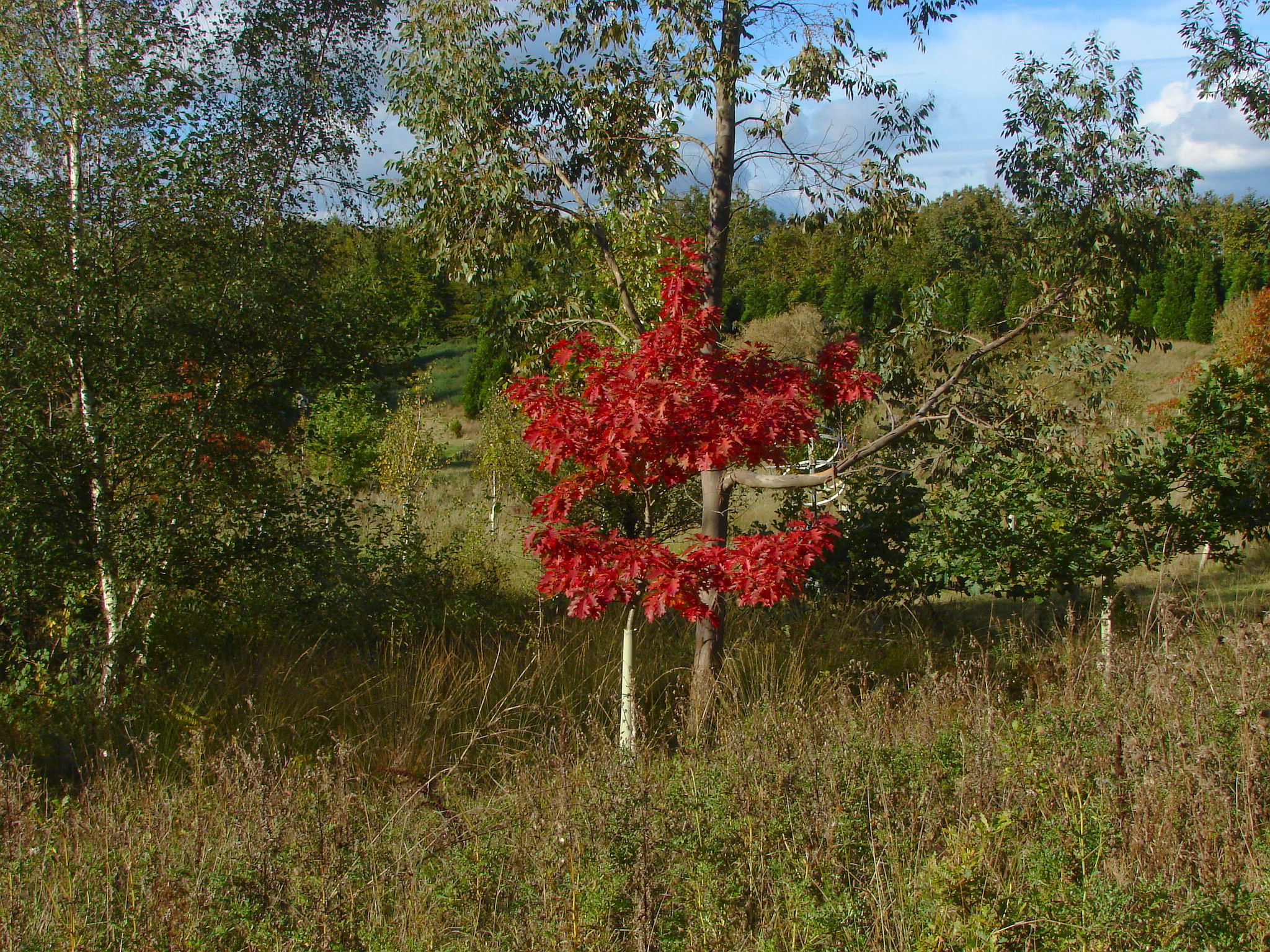
Quercus coccinea, the Scarlet Oak, earns its name every October with one of the most spectacular fall color displays in the eastern deciduous forest. When this large, fast-growing native tree turns scarlet-red in autumn, it can stop traffic — the intensity of its crimson fall foliage is unmatched among oaks and rivals any ornamental tree planted for fall color. Growing 60–80 feet tall (occasionally exceeding 100 feet) with an open, broadly rounded crown and deeply cut, star-shaped leaves, Scarlet Oak is both a magnificent landscape tree and a critically important ecological species for wildlife, insects, and forest ecosystem health throughout the eastern United States.
Scarlet Oak is a member of the Red Oak group, meaning its acorns mature over two growing seasons — they overwinter as small, undeveloped acorns before completing development and falling the following autumn. Like all oaks, it is a keystone species for wildlife: its acorns support white-tailed deer, black bears, Wild Turkeys, Blue Jays, squirrels, and dozens of other species. Its foliage hosts hundreds of caterpillar species whose protein-rich bodies feed nesting birds and songbird migration. Few native trees deliver greater ecological value per square foot of canopy.
A fast grower by oak standards — adding 18–24 inches per year in youth — Scarlet Oak is also one of the most drought-tolerant oaks, thriving on dry, sandy, and gravelly soils where species like White Oak or Bur Oak grow more slowly. It is an excellent street tree, park tree, and suburban landscape tree for sites with adequate space. Its combination of rapid establishment, brilliant fall color, wildlife value, and drought tolerance makes Scarlet Oak one of the most highly recommended native oaks for the Mid-Atlantic and Northeast region.
Identification
Scarlet Oak is a large deciduous tree, typically 60–80 feet tall in landscape settings with a roughly equal spread, forming a broadly oval to rounded, somewhat open crown. Growth is rapid in youth — one of the faster-growing oaks — slowing as the tree matures. The trunk can reach 2–3 feet or more in diameter on old specimens, with a handsome bark pattern distinct from most other oaks.
Bark
The bark of Scarlet Oak is dark grayish-brown to nearly black, developing into irregular, broadly ridged and furrowed plates as the tree matures. The inner bark — visible when scratched or cut — is distinctly reddish, which helps distinguish it from similar oaks. Young bark is smoother and brown. Overall, the bark is less dramatically ridged than Chestnut Oak but more textured than Black Oak (Q. velutina).
Leaves
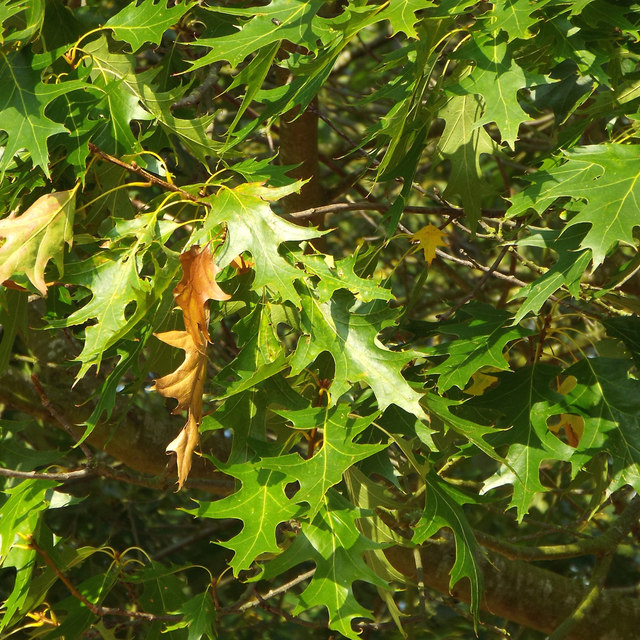
The leaves are the most diagnostic feature of Scarlet Oak: deeply and narrowly lobed with 7–9 lobes, each lobe ending in several bristle-tipped teeth. The sinuses (spaces between lobes) are cut very deeply — often nearly to the midrib — giving the leaf a star-like or skeletal appearance quite different from the rounded lobes of White or Chestnut Oak. Leaves are 3–7 inches long, lustrous dark green above, paler below with small tufts of hair in the vein axils. The combination of deeply cut sinuses and brilliant scarlet red fall color that persists into late October or November is the hallmark of this species.
Flowers & Acorns
Male catkins hang in pendulous clusters 3–4 inches long in April–May. The acorns are ¾ to 1 inch long, broadly oval to hemispherical, with a deep cup (turbinate, covering ½ or more of the nut) with tightly overlapping scales. Acorns are dark brown to nearly black when ripe. As a Red Oak group member, the acorns are bitter (high tannin) and require two growing seasons to mature — acorns from the current year overwinter as small nubs and mature the following autumn. They are nevertheless eagerly consumed by wildlife despite the bitterness.
Quick Facts
| Scientific Name | Quercus coccinea |
| Family | Fagaceae (Beech) |
| Plant Type | Deciduous Tree |
| Mature Height | 75 ft |
| Sun Exposure | Full Sun to Part Shade |
| Water Needs | Low (Drought Tolerant) |
| Bloom Time | April – May |
| Flower Color | Yellowish-green (catkins) |
| USDA Hardiness Zones | 4–9 |
Native Range
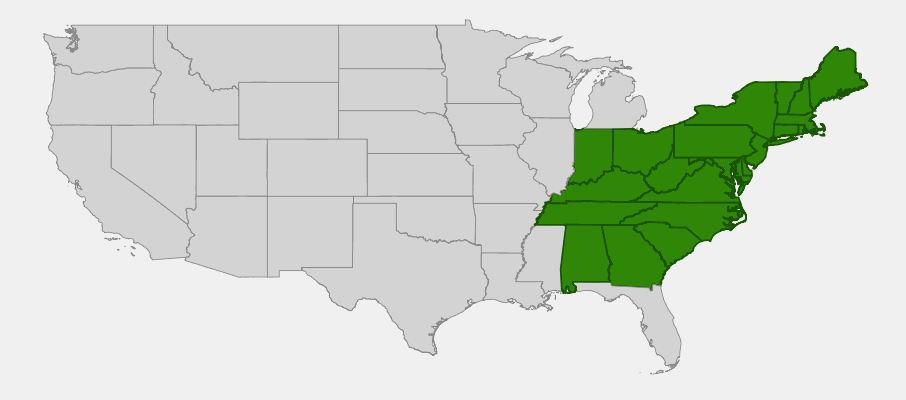
Scarlet Oak is native to the eastern United States, with a range extending from southwestern Maine south through New England, New York, New Jersey, Pennsylvania, Delaware, Maryland, Virginia, West Virginia, North Carolina, South Carolina, Georgia, Alabama, Tennessee, Kentucky, Ohio, and Indiana. It is most abundant in the mid-Atlantic and central Appalachian regions. The species favors dry, acidic, sandy or gravelly upland soils — the same habitat conditions that characterize the Ridge-and-Valley Province, the coastal plain, and the Piedmont across much of its range.
Within the NY-NJ-PA region, Scarlet Oak is a characteristic species of the New Jersey Pinelands (Pine Barrens), where it grows on sandy, acidic soils alongside Pitch Pine and Blackjack Oak. It is also abundant throughout the Appalachian ridges of Pennsylvania and New York, and in the oak-dominated upland forests of the Piedmont. In areas with slightly richer soils, it associates with Red Oak and White Oak, but it consistently outcompetes these species on the most droughty, sandy, and acidic sites.
Scarlet Oak is notably absent from the northern portion of New England (Vermont, New Hampshire, Maine) except in isolated southern stations — it is less cold-hardy than Red Oak and reaches its northern limits around central Connecticut and the lower Hudson Valley of New York. Southward it extends throughout the coastal plain and piedmont states to its limits in the Gulf states.
📋 Regional plant lists featuring Scarlet Oak: New York, Pennsylvania & New Jersey
Growing & Care Guide
Scarlet Oak is one of the best native oaks for landscape use — fast-growing by oak standards, exceptionally adaptable to dry and acidic soils, and producing some of the most brilliant fall color of any eastern tree. Its main requirement is full sun and good drainage; given those, it is remarkably self-sufficient.
Light
Scarlet Oak requires full sun to full sun with minimal shade for best growth and fall color development. In partial shade the crown thins, growth slows, and fall color is less vivid. For maximum fall color impact, site this tree in a location that receives full afternoon sun — south- or west-facing exposures produce the most intense scarlet coloration. It naturally occurs on open, sun-exposed ridges and slopes.
Soil & Water
Among its outstanding qualities is exceptional drought tolerance — Scarlet Oak thrives on dry, sandy, gravelly, or rocky soils that stress other oaks. It prefers acidic to neutral soil pH (4.5–7.0) and performs poorly in heavy clay or alkaline conditions. Avoid sites with high soil pH (limestone soils), which cause chlorosis (yellowing) in this acid-loving species. Once established — typically within 2–3 years of planting — it requires no supplemental irrigation. It is one of the most drought-tolerant large native trees for the eastern region.
Planting Tips
Plant Scarlet Oak in spring or fall from container stock. It transplants well when young. Dig a wide, shallow hole no deeper than the root ball. Avoid amending the soil — Scarlet Oak thrives in poor soil and amendment can encourage soft growth. Mulch with 3–4 inches of organic mulch to retain moisture during establishment. Protect from deer browsing during the first few years. After establishment, no special care is needed.
Pruning & Maintenance
Prune in late winter (January–March) to avoid the oak wilt disease window (April–July when beetle vectors are most active). Remove dead, diseased, or crossing branches. Young trees may develop somewhat codominant leaders — select the strongest and prune competing leaders to develop a well-structured crown. Once established, Scarlet Oak is largely pest- and disease-free. It is susceptible to oak wilt, so avoid any pruning wounds during spring and summer.
Landscape Uses
- Specimen shade tree — unmatched fall color display
- Street tree on sites with acidic, sandy soils
- Parking lot and urban tree on well-drained sites
- Slope and ridgeline planting on dry, rocky ground
- Wildlife anchor tree — acorns, caterpillar host, bird habitat
- Naturalistic oak woodland plantings on sandy or poor soils
Wildlife & Ecological Value
As a keystone native tree in eastern forests, Scarlet Oak delivers extraordinary ecological value across all seasons — acorns for mammals and birds in fall and winter, caterpillar habitat in spring and summer, and nesting structure year-round. Its rapid growth allows it to reach wildlife-productive size faster than slower-growing oaks.
For Birds
Scarlet Oak acorns are consumed by Wild Turkeys, Blue Jays, Red-headed Woodpeckers, Tufted Titmice, White-breasted Nuthatches, and many woodpecker and raptor species. Blue Jays are the primary long-distance acorn dispersers — caching acorns hundreds of yards from parent trees, effectively reforesting cleared areas. The complex bark supports large populations of insect prey, attracting woodpeckers and creepers throughout winter. The tree’s canopy hosts breeding pairs of Red-tailed Hawks, Cooper’s Hawks, and Barred Owls.
For Mammals
White-tailed deer, black bears, raccoons, opossums, gray squirrels, and chipmunks all feed heavily on Scarlet Oak acorns in autumn. Despite the high tannin content (bitterness), mammals consume them avidly, particularly after freeze-thaw cycles that break down some of the tannin compounds. Gray Squirrels scatter-cache large quantities of acorns, and uneaten caches germinate to become new oak trees — one of the most important seed dispersal relationships in eastern forests.
For Pollinators
Like all oaks, Scarlet Oak is wind-pollinated and not a significant nectar source. However, its spring catkins provide early pollen for native bees, and its foliage supports over 450 moth and butterfly caterpillar species — making it one of the most productive native caterpillar host plants in the eastern United States. These caterpillars are the primary protein source for songbirds raising young in spring and early summer.
Ecosystem Role
Scarlet Oak is a foundational species in dry upland oak forests and pine barrens. Its rapid growth allows it to quickly establish canopy structure after disturbance, providing the structural complexity that supports diverse wildlife communities. As a fire-adapted species — its thick bark and deep taproots help it survive moderate ground fires — it plays an important role in fire-maintained ecosystems like the New Jersey Pine Barrens, where periodic fire prevents succession to less wildlife-productive forest types.
Cultural & Historical Uses
Scarlet Oak has been valued as a timber tree throughout its range. The wood is in the Red Oak group: ring-porous hardwood, moderately hard and heavy, with prominent ray patterns when quartersawn. It is used for flooring, furniture, cabinetry, interior millwork, and firewood. In the 18th and 19th centuries, Scarlet Oak was harvested extensively for charcoal production and tanbark — its bark is moderately high in tannins, though less so than Chestnut Oak. The species regenerates readily from stump sprouts after cutting, making it a valuable coppice species in traditional woodland management.
Indigenous peoples throughout its range used various parts of Scarlet Oak medicinally. The Cherokee used bark decoctions as antiseptics and to treat skin conditions. The Iroquois used oak bark preparations for various medicinal purposes, and the acorns — though bitter — were processed and consumed as food after leaching in running water to remove tannins. Acorn flour was a dietary staple for many northeastern tribes, and oak mast years were carefully tracked as they indicated good years for hunting deer and other game that fed on the acorns.
Today, Scarlet Oak is widely planted as an ornamental shade tree and street tree. Its brilliant fall color — among the most vivid of any native tree — has made it a favorite in landscape design since the 19th century. It is planted in parks, campuses, and residential landscapes throughout its native range and beyond. As awareness of native plant value for wildlife has grown, Scarlet Oak has gained additional recognition as one of the most ecologically productive shade trees available to eastern homeowners and landscape professionals.
Frequently Asked Questions
Is Scarlet Oak the best oak for fall color?
Scarlet Oak is generally considered one of the top two or three native oaks for fall color, rivaling Red Oak (Q. rubra) and Pin Oak (Q. palustris) for intensity of display. Its colors tend to be more purely scarlet-red (vs. Red Oak’s more variable red to russet-brown). The intensity varies by individual tree, weather, and site — generally, dry, sunny fall weather following moderate summer drought produces the most vivid color.
How fast does Scarlet Oak grow?
Scarlet Oak is relatively fast-growing for an oak — expect 18–24 inches per year in youth under good conditions. Growth slows as the tree matures. It reaches landscape significance (30–40 feet) in 15–20 years from planting, making it one of the faster native oaks for establishing a mature woodland effect.
Is Scarlet Oak susceptible to oak wilt?
Yes — Scarlet Oak, like all Red Oak group members, is highly susceptible to oak wilt (Bretziella fagacearum), a devastating fungal disease. Avoid pruning from April through July when the sap beetle vectors are most active. If oak wilt is present in your area, consult with a certified arborist before pruning. Any wounds during the growing season should be immediately covered with pruning sealant.
Can Scarlet Oak grow in clay soil?
Scarlet Oak strongly prefers well-drained, sandy, gravelly, or loamy soil and is not well-suited to heavy clay or poorly drained sites. In clay, it grows slowly and is more susceptible to root disease. For clay soils, choose Swamp White Oak (Q. bicolor) or Bur Oak (Q. macrocarpa) instead.
How long does Scarlet Oak fall color last?
Scarlet Oak fall color typically persists for 2–4 weeks, often extending from mid-October into early November in the Mid-Atlantic region. Critically, the leaves often remain on the tree for weeks after reaching peak color, giving the tree a longer effective display period than many other fall-coloring species. Trees in full sun with slightly dry conditions tend to hold their color the longest.

Looking for a nursery that carries Scarlet Oak?
Browse our native plant nursery directory: New York · Pennsylvania