
Spikenard (Aralia racemosa)
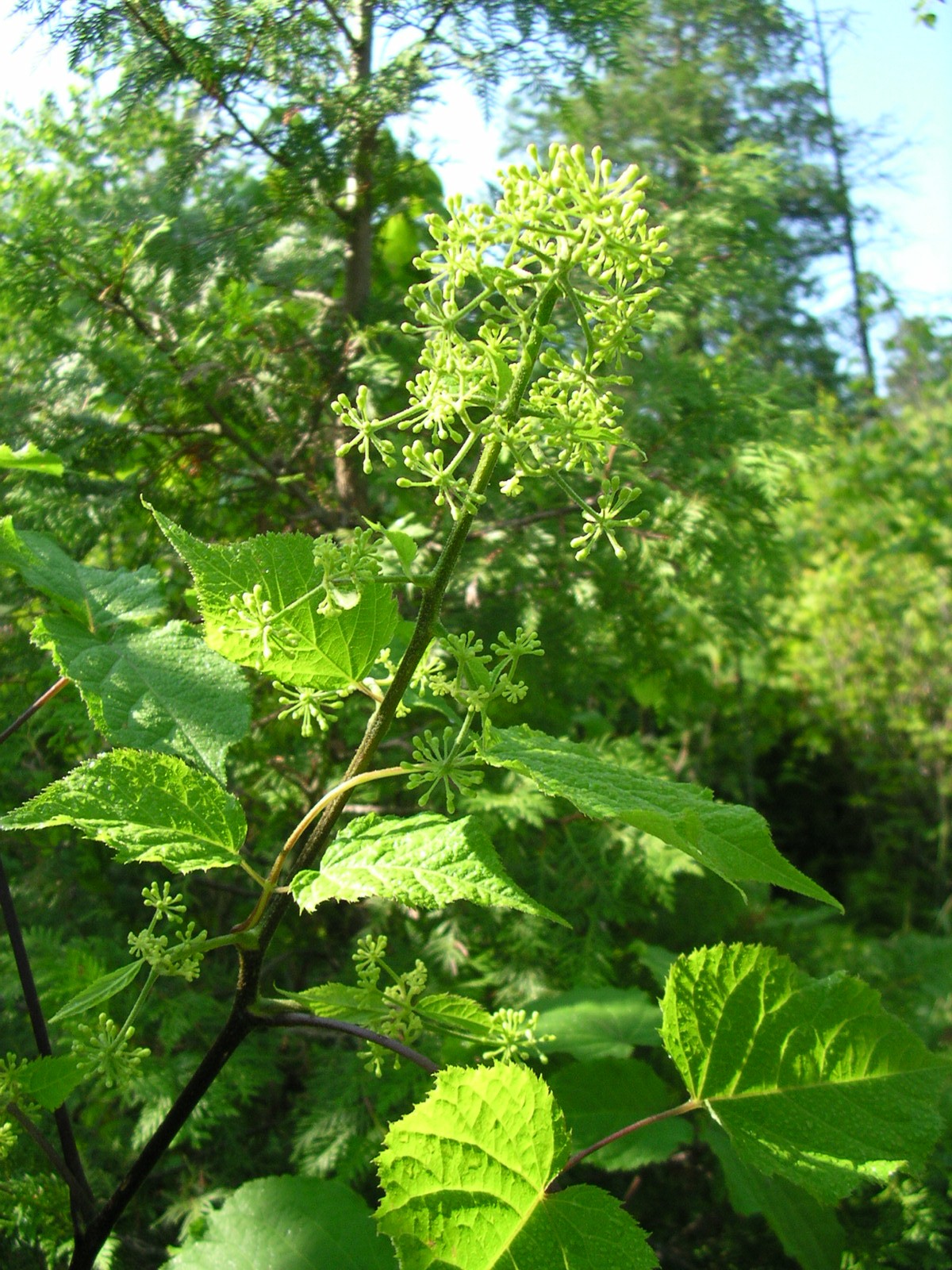
Aralia racemosa, commonly known as Spikenard, American Spikenard, or Indian Root, is one of the most dramatic and lush native perennials available for shaded gardens in eastern North America. A member of the Araliaceae (Ginseng) family, Spikenard is a large, bushy, herbaceous perennial that dies back to the ground each winter and re-emerges each spring with bold, tropical-looking compound leaves that quickly create a dramatic, layered presence in the woodland garden. Its common name “Spikenard” links it to the ancient and aromatic Asian spikenard (Nardostachys jatamansi), with which it shares a similar aromatic root character.
Growing naturally in the rich, moist soils of deciduous woodlands throughout much of eastern and central North America, Spikenard is a substantial perennial — easily reaching 3 to 5 feet tall (sometimes taller) with a spread of equal or greater width. The large, doubly compound leaves (leaves divided into leaflets, which are themselves divided) can reach 3 feet long, creating a lush, almost tropical canopy effect in the shaded garden. Small white flowers arranged in branched, compound umbel clusters appear in summer, followed by small clusters of dark reddish-purple to black berries in late summer and fall that are eagerly consumed by numerous bird species.
Spikenard has been a valued medicinal and food plant for Indigenous peoples of eastern North America for centuries. Its aromatic, spicy roots were used to treat a wide range of conditions, and the young spring shoots were eaten as a cooked vegetable. Today, Spikenard is primarily appreciated as a bold, low-maintenance woodland perennial — one of the finest native plants for creating dramatic foliage effect in deep shade. For anyone building a shade garden, woodland garden, or naturalistic planting in eastern North America, Spikenard is a must-have plant of exceptional character and wildlife value.
Identification
Spikenard is a large, non-woody herbaceous perennial that dies back completely to the ground each winter and re-emerges from a thick, aromatic taproot/rhizome system each spring. At maturity, the plant reaches 3 to 5 feet (0.9–1.5 m) tall and often spreads equally wide, creating a broad mound of arching foliage. The stems are stout, reddish-brown or purplish, and soft-textured — distinctly different from the woody stems of shrubs. The entire plant has a spicy, aromatic scent, particularly when the roots or stems are disturbed.
Leaves
The leaves are the plant’s most striking feature — they are large, bipinnate compound leaves (divided into compound leaflets), 1 to 3 feet (30–90 cm) long, arising alternately from the branching stems. Each leaf is divided into 2–5 pairs of lateral leaflets plus a terminal leaflet, with each leaflet 2 to 4 inches (5–10 cm) long, ovate with a heart-shaped base and sharply serrated margins. The leaflets are dark green above, paler and often hairy below. The large, arching leaves create a dramatic, lush, almost jungle-like effect in the woodland garden — Spikenard’s most distinctive ornamental feature. Leaves turn yellow in fall before dying back with frost.
Flowers
The flowers are tiny — barely ⅛ inch (2–3 mm) across — and creamy white, arranged in large, branching, compound clusters of spherical small umbels (umbellets) at the tips of the arching stems. The overall flowering structure (a compound umbel or panicle) can be 12 to 24 inches long, with dozens of small umbellets each containing 5–15 tiny flowers. Flowering occurs from June through August. Despite their small individual size, the white flower clusters are showy against the dark green foliage and attract a variety of small native bees, beetles, and flies as pollinators.
Fruit
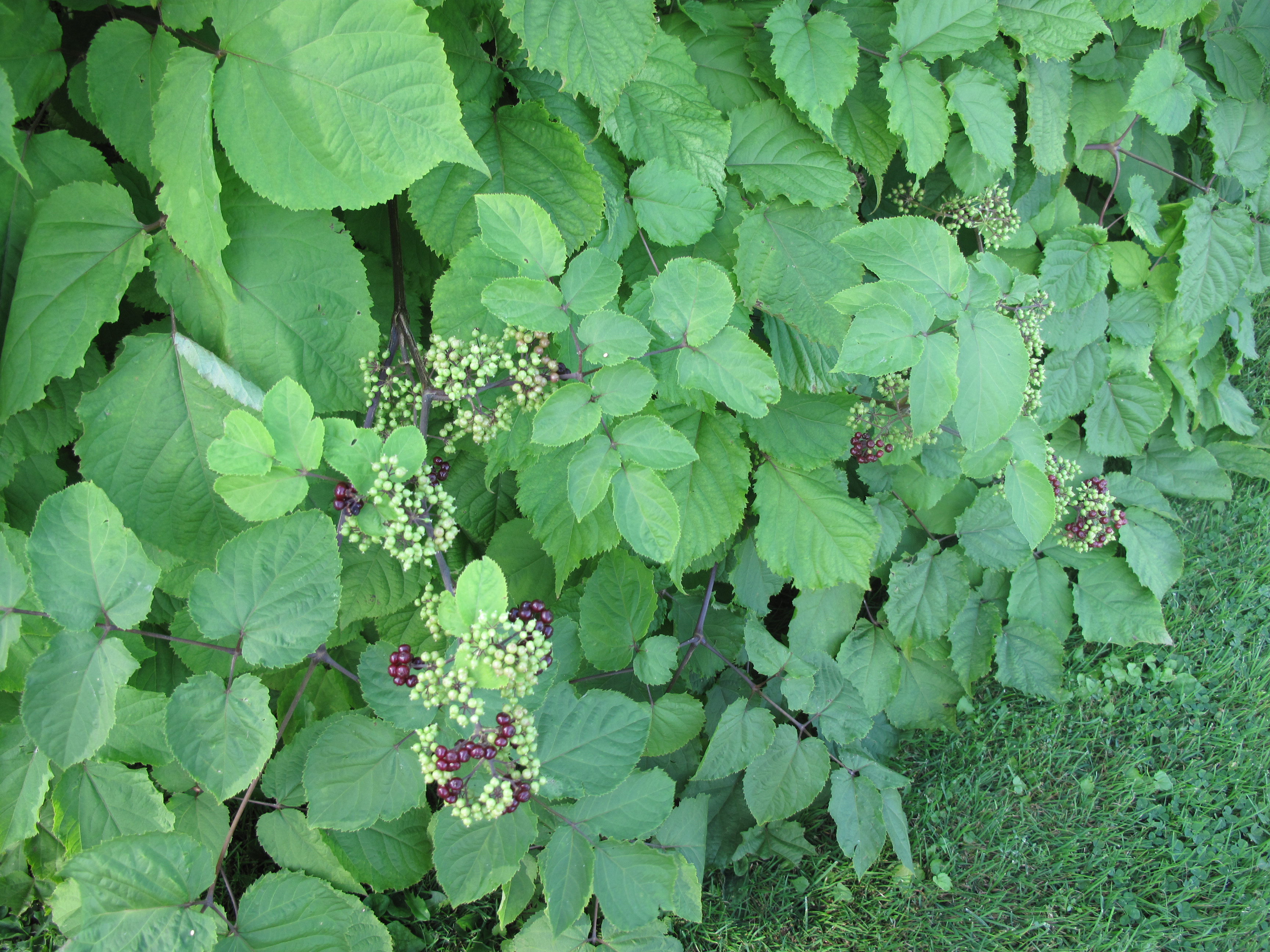
After flowering, the flower clusters transform into branched clusters of small, round drupes ¼ to ⅜ inch (5–8 mm) in diameter. The berries ripen through a beautiful progression from green to dark red to deep reddish-purple or nearly black by late summer and early fall. The clusters can contain dozens to hundreds of berries, creating an attractive display of dark-colored fruit on reddish stems — a feature birds find irresistible. The berries are technically edible but are not commonly eaten by humans; they have a somewhat spicy, resinous flavor.
Quick Facts
| Scientific Name | Aralia racemosa |
| Family | Araliaceae (Ginseng) |
| Plant Type | Herbaceous Perennial |
| Mature Height | 3–5 ft |
| Sun Exposure | Part Shade to Full Shade |
| Water Needs | Moderate to High |
| Bloom Time | June – August |
| Flower Color | White (small, in compound clusters) |
| Fruit | Dark reddish-purple to black drupes |
| USDA Hardiness Zones | 3–8 |
Native Range
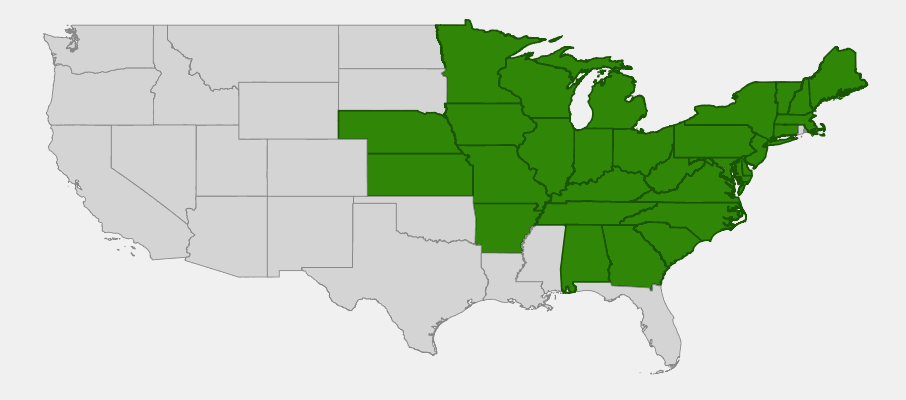
Spikenard is native to a broad swath of eastern and central North America, from southern Quebec, Ontario, and New England south through the Appalachian Mountain chain to Georgia and Alabama, and westward through the Midwest to the eastern Great Plains. It is most abundant in the Appalachian highlands and the rich, mesic deciduous forests of the eastern United States, where the deep, moist, nutrient-rich soils of coves and north-facing slopes provide ideal growing conditions.
Throughout its range, Spikenard grows almost exclusively in moist, rich deciduous forest understory — particularly in mesic (moderately moist) hardwood forests dominated by Sugar Maple (Acer saccharum), Beech (Fagus grandifolia), Yellow Birch (Betula alleghaniensis), and Tulip Poplar (Liriodendron tulipifera). It typically occurs on north- and east-facing slopes, in sheltered coves, and along shaded stream banks where cool temperatures and consistent moisture create the forest conditions that support a diverse flora of woodland wildflowers. It is often found growing alongside Jack-in-the-Pulpit (Arisaema triphyllum), Wild Ginger (Asarum canadense), Maidenhair Fern (Adiantum pedatum), and Bloodroot (Sanguinaria canadensis).
Spikenard occupies a distinct ecological niche as one of the largest native herbaceous perennials of the eastern forest understory. Its ability to thrive in deep shade distinguishes it from most other large perennials, which require more light. In the northeastern states — including New York, Pennsylvania, and New Jersey — Spikenard is a characteristic species of the Appalachian mixed mesophytic forest, where it grows in the understory of mature second-growth and old-growth forests at elevations from near sea level to approximately 4,000 feet.
📋 Regional plant lists featuring Spikenard: New York, Pennsylvania & New Jersey
Growing & Care Guide
Spikenard is a bold, rewarding perennial for shaded gardens with moist, rich soil. It is one of the most dramatic native woodland perennials available — nothing else creates quite the same lush, tropical effect in deep shade. Once established, it is long-lived and essentially maintenance-free.
Light
Spikenard thrives in part shade to full shade — the deeper the shade, the better, as long as moisture is adequate. It naturally grows in the understory of mature deciduous forests and is one of the few large native perennials that actually prefers deep shade. In deep shade, the large compound leaves stretch wide and create a dramatic layered effect. Some morning sun is beneficial, but afternoon shade is preferred, especially in warmer climates. Avoid planting in full sun unless soil moisture can be maintained consistently — full sun causes leaf scorch and stress.
Soil & Water
Rich, consistently moist, well-drained to moderately moist soil is ideal. Spikenard grows best in the kind of deep, humus-rich, loamy soil found in mature deciduous forest floors — moist but not waterlogged, fertile, and with good organic matter content. Amend sandy or clay soils generously with compost before planting. A soil pH of 5.0–7.0 (acidic to near-neutral) suits it well. Mulching with 2–3 inches of shredded leaves or bark chips is beneficial and mimics the natural forest floor leaf litter that keeps roots cool and moist. Once established, Spikenard is surprisingly tolerant of brief dry spells, though it performs best with consistent moisture.
Planting Tips
Plant Spikenard in spring or fall in a shaded location with rich, moist soil. Choose a site where it can spread — this is a large plant that needs 4–6 feet of width at maturity. It is perfect for the back of a shaded border, as a bold specimen beneath large trees, or for massing in a woodland garden. Space multiple plants 3–4 feet apart for a naturalistic colony effect. Transplanting is most successful with container-grown nursery stock. Division of established clumps in early spring is possible but often unnecessary, as Spikenard is naturally non-invasive and stays where it is planted.
Pruning & Maintenance
Spikenard is virtually maintenance-free. Remove old stems in late fall or winter after frost kills back the foliage, or simply leave the stems standing — they collapse naturally and can provide minor winter interest. Mark plant locations with a permanent marker or stake, as the plant emerges late in spring and may not be visible when early spring garden work begins. Spikenard has very few pest or disease problems; slugs may occasionally feed on young growth in wet springs, which can be managed with iron phosphate baits if necessary.
Landscape Uses
Spikenard is a standout choice for:
- Deep shade gardens — one of the few large-scale perennials that thrives in true deep shade
- Woodland gardens — creates a bold, naturalistic understory layer beneath large deciduous trees
- Rain gardens in shade — tolerates periodic excess moisture
- Bold foliage contrast — pairs beautifully with ferns, hostas, and small-leaved woodland wildflowers
- Bird-friendly plantings — the dark berry clusters are magnets for songbirds in late summer
- Native plant restoration — excellent for establishing a diverse native woodland understory
- Four-season interest — dramatic spring emergence, bold summer foliage, attractive fruit, interesting stem structure in winter
Wildlife & Ecological Value
Spikenard is an ecologically significant native perennial of the forest understory, providing food and habitat for a variety of wildlife species while playing an important structural role in forest floor communities.
For Birds
The dark berry clusters of Spikenard are a preferred food source for many bird species in late summer and early fall. American Robins, Hermit Thrushes, Veeries, Swainson’s Thrushes, Gray Catbirds, Cedar Waxwings, and Red-eyed Vireos readily consume the berries. The dense, lush growth also provides important summer nesting habitat and foraging grounds for insectivorous birds that hunt invertebrates through the rich forest floor vegetation.
For Mammals
Black bears consume Spikenard berries and roots — the plant is listed as a significant bear food in forested regions of its range. White-tailed Deer browse the foliage, though the aromatic compounds in the leaves make it less preferred than many other forest perennials. Chipmunks and mice eat the fallen berries and may cache seeds in the leaf litter.
For Pollinators
The small white flowers attract a diverse community of small native bees, including sweat bees (Halictus and Lasioglossum spp.) and mining bees (Andrena spp.), as well as various beetles and flies. Spikenard blooms in mid-summer when the forest understory offers relatively few other flowering plants, making it an important mid-season nectar source in woodland ecosystems. It is also a larval host plant for several specialist bee species that have evolved to forage primarily on Aralia species.
Ecosystem Role
In the deciduous forest understory, Spikenard plays a critical role as a large-stature herbaceous component of the vegetation structure. Its bold, spreading growth shades the forest floor, moderating soil temperature and moisture — creating conditions favorable for smaller woodland wildflowers that need cool, moist root zones. The large leaf area intercepts rainfall and creates significant leaf litter that enriches the forest soil. As a relatively long-lived perennial with an extensive root system, Spikenard helps maintain soil structure and supports the mycorrhizal fungal networks that underpin forest ecosystem function.
Cultural & Historical Uses
Spikenard has one of the richest ethnobotanical histories of any native North American perennial. Indigenous peoples across its range used virtually every part of the plant — roots, bark, berries, and young shoots — for medicine and food. The root was particularly valued: thick, fleshy, and strongly aromatic, it smells of a complex mixture of earth, spice, and something almost medicinal. This root aroma likely inspired the common name “Spikenard,” connecting it to the unrelated but similarly aromatic Asian plant (Nardostachys jatamansi) that was the original “spikenard” of ancient trade and biblical reference.
The Cherokee used Spikenard root extensively — as a poultice for broken bones and backaches, as a tea for coughs, asthma, and chest complaints, and as a treatment for general debility and as a strengthening tonic. The Iroquois used root preparations to treat fevers, back pain, and blood conditions. The Ojibwe used the root as a general strengthening medicine and as a treatment for stomach complaints. The Potawatomi used the aromatic root bark in various medicinal preparations. The young, tender shoots emerging in spring were eaten as a cooked vegetable by multiple groups — similar in use to Asparagus, and reportedly mild and pleasant in flavor when cooked.
European settlers adopted many of these uses, and Spikenard appeared in early American herbals and medical texts as a treatment for rheumatism, coughs, kidney complaints, and various inflammatory conditions. The roots were also used in making a fermented root beer-like beverage. Today, Spikenard root extract is sold as an herbal supplement for respiratory support, anti-inflammatory effects, and general tonic use. While there is some evidence for its bioactive compounds (including acetylenes and diterpenes), clinical evidence for specific medical uses remains limited. Its legacy as a medicinal plant, however, spans thousands of years of Indigenous knowledge that continues to inform modern ethnobotanical research.
Frequently Asked Questions
Is American Spikenard the same as the spikenard in the Bible?
No — the “spikenard” mentioned in ancient texts including the Bible is Nardostachys jatamansi, a plant native to the Himalayas that was traded as a precious aromatic oil across the ancient world. American Spikenard (Aralia racemosa) is a completely different plant, native to North America, that was given the same common name because its roots share a similarly aromatic, earthy-spicy character. The two plants are not closely related but share a similar aromatic root quality.
Can Spikenard grow in deep shade?
Yes — Spikenard is one of the finest native perennials for true deep shade. It naturally grows beneath the canopy of closed-canopy deciduous forests and thrives where many other plants struggle. It prefers part to full shade and will show leaf stress (yellowing, scorching) if placed in too much direct sun, particularly in the afternoon. For shaded gardens beneath large trees, Spikenard is an outstanding choice that few other perennials can match in scale and drama.
How do I start Spikenard from seed?
Spikenard seeds require a warm-then-cold stratification period to germinate. Collect ripe berries in fall, clean the pulp from the seeds, and either sow them immediately outdoors (where they will naturally stratify over winter) or refrigerate them in moist medium for 3 months followed by a brief warm period, then cold stratify for another 3 months before sowing. Germination can be slow and irregular. Most gardeners find it easier to start with container-grown nursery plants, which are increasingly available from native plant nurseries throughout its range.
Does Spikenard spread aggressively?
No — Spikenard is not aggressive and does not spread by rhizomes or runners. It grows as a clump from its central root crown and expands slowly over many years without becoming invasive. It may self-seed in favorable conditions, but seedlings are easy to manage and rarely become a nuisance. This non-spreading habit makes it an excellent choice for gardens where control of spread is important.
When does Spikenard emerge in spring?
Spikenard is one of the later-emerging native perennials — it does not typically appear above ground until mid-to-late spring, well after many other woodland wildflowers have already bloomed. Mark its location clearly in fall before the stems die back, as it is easy to accidentally damage the root crown with spring garden tools when the plant is not yet visible. Once it emerges, growth is rapid, and the plant quickly reaches its full size.

Looking for a nursery that carries Spikenard?
Browse our native plant nursery directory: New York · Pennsylvania