Shrubby St. Johns Wort (Hypericum prolificum)
Hypericum prolificum, commonly known as Shrubby St. John’s Wort, is a tough, adaptable, and abundantly flowering native shrub that deserves far more attention in native plant gardens than it typically receives. One of only a handful of shrubby species in the predominantly herbaceous Hypericum genus, this compact, mounding native produces an extraordinary display of bright golden-yellow, five-petaled flowers from June through August — a bloom period of 8 or more weeks that rivals even the showiest cultivated shrubs while providing genuine ecological value to native pollinators.
A member of the Hypericaceae family, Shrubby St. John’s Wort grows 1 to 4 feet tall, forming a dense, rounded shrub with attractive shredding bark on older stems, narrow blue-green leaves, and abundant flowers produced on new wood throughout the summer months. Native to eastern and central North America, it grows naturally in a wide variety of conditions — rocky outcrops, open woods, stream banks, dry bluffs, and disturbed areas — demonstrating a hardiness and adaptability that makes it an excellent choice for challenging landscape sites.
Unlike the better-known medicinal Hypericum perforatum (Common St. John’s Wort), which is a European introduction and invasive in many areas, Shrubby St. John’s Wort is a true native species that evolved alongside native pollinators and contributes meaningfully to local food webs. Its profuse blooming habit — reflected in its species name prolificum, meaning “prolific” — combined with its tolerance for poor soils, drought, and heat make it one of the most functional flowering shrubs available for Kentucky and Tennessee native gardens.
Identification
Shrubby St. John’s Wort is a distinctive native shrub that can be identified by its combination of compact mounding form, shredding bark, narrow opposite leaves with translucent dots, and bright yellow flowers with prominent stamens produced over a long summer bloom period.
Bark & Stems
The bark is a distinctive and attractive feature — on older stems, it is reddish-brown and exfoliates (peels) in thin, papery strips, revealing lighter-colored inner bark beneath. This attractive shredding quality adds winter interest to the plant. Young stems are smooth and two-winged (having narrow ridges along their length). The overall form is compact and densely branched, creating a rounded to mounding shrub that requires virtually no pruning to maintain an attractive form.
Leaves
The leaves are opposite, simple, narrowly oblong to elliptic, 1 to 3 inches long, and dark blue-green above with a distinctly glaucous (bluish-gray) cast. Like all true St. John’s Worts, the leaves are dotted with translucent or black oil glands that are visible when held up to light. This is a diagnostic feature of the genus Hypericum. The leaf texture is somewhat leathery and the leaves are persistent in mild winters, making the plant semi-evergreen in the southern portion of its range.
Flowers & Fruit
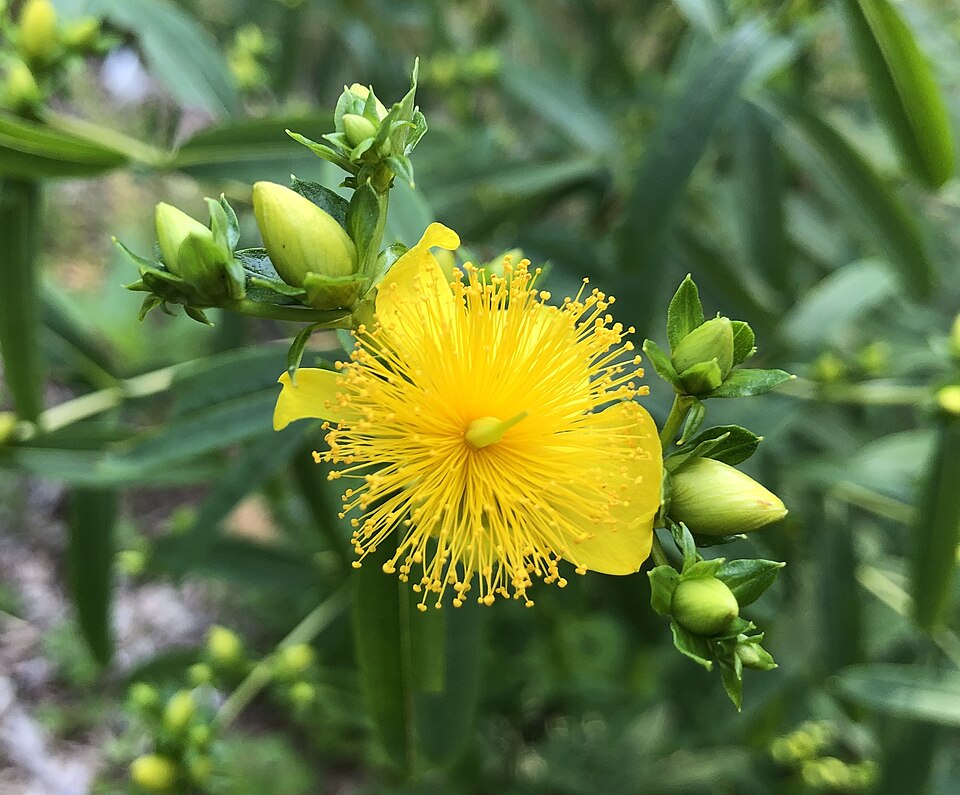
The flowers are the plant’s primary ornamental feature: bright golden-yellow, with five broad petals and a prominent central cluster of 70 to 100 stamens that gives each flower a cheerful, sun-like appearance. Individual flowers are 1 to 1¼ inches across and are produced in profuse clusters at the tips of branches. The flowering season is remarkably long — typically June through August — with peak bloom in July. The fruit is a small, dry capsule (about ½ inch long) that persists through winter and provides some seed-eating bird value.
Quick Facts
| Scientific Name | Hypericum prolificum |
| Family | Hypericaceae (St. John’s Wort) |
| Plant Type | Deciduous to Semi-Evergreen Shrub |
| Mature Height | 1–4 ft |
| Sun Exposure | Full Sun |
| Water Needs | Low to Moderate (Drought Tolerant once established) |
| Bloom Time | June – August (8+ weeks) |
| Flower Color | Bright golden-yellow |
| Bark Interest | Attractive reddish-brown exfoliating bark |
| Deer Resistant | Generally yes |
| USDA Hardiness Zones | 4–8 |
Native Range
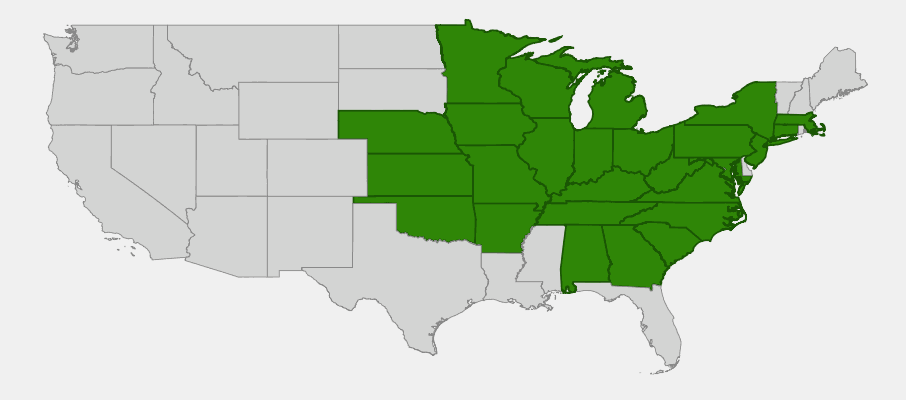
Shrubby St. John’s Wort is native to eastern and central North America, with a range extending from New England and the Great Lakes states southward through the Appalachian region to the Carolinas, Georgia, and Alabama, and westward through the Midwest to Nebraska and Oklahoma. Its range broadly overlaps with the eastern deciduous forest biome, with the greatest concentrations in the Midwest, Ohio Valley, and southern Appalachian states.
In Kentucky and Tennessee, Shrubby St. John’s Wort occurs statewide in a variety of habitats, including rocky, open woodlands, stream banks, sandstone bluffs, prairie edges, and disturbed areas. It shows a preference for well-drained to dry soils in open, sunny to partially shaded conditions — a habitat profile that makes it well-suited to the rocky, thin-soiled knobs of central Kentucky and the cedar glades and rocky barrens of Tennessee.
The species often colonizes disturbed or naturally open habitats, and it can be found growing in successional habitats such as old fields, power line corridors, and road banks throughout its range. This habitat flexibility, combined with its tolerance for poor soils, makes it one of the most broadly adapted native shrubs in the eastern United States.
📋 Regional plant lists featuring Shrubby St. John’s Wort: Kentucky & Tennessee
Growing & Care Guide
Shrubby St. John’s Wort is one of the lowest-maintenance native shrubs you can plant. Once established in a sunny, well-drained spot, it asks for almost nothing — just a hard cutback every few years to keep it vigorous and tidy. It rewards minimal care with a spectacular, months-long flower display.
Light
Full sun is essential for maximum flowering. Shrubby St. John’s Wort tolerates light shade but will produce significantly fewer flowers and a more open, less attractive form. For a dense, compact mound covered in bright yellow blooms throughout summer, give it the sunniest spot available. In Kentucky and Tennessee, it thrives in full-sun garden beds, rock gardens, and open borders.
Soil & Water
This species is remarkably adaptable in terms of soil — it grows in sandy, rocky, clay, and loamy soils, and tolerates a range of pH values from slightly acidic to slightly alkaline. Good drainage is the primary requirement; it will not thrive in constantly wet or waterlogged soils. Once established (typically after 1–2 growing seasons), Shrubby St. John’s Wort is notably drought-tolerant and may require little to no supplemental irrigation. During the establishment period, water regularly to help develop deep roots.
Planting Tips
Plant in spring or fall in a full-sun location with well-drained soil. Space plants 2–4 feet apart for a mass planting that will fill in over 2–3 seasons. Shrubby St. John’s Wort is an excellent choice for slopes, rock gardens, dry borders, and any location where drainage is good and sun is abundant. It combines beautifully with ornamental grasses, Black-eyed Susans, Butterfly Milkweed, and other dry-adapted native plants.
Pruning & Maintenance
Shrubby St. John’s Wort blooms on new wood, which means hard pruning in late winter or very early spring actually stimulates abundant new growth and better flowering. Cut plants back by one-half to two-thirds in late February or March before new growth begins. This rejuvenation pruning keeps the plant compact, prevents the base from becoming leggy, and promotes the new wood that carries the summer flowers. Without periodic cutbacks, older plants develop a woody, less attractive base over several years.
Landscape Uses
- Mass plantings — a spectacular ground-covering effect when planted 3 feet apart
- Rock gardens — thrives in the sharp drainage and heat retention of rock garden settings
- Dry borders — excellent for hot, dry sites where many plants struggle
- Slope stabilization — dense root system holds soil on slopes and banks
- Pollinator gardens — profuse summer blooms attract diverse native bees and insects
- Low hedges — can be maintained as an informal low hedge with annual pruning
Wildlife & Ecological Value
Shrubby St. John’s Wort provides important ecological value in its role as a prolific summer-blooming shrub that supports native pollinators during the often-challenging midsummer period.
For Birds
The persistent seed capsules provide modest food value for seed-eating birds including goldfinches, sparrows, and finches. The dense, compact branching structure provides cover and nesting sites for small songbirds. While not a primary food source for most birds, Shrubby St. John’s Wort provides cover and attracts the insect prey that many birds depend on during the breeding season.
For Mammals
White-tailed deer generally avoid Shrubby St. John’s Wort — the plant contains hypericin and other compounds that make it unpalatable. This deer resistance, combined with its excellent drought tolerance and long bloom period, makes it one of the most practical native shrubs for challenging landscape conditions. Rabbits may occasionally browse young shoots but typically leave established plants alone.
For Pollinators
The profuse, pollen-rich flowers of Shrubby St. John’s Wort are visited by an extraordinary diversity of native bees — more than 50 bee species have been documented visiting Hypericum species. Specialist bee genera including Andrena (mining bees) and Ptiloglossia are known to show particular affinity for Hypericum flowers. Bumble bees, sweat bees, and large carpenter bees also visit the flowers extensively. The long blooming period — June through August — provides continuous nectar and pollen when many other native shrubs have finished blooming.
Ecosystem Role
As a colonizer of open, disturbed, and rocky habitats, Shrubby St. John’s Wort plays an important role in ecological succession and habitat restoration. Its drought tolerance and ability to grow in poor soils make it valuable for stabilizing and enriching disturbed sites. The plant’s compact form and dense branching create micro-habitats for ground-nesting insects and provides structural complexity in otherwise open habitats.
Cultural & Historical Uses
The genus Hypericum has a long history of medicinal and cultural use across multiple continents, though much of the historical attention has focused on the European species H. perforatum (Common St. John’s Wort) rather than native North American species. Indigenous peoples in eastern North America did use various native Hypericum species medicinally — the Cherokee used preparations from H. prolificum and related species for treating respiratory conditions, as an astringent, and in topical applications for wounds and skin irritations.
The common name “St. John’s Wort” refers to the plant’s traditional blooming time around the feast day of St. John the Baptist (June 24) in European folk tradition, a connection that was transferred to American species by settlers familiar with European Hypericum. In European folklore, St. John’s Wort was a powerful herb used to ward off evil spirits and witches, particularly when hung in doorways on St. John’s Eve. These folk traditions did not transfer strongly to the native American species, which were used more pragmatically as medicinal plants.
In modern landscaping, Shrubby St. John’s Wort is experiencing growing appreciation as a tough, beautiful, low-maintenance native shrub alternative to non-native landscape plants. Its exceptional drought tolerance, long bloom season, and attractive form make it well-suited to the low-water, low-maintenance gardens that are increasingly popular as water conservation concerns grow. Several nurseries in Kentucky and Tennessee now offer this species, and it is increasingly specified in native plant restoration projects and pollinator gardens.
Frequently Asked Questions
Is Shrubby St. John’s Wort the same as the medicinal St. John’s Wort sold in health stores?
No — the medicinal St. John’s Wort sold as an herbal supplement is the European species Hypericum perforatum, which is actually an invasive weed in many parts of North America. Shrubby St. John’s Wort (H. prolificum) is a native North American species. While both share similar bioactive compounds, the native species has not been as extensively studied for medicinal applications and should not be used as a substitute for commercially prepared supplements without professional guidance.
Why does my Shrubby St. John’s Wort have fewer flowers than expected?
Insufficient sunlight is the most common cause — this plant demands full sun for maximum flowering. Additionally, if the plant has not been pruned in several years, it may have an older, woodier structure that produces fewer new blooming shoots. A hard cutback in late winter (cutting back to 4–6 inches from the ground) will rejuvenate the plant and promote abundant new growth with more flowers the following summer.
Is Shrubby St. John’s Wort invasive?
No — Hypericum prolificum is a native North American species and is not invasive. You may be thinking of H. perforatum (Common St. John’s Wort), which is a European introduction that has naturalized invasively in many parts of North America. The native shrubby species is well-behaved in the landscape and spreads only modestly.
How is Shrubby St. John’s Wort different from Kalm’s St. John’s Wort?
Hypericum kalmianum (Kalm’s St. John’s Wort) is a related native species with a similar growth habit and flowers. It has slightly smaller flowers and is more cold-hardy (Zone 4). Both are excellent native shrubs for dry, sunny sites. H. prolificum tends to have more flowers per plant and a slightly larger overall size. Both are valuable for pollinators and are appropriate for Kentucky and Tennessee gardens.
Can Shrubby St. John’s Wort grow in clay soil?
It tolerates clay with good drainage but truly thrives in well-drained conditions. If your site has heavy clay, amend the planting area with gravel and organic matter to improve drainage, or create a slightly raised planting area. Avoid planting in areas that stay wet. The species is far more tolerant of dry, rocky conditions than of wet or waterlogged soils.