Splendid Mariposa Lily (Calochortus splendens)
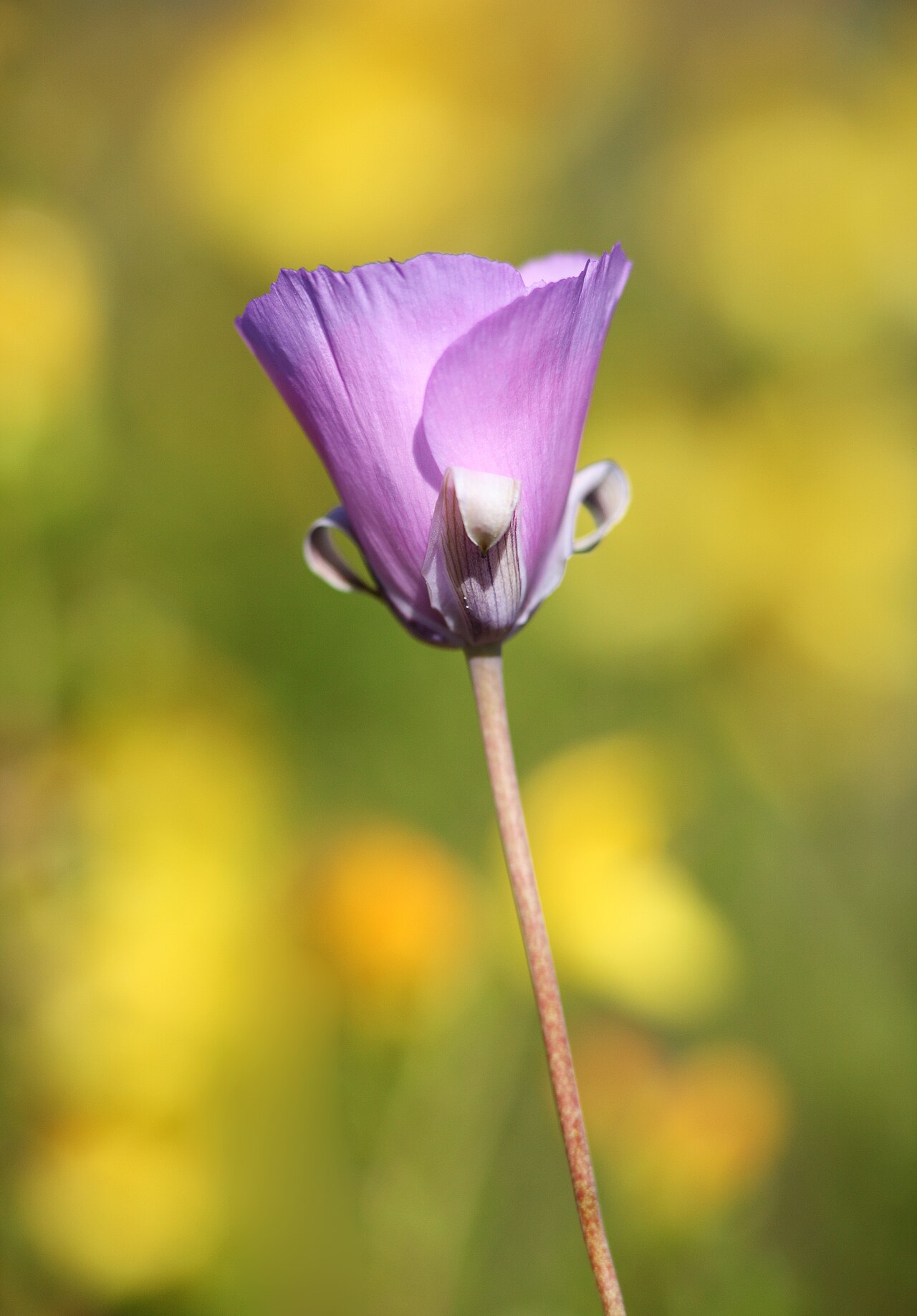
Calochortus splendens, known as the splendid mariposa lily, is one of California’s showiest spring bulbs, a member of the lily family (Liliaceae, sometimes placed in Calochortaceae) found nowhere in the wild outside the Golden State. Its name comes straight from its looks: mariposa is Spanish for butterfly, and the three broad, cupped petals do resemble wings caught mid-flutter, each one washed in shades of lavender, lilac, or soft pink with a darker blotch at the base. The genus Calochortus means “beautiful grass” in Greek, a nod to the narrow, grass-like leaf that is often withered by the time the flower opens.
Splendid mariposa lily grows from a small underground bulb (actually a corm) that survives California’s long dry summer underground, sending up a slender flowering stem each spring after winter and early spring rains have soaked the soil. It is a plant of open, sun-baked slopes — grassland, chaparral, and oak woodland edges from the inner South Coast Ranges and Sierra Nevada foothills down into the mountains of Southern California and just across the border into Baja California. Because it depends on a dry summer dormancy, it is a textbook example of a true California native bulb, and a favorite of native-plant gardeners who want spring color without summer irrigation.
In the garden, this mariposa lily rewards patience rather than fuss. It wants excellent drainage, full sun, and absolutely no water once it goes dormant in early summer — conditions that are hard to fake in a typical irrigated yard but easy to provide in a dedicated dry bulb bed, rock garden, or unwatered hillside planting. Once established in the right spot, the bulbs will multiply slowly and return reliably each spring.
Identification
Splendid mariposa lily is a slender perennial herb growing from an underground corm, typically reaching 8 to 24 inches tall at flowering time, though plants on poor, dry sites may stay shorter. A single, narrow, channeled basal leaf emerges first in late winter and is often dried and inconspicuous by the time the flowers open, so the plant is identified almost entirely by its blossoms.
Flowers
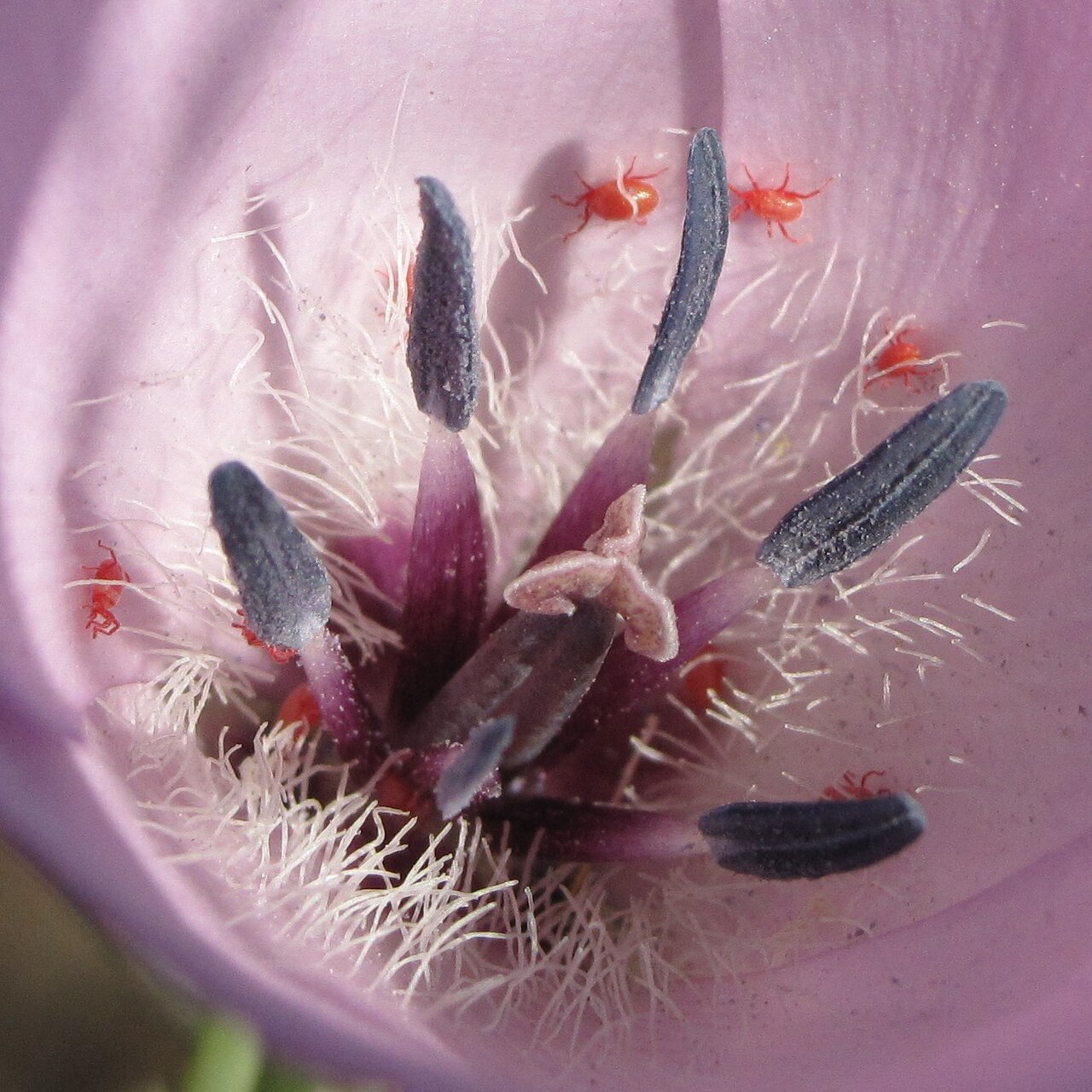
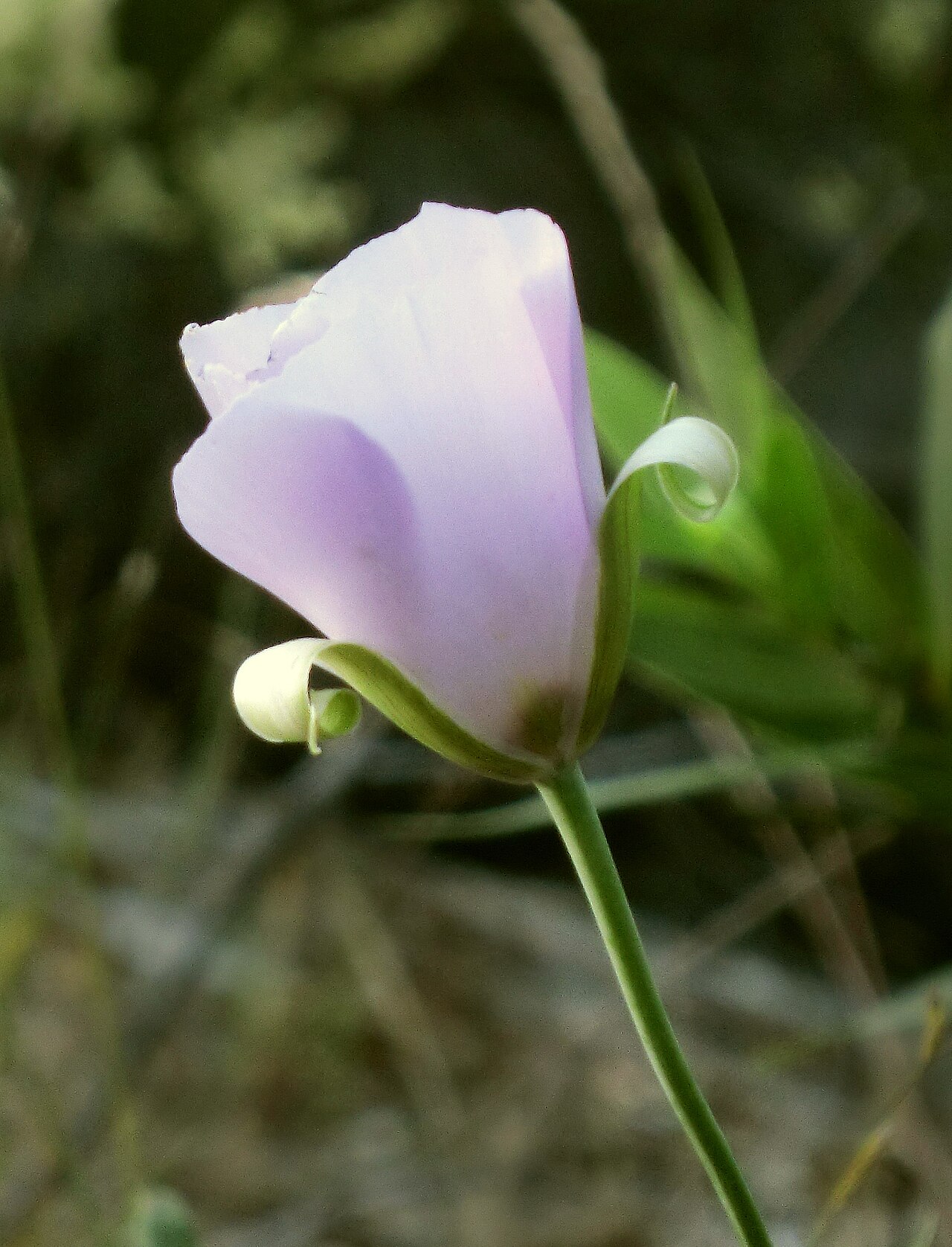
Each flowering stem carries one to several large, upward-facing, bell-to-cup-shaped flowers, usually 1.5 to 2.5 inches across. The three broad petals are lavender, pale lilac, or occasionally nearly white to pink, often with a deeper purple blotch near the base and fine purple veining radiating outward. Unlike many of its showier cousins, C. splendens petals usually lack the dense colored hairs and sharply contrasting “eye” spot seen in species like the butterfly mariposa lily — the inner surface instead carries a scatter of fine, pale hairs, giving the flower a softer, more uniform wash of color. Three narrow green sepals alternate with the petals, visible behind and between them. At the center, six stamens with grayish-lavender anthers surround a stout three-lobed stigma. Flowers bloom from April into June depending on elevation and rainfall, each bloom lasting several days and typically opening fully in afternoon sun.
Leaves & Stem
The basal leaf is linear, channeled (folded lengthwise), and 4 to 16 inches long, arising directly from the corm. It frequently withers before or during flowering, a drought-avoidance trait shared by many Calochortus species. The flowering stem is wiry, often branched above into two or three flower-bearing stalks, and nearly leafless except for small, reduced bracts near the flowers.
Fruit
After pollination, the flower develops into a narrow, three-angled capsule up to 2 inches long, erect on its stalk, which splits open at maturity to release numerous flat, papery seeds. The capsules dry to tan or brown and persist through summer as the rest of the plant disappears underground.
Quick Facts
| Scientific Name | Calochortus splendens |
| Family | Liliaceae (Lily) |
| Plant Type | Perennial bulb (corm) |
| Mature Height | 8–24 in (20–60 cm) |
| Growth Rate | Slow (bulbs multiply gradually) |
| Sun Exposure | Full Sun |
| Water Needs | Low; none in summer dormancy |
| Soil Type | Well-drained clay, loam, or rocky soil |
| Soil pH | 6.0–7.5 (neutral) |
| Bloom Time | April – June |
| Flower Color | Lavender, lilac, pale pink |
| Dormancy | Summer (foliage dies back after seed set) |
| Deer Resistant | Mostly yes; bulbs may be dug by rodents |
| USDA Hardiness Zones | 8–10 |
Native Range
The splendid mariposa lily is a California endemic, found almost entirely within the state’s borders (with a small extension across the international line into northern Baja California, Mexico). Within California it occurs from the inner South Coast Ranges and the western Sierra Nevada foothills south through the Transverse and Peninsular Ranges of Southern California, generally below about 6,000 feet elevation. It is absent from the Central Valley floor, the immediate coast, and the deserts, favoring the transition zones in between.
Typical habitat includes open grassland, dry rocky slopes, chaparral clearings, and the edges of oak woodland, usually on well-drained clay, loam, or decomposed granite soils that are soggy in winter and bone dry by early summer. This boom-and-bust moisture pattern is exactly what the corm is built for: it grows and flowers during the wet season, then shuts down completely once the rains stop.
Although USDA PLANTS lists California as the only native state for this species, it is worth noting explicitly for gardeners in neighboring states: splendid mariposa lily is not native to Nevada, Arizona, or Oregon, and plants offered for sale outside California should be treated as garden subjects rather than regional natives.
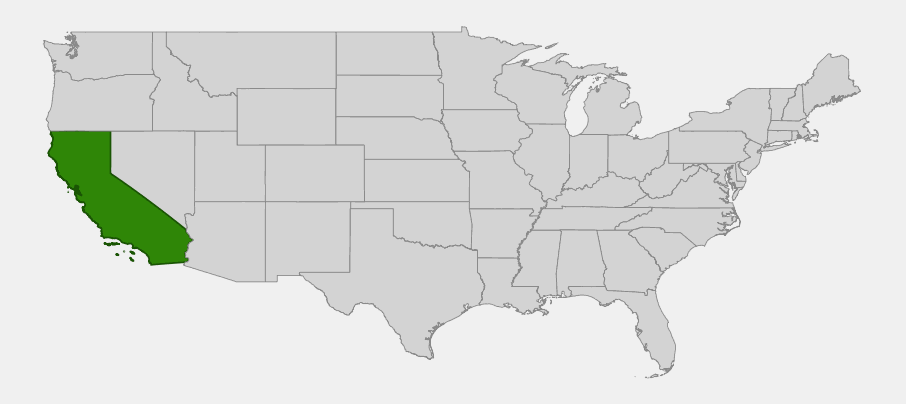
📋 Regional plant lists featuring splendid mariposa lily: California & Nevada
Growing & Care Guide
Splendid mariposa lily is not a plant for a typical watered flowerbed — it is a dry-summer bulb that wants to be treated like the wildflower it is. Grown in the right spot, it is low-maintenance and long-lived, slowly forming small colonies over the years.
Light
Give it full sun. In the wild it grows on open, exposed slopes, and shaded or crowded conditions lead to weak, non-flowering plants.
Soil & Water
Drainage is the single most important factor. Plant corms in well-drained clay, loam, or decomposed granite — heavy, poorly drained soil that stays wet in summer will rot the bulbs. Water during the winter and spring growing season if rainfall is light, then stop watering completely once the leaves begin to yellow in late spring. The corms need a genuinely dry summer dormancy to survive and rebloom; this is the detail most gardeners get wrong, often by planting mariposa lilies among summer-irrigated perennials.
Planting Tips
Plant corms in fall, 3 to 4 inches deep, in a spot that will not be irrigated in summer — a dry rock garden, a hillside planting with other summer-dormant natives, or the back of a border that is deliberately left unwatered after bloom. Mark the planting spot, since the dormant bulb leaves no trace above ground from early summer through fall. Mariposa lilies can also be grown from seed, though flowering may take three to four years.
Pests & Problems
Gophers and ground squirrels readily eat the corms, so gardeners in areas with heavy rodent pressure often plant in wire baskets. Overwatering in summer is the most common cause of failure in cultivation.
Landscape Uses
Splendid mariposa lily is best suited to:
- Dry rock gardens and raised beds with sharp drainage
- Unirrigated native wildflower meadows, mixed with bunchgrasses
- Oak woodland gardens, naturalized at the edge of the canopy
- Bulb collections focused on California natives
- Restoration plantings on dry grassland and chaparral-adjacent sites
Wildlife & Ecological Value
Like other mariposa lilies, Calochortus splendens plays a modest but real role in California’s grassland and chaparral ecosystems, both as a nectar source and, historically, as a food plant.
For Pollinators
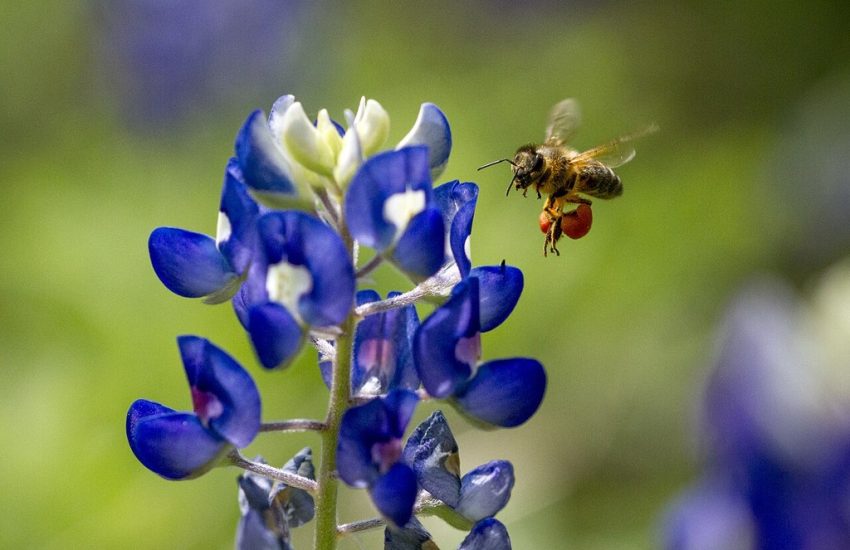
The large, open, cup-shaped flowers are visited by native bees, including solitary bees and bumblebees, which climb inside to reach pollen on the six prominent anthers. The flower’s wide landing platform and central cluster of stamens make it an easy target for pollen-collecting insects, and the bloom period overlaps with the main spring flush of California wildflowers, supplementing other nectar sources.
For Mammals
Ground squirrels and pocket gophers readily dig up and eat the starchy corms, which can limit population size in some areas; this is the same trait that makes the bulbs vulnerable in cultivated gardens.
Ecosystem Role
As a geophyte (a plant that survives unfavorable seasons as an underground storage organ), splendid mariposa lily is part of a guild of California bulbs — including other Calochortus species, blue dicks, and soap plant — that fill the gap between the end of the rainy-season wildflower bloom and the onset of summer drought, keeping flowering resources available to pollinators later into the spring than most annual wildflowers manage.
Cultural & Historical Uses
Mariposa lily corms across the genus Calochortus were historically an important food source for California Indigenous peoples, who dug, roasted, or boiled the starchy bulbs, particularly in lean early-spring months before other food plants became available. While specific historical references to Calochortus splendens by name are sparser than for some of its more widespread relatives, the genus as a whole was widely used across California, and the plant was sometimes called “Indian potato” in early botanical and settler accounts. Today the species is valued almost entirely as an ornamental and as part of California’s native spring wildflower display; digging wild corms is neither legal on most public land nor necessary, since nursery-propagated bulbs are available from native plant specialists.
Frequently Asked Questions
Is splendid mariposa lily the same as the butterfly mariposa lily?
No. They are closely related California natives in the same genus, but Calochortus splendens has smoother-washed lavender petals with only fine, scattered hairs, while the butterfly mariposa lily (Calochortus venustus) typically shows a bolder, sharply defined eye spot and denser hair tufts. Both are garden-worthy, but they are distinct species with somewhat different ranges.
Why did my mariposa lily disappear after it bloomed?
Nothing is wrong — this is normal summer dormancy. The corm survives underground without any visible growth until the following winter’s rains trigger new leaves. Avoid watering or disturbing the soil where it is planted during this dormant period.
Can I grow splendid mariposa lily outside California?
It can be grown in gardens outside its native range as long as you can replicate a dry, sunny, well-drained summer-dormant site, but it will not naturalize or provide the same regional ecological value as it does within California, and it should not be labeled a regional native outside the state.
Do I need to water splendid mariposa lily in summer?
No — and you shouldn’t. Summer water is the most common cause of bulb rot and garden failure for this species. Let the bed dry out completely once the foliage yellows.
How long before a mariposa lily grown from seed will bloom?
Expect three to four years from seed to first bloom, since the corm needs to build up enough stored energy underground before it can support flowering.

Looking for a nursery that carries splendid mariposa lily?
Browse our native plant nursery directory: California