
Starflower (Trientalis borealis)
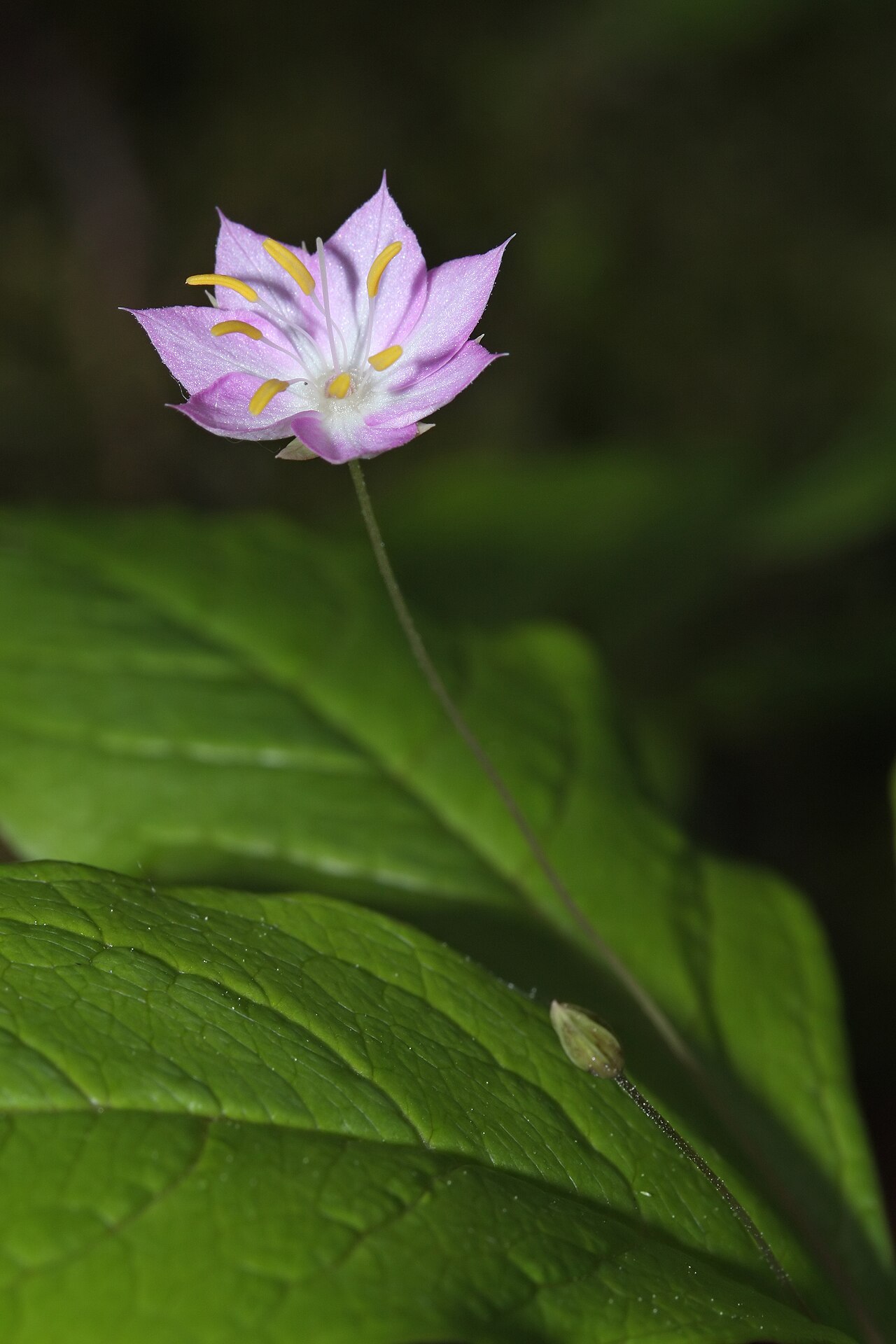
Trientalis borealis, commonly called Starflower or Northern Starflower, is one of the most delicately beautiful wildflowers of the northeastern and boreal forest understory. This low-growing perennial belongs to the Primulaceae (primrose) family and is instantly recognizable by its single whorl of 5–9 lance-shaped leaves at the top of a slender stem, from the center of which arise 1–2 thread-thin peduncles each bearing a perfectly star-shaped white flower. The flowers are distinctively 7-petaled — an unusual number in the plant world, where flowers with 4, 5, or 6 petals are far more common. The genus name Trientalis means “one-third of a foot,” referring to the plant’s characteristic small stature.
Starflower is a plant of cool, acidic forest floors, typically growing alongside May Lily, bunchberry, twin flower, and various ferns in the understory of coniferous and mixed forests. It blooms in May and June, its pristine white stars hovering just above the leaf whorl on hair-thin stalks, creating an ethereal effect in the dappled forest light. The flowers are followed by small, round, white berries that ripen to a pale pinkish-white. Like May Lily, Starflower spreads through underground rhizomes to form loose, open colonies across the forest floor.
For woodland gardeners in the Northeast and upper Midwest, Starflower is a sought-after specialty groundcover for acidic, shaded gardens. It is more exacting in its requirements than some other woodland plants — demanding consistently cool temperatures, high soil acidity, and consistent moisture — but in the right environment it establishes steadily and rewards with one of the most charming spring displays of any native perennial. It is at its best in cool northern gardens under conifers, where its modest but exquisite flowers complement the richly textured forest floor.
Identification
Starflower is a small, unbranched perennial just 4 to 9 inches (10–23 cm) tall, with a distinctive appearance that makes it easy to identify even when not in flower. The key features are the whorl of 5–9 lance-shaped leaves at the top of the stem, and the 1–2 flowers borne on thread-like stalks arising from the leaf whorl center.
Leaves
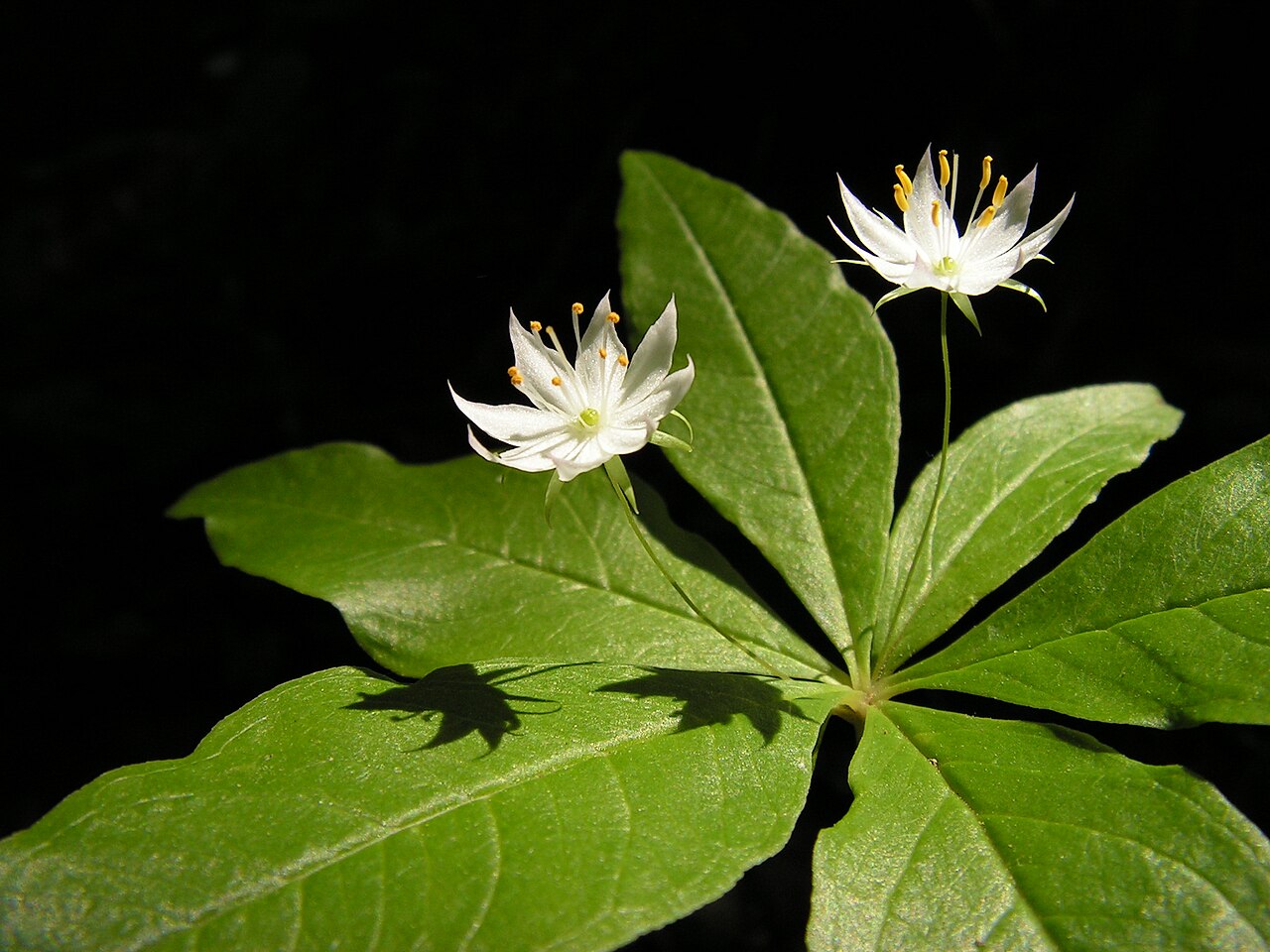
The leaves are arranged in a single whorl of 5–9 leaves at the very top of the stem. Each leaf is lance-shaped (lanceolate), 1 to 4 inches long and ½ to 1 inch wide, tapering to a pointed tip and narrowing to a sessile (stalkless) base. Leaves are smooth, medium to dark green, with a glossy sheen, and show prominent parallel-pinnate venation. The whorled arrangement is highly distinctive — no other common forest floor plant in the Northeast has quite the same appearance. Occasionally, a single small leaf is present lower on the stem, but the main leaf display is the terminal whorl.
Flowers & Fruit
Flowers are borne on 1–2 thread-like stalks (peduncles) arising from the center of the leaf whorl. Each flower is ½ to ¾ inch across, with 7 (rarely 5, 6, or 8) white petals, 7 stamens, and a single pistil. The petals are flat and spreading, creating a perfect star shape. The sepals are also present but linear and inconspicuous. Flowering occurs in May and June. The fruit is a small, round capsule (often described as berry-like) that ripens to whitish and splits to release small brown seeds. As with the flowers, the ovary and resulting fruit typically have 7 parts, though variation is not uncommon.
Quick Facts
| Scientific Name | Trientalis borealis |
| Family | Primulaceae (Primrose Family) |
| Plant Type | Herbaceous Perennial Ground Cover |
| Mature Height | 4–9 in |
| Sun Exposure | Part Shade to Full Shade |
| Water Needs | Moderate |
| Bloom Time | May – June |
| Flower Color | White (7-petaled stars) |
| Soil Type | Acidic, humus-rich, cool woodland soil |
| Deer Resistant | Somewhat (not a preferred deer food) |
| USDA Hardiness Zones | 3–7 |
Native Range
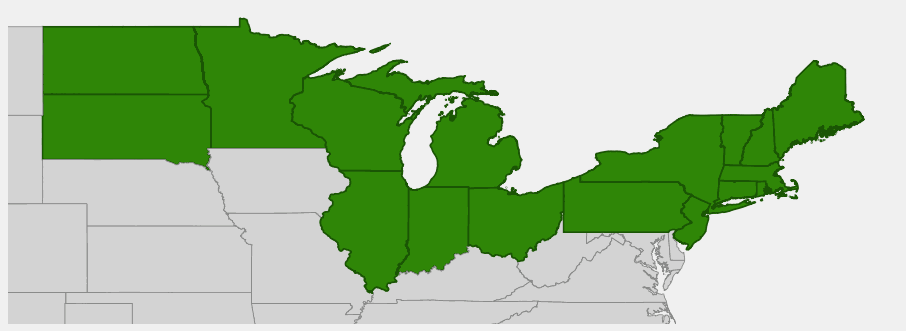
Starflower is a species of the northeastern and north-central United States, ranging southward from the Canadian boreal forest into the cooler portions of the eastern United States. In the U.S., it occurs from Maine and the Maritime-adjacent states westward through the Great Lakes region (Michigan, Wisconsin, Minnesota) and into the northern Plains (North and South Dakota). Along the East Coast and Appalachians, it extends south into Pennsylvania, New Jersey, and at higher elevations into West Virginia and Virginia. It is most abundant in New England, the upper Great Lakes, and the Adirondack and Appalachian highlands.
The species is strongly associated with cool, boreal-influenced forest environments. It is characteristic of conifer-dominated forests — particularly those with white pine, hemlock, spruce, fir, and tamarack — as well as cool mixed forests in the northern states. Key habitat features are deep, acidic (pH 4.5–5.5), humus-rich soils and persistent cool, moist conditions. Starflower is intolerant of heat and drought, which limits its southward distribution to higher elevations in the Appalachians. It is found from sea level in coastal Maine to elevations above 4,000 feet in the White Mountains and Adirondacks.
Common associates include May Lily (Maianthemum canadense), bunchberry (Cornus canadensis), twinflower (Linnaea borealis), wintergreen (Gaultheria procumbens), wood sorrel (Oxalis acetosella), various clubmosses (Lycopodium spp.), and partridgeberry (Mitchella repens). The presence of this community of plants is a reliable indicator of high-quality northern forest conditions.
📋 Regional plant lists featuring Starflower: Southeastern U.S.
Growing & Care Guide
Starflower is a specialist woodland plant that requires specific conditions to thrive. It is best suited to cool-climate gardens (Zones 3–7) with acidic, humus-rich soils under coniferous or mixed-forest canopy. In the right environment, it is a delightful, easy-care ground cover; in unsuitable conditions, it will decline regardless of care.
Light
Starflower demands shade — partial to full shade from a dense canopy of conifers or mixed trees. It is particularly well-suited to the deep, dappled shade under white pines, hemlocks, spruces, and firs, where light is filtered and cool. It will tolerate brief periods of morning sun in cool northern climates but should be protected from midday and afternoon sun, which causes rapid wilting and long-term decline. The plant’s natural habitat — the interior of boreal and cool mixed forests — is typically dim and sheltered.
Soil & Water
Highly acidic soil (pH 4.5–5.5) is essential. Starflower grows naturally in the deep, organic, needle-litter layer of coniferous forests, and it cannot thrive in neutral or alkaline soils. Amend soil heavily with acidic materials — peat moss, composted pine bark, shredded conifer needles — before planting. Maintain consistent moisture; Starflower requires evenly moist soil throughout the growing season. It is intolerant of drought, especially in warm weather. Cool soil temperatures are as important as moisture — mulching with 2–3 inches of pine bark or shredded conifer needles maintains both soil acidity and cool temperature.
Planting Tips
Starflower is best established from rhizome divisions taken in early spring. Plant just 1 inch deep in prepared, acidic, humus-rich soil. Space divisions 6–10 inches apart. The plant establishes slowly — patience is required during the first season. Avoid disturbing the shallow rhizomes once established, as they are easily damaged. Starflower is rarely available from commercial nurseries outside of specialty native plant nurseries in the Northeast; look for it at local botanical garden sales or native plant society events.
Pruning & Maintenance
No pruning is needed or desired. Allow all foliage to die back naturally in fall. Maintain the acidic pine bark or needle mulch layer, refreshing it annually if needed. Keep competing invasive plants removed — garlic mustard in particular can overwhelm delicate woodland plants like Starflower. Avoid any alkaline soil amendments, fertilizers, or pesticides in the vicinity of Starflower plantings.
Landscape Uses
- Acidic conifer woodland groundcover under pines, hemlocks, and spruces
- Northern boreal-style garden alongside bunchberry and May Lily
- Specialty woodland collection in cool-climate gardens
- Shade garden accent for its unique 7-petaled star flowers
- Rhododendron/azalea understory in cool acidic conditions
- Forest restoration in northeastern cool-climate forests
Wildlife & Ecological Value
Starflower contributes to the ecology of northern forest communities through its roles as a pollinator resource and food plant, while also serving as an indicator of forest health and quality.
For Birds
The small berries of Starflower are eaten by several ground-feeding forest birds, including Veeries, Hermit Thrushes, and Swainson’s Thrushes, as well as various woodland sparrows. The plants provide minimal direct cover but contribute to the diverse forest floor structure that supports ground-nesting birds.
For Mammals
Chipmunks and white-footed mice consume the berries and seeds. White-tailed deer may occasionally browse the foliage, but Starflower is not a major component of deer diets. The plant’s small size and low productivity make it a minor food source for most mammals.
For Pollinators
Starflower is pollinated primarily by small native bees, particularly mining bees (Andrena species) that are among the first bees to emerge in cool northern springs. The flowers provide nectar and pollen in the cool, early-season forest environment when few other blooms are available. Smaller hoverflies and sweat bees also visit. The spring bloom timing, coinciding with the critical early-season period for emerging bees, makes Starflower a valuable early food source in boreal forest ecosystems.
Ecosystem Role
As a characteristic element of the boreal and cool mixed forest understory community, Starflower contributes to the biological integrity of these ecosystems. Its presence alongside May Lily, bunchberry, twinflower, and partridgeberry forms the classic boreal forest floor community that supports high biodiversity. The loss of Starflower and its associates from a forest site typically signals ecological degradation through invasive species competition, altered soil chemistry, or increased deer pressure. Its cultivation and restoration are meaningful conservation actions for cool-climate forest ecosystems.
Cultural & Historical Uses
Starflower has a more limited ethnobotanical record than some other forest floor wildflowers, likely because the plant is small and relatively low-yielding. However, various Indigenous nations of the northeastern forests incorporated it into their knowledge of the natural world. The Ojibwe recognized the plant and its ecological associations, and several nations may have used it in minor medicinal preparations, though documentation is limited compared to more widely used species.
European botanists and naturalists exploring the northeastern forests in the 18th and 19th centuries were charmed by Starflower’s delicate appearance and the unusual 7-petaled flower structure. Henry David Thoreau noted its presence at Walden Pond and other Concord-area forests in his journals, describing its dainty white flowers with evident appreciation. The plant appears in early American botanical illustrations as one of the distinctive wildflowers of the northeastern forest floor.
Today, Starflower is valued primarily as a specialty native plant for enthusiasts of woodland gardening and for forest restoration projects in the northeastern and upper midwestern United States. Its cultural value lies primarily in its intrinsic beauty and its role as an indicator of healthy, intact northern forest communities. Encounters with Starflower on a woodland walk — its pristine white stars hovering above the leafy whorl — remain one of the quiet pleasures of springtime in the northeastern forests.
Frequently Asked Questions
Why does Starflower have 7 petals?
The 7-petaled flower is one of Starflower’s most distinctive and botanically interesting features. While most flowering plants produce flowers with 4, 5, or 6 petals (or multiples thereof), Trientalis and related primrose-family plants characteristically have a variable petal count centered around 7. This 7-part symmetry extends to the stamens (also 7) and the parts of the fruit capsule. The reason for this unusual petal number is not fully understood from an evolutionary perspective, but it is consistent enough to be a reliable identification feature.
Is Starflower hard to grow?
Starflower is demanding in its soil requirements (highly acidic, pH 4.5–5.5) but not particularly difficult in the right environment. Cool-climate gardeners in northern New England, the upper Great Lakes, and similar regions who have naturally acidic soils under conifers often find Starflower establishes well. In warmer climates or gardens with neutral or alkaline soil, success is very difficult. Start with a soil pH test and amend accordingly before attempting to establish Starflower.
Can I grow Starflower in Zone 8?
Starflower is cold-climate plant that does not tolerate heat well. Its southern limit in nature is around Zone 6 (with exceptions at high elevations), and it performs best in Zones 3–5. In Zone 7, it may survive in cool, shaded, high-elevation sites but is unlikely to thrive. Zone 8 is generally too warm and dry for this species; consider other woodland natives better suited to your climate.
What companion plants work well with Starflower?
Starflower grows naturally alongside May Lily (Maianthemum canadense), bunchberry (Cornus canadensis), twinflower (Linnaea borealis), wintergreen (Gaultheria procumbens), partridgeberry (Mitchella repens), wood sorrel (Oxalis acetosella), and various northern ferns. All of these share similar acidic soil and shade requirements and make excellent companions in a northern woodland garden.
How quickly does Starflower spread?
Starflower spreads slowly via underground rhizomes, typically expanding a colony by a few inches per year. It does not spread aggressively and will not take over a garden. Established colonies gradually expand over many years, creating a natural-looking, open groundcover rather than a dense mat. Seed germination is slow and unreliable; most increase comes from rhizome growth.

Looking for a nursery that carries Starflower?
Browse our native plant nursery directory: Virginia · North Carolina · Georgia