
Tiburon Mariposa Lily (Calochortus tiburonensis)
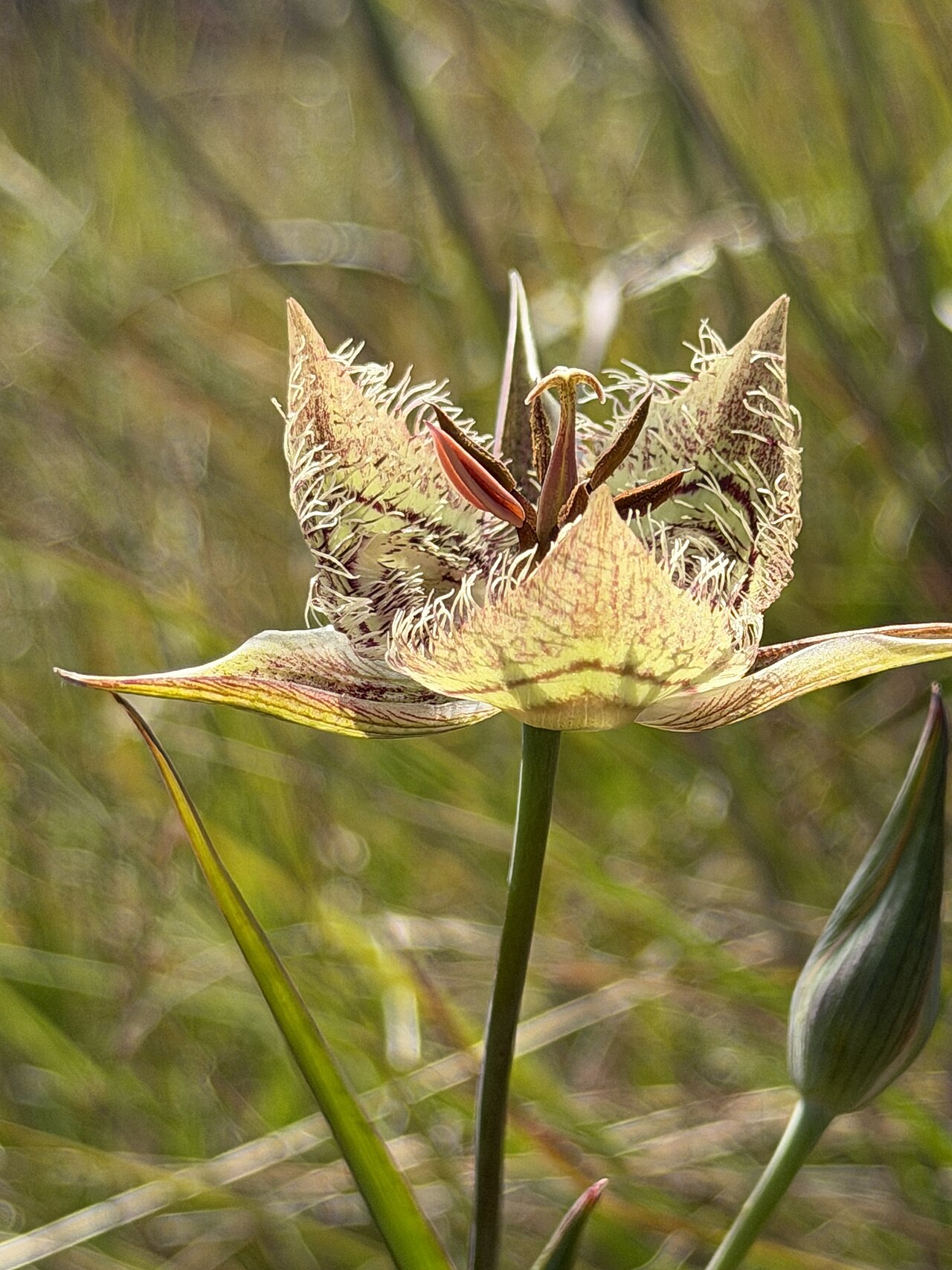
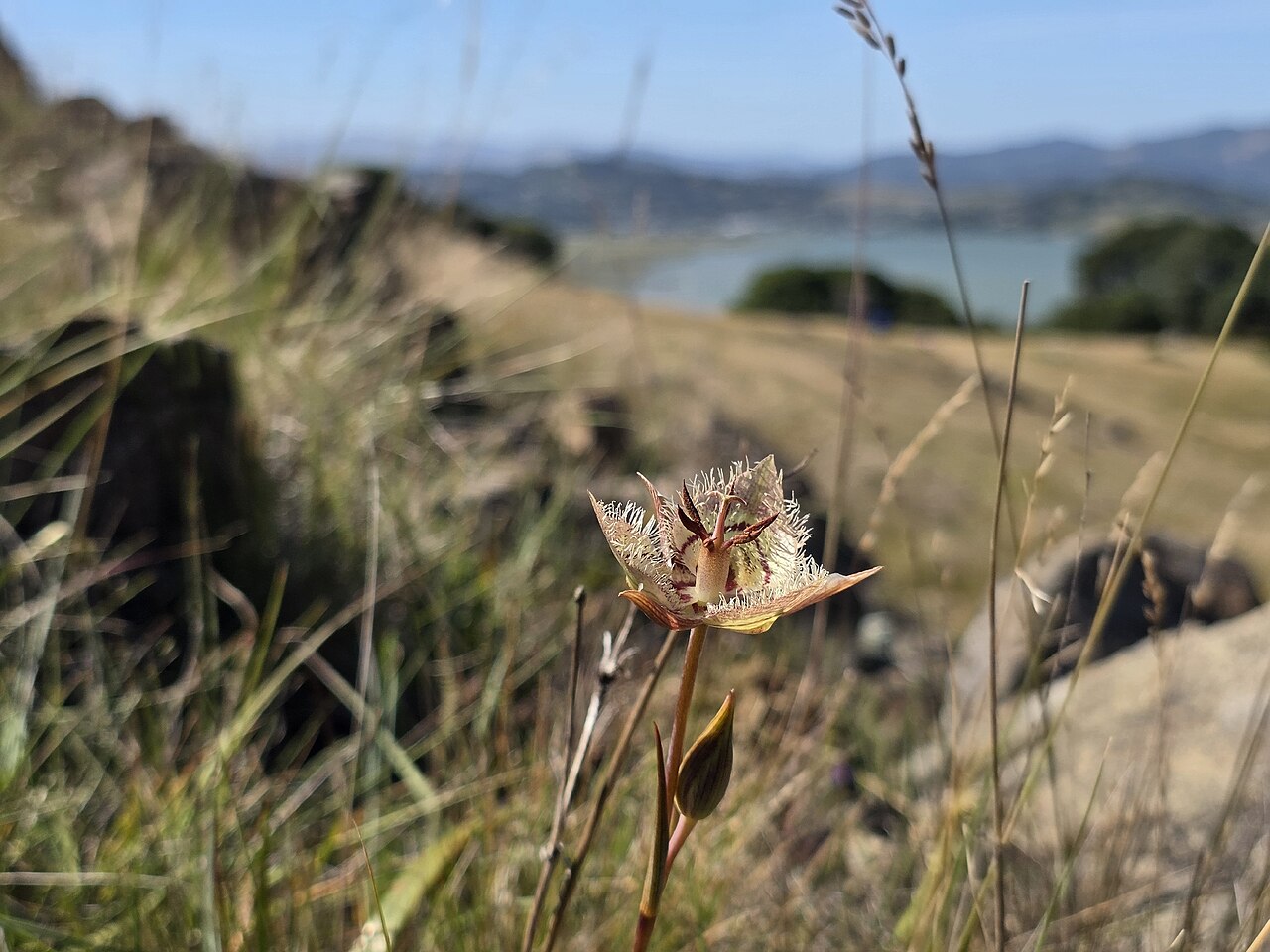
Calochortus tiburonensis, the Tiburon Mariposa Lily, is one of the rarest wildflowers in California. The entire species grows on a single hill: Ring Mountain, on the Tiburon Peninsula in Marin County, just north of San Francisco. There it blooms each late spring among rocks and bunchgrasses on thin serpentine soil, with views across San Francisco Bay.
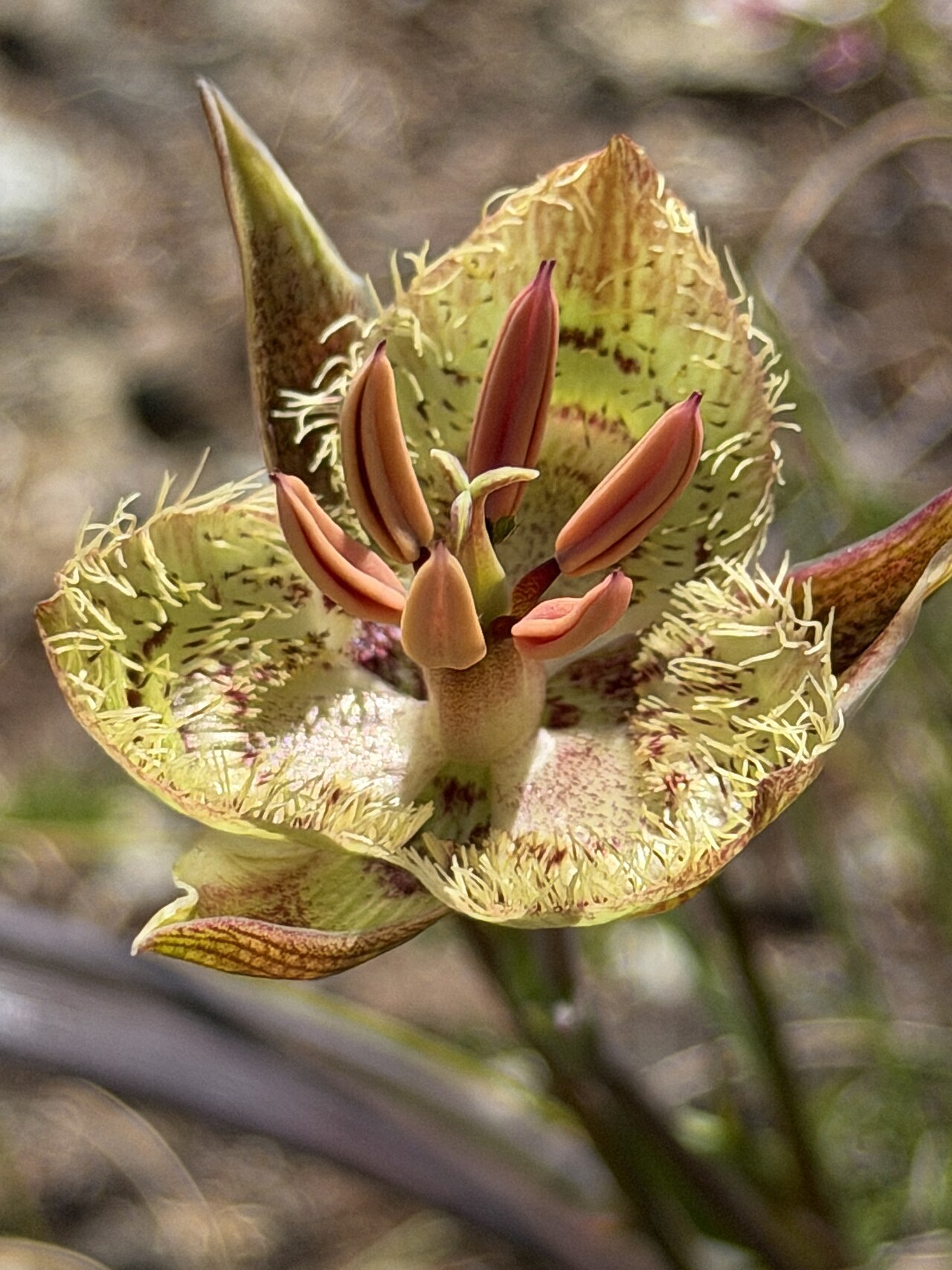
Its flowers are unlike those of most mariposa lilies. Instead of bright, cup-shaped petals, it has open, upward-facing flowers about an inch across with yellowish-green petals streaked and spotted with purplish brown and fringed with long hairs, a subtle, almost moth-like coloring that blends into the dry grassland. It was not noticed by botanists until the early 1970s, remarkable for a plant growing within sight of a major city.
The Tiburon mariposa lily is listed as threatened under the federal Endangered Species Act (since 1995). It is not available as nursery stock, and it must never be dug up or collected. This page is an identification and appreciation guide: how to recognize it, why it grows where it does, and how to see it respectfully on Ring Mountain.
Identification
The Tiburon mariposa lily is a slender, branched plant growing from a small bulb. Look for a single long basal leaf, branching stems up to about 2 feet tall, and erect, open flowers with three hairy, yellowish-green petals marked with purplish brown.
Leaves & Stems
Each plant has one long, narrow, grass-like basal leaf, usually 1 to 2 feet long, that is often still green at flowering. The flowering stem is slender, 6 inches to about 2 feet tall, and usually branched, with a few small leaf-like bracts at the branch points.
Flowers
Plants bear one to several upright flowers about 1 inch across. The three sepals are greenish and pointed. The three broad petals are yellowish green with purplish-brown streaks and flecks, and their inner surface and edges carry long, slender hairs that give the flower a fringed, fuzzy look. Near the base of each petal is a dark nectar gland. The six stamens have reddish to purplish-brown anthers. Flowering is in May and June, after most of the grassland has started to dry.
Fruit
The fruit is an erect, three-angled capsule about 1 inch long that splits open in summer to release flat seeds. Seed dispersal is short-range, one reason the species has stayed confined to such a small area.
Look-alikes
No other mariposa lily on Ring Mountain looks like it. The related cat’s ears (Calochortus tolmiei), found elsewhere in Marin County, also have hairy petals but are white to pale lavender, smaller and more spreading. Showier mariposas such as Superb Mariposa Lily and Butterfly Mariposa Lily have smooth, cup-shaped white, pink or yellow petals and do not grow on Ring Mountain.
Quick Facts
| Scientific Name | Calochortus tiburonensis A.J. Hill |
| Family | Liliaceae (lily family) |
| Plant Type | Perennial bulb (geophyte) |
| Mature Height | 6 in–2 ft in flower |
| Mature Spread | A few inches; single basal leaf 1–2 ft long |
| Growth Rate | Slow; seedlings take several years to flower |
| Sun Exposure | Full sun |
| Water Needs | Winter rain; completely dry summer dormancy |
| Soil Type | Thin, rocky serpentine soil |
| Soil pH | About 6.5–7.5; serpentine (low calcium, high magnesium) |
| Bloom Time | May–June |
| Flower Color | Yellowish green with purplish-brown markings |
| Fall Color | Dormant underground |
| Fruit | Erect three-angled capsule, about 1 in |
| Deer Resistant | Unknown; deer and rodents may graze bulbs and shoots |
| USDA Hardiness Zones | 9–10 (wild habitat only) |
Native Range
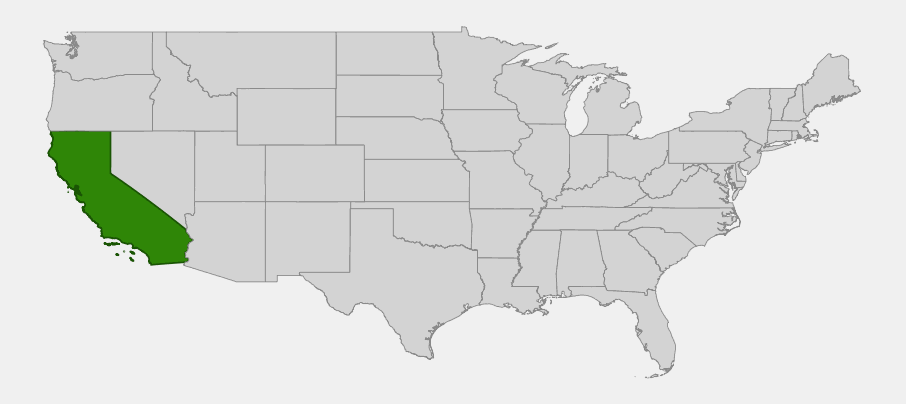
The Tiburon mariposa lily is a narrow endemic. It is known only from Ring Mountain on the Tiburon Peninsula in Marin County, California, where it grows across a small area of serpentine grassland near the summit ridge. No other natural population is known anywhere, so the U.S. range map shows California, but the real range is a few hundred acres on a single hill.
Ring Mountain is an outcrop of serpentinite and related rocks from the Franciscan Complex. Serpentine soils are low in calcium and nutrients and high in magnesium and heavy metals, which keeps out many aggressive grasses and weeds and allows specialized native plants to survive. The mariposa lily grows on rocky, open slopes with native bunchgrasses, alongside other rare serpentine plants of the Tiburon Peninsula, including the endangered Tiburon jewelflower and Tiburon paintbrush.
Most of its habitat is now protected in the Ring Mountain Open Space Preserve, managed by Marin County Parks. Because there is only one population, it remains vulnerable to invasive non-native grasses and shrubs, fire, trampling and soil disturbance, and the loss of serpentine grassland around the preserve. The U.S. Fish and Wildlife Service listed it as threatened in 1995, and the California Native Plant Society ranks it 1B.1 (rare and seriously threatened in California).
📋 Regional plant lists featuring Tiburon Mariposa Lily: California & Nevada
Can You Grow It?
No. The Tiburon mariposa lily is not available as nursery stock and is not a garden plant. It is federally listed as threatened, it exists in a single wild population, and the plants are protected on public land. Never dig, pick or collect the bulbs, flowers or seeds. Removing even a few plants harms the only population in the world, and collecting a listed plant from public land is illegal.
If you love mariposa lilies and want them in your garden, choose more widespread California species that are propagated by specialty bulb nurseries and native plant society sales, such as Yellow Mariposa Lily, Superb Mariposa Lily or White Fairy Lantern. Buy only nursery-propagated bulbs.
Light
In the wild it grows in full sun on open, rocky slopes where the grass cover is thin. Shade from encroaching shrubs and tall non-native grasses is one of the threats it faces.
Soil & Water
It depends on thin, rocky serpentine soil, wet with winter rain and completely dry in summer, when the bulbs are dormant. These conditions cannot realistically be reproduced in a garden, and they are part of what makes the species so restricted.
Planting Tips
Don’t plant it. Conservation propagation, such as banking seed in conservation seed banks, is done only by authorized botanists working under permits as part of recovery efforts.
Pruning & Maintenance
In the preserve, land managers help the species by removing invasive plants such as non-native grasses, broom and other shrubs, and by protecting the serpentine slopes from erosion and off-trail trampling.
Propagation
Not applicable for gardeners. Like other mariposa lilies, it reproduces from seed and very slowly from bulb offsets, and seedlings take several years to flower.
Where to See It
- Ring Mountain Open Space Preserve: in Corte Madera and Tiburon, Marin County; reached by trails from trailheads in Corte Madera and Tiburon
- Best time: May and June, on the open serpentine slopes near the summit
- Stay on trails: the bulbs and seedlings are easily crushed, and serpentine soil erodes
- Photograph, don’t pick: leave every flower to set seed
- Guided walks: local naturalist groups and Marin County Parks sometimes lead spring wildflower walks
Wildlife & Ecological Value
The Tiburon mariposa lily is part of a small but unusually rich serpentine grassland community, home to several plants found nowhere else.
For Pollinators
Mariposa lilies are visited mainly by native bees, including bumble bees and smaller solitary bees, as well as beetles and flies drawn to the nectar glands at the base of the petals. Its hairy, greenish flowers suggest it may also attract small beetles and flies, but its pollination has been studied little.
For Birds
It is not a significant food plant for birds, but the native grassland where it grows supports grassland birds such as western meadowlarks and sparrows.
For Mammals
Gophers, voles and deer may eat bulbs and shoots of mariposa lilies. Ground squirrel and gopher digging can both damage plants and create bare patches where seedlings establish.
Ecosystem Role
As a serpentine endemic, it is an indicator of intact native serpentine grassland, a habitat that has largely disappeared from the urban Bay Area. Protecting it also protects the other rare plants and native insects of Ring Mountain.
Cultural & Historical Uses
The Tiburon mariposa lily was first noticed on Ring Mountain in the early 1970s and was formally described in 1973 by A.J. Hill, who named it for the Tiburon Peninsula. Its discovery in the middle of the densely populated San Francisco Bay Area surprised botanists and helped draw attention to the unique serpentine flora of Ring Mountain.
That attention helped protect the mountain. In the 1980s, conservationists and The Nature Conservancy worked to save Ring Mountain from development, and the land later passed to Marin County as the Ring Mountain Open Space Preserve. The mountain is also known for its petroglyphs carved into serpentine boulders by the Coast Miwok people, whose homeland includes the Tiburon Peninsula.
The genus name Calochortus comes from Greek for “beautiful grass,” a reference to the narrow leaves, and “mariposa” is Spanish for butterfly. The Tiburon mariposa lily shows that some of the rarest plants in the United States grow very close to where people live, and that small preserves can make the difference between survival and extinction for a species.
Frequently Asked Questions
Where does the Tiburon mariposa lily grow?
Only on Ring Mountain on the Tiburon Peninsula in Marin County, California. It grows on rocky serpentine grassland and is found nowhere else in the world.
Is the Tiburon mariposa lily endangered?
It is listed as threatened under the federal Endangered Species Act, a status it has had since 1995, and the California Native Plant Society ranks it 1B.1. With only one population, it is vulnerable to invasive plants, fire and disturbance.
Can I buy Tiburon mariposa lily bulbs?
No. It is not available as nursery stock. Never dig or collect wild plants or seeds. If you want mariposa lilies in your garden, buy nursery-propagated bulbs of common species such as yellow or superb mariposa lily.
When does it bloom?
In May and June. Look for it on the open serpentine slopes of Ring Mountain, staying on the trails.
Why does it grow only on Ring Mountain?
It is adapted to the thin, mineral-rich serpentine soil there, which excludes many competing plants. Its seeds disperse only short distances, so it has never spread beyond this small patch of habitat.

Looking for a nursery that carries Tiburon Mariposa Lily?
Browse our native plant nursery directory: California

