
Bush Morning-glory (Ipomoea leptophylla)
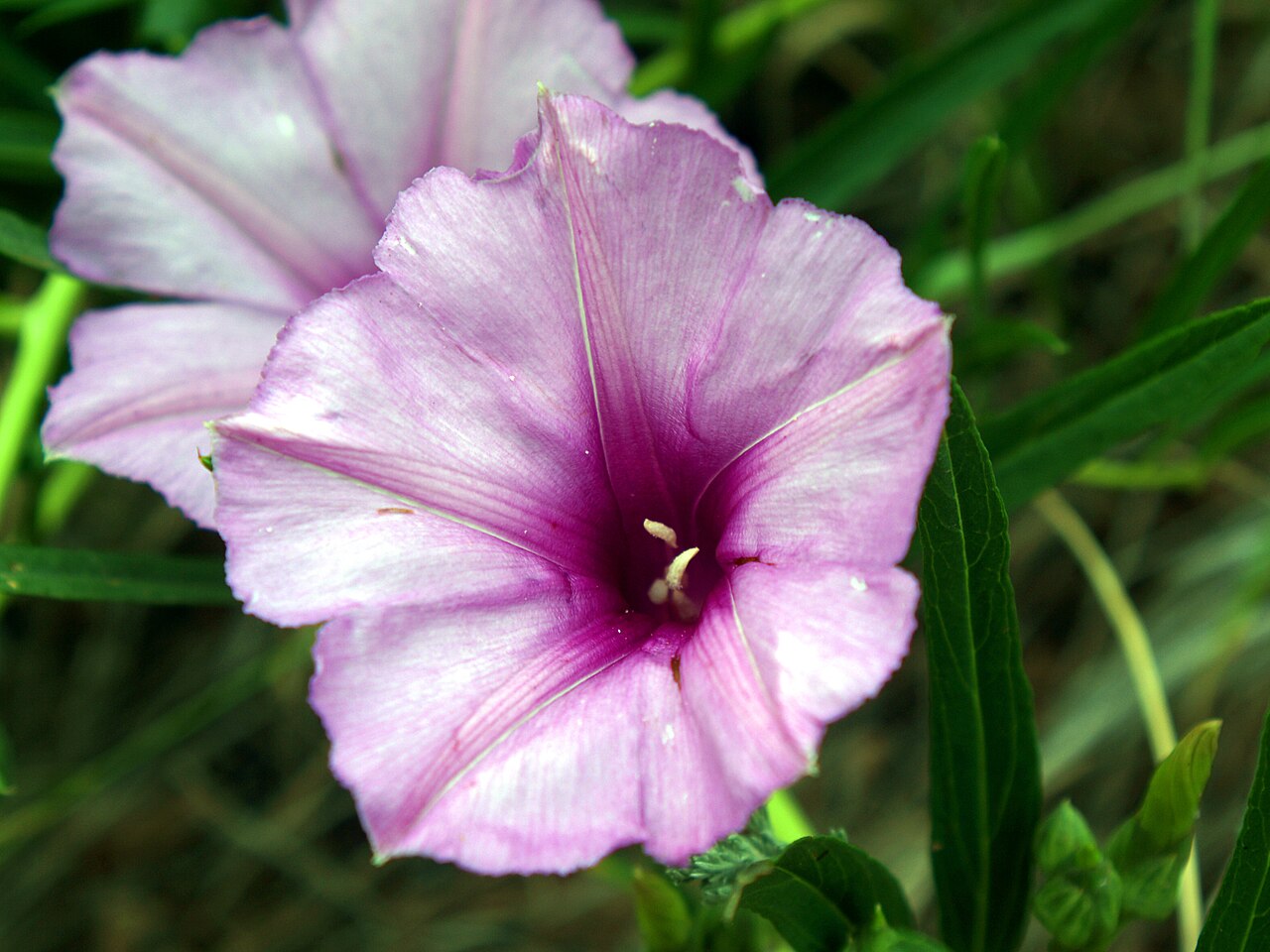
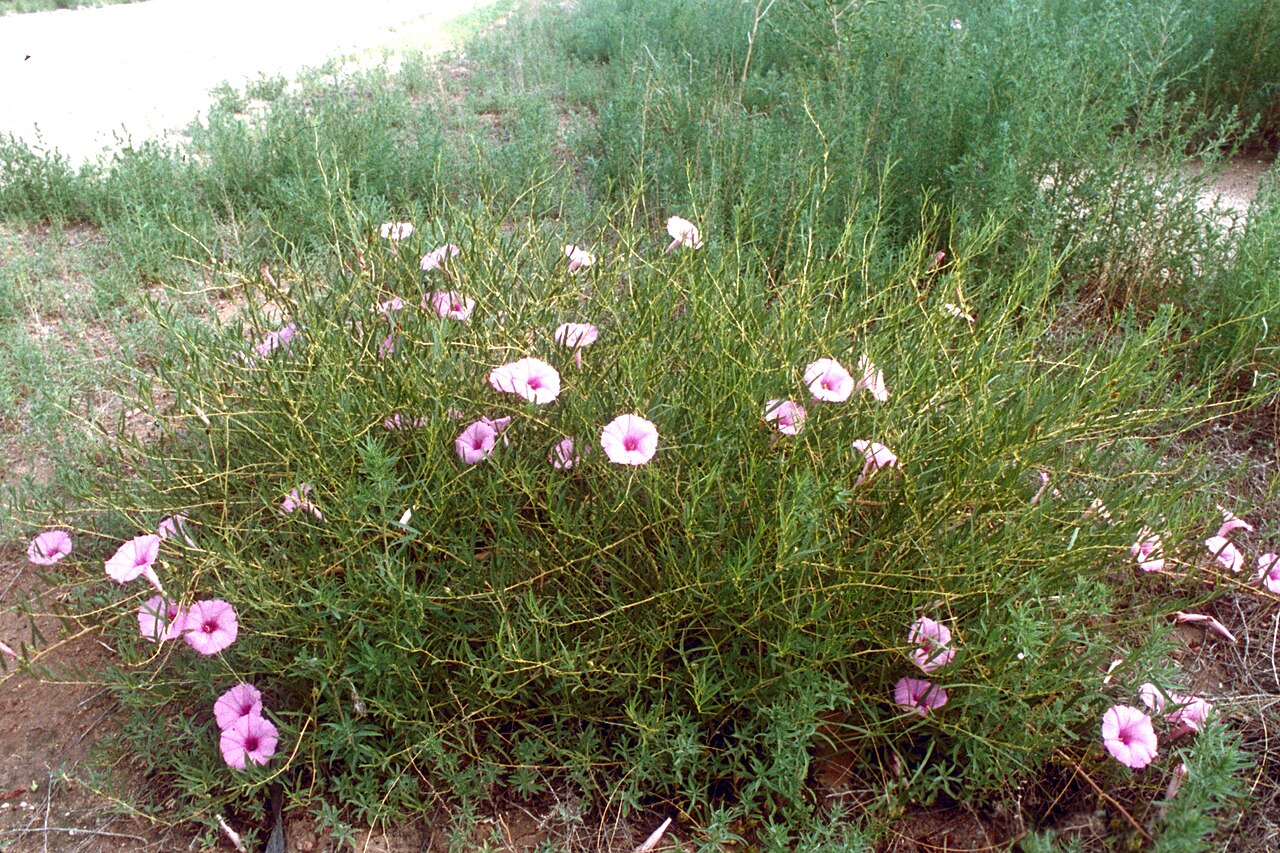
Ipomoea leptophylla, Bush Morning-glory (also called bush moonflower, manroot or man-of-the-earth), is the morning glory of the Great Plains. It doesn’t twine or climb. Instead it forms a rounded, shrub-like clump of arching stems with narrow, grass-like leaves, 2 to 4 feet tall and wide, and through early and midsummer it is covered with large, pink-lavender trumpets with a deep magenta throat.
What you see above ground is only part of the plant. Bush morning-glory grows from an enormous, woody, carrot-shaped storage root that can reach several feet into the ground and weigh many pounds, which lets it survive the drought, heat, cold, grazing and fire of the high plains. A single plant can live for decades.
It grows on sandy and sandy-loam prairies, sandhills, dunes, roadsides and dry rangeland from Montana and South Dakota south to Texas and New Mexico. For dry-climate gardeners on the plains it is a striking, nearly maintenance-free native, provided you give it sun, sharp drainage and room for that giant root.
Identification
Bush morning-glory is unmistakable in bloom: a bush covered with large pink morning-glory flowers in the middle of a dry prairie. Out of flower, look for the clump of arching stems with long, very narrow leaves.
Habit & Root
Plants form a dense, rounded clump 2 to 4 feet tall and up to 4 feet or more across, with many smooth, branching stems that arch outward from a single root crown. The root is a huge, spindle-shaped tuber that may be 1½ feet thick near the top and penetrate several feet into the soil. Above-ground stems die back each winter and resprout in late spring.
Leaves
Leaves are alternate, linear and very narrow (leptophylla means “slender-leaved”), 2 to 6 inches long and less than ¼ inch wide, smooth, with a short stalk. They give the plant a fine, grassy texture quite unlike the heart-shaped leaves of most morning glories.
Flowers
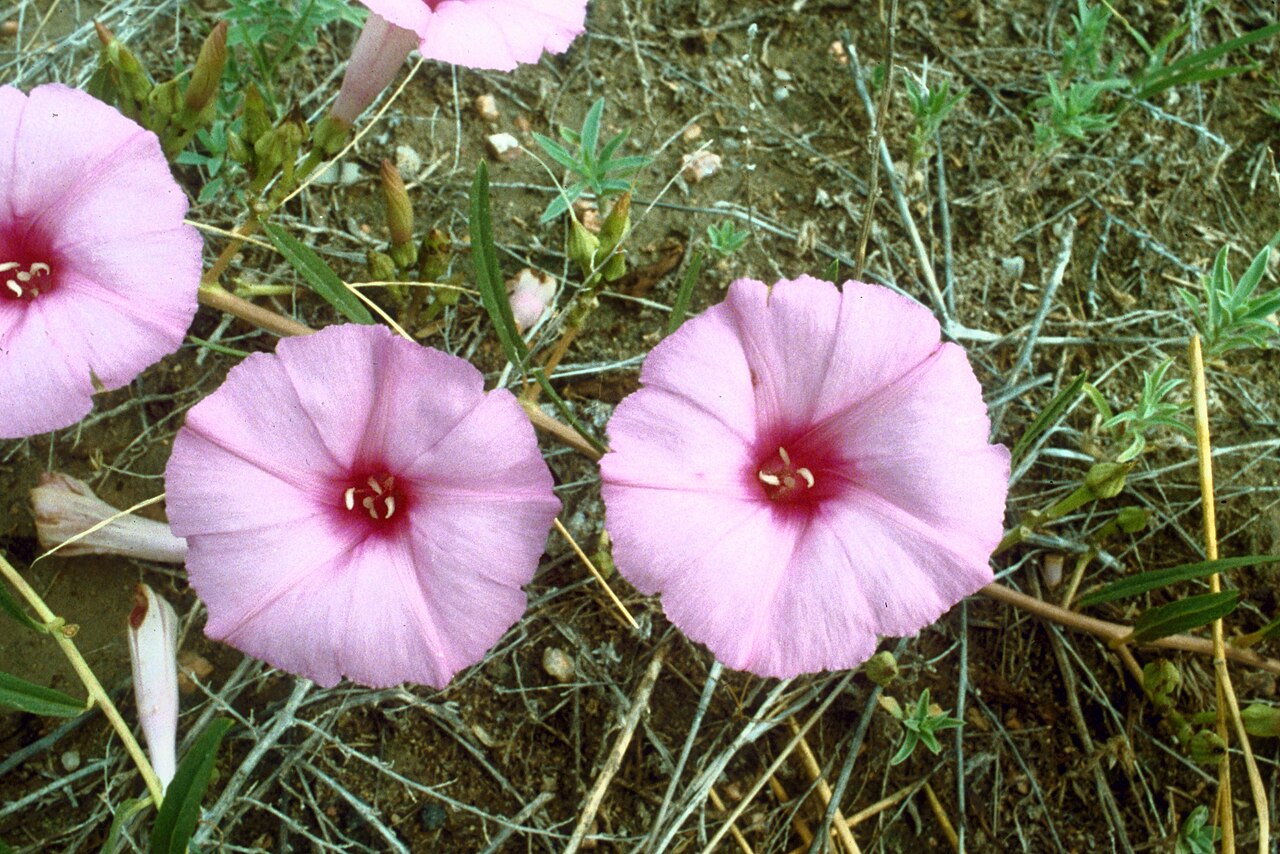
Funnel-shaped flowers 2 to 3½ inches long and across are borne singly or in small clusters of up to three in the leaf axils. They are pink to lavender-pink, with a deep red-purple to magenta throat and darker bands radiating from the center. Each flower opens in the morning and closes by afternoon, but the plant produces new flowers almost daily from late May or June into August.
Fruit & Seeds
The fruit is an egg-shaped capsule about ½ to ¾ inch long that splits to release a few large, brown, finely hairy seeds.
Look-alikes
Wild Potato Vine, its eastern relative with a similarly huge root, is a trailing vine with heart-shaped leaves and white flowers with a purple center. Field bindweed (Convolvulus arvensis), an invasive weed, has much smaller white to pale pink flowers and arrowhead-shaped leaves on creeping stems.
Quick Facts
| Scientific Name | Ipomoea leptophylla Torr. |
| Family | Convolvulaceae (morning glory family) |
| Plant Type | Bushy herbaceous perennial from a huge tuberous root |
| Mature Height | 2–4 ft |
| Mature Spread | 2–5 ft |
| Growth Rate | Slow to establish; long-lived |
| Sun Exposure | Full sun |
| Water Needs | Very low; drought-tolerant |
| Soil Type | Sandy, sandy loam or gravelly; must drain well |
| Soil pH | About 6.0–8.0 |
| Bloom Time | Late May–August |
| Flower Color | Pink to lavender with a magenta throat |
| Fall Color | Stems turn straw-yellow |
| Fruit | Egg-shaped capsule with a few large hairy seeds |
| Deer Resistant | Moderately; occasionally browsed by livestock and deer |
| USDA Hardiness Zones | 4–9 |
Native Range
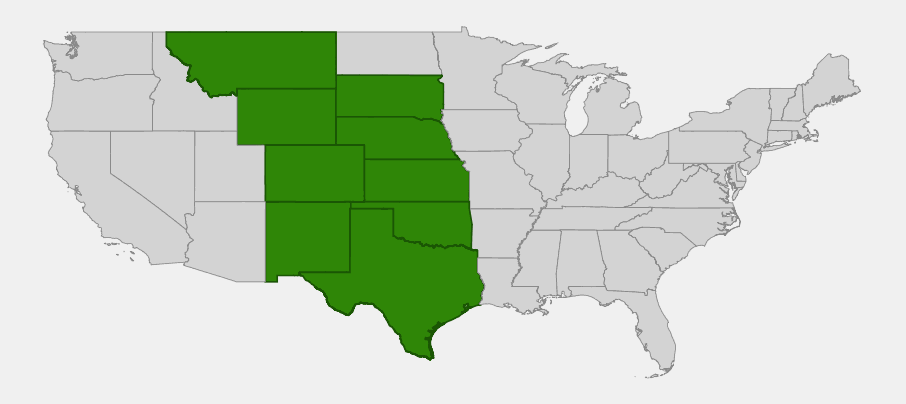
USDA PLANTS lists bush morning-glory as native in Montana, Wyoming, South Dakota, Nebraska, Colorado, Kansas, Oklahoma, New Mexico and Texas. It is a characteristic plant of the western and central Great Plains, rarely found east of the 98th meridian.
It is most common on sandy soils: the Nebraska Sandhills, sand prairies along the Arkansas, Platte and Cimarron rivers, sandy shortgrass and mixed-grass prairie, and dunes and sandy draws of eastern Colorado and New Mexico and the Texas Panhandle and Trans-Pecos. It also grows on badlands slopes and dry roadsides.
Because of its deep root it survives heavy grazing, drought and prairie fires, and it is often conspicuous along roadsides and in pastures where grasses are grazed short. It reaches the northern edge of its range in central Montana and South Dakota, where it grows in the Badlands and the Black Hills foothills.
📋 Regional plant lists featuring Bush Morning-glory: Montana & Wyoming · Nebraska, Kansas & Eastern Colorado · North Dakota, South Dakota & Western Minnesota · South & West Texas
Growing & Care Guide
Bush morning-glory is sold by some native plant nurseries and seed companies on the Great Plains and in the Rocky Mountain region, and it is part of several xeric garden programs. It is easy to keep once established but has two firm requirements: full sun and fast-draining soil. Plant it where you want it to stay, because the giant root makes it almost impossible to move later.
Safety note: the seeds of many morning glories contain alkaloids and should not be eaten. Keep seed away from children and pets. The large root was roasted as food by Plains peoples, but don’t experiment with it.
Light
Full sun, all day. In shade it grows weakly and flowers little.
Soil & Water
Sand, sandy loam or gravelly soil that drains very quickly is ideal. Heavy clay and wet soils in winter rot the root. Water young plants during their first summer; after that it lives on rainfall in most of its native range, and too much water only produces floppy growth.
Planting Tips
Plant small container-grown plants in spring, before the root becomes large. Choose a permanent spot with at least 4 feet of room. It is a good specimen for a dry slope, a hell strip, a gravel garden or a native prairie planting, paired with grasses such as sand bluestem and blue grama.
Pruning & Maintenance
Cut the dead stems to the ground in late fall or winter. No fertilizer is needed. New shoots appear late, often not until May or June, so mark its location to avoid digging into it in spring.
Propagation
Grow from seed. Nick or file the hard seed coat, or soak seeds in warm water overnight, then sow them in deep containers in warm weather. Seedlings quickly form a long taproot and should be planted out young. Plants take a few years to reach full size and flower heavily.
Landscape Uses
- Xeric and water-wise gardens: a showy, drought-proof specimen for dry, sandy or gravelly sites
- Prairie and sandhill restoration: native seed mixes for sandy rangeland on the plains
- Slopes and banks: its deep root helps hold sandy soil
- Pollinator gardens: large flowers for bees from late spring through summer
- Roadside and hell-strip plantings: thrives on heat, reflected light and neglect
Wildlife & Ecological Value
On the open plains, bush morning-glory’s long bloom season and large, nectar-rich flowers make it an important food source for bees during the heat of summer.
For Pollinators
The flowers are visited mostly by bees, from bumble bees to smaller native bees that crawl deep into the throat for nectar and pollen. Some native bees specialize on morning glory pollen. Because each flower lasts only a morning, the best time to watch pollinators is early in the day.
For Birds
The clumps provide shade and cover for ground-dwelling birds such as quail and lark buntings on otherwise open grassland.
For Mammals
Livestock and deer browse the foliage occasionally.
Ecosystem Role
Its massive root stores water and carbon deep in sandy soils and helps stabilize sand dunes and blowouts. Because it resprouts after fire, drought and grazing, it is one of the long-lived perennials that give prairie plant communities their resilience.
Cultural & Historical Uses
John Torrey described Ipomoea leptophylla in the mid-1800s from specimens collected on early government expeditions across the plains. Names such as manroot and man-of-the-earth refer to the human-sized root, which early travelers and settlers noted with amazement when it was dug out of the sand.
Plains peoples, including the Lakota, Cheyenne and Pawnee, are reported to have roasted the starchy root and eaten it, mostly in times of food shortage, and to have used the root in traditional medicine.
Today bush morning-glory is valued in western gardens as one of the most spectacular drought-tolerant native perennials of the plains.
Frequently Asked Questions
Does bush morning-glory climb like other morning glories?
No. Unlike most morning glories, it does not twine. It forms a self-supporting, rounded bush of arching stems 2 to 4 feet tall.
How big is the root of bush morning-glory?
Very big. The root is a woody, spindle-shaped tuber that can grow several feet deep and weigh many pounds on old plants. This is why it survives drought and fire, and why established plants can’t be transplanted.
Is bush morning-glory invasive?
No. It is a native, long-lived perennial that spreads only slowly by seed. It is not related to the invasive field bindweed, which creeps through gardens by roots.
When does bush morning-glory bloom?
From late May or June through August. Each flower lasts one morning, but plants produce new flowers nearly every day through summer.
Can I grow bush morning-glory in clay soil?
It is risky. The root rots in heavy, wet soil. If you have clay, plant it on a berm or slope amended with plenty of sand or gravel, and never irrigate it heavily.

Looking for a nursery that carries Bush Morning-glory?
Browse our native plant nursery directory: Colorado · Kansas · Montana · Nebraska, New Mexico & Oklahoma · South Dakota & Texas · Wyoming

