Needle-and-Thread Grass (Hesperostipa comata)
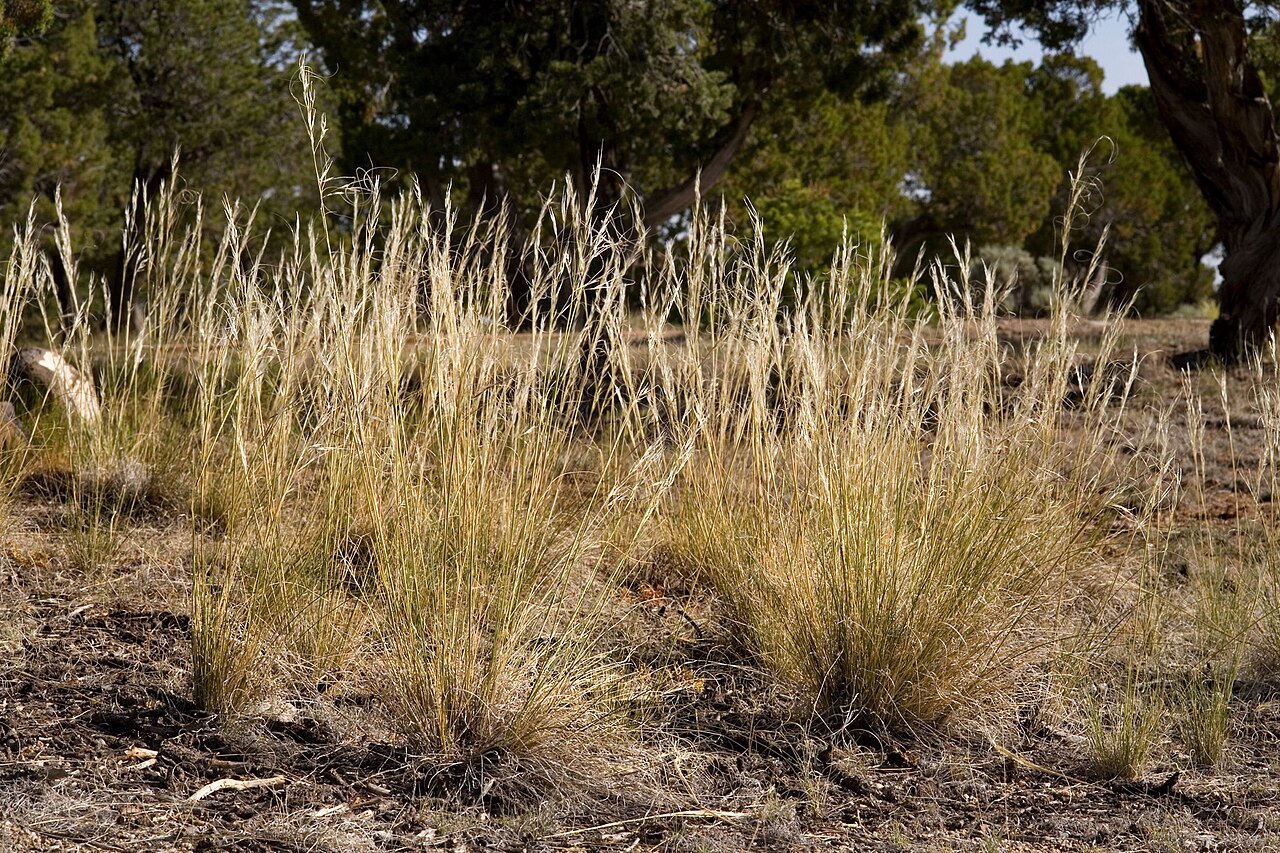
Needle-and-thread grass brings movement and fine texture to a western native planting. Its long seed awns catch the light above a clump of narrow leaves, making a dry hillside look almost silky at the right season. Beneath that delicate appearance is a cool-season perennial bunchgrass adapted to open, well-drained ground across much of western and central North America.
The scientific name used here is Hesperostipa comata, with Stipa comata retained as a synonym. The regional table's older spelling, Stipa comate, is a typographical error rather than a different species. Accurate naming matters because nursery plants sold under broad names such as feather grass can be unrelated or nonnative, and a similar-looking ornamental is not automatically an ecological replacement.
For Utah and western Colorado gardens, the attraction is its combination of spring growth, drought adaptation and a distinctive seed display. The same pointed, awned seeds also require thoughtful placement: this is not the best grass immediately beside a dog run, a narrow path brushed by clothing, or an area used for barefoot play. Use it where mature seed heads can be appreciated without frequent close contact.
Identification
Clumps and stems
Needle-and-thread forms perennial tufts, not a spreading rhizomatous lawn. The flowering stems rise above narrow basal leaves and commonly reach about two to three feet in the regional landscape, although size changes with source and growing conditions. Observe the entire plant before comparing heights: seed stems are taller than the foliage mound, and a grazed or drought-stressed specimen will not show its full potential.
Leaves
The leaves are fine and often rolled, giving the clump a narrow-textured appearance. Basal foliage may be green during active cool-season growth and become tan as the site dries. A summer photograph can therefore look very different from a spring one. Leaf width and color are useful observations but insufficient on their own for separating all needlegrasses. Retain a flowering or fruiting stem for a proper key-based identification when needed.
Flowers and long awns
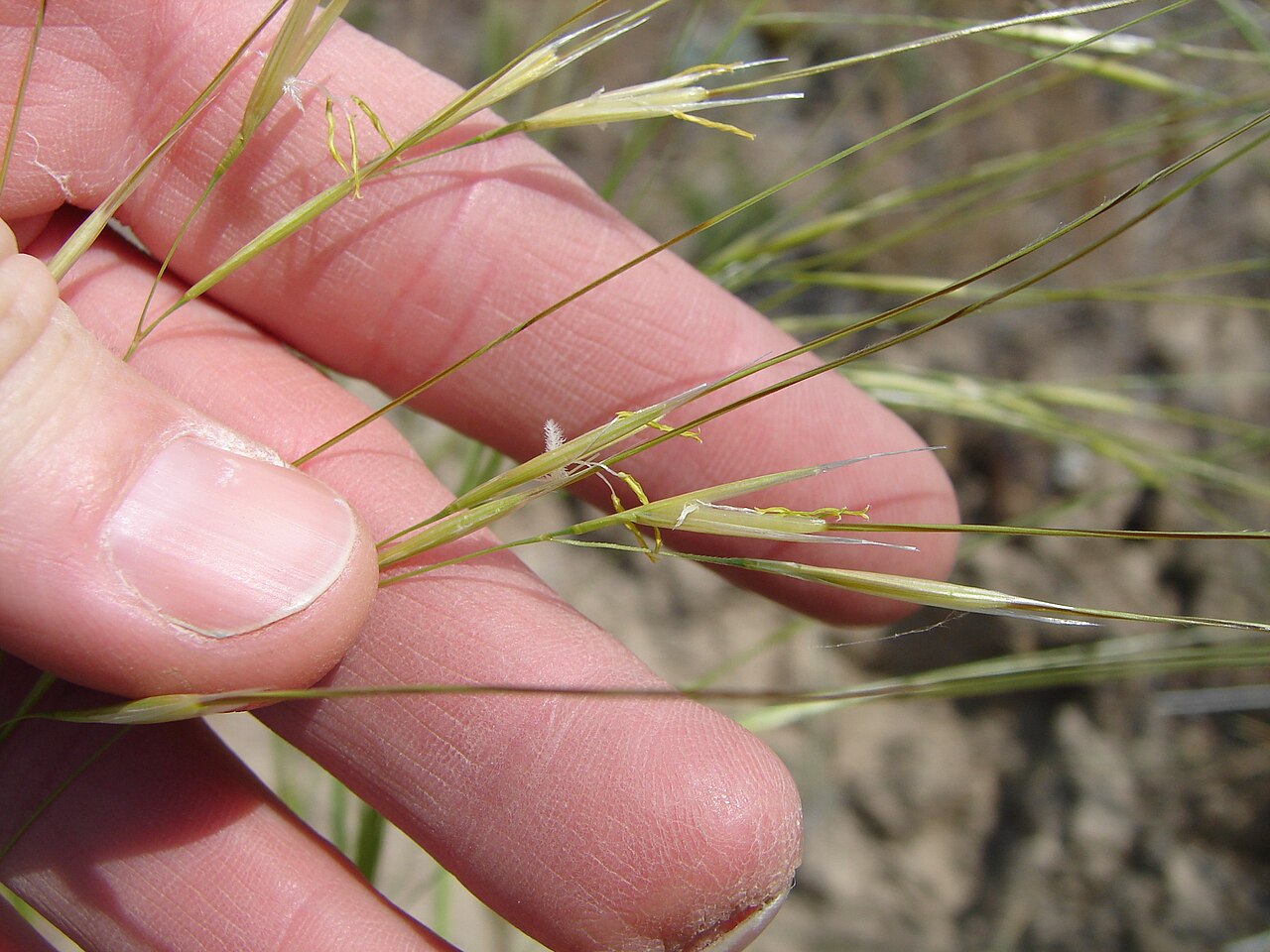
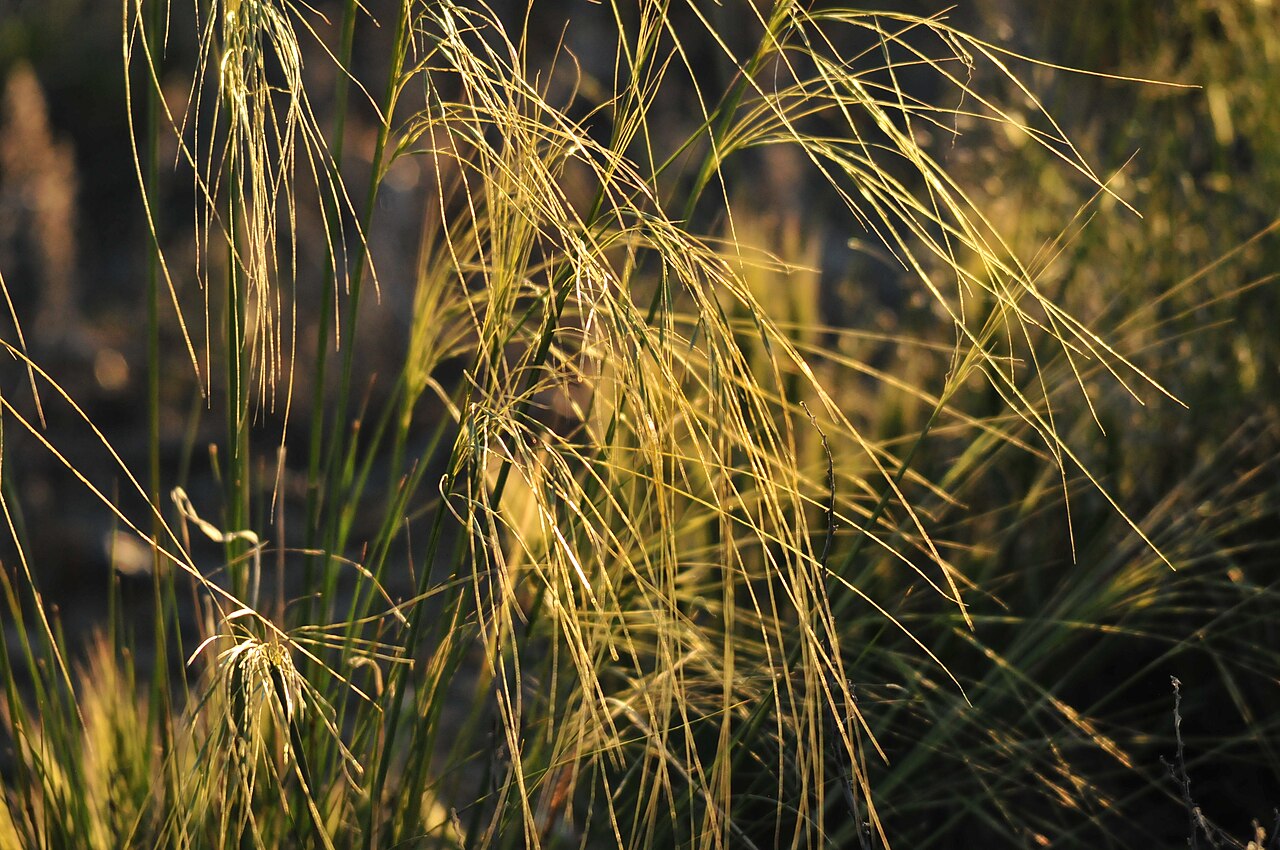
The flowering panicle bears slender spikelets that develop into pointed, awned seed units. The awn is the long threadlike extension, not a root or a separate vine. It can twist with changes in humidity, helping the seed unit interact with the ground. The photograph of a flowering stem shows the fine structure at close range; a landscape view alone can hide the characters needed to distinguish this species from other grasses.
Seeds and similar plants
The pointed seed unit gives the plant the needle part of its common name. Do not confuse it with porcupinegrass, Hesperostipa spartea, or assume every long-awned Stipa in the nursery trade is native locally. Mexican feather grass and other ornamentals may be offered under superficially similar names. Check the botanical name and regional origin rather than choosing solely by a photograph of silky seed heads. Gloves are sensible when handling mature seed material.
Quick Facts
| Scientific Name | Hesperostipa comata; synonym Stipa comata |
| Family | Poaceae (grass family) |
| Plant Type | Cool-season perennial bunchgrass |
| Mature Height | Commonly 24–36 inches in flower; site-dependent variation |
| Mature Spread | Clumping; allow approximately 12–18 inches of planting space, then observe mature growth |
| Growth Rate | Seasonal, with most growth in cooler moist periods |
| Sun Exposure | Full sun and open woodland gaps |
| Water Needs | Low once established; drought-adapted, with moisture needed for seedlings |
| Soil Type | Well-drained sandy, gravelly or loamy soil; avoid persistent saturation |
| Soil pH | Often neutral to alkaline in western habitats |
| Bloom Time | Late spring to early summer, varying with elevation |
| Flower Color | Small greenish florets; seed awns become pale straw-colored |
| Fall Color | Tan; may regreen with suitable cool-season moisture |
| Fruit | Pointed dry seed unit with a long twisting awn |
| Deer Resistant | Not guaranteed; green growth is grazed |
| USDA Hardiness Zones | Broad western and northern adaptation; match provenance and site rather than one universal zone rating |
Native Range
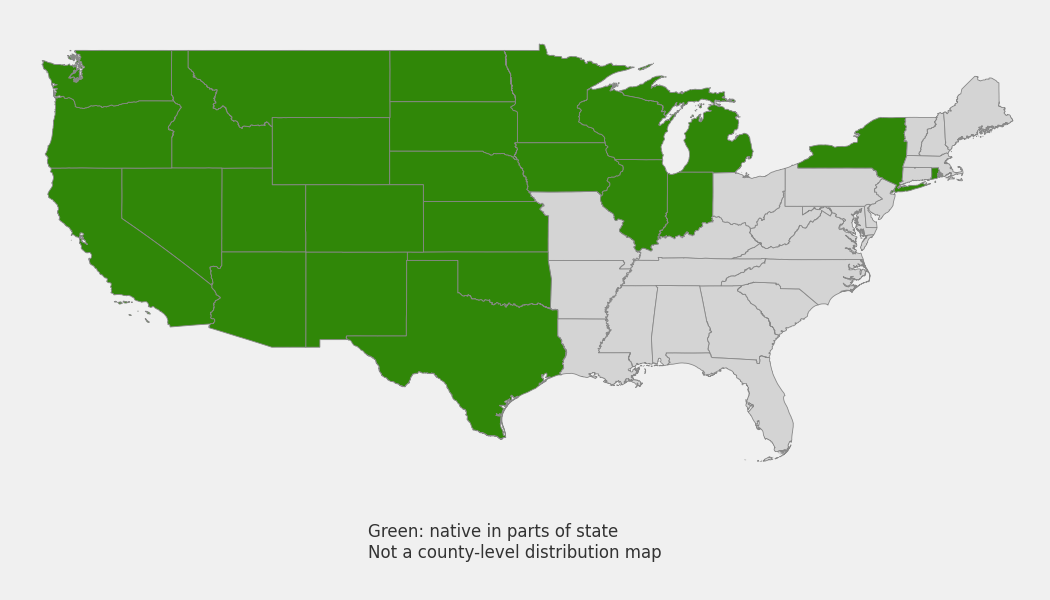
Needle-and-thread is native across much of western and central North America, extending from Canada into Mexico. The U.S. range includes the Intermountain West and Great Plains, with scattered eastern outliers. The map follows the native states listed by Kew's species treatment rather than treating every planting or broad occurrence record as an indigenous population.
In Utah it occurs in open grassland, sagebrush and other shrubland settings and in suitable woodland openings. Forest Service accounts give a broad Utah elevation span of roughly 3,500–10,000 feet, illustrating that it is not limited to one narrow garden climate. Drainage and available growing-season moisture remain decisive. A dry, open slope and a regularly flooded depression at the same elevation are not equivalent planting sites.
Use the state map as a starting point and consult the USDA county-level profile and regional flora for a particular location. Some eastern populations are isolated and warrant local advice before planting. Seed from a distant western source should not be introduced beside a small native population simply because it has the same species name. For a home garden, nursery-propagated material from an appropriate regional source is preferable to digging wild clumps.
📋 Regional plant list: Utah and Western Colorado
Growing & Care Guide
Light
Plant in full sun or a genuinely open woodland gap. The dramatic seed display depends on enough light for sturdy flowering stems. In a garden plan, account for the eventual size of nearby shrubs so a sunny new bed does not become a shaded pocket within a few years. This grass can provide a light visual screen, but it is not a shade-tolerant underplanting for a dense hedge.
Soil and water
Drainage is fundamental. Sandy, gravelly and well-drained loamy sites resemble many of its natural habitats; a wet planting basin beside irrigated turf does not. Established clumps tolerate drought, but seedlings and new plugs require moisture while roots establish. Water the rootball and surrounding ground at planting, then respond to soil moisture and weather. Avoid repeated irrigation simply to keep the entire plant green through a naturally dry summer.
Planting tips
Place nursery plugs at the original crown level and firm the soil without burying the basal leaves. Give the flowering stems room so their awns do not constantly catch on passing people or animals. A small trial planting makes it easier to evaluate local performance and maintenance needs. On a slope, manage concentrated runoff before relying on the new plants to hold soil; a single storm can undermine small rootballs before they establish.
Propagation from seed
Long awns complicate handling and sowing, and germination can vary by lot and treatment. Buy identified seed with a current germination or viability test and follow regional nursery guidance instead of assuming every fresh seed will sprout promptly. Keep material from different sources labeled. For small gardens, propagated plugs may offer a simpler starting point than processing awned seed. Do not strip wild populations to obtain seed for a large project.
Pruning and seed-head management
Where mature awns pose a contact problem, remove the seed heads before they shed and dispose of them so animals cannot rummage through a pile. In a well-placed naturalistic area, some stems can remain for visual and ecological structure. Avoid repeated close mowing of the green clump. A cleanup timed before the next active growth period can remove collapsed material, while local fire-safety requirements determine how much dry vegetation is appropriate near structures.
Seasonal behavior
Cool-season growth often starts well before warm-season grasses become active. Flowering and seed ripening are followed by curing as heat and drought develop; suitable autumn moisture may bring renewed green leaves. That sequence is normal and does not mean the plant must receive fertilizer. Watch the crown and new growth, not just the color of old stems. Persistent failure after the appropriate growth season warrants checking drainage, planting depth and browsing.
Design and animal contact
The long awns are attractive at a distance but the pointed seed units can be troublesome where animals brush through them. Keep plantings away from dog exercise routes and frequently used narrow paths. If animals regularly use the area, choose placement or seed-head removal accordingly. A native species can be valuable in its habitat and still be inconvenient in a particular garden location; good design recognizes both facts.
Competition and restoration
Needle-and-thread can contribute to a diverse dryland mixture, but establishment is not guaranteed on ground dominated by annual weeds. Reduce competing seed sources and monitor seedlings through their first dry season. Repeated heavy grazing during active growth can weaken plants. For a larger restoration area, select species and sources using local reference vegetation rather than combining every grass described as drought tolerant.
Landscape Uses
- A fine-textured accent in a sunny regional native meadow.
- Open dry slopes with suitable drainage and enough establishment moisture.
- Mixed grass-and-forb plantings where spring growth and summer seed texture are welcome.
- A teaching planting demonstrating awns and grass seed dispersal.
- Naturalistic areas set back from pet runs, narrow paths and barefoot recreation.
Wildlife & Ecological Value
Pollinators and insects
The flowers do not offer the conspicuous nectar display of many broadleaf native plants. Combine the grass with appropriate flowering species if pollinator forage is a design goal. Its clumps and seasonal litter add another kind of habitat structure, but this guide does not attach an unsupported list of specialist insect hosts to it.
Birds and cover
Grass clumps and seed-bearing vegetation form part of open-country habitat. Their contribution depends on surrounding vegetation and land use, not just on the presence of one ornamental specimen. Where it is safe to leave stems, retain a mix of standing and open areas. Where sharp seeds would create contact problems, placement and selective removal are more sensible than abandoning the species' habitat role altogether.
Mammals and forage
Young green growth can be grazed, while mature awned seed heads change the plant's usefulness and handling requirements. Do not equate drought resistance with resistance to all browsing. Protect new plugs if animals repeatedly remove active leaves, and seek local range-management advice for pasture use rather than treating a garden guide as a forage prescription.
Root systems and soil
A fibrous root system helps perennial clumps occupy suitable soil and contribute to stability. Healthy mature plants are more effective than a newly seeded surface, so erosion-control expectations must account for establishment time. Preserve existing native cover and avoid unnecessary disturbance around the crowns. On a restoration site, the condition of the whole community matters more than whether one favored grass is present.
Cultural & Historical Uses
The older name Stipa comata remains common in field guides and seed records. The transfer to Hesperostipa is a taxonomic change, while the misspelling comate is simply an error. Recording both the accepted name and the legitimate synonym helps connect a new planting to older botanical literature without perpetuating the typo.
Needle-and-thread has been studied as a component of western range and grassland communities, including its seasonal growth, grazing response and recovery after disturbance. Those studies describe particular sites and conditions. They should not be condensed into a claim that every garden clump needs fire, tolerates unlimited grazing or will establish successfully on any dry soil.
The twisting awn is an excellent feature for botanical observation. It shows how a seemingly simple grass seed unit can interact with humidity and the soil surface. Observe detached material carefully rather than placing sharp seed units against skin or near pets. No medicinal or edible preparation is recommended in this guide.
Frequently Asked Questions
Is Stipa comate a valid alternative name?
The intended older name is Stipa comata. This page uses Hesperostipa comata and retains the correctly spelled synonym for reference.
Is it the same as Mexican feather grass?
No. Similar appearance and common names do not make them interchangeable. Buy the full botanical name and an appropriate regional source.
Should I plant it beside a dog run?
A different location is usually wiser. Mature pointed, awned seed units can catch on animals; place it where close contact is limited or manage seed heads before shedding.
Why does it turn tan in summer?
Curing after cool-season growth is normal on dry sites. Check the living crown and seasonal response rather than assuming every tan stem signals a dead plant.
Can it grow in heavy irrigated soil?
Persistent wetness is a poor match. It is more naturally suited to open, draining sites; soil texture alone matters less than how long the root zone stays saturated.
Sources & Further Reading
- Kew: Hesperostipa comata taxonomy and native distribution
- US Forest Service FEIS: needle and thread
- USDA NRCS: conservation grasses for Idaho and Utah
- USDA PLANTS profile
Find Native Plants
Ask growers about nursery propagation and regional provenance. Browse our UT native plant nurseries, CO native plant nurseries directory for suppliers. Explore the native nursery finder.