Virginia Blue Flag (Iris virginica)
Iris virginica, commonly known as Virginia Blue Flag or Southern Blue Flag, is one of the most breathtakingly beautiful native wildflowers of the eastern United States — a stately, moisture-loving iris that graces the margins of ponds, streams, marshes, and wet meadows with spectacular violet-blue flowers in late spring. A true native iris of the Appalachian and coastal plain regions, Virginia Blue Flag brings the elegance of formal garden irises into natural wetland and rain garden settings, all while providing critical ecological services for native pollinators.
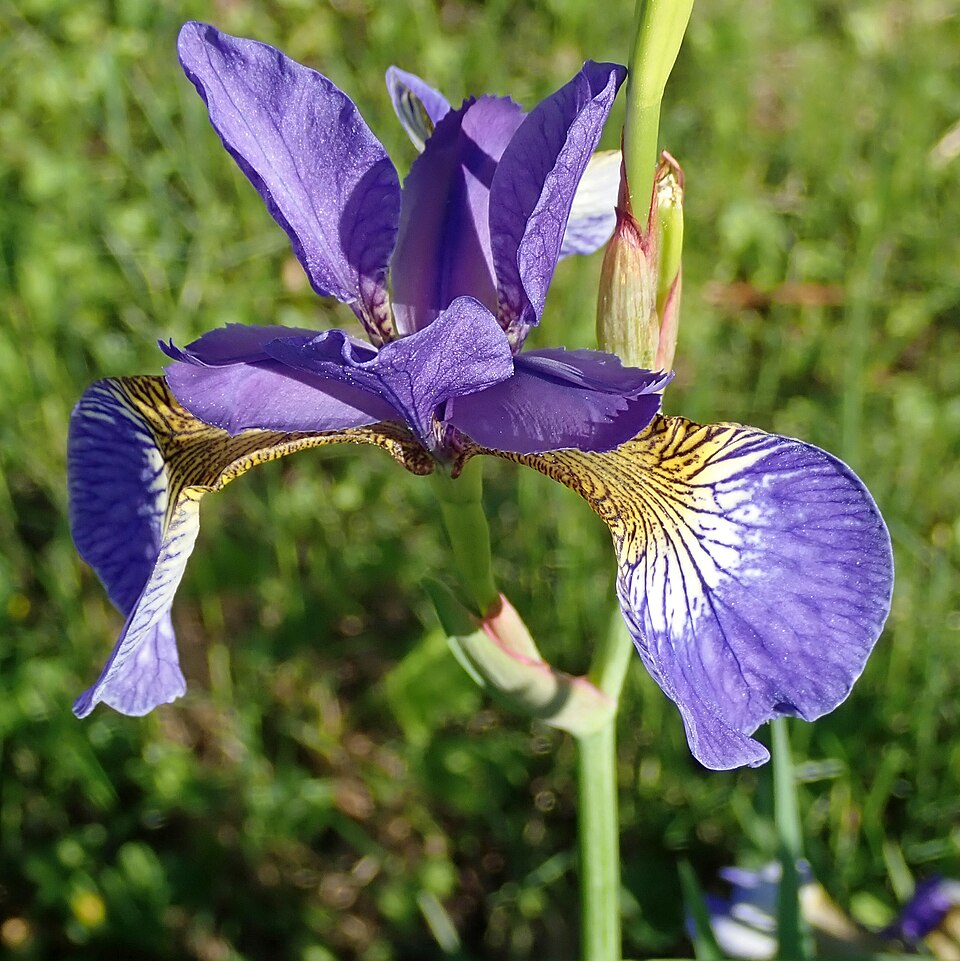
Growing 1 to 2 feet tall with upright, sword-shaped leaves that emerge from thick rhizomes, Virginia Blue Flag produces flowers of extraordinary complexity and beauty: three large drooping "falls" in rich violet-blue with intricate white and yellow markings at the center, and three upright "standards" in a slightly paler blue-violet — the whole composition reminiscent of the finest cultivated bearded irises, but wilder and more graceful. The flowers appear in late April through June, providing a spectacular spring display at the water's edge.
Virginia Blue Flag is uniquely adapted to wet, low-oxygen soils that challenge most garden plants. Its thick rhizomes tolerate prolonged flooding and saturated conditions, making it one of the most reliable native perennials for rain gardens, wet swales, pond margins, and any consistently moist or seasonally flooded site. Its naturalizing habit, tolerance of part shade, and exceptional beauty make it an outstanding choice for the Mid-Atlantic gardener who wants to bring native wildflower drama to challenging wet spots.
Identification
Virginia Blue Flag is a rhizomatous, herbaceous perennial that grows in clumps or colonies from thick, horizontal, spreading rhizomes at or just below the soil surface. The foliage emerges in erect, fan-shaped arrangements — the classic iris growth form — with leaves arising from the base and overlapping at the base in a flattened arrangement. Plants reach 1 to 2 feet in height at flowering, with the leaves often persisting slightly taller through the growing season.
Leaves
The leaves are long, flat, and sword-shaped (ensiform) — typically 18 to 36 inches long and 1 to 1½ inches wide, with a prominent midrib and parallel venation. The leaf surface is smooth, bluish-green to green, and somewhat glaucous (waxy). Leaves emerge from the rhizome in a flattened, fan-shaped arrangement, with each leaf sheathing the next in a characteristic iris pattern. The foliage is erect and tidy throughout the growing season, providing attractive vertical accent at the water's edge even when the plant is not in bloom. In fall, the leaves yellow and die back to the ground, with the rhizomes persisting through winter.
Flowers
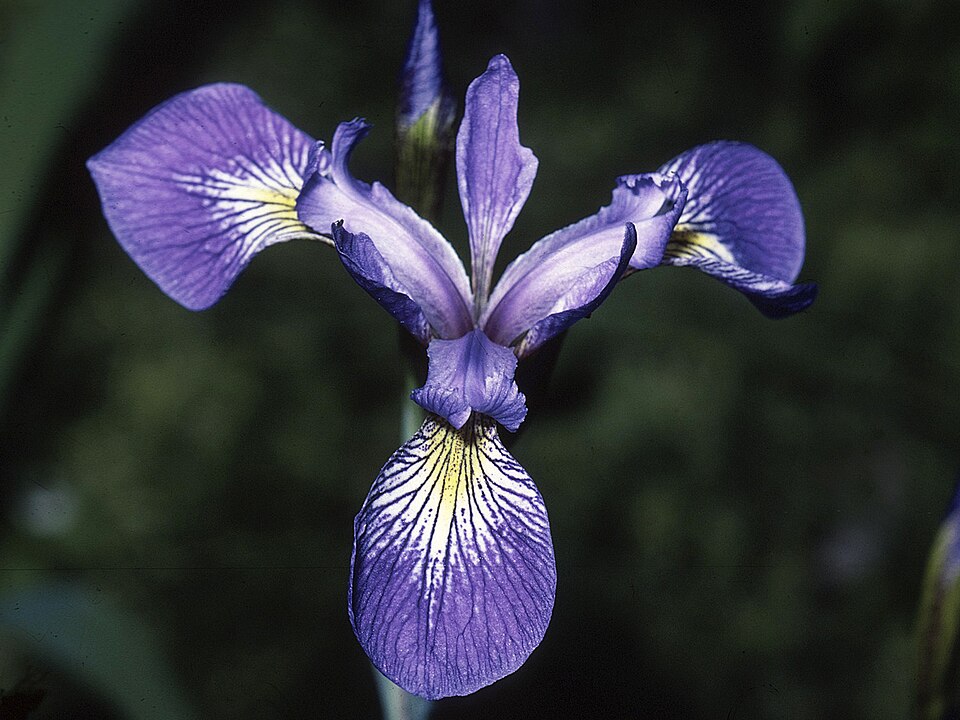
The flowers of Virginia Blue Flag are the plant's crowning glory — large (3 to 4 inches across), structurally complex, and strikingly beautiful. Each flower consists of two sets of three petals: the three drooping "falls" (sepals) that hang downward or outward, and the three upright "standards" (petals) that rise above. The falls are violet-blue to blue-lavender, typically with a distinctive central marking — a white or yellow blotch surrounded by intricate violet veining — that serves as a nectar guide for pollinators. The standards are a slightly paler blue-violet, upright and somewhat narrower. The three petaloid style branches arch over the falls, each with a small crest at the tip, creating an elaborate architectural structure. Flowers are borne singly or in pairs atop slightly flattened flower stalks that may branch to produce 3 to 5 flowers per stem. Bloom time is April through June in the Mid-Atlantic region.
Fruit & Seeds
The fruit is a three-chambered, somewhat cylindrical capsule, 1½ to 2¼ inches long, with a blunt or constricted tip. Capsules ripen from green to tan-brown in late summer, drying and splitting along three seams to release the seeds. The seeds are large, flat, and D-shaped — adapted for water dispersal — with a corky seed coat (aril) that allows them to float. Seeds dispersed by water can colonize new sites downstream, which is how Virginia Blue Flag naturally spreads along watercourses.
Quick Facts
| Scientific Name | Iris virginica |
| Family | Iridaceae (Iris) |
| Plant Type | Herbaceous Perennial |
| Mature Height | 1–2 ft |
| Sun Exposure | Full Sun to Part Shade |
| Water Needs | High |
| Soil Type | Wet to saturated; tolerates standing water; acidic to neutral |
| Soil pH | 5.5–7.0 |
| Bloom Time | April – June |
| Flower Color | Violet-blue to blue-lavender with white and yellow markings |
| Spreads By | Rhizomes and water-dispersed seeds |
| Deer Resistant | Yes (toxic foliage generally avoided by deer) |
| USDA Hardiness Zones | 4–9 |
Native Range
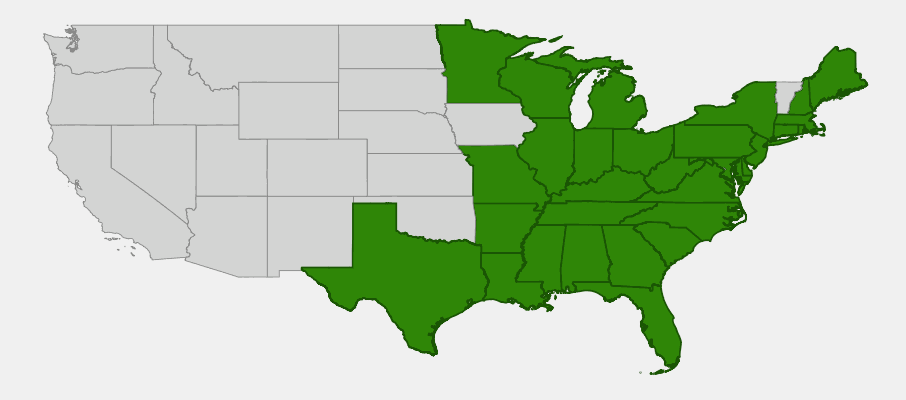
Virginia Blue Flag is native to the eastern United States, ranging from Maine and southern Canada south through the Mid-Atlantic states to Florida, and west through the Gulf Coast states to Texas and Oklahoma, with inland populations extending through the Mississippi Valley to Minnesota, Wisconsin, and Michigan. It is one of the most widely distributed native irises in eastern North America, occurring in suitable wetland habitats across a remarkably large geographic area.
In Maryland, Virginia, and West Virginia, Virginia Blue Flag is found throughout the coastal plain and Piedmont in freshwater marshes, wet meadows, pond margins, stream banks, and the edges of tidal and non-tidal wetlands. The species is particularly common in tidal freshwater marshes of the Chesapeake Bay watershed, where it often grows in dense colonies among other marsh plants. It is less common in the mountains of western Virginia and West Virginia but occurs along stream margins and in mountain fens at lower elevations.
Virginia Blue Flag should not be confused with the closely related Blue Flag Iris (Iris versicolor), which is native primarily to the northern United States and Canada and has a more northerly distribution in the Mid-Atlantic. In the Mid-Atlantic, Iris virginica is the more southerly and common species, though both may occur in the same region. The two species hybridize where their ranges overlap, producing plants with intermediate characteristics. A third related species, Iris shrevei (Midwest Blue Flag), occurs in the interior of the continent and is sometimes treated as a variety of I. virginica.
📋 Regional plant lists featuring Virginia Blue Flag: Maryland, Virginia & West Virginia
Growing & Care Guide
Virginia Blue Flag is a rewarding and low-maintenance native perennial for wet garden sites. Given adequate moisture, it is vigorous, long-lived, and returns each year with an increasingly spectacular flower display as the colony matures. The key to success is understanding and respecting its absolute requirement for wet to moist soils.
Light
Virginia Blue Flag grows best in full sun to part shade. In full sun with consistently wet or moist soil, plants develop the most robust growth and the most prolific flower display. In part shade — dappled light beneath high-branching trees, or morning sun with afternoon shade — plants grow and flower well, though flower color may be slightly less vibrant. In dense shade, flowering is reduced and plants become stretched and less vigorous. For rain garden and pond-margin plantings, full sun with wet soil produces the most dramatic display.
Soil & Water
Virginia Blue Flag requires consistently wet to saturated soils and is one of the most water-demanding native perennials in this guide. It thrives in standing water up to 6 inches deep and grows naturally in marshes and pond margins where roots are in constantly saturated soil. For garden use, it is ideal for rain garden wet zones, pond margins, wet swales, and any site where water consistently collects. The rhizomes tolerate occasional dry periods once established, but extended drought causes significant stress. Do not plant in well-drained garden borders — the plant will decline rapidly without consistent moisture.
Planting Tips
Plant Virginia Blue Flag rhizomes in spring or early fall with the rhizome just barely covered with soil — about 1 inch deep. Container plants transplant very easily at any time during the growing season if watered adequately. For pond margins, plant at the water's edge or in shallow water up to 4 inches deep. For rain gardens, plant in the lowest, wettest zone. Space plants 18–24 inches apart for naturalistic groupings — they will fill in as the rhizomes spread. Virginia Blue Flag naturalizes readily in suitable conditions and creates increasingly large, spectacular colonies over time.
Pruning & Maintenance
Virginia Blue Flag requires minimal maintenance. Cut back the foliage to the ground in late fall or early spring after new growth appears. Divide overcrowded colonies every 3–5 years in late summer or early fall — after bloom, when the foliage is dying back — to maintain vigor and control spread. Rhizomes can be divided easily with a sharp spade; replant divisions immediately in moist soil. Caution: Virginia Blue Flag rhizomes are mildly toxic and may cause skin irritation on contact. Wear gloves when dividing plants. The plant has no serious pest or disease problems in its native range.
Landscape Uses
Virginia Blue Flag is a premier native perennial for wet sites and water-feature plantings:
- Pond and lake margins — magnificent at the water's edge, growing into water up to 6 inches deep
- Rain garden wet zones — one of the most beautiful native plants for consistently wet areas
- Freshwater marshes and wetland restoration — an important native marsh species
- Stream bank plantings — rhizomes help stabilize eroding banks in wet conditions
- Wet meadow plantings — spectacular spring bloomer in moist meadow settings
- Tidal freshwater wetlands — highly tolerant of tidal fluctuation and seasonal flooding
- Wildlife and pollinator gardens — a premier bumble bee plant in spring
Wildlife & Ecological Value
Virginia Blue Flag provides exceptional ecological value in wetland communities, serving as a critical spring food source for pollinators, providing shelter and nesting habitat for wetland birds, and helping stabilize the wet soils that are foundational to the entire ecosystem.
For Birds
Virginia Blue Flag provides significant nesting habitat and cover for a variety of wetland and marsh birds. Red-winged Blackbirds frequently nest in dense colonies of Virginia Blue Flag and other marsh vegetation. Common Yellowthroat, Marsh Wren, and Swamp Sparrow use Blue Flag stands for nesting and foraging cover. The dense rhizome mat at the base of Blue Flag colonies provides important foraging habitat for rails, herons, and other wading birds that probe for invertebrates in saturated soil. The large seed capsules are occasionally consumed by waterfowl and rails.
For Mammals
Virginia Blue Flag rhizomes are mildly toxic to mammals, making it generally avoided by deer and other herbivores — an important attribute for plantings in areas with high deer pressure. However, muskrats occasionally eat the rhizomes and may damage plantings in areas where muskrats are common. The dense stands of Blue Flag foliage and rhizomes provide cover for small mammals including muskrats, meadow voles, and water shrews in wetland habitats.
For Pollinators
Virginia Blue Flag is a critically important spring nectar and pollen source for bumble bees (Bombus spp.) — particularly bumble bee queens that are establishing new colonies in spring. The flower structure of iris is specifically adapted for bumblebee pollination: bees enter beneath the style branch to reach nectar, and in doing so contact the pollen-bearing anthers above and the sticky stigma below, facilitating cross-pollination. The nectar guide markings on the falls — the white and yellow central markings surrounded by violet veining — are ultraviolet-reflective patterns that attract bees specifically. Several species of long-tongued native bees also visit Virginia Blue Flag. The flowers are not effectively visited by honeybees, making this a particularly important plant for native bee conservation.
Ecosystem Role
In freshwater wetland communities, Virginia Blue Flag plays an important structural and functional role. Its extensive rhizome network helps bind and stabilize wet soils, reducing erosion and improving water clarity by reducing bank slumping and sedimentation. In tidal freshwater marshes, Blue Flag is an important component of the diverse plant community that filters nutrients, sequesters carbon, and attenuates wave energy. The dense leaf canopy shades the water surface, moderating temperature and providing important habitat for aquatic invertebrates, fish fry, and amphibians that shelter among the submerged stems and rhizomes.
Cultural & Historical Uses
Virginia Blue Flag and related native irises have a long history of use by Indigenous peoples throughout eastern North America. The Chippewa, Ojibwe, and other Great Lakes nations used iris rhizomes medicinally — most often as a topically applied remedy for skin problems, wounds, and eye irritations. The Iroquois used preparations of Blue Flag root for liver ailments and as a purgative, while the Meskwaki used it in ceremonial contexts. Important caution: All parts of Virginia Blue Flag, particularly the rhizomes, contain irisin and iridin — compounds that are toxic if ingested and may cause skin irritation on contact. The plant should never be consumed in any form without expert guidance.
In 19th-century American botanical medicine, Blue Flag (Iris versicolor and related species) was an official drug plant listed in the U.S. Pharmacopoeia from 1820 to 1895. The dried rhizomes ("orris root" of the New World) were used as a cathartic, emetic, and in preparations for liver and gallbladder conditions. Early American herbalists and botanical physicians, including Eclectic physicians, used Blue Flag root preparations extensively, though the toxicity of the plant made dosing and use difficult. The commercial rhizome trade contributed to overharvesting of wild iris populations in some areas during the 19th century.
Today, Virginia Blue Flag is celebrated primarily as an ornamental and ecological native plant. It has gained significant recognition in native plant restoration and ecological gardening communities, where its combination of extraordinary beauty, water tolerance, and high wildlife value make it one of the most recommended native perennials for wet sites. The plant is also gaining recognition as an important component of tidal freshwater wetland restoration projects throughout the Chesapeake Bay watershed, where restoration of native plant communities — including Virginia Blue Flag — is a key strategy for improving water quality and providing habitat.
Frequently Asked Questions
Is Virginia Blue Flag toxic?
Yes — all parts of Virginia Blue Flag are mildly to moderately toxic if ingested, and the rhizomes and fresh juice may cause skin irritation in sensitive individuals. The plant is not a threat to wildlife that naturally avoids it, but should be kept away from areas where children or pets might chew on it. Wear gloves when dividing rhizomes. Do not consume any part of this plant.
What is the difference between Virginia Blue Flag and Blue Flag Iris?
Virginia Blue Flag (Iris virginica) and Blue Flag Iris (Iris versicolor) are closely related native irises. Virginia Blue Flag is native to the southeastern United States and has a more southerly distribution; Blue Flag Iris is native primarily to the northeastern United States and Canada and has a more northerly distribution. Both may occur together in the Mid-Atlantic transition zone. Virginia Blue Flag tends to be slightly taller and has leaves that are greener and less glaucous (waxy) than Blue Flag Iris.
Can Virginia Blue Flag grow in a pond?
Yes — Virginia Blue Flag is well-suited to growing in shallow water at the margins of ponds, lakes, and water gardens. Plant rhizomes in submerged planters or directly in wet soil at the water's edge, in water up to 4–6 inches deep. It is one of the most beautiful and ecologically valuable plants for the margin zone of natural and constructed ponds.
How do I get Virginia Blue Flag to bloom reliably every year?
Virginia Blue Flag blooms most reliably when grown in consistently moist to wet soil with adequate sunlight (full sun to part shade). Plants that dry out in summer produce fewer flowers the following spring. Division of overcrowded clumps every 3–5 years also improves blooming. Allow seed capsules to develop and self-seed for a naturalistic colony that expands over time.
Is Virginia Blue Flag the Virginia state flower?
No — despite its name, Virginia Blue Flag is not the Virginia state flower. The Virginia state flower is the American Dogwood (Cornus florida). Virginia Blue Flag's name reflects the plant's scientific name (Iris virginica), which commemorates the Virginia colony where the plant was first formally described by European botanists in the 17th and 18th centuries.

Looking for a nursery that carries Virginia Blue Flag?
Browse our native plant nursery directory: Maryland · Virginia · West Virginia