Virginia Pine (Pinus virginiana)
Pinus virginiana, commonly known as Virginia Pine (also Scrub Pine, Jersey Pine, or Possum Pine), is a small to medium-sized native evergreen tree of the eastern United States that thrives where few other trees can — on dry, infertile, acidic soils of the Piedmont, Coastal Plain, and Appalachian foothills. This tough, adaptable member of the Pinaceae (pine) family grows 15 to 40 feet tall with a characteristically irregular, somewhat ragged crown that gives the tree a picturesque, windswept quality. Though often dismissed as a “pioneer weed tree” compared to more stately eastern pines, Virginia Pine is an ecologically essential native that supports a remarkable community of wildlife and fills a critical niche in dry upland forest succession throughout the Mid-Atlantic.
Virginia Pine is the classic “Christmas tree pine” of the Mid-Atlantic region — its short, twisting needles, dense branching, and manageable size have made it the most widely grown Christmas tree species in Maryland, Virginia, and the Carolinas. The foliage is prized in floral arrangements and Christmas decorations throughout the region, and wild trees are still gathered for these purposes in some areas. But beyond its seasonal decorative value, Virginia Pine provides year-round ecological services: dense seed crops feed birds and small mammals, the persistent small cones provide nest attachment sites for cavity-nesting birds, and the tree’s tolerance of disturbed, degraded soils makes it one of the most important native pioneer trees for reforestation of abandoned agricultural lands and strip-mined sites throughout the Appalachian region.
In the landscape, Virginia Pine rewards those who appreciate rugged native character over manicured perfection. Its irregular, sculptural form, year-round greenery, wildlife value, and exceptional toughness in poor soils make it a valuable choice for naturalistic landscapes, wildlife gardens, and ecological restorations where other trees would struggle. It is particularly useful for quickly establishing native canopy cover on dry, compacted, or disturbed sites.
Identification
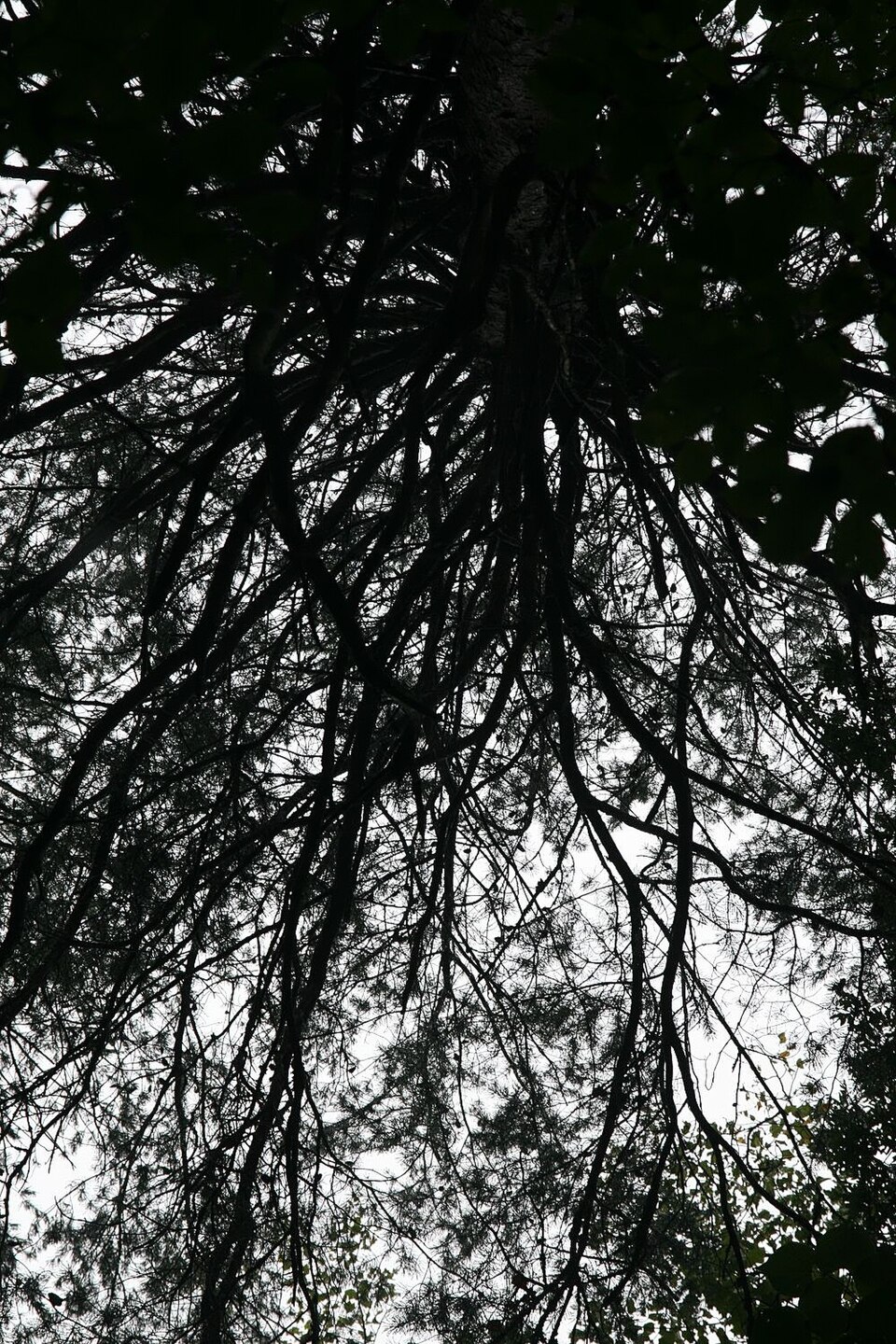
Virginia Pine is a small to medium tree, typically reaching 15 to 40 feet (4.5–12 m) tall at maturity, with occasional specimens to 60 feet in favorable conditions. The crown is distinctly irregular and open — unlike the pyramidal symmetry of many pines — with crooked, wiry branches that spread somewhat horizontally and give the tree a windswept character. Old trees develop a flat-topped or broadly spreading crown. The trunk is often forked or crooked, particularly in open, exposed sites. Growth rate is moderate, typically 12 to 18 inches per year in suitable conditions.
Bark
On young trees, the bark is thin, smooth, and orange-brown to reddish-brown. On mature trees (20+ years), the bark becomes scaly and grayish-brown, breaking into irregular rectangular plates with reddish inner surfaces visible in the furrows. The distinctive reddish-orange bark color, especially visible on the upper trunk and branches, is a reliable identification feature and gives the tree ornamental interest even in winter.
Needles
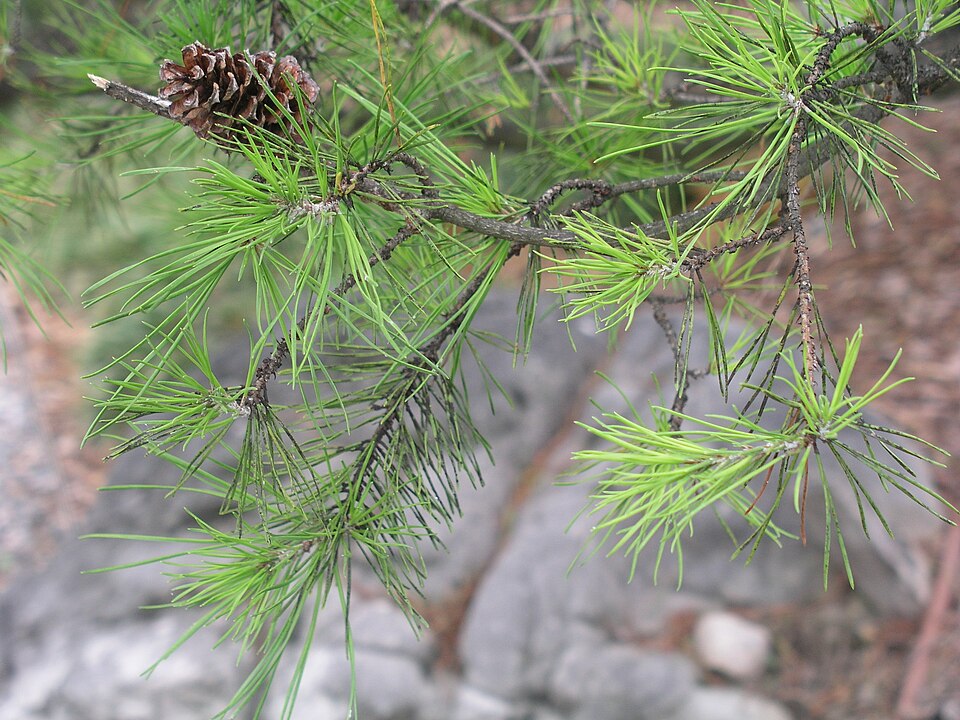
The needles are perhaps the most distinctive feature of Virginia Pine — they are borne in bundles of 2 (pairs), are short (1.5 to 3 inches / 4–7.5 cm long), slightly twisted, and often appear somewhat crowded or dense on the branches. They are dull gray-green to yellow-green, somewhat stiffer than many other two-needled pines. The needles persist for 3 years before dropping, giving the inner branches a somewhat cluttered appearance with old, brown needle clusters. This characteristic “messy” inner branching is one of the features that distinguishes Virginia Pine from the tidier Shortleaf Pine and Pitch Pine.
Cones
The cones are small, 1.5 to 2.5 inches (4–6 cm) long, oval-shaped, and prickly — each scale bearing a sharp, curved prickle. They are brown and persistent, remaining on the tree for several years before opening. The persistent cones are another identification feature, as they accumulate on the branches, giving older trees a characteristic clustered appearance. Seeds are small and winged, released when cones open in dry weather.
Quick Facts
| Scientific Name | Pinus virginiana |
| Family | Pinaceae (Pine) |
| Plant Type | Evergreen Coniferous Tree |
| Mature Height | 15–40 ft |
| Sun Exposure | Full Sun |
| Water Needs | Low (Drought Tolerant) |
| Bloom Time | March – May (inconspicuous pollen cones) |
| Needle Length | 1.5–3 in (pairs of 2) |
| Cone Size | 1.5–2.5 in (prickly, persistent) |
| USDA Hardiness Zones | 4–8 |
Native Range
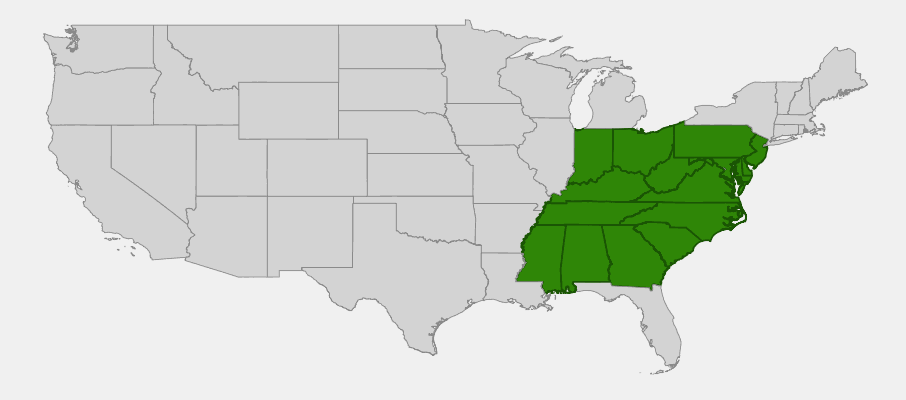
Virginia Pine is native to the eastern United States, with a range centered on the Mid-Atlantic states and extending south through the Appalachians into the Deep South. It grows from southern New Jersey and Delaware south through Maryland, Virginia, West Virginia, North Carolina, South Carolina, Georgia, Alabama, and Mississippi, with extensions north into southern Indiana and Ohio and west into Tennessee and Kentucky. It is absent from the coastal plain of the deep South (where Longleaf Pine historically dominated) and from most of New England.
In the Mid-Atlantic states, Virginia Pine is a widespread and common tree throughout the Piedmont, Blue Ridge foothills, Ridge and Valley, and Appalachian Plateau physiographic provinces. It is characteristically found on dry, south-facing slopes, ridgetops, old fields, and disturbed uplands with poor, thin, acidic soils. In Maryland and Virginia, it is one of the most common early-successional tree species on abandoned farmland and depleted upland sites, where it pioneers forest recovery on soils that initially cannot support more demanding hardwood species. In West Virginia, it is common throughout the central and western portions of the state on dry, rocky ridges and disturbed areas.
Virginia Pine reaches its greatest abundance and size in the Virginia Piedmont and the mountain valleys of West Virginia, where the combination of acidic upland soils, moderate rainfall, and a history of agricultural disturbance has created extensive stands. Pure Virginia Pine forests or woodlands are a characteristic landscape element of the Mid-Atlantic Piedmont, particularly on red clay soils of the Virginia Triassic basin.
📋 Regional plant lists featuring Virginia Pine: Maryland, Virginia & West Virginia
Growing & Care Guide
Virginia Pine is one of the most adaptable native conifers in the Mid-Atlantic, tolerating poor soils, drought, and disturbed sites that would defeat many other native trees. Understanding its preferences — full sun and well-drained, infertile, acidic soils — is the key to growing it successfully.
Light
Virginia Pine is a full-sun species that requires at least 6 hours of direct sunlight daily for vigorous growth and good cone production. It does not tolerate shade well — young trees planted in shade quickly become etiolated, sparse, and unhealthy, and will eventually die if overshadowed. This is a tree for open, sunny sites. Its intolerance of shade is a key ecological feature — it establishes rapidly in open, disturbed conditions but is eventually shaded out by the hardwoods that it helps establish through forest succession.
Soil & Water
Virginia Pine is best known for its exceptional drought tolerance and ability to thrive in poor, dry, acidic soils (pH 4.5–6.0) where other trees fail. It is well-suited to the thin, rocky soils of ridge tops, the heavy clay soils of the Virginia Piedmont, and the nutrient-poor soils of reclaimed mine lands and old abandoned fields. Once established (typically after 2 years), Virginia Pine requires no supplemental watering. It dislikes constantly wet soils and poorly drained sites. Avoid planting in compacted, alkaline, or permanently moist soils.
Planting Tips
Plant Virginia Pine from container-grown or bare-root nursery stock in fall or early spring. On dry, disturbed sites, it establishes readily even without soil amendment — in fact, excessive fertilization can cause overly rapid, weak growth. On better soils, it may be quickly overtopped by other trees. Space trees 15 to 25 feet apart to allow natural crown development. For Christmas tree production, trees are planted at 6 to 8 feet spacing and sheared annually. For naturalistic plantings, no shearing is needed.
Pruning & Maintenance
Virginia Pine requires minimal pruning in naturalistic settings. Remove dead or damaged branches in late winter. For Christmas tree production, annual shearing in early summer produces the dense, symmetrical form desired for the holiday market. For wildlife garden use, avoid pruning the lower branches — dense branching to the ground provides superior wildlife cover. Virginia Pine is generally pest-free, though it can be attacked by pine bark beetles on stressed trees; avoid wounding the bark and maintain tree health through appropriate site selection.
Landscape Uses
- Reforestation of disturbed sites — one of the best native pioneers for degraded uplands
- Mine reclamation — used extensively in Appalachian strip mine revegetation
- Wildlife cover — dense branching provides excellent year-round cover for birds
- Christmas tree production — the most widely grown Christmas tree in the Mid-Atlantic
- Dry slope stabilization — excellent for erosion control on dry, acidic slopes
- Naturalistic windbreak or privacy screen — provides evergreen screening in difficult dry sites
Wildlife & Ecological Value
Virginia Pine provides exceptional year-round wildlife value, particularly during winter when its seeds, cones, and dense evergreen foliage are critical resources for birds and mammals.
For Birds
The seeds are consumed by many bird species, including Pine Warbler, Yellow-rumped Warbler, American Goldfinch, Pine Siskin, Red-breasted Nuthatch, White-breasted Nuthatch, and Red Crossbill. Eastern Towhees, Field Sparrows, Song Sparrows, and other ground-feeding birds forage for seeds that fall beneath the trees. Red-headed Woodpeckers and Pileated Woodpeckers use older, partially dead trees for foraging and cavity excavation. The dense, low branching of Virginia Pine provides critical winter roosting cover for many species, including Eastern Screech-Owl, Great Horned Owl, and American Kestrel. Virginia Pine foliage is an important foraging substrate for Pine Warblers — a species that is closely associated with pine forests year-round in the Mid-Atlantic.
For Mammals
Gray Squirrels and Flying Squirrels consume Virginia Pine seeds from the cones. White-tailed Deer browse the foliage in winter when other food is scarce, and the dense stands provide important thermal cover for deer during cold weather. Eastern Cottontails and other small mammals use Virginia Pine stands for escape cover and denning. Black Bears may forage for insects in rotting logs and stumps in older Virginia Pine stands.
For Pollinators
Virginia Pine produces abundant yellow pollen in spring, shed in large quantities from small male (pollen) cones. This pollen is collected by a variety of native bees, including bumblebees and specialist pollen-collecting species. Pine pollen is an important protein resource for early-season bees in the Mid-Atlantic, as it becomes available before many spring wildflowers are open. The tree also supports dozens of specialist moth and butterfly species whose larvae feed on pine foliage, including the Pine Elfin butterfly (Callophrys niphon) — a species closely tied to Virginia Pine and other short-needled pines.
Ecosystem Role
Virginia Pine is a foundational pioneer species in dry upland forest succession throughout the Mid-Atlantic. It colonizes open, disturbed areas rapidly from wind-blown seed, stabilizing soils and creating the partially shaded, leaf-litter-enriched conditions under which hardwood seedlings can establish. Over time (30–80 years), Virginia Pine stands are gradually shaded out and replaced by oaks, hickories, and other hardwoods — but they play an essential transitional role in rebuilding native forest structure on degraded lands. This successional function has made Virginia Pine one of the most important tools for native upland forest restoration in the region.
Cultural & Historical Uses
Virginia Pine has deep roots in the cultural history of the Mid-Atlantic states. Indigenous peoples of the region used pine resin for waterproofing canoes and containers, as a wound dressing (resin has natural antimicrobial properties), and for torches and fire-making. Pine needles were used in basket-making by several eastern woodland tribes, and pine bark tea was used medicinally for respiratory conditions. The pitch pine forests of the New Jersey Pine Barrens — closely related to Virginia Pine stands in the Coastal Plain — supported entire communities of traditional craftspeople and charcoal burners in the 18th and 19th centuries.
Virginia Pine’s most celebrated modern cultural role is as the dominant Christmas tree of the Mid-Atlantic region. Christmas tree farming became a major agricultural industry in Maryland, Virginia, and the Carolinas during the 20th century, and Virginia Pine — with its manageable size, dense needle coverage, characteristic pine fragrance, and adaptability to marginal soils — became the preferred species for farm-grown cut Christmas trees in the region. Millions of Virginia Pine trees are harvested annually as Christmas trees, and the foliage branches are widely used in wreaths, garlands, and holiday decorations. The species’ association with Christmas has created a cultural affection for this often-underappreciated native tree.
In conservation and ecological restoration, Virginia Pine has been widely used for reclaiming abandoned strip mines and other severely degraded lands in the Appalachian region, particularly in Virginia and West Virginia. Millions of seedlings have been planted on reclaimed surface mine lands under the Surface Mining Control and Reclamation Act (SMCRA) since the 1970s — making Virginia Pine one of the most extensively planted native trees in the Appalachian restoration effort. The species’ ability to establish and persist on acid mine spoils, where soil pH and nutrient levels are often extreme, makes it nearly irreplaceable for the earliest stages of mine reclamation.
Frequently Asked Questions
How is Virginia Pine different from other eastern pines?
Virginia Pine is distinguished by its short needles (1.5–3 in) in pairs, small prickly cones that persist on the tree for several years, irregular/open crown form, and preference for dry, poor soils. Compared to Shortleaf Pine (longer needles, less prickly cones), Eastern White Pine (5 needles, much longer), Pitch Pine (3 needles), and Loblolly Pine (3 longer needles, more southern), Virginia Pine’s combination of 2 short twisted needles, persistent prickly cones, and dry-site preference is distinctive.
Is Virginia Pine a good Christmas tree?
Yes — it is the most widely grown Christmas tree in Maryland, Virginia, and the Carolinas. Its dense, compact branching, short needles that hold well after cutting, classic pine shape, and pleasant fragrance make it an excellent choice. Farm-grown trees are sheared annually to produce dense, symmetrical specimens. However, wild trees have the irregular, open form typical of the species.
Can Virginia Pine grow in average garden soil?
Virginia Pine prefers poor, dry, acidic soil — it can actually grow too fast and become weak in rich, moist, fertile garden soils, making it more susceptible to storm damage and disease. For a native garden, it is best planted in dry, well-drained sites with naturally poor soils, where it will thrive with minimal care. Avoid planting in wet, alkaline, or heavily amended soils.
How long does Virginia Pine live?
Virginia Pine is not a long-lived tree by forest standards — most individuals live 65 to 90 years, with exceptional specimens occasionally reaching 120+ years. Its relatively short lifespan compared to oaks and hickories is typical of pioneer tree species — it is adapted to establish quickly, live productively for a human lifetime, and then yield to the longer-lived hardwoods it helps establish.
Do deer eat Virginia Pine?
White-tailed Deer do browse Virginia Pine foliage, particularly in winter when other food sources are scarce. Young trees (under 4–5 feet tall) may be significantly damaged by deer browse in areas with high deer pressure. Protecting small trees with tree tubes or wire cages until they grow out of browsing height (above 5 feet) is recommended in high-deer areas.

Looking for a nursery that carries Virginia Pine?
Browse our native plant nursery directory: Maryland · Virginia · West Virginia