West Indian Mahogany (Swietenia mahagoni)
Swietenia mahagoni, the West Indian Mahogany, is the original “mahogany” of furniture history — the tree whose reddish-brown timber built Spanish colonial cathedrals, Chippendale furniture, and the hulls of PT boats in World War II, and launched a 500-year global trade that still shapes how the word “mahogany” is used today. In the United States it occurs naturally only at the very southern tip of Florida, in the northern Florida Keys and the hardwood hammocks of the southern Everglades — the northernmost edge of a range that otherwise spans the Bahamas, Cuba, Jamaica, Hispaniola, and the Cayman Islands.
This is a medium to large semi-evergreen tree with a broad, rounded crown, pinnately compound leaves, and an unmistakable connection to South Florida’s tropical hardwood hammock ecosystem — one of the rarest and most threatened plant communities in the continental United States. Because of that scarcity, West Indian Mahogany is officially listed as “Threatened” under Florida’s Preservation of Native Flora Act, even as the related, non-native Honduras Mahogany (Swietenia macrophylla) has become widely planted and can hybridize with it in South Florida landscapes.
For gardeners and restoration practitioners in Miami-Dade and Monroe Counties, true West Indian Mahogany is a distinctive, historically significant shade tree — but one that deserves careful sourcing, since so much of the “mahogany” sold in South Florida nurseries today is actually the introduced Honduras Mahogany or a hybrid of the two.
Identification
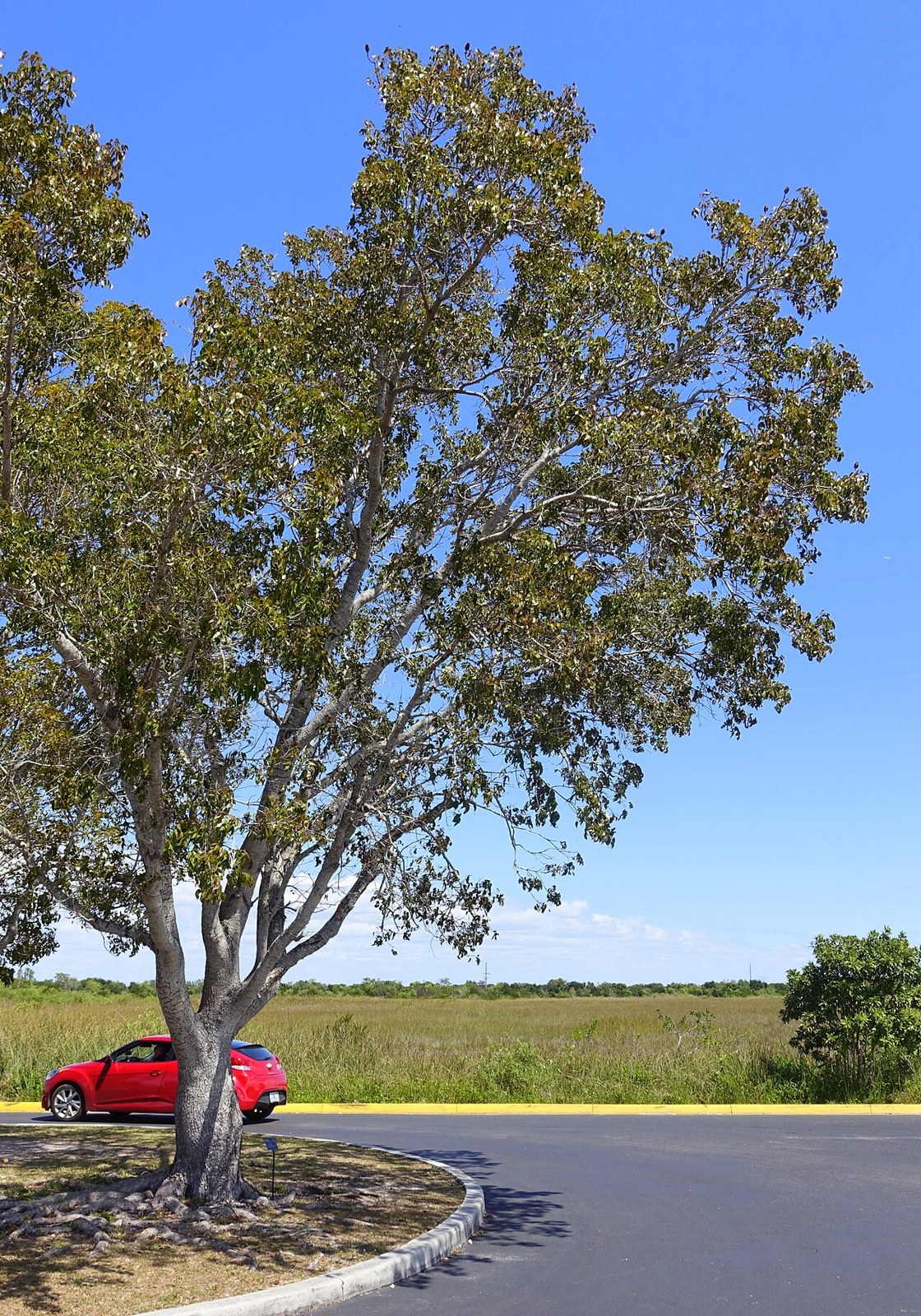
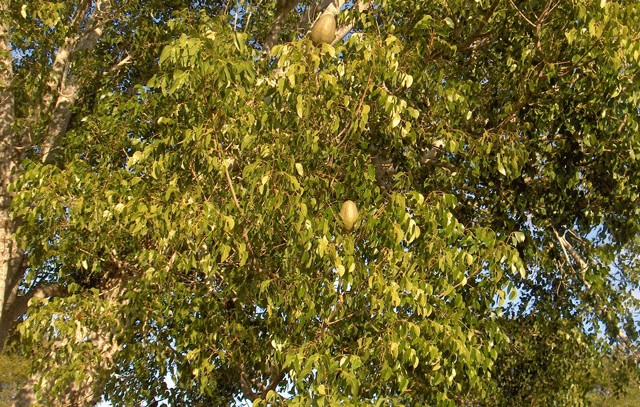
West Indian Mahogany typically reaches 40 to 50 feet in South Florida landscapes (considerably taller in its native Caribbean range, occasionally over 100 feet), with a broad, rounded, umbrella-like crown and a straight trunk that can develop buttressed roots with age.
Bark & Stems
Bark on young trees is smooth and grayish, becoming darker, rougher, and furrowed into plates as the tree matures. In the U.S. portion of its range the tree is semi-deciduous, briefly dropping its leaves in late winter or early spring before quickly leafing out again — a trait that distinguishes it from the fully evergreen habit it shows in the wetter parts of its tropical range.
Leaves
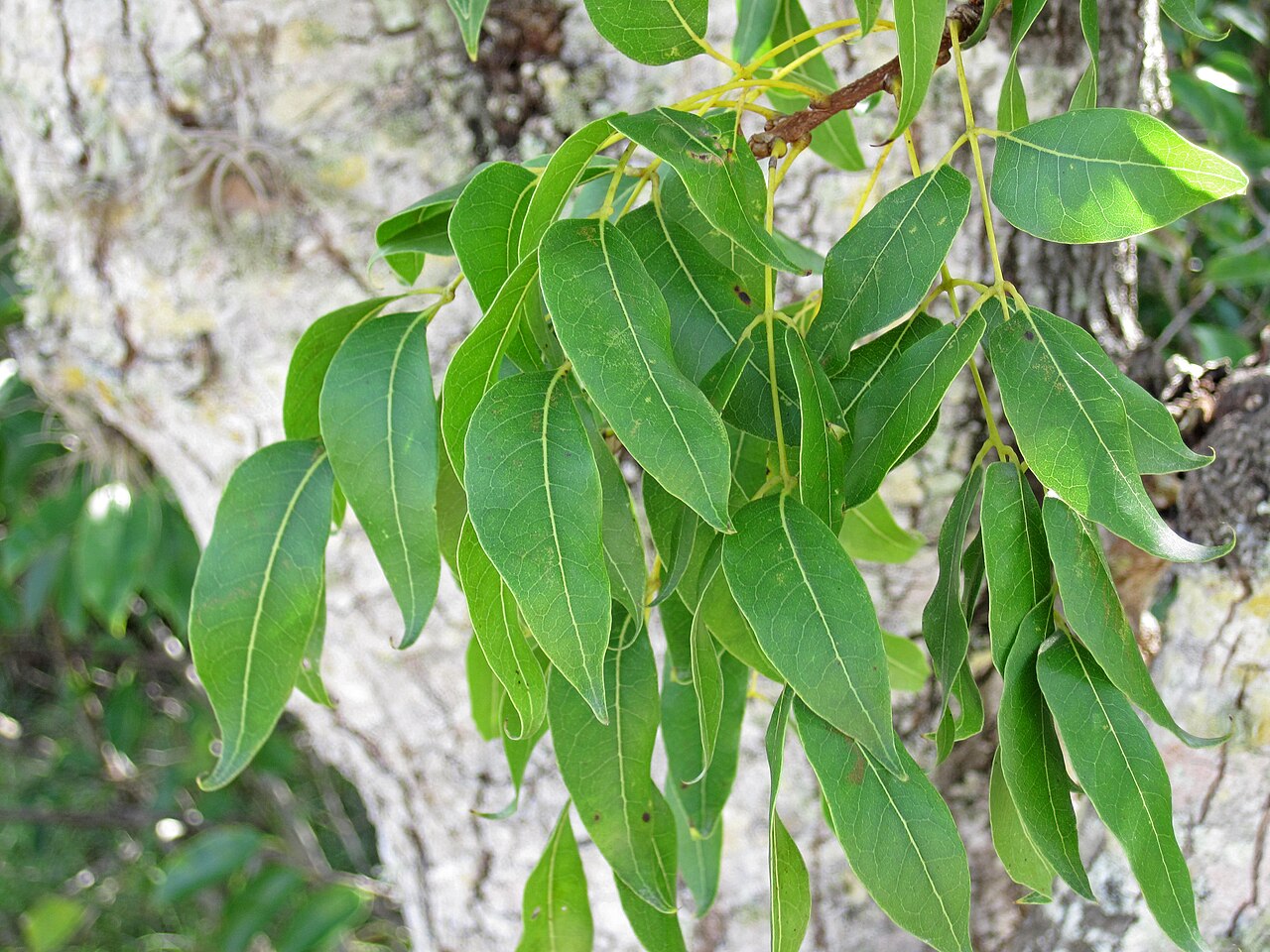
Leaves are pinnately compound, 4 to 10 inches long, with 4 to 8 leaflets and no terminal leaflet — the leaf simply ends abruptly at the last pair. Individual leaflets are glossy dark green, 2 to 3 inches long, and distinctly asymmetrical (oblique) at the base, a reliable identification feature for the genus.
Flowers & Fruit
Flowers are small, greenish-white, and inconspicuous, borne in loose clusters (panicles) in spring and of little ornamental interest. The fruit is a woody, pear-shaped capsule 3 to 5 inches long that matures over roughly a year, then splits from the base into five sections, releasing numerous papery, winged seeds that spiral down on the wind. Old, empty capsules often persist on the tree, hanging like small wooden pears.
Quick Facts
| Scientific Name | Swietenia mahagoni |
| Family | Meliaceae (Mahogany) |
| Plant Type | Semi-Evergreen Tree |
| Mature Height | 40–50 ft in Florida |
| Mature Spread | 30–50 ft |
| Growth Rate | Moderate |
| Sun Exposure | Full Sun |
| Water Needs | Low to moderate once established |
| Soil Type | Well-drained limestone, sandy, or loamy soil |
| Soil pH | Neutral to alkaline |
| Bloom Time | Spring |
| Flower Color | Greenish-white |
| Fall Color | None (semi-evergreen) |
| Fruit | Woody, pear-shaped capsule with winged seeds |
| Deer Resistant | Yes |
| USDA Hardiness Zones | 10b–11 |
Native Range
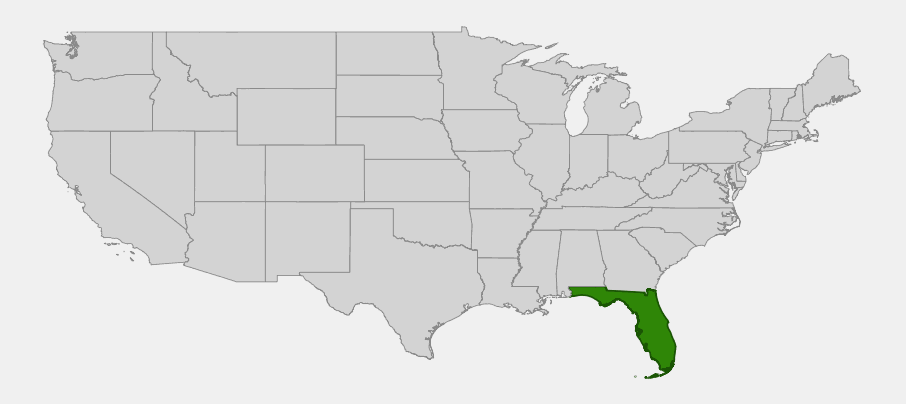
In the United States, West Indian Mahogany is native only to the southern tip of Florida — primarily the northern Florida Keys and the hardwood hammocks of the southern Everglades — representing the absolute northern limit of a range that extends through the Bahamas, Cuba, Jamaica, Hispaniola, and the Cayman Islands. It has been widely planted far beyond this natural range throughout South Florida, so cultivated trees are common well outside the small area where the species occurs naturally.
Its native habitat is tropical hardwood hammock: dense, broadleaf forest growing on slightly elevated limestone outcrops amid the surrounding pine rockland, marl prairie, and mangrove wetlands of South Florida. These hammocks are among the rarest plant communities in the continental United States, reduced dramatically by development, and West Indian Mahogany is one of the characteristic canopy trees of the habitat that remains.
Florida’s population is genetically and ecologically distinct from the mahogany most commonly sold commercially today. Decades of landscape planting using the faster-growing, non-native Honduras Mahogany (Swietenia macrophylla) has introduced hybridization risk into wild and naturalized West Indian Mahogany populations, a conservation concern that land managers in South Florida are actively working to address.
📋 Regional plant lists featuring West Indian Mahogany: No Florida regional plant list currently covers this species; browse all Native Plant Profiles.
Growing & Care Guide
West Indian Mahogany makes a handsome, tough shade tree for South Florida landscapes within its climate range, tolerant of heat, wind, salt spray, and limestone soil once established — qualities that have made it a popular street and park tree in the Keys and Miami-Dade for well over a century.
Light
Give West Indian Mahogany full sun for the strongest growth and best form. It tolerates some light shade when young but develops a fuller, more rounded canopy in open, sunny sites.
Soil & Water
This tree is well adapted to South Florida’s thin, well-drained limestone and sandy soils, and tolerates both periodic drought and occasional salt exposure once established, making it a good choice for Keys and coastal Miami-Dade landscapes seeking resilient shade trees for South Florida. Regular watering during the establishment period speeds growth, but mature trees need little supplemental irrigation.
Planting Tips
Plant in full sun with room for a mature spread of 30 to 50 feet — this is not a small-yard tree. Because of ongoing hybridization concerns with introduced Honduras Mahogany, source plants specifically labeled as Swietenia mahagoni from reputable native-plant nurseries rather than generic “mahogany” stock.
Pruning & Maintenance
Prune to establish a strong central leader and well-spaced scaffold branches while young; mature trees need only routine removal of dead or storm-damaged wood. The tree is generally wind-resistant and a reliable performer through South Florida’s hurricane season, though it benefits from structural pruning in youth to minimize storm damage later.
Landscape Uses
- Shade tree for streets, parks, and large residential lots
- Hardwood hammock restoration in Miami-Dade and the Keys
- Coastal and salt-tolerant plantings near the shoreline
- Historic and heritage tree plantings reflecting South Florida’s mahogany trade history
Wildlife & Ecological Value
For Pollinators
Though the small greenish flowers are not showy, they are visited by a range of generalist insect pollinators typical of South Florida’s hardwood hammocks, including native bees.
For Birds & Mammals
The dense canopy provides nesting and roosting habitat for hammock birds, and the tree serves as host to the Florida-endangered mahogany mistletoe (Phoradendron rubrum), itself an important, though parasitic, component of the hammock food web, its berries eaten by birds.
Ecosystem Role
As one of the characteristic canopy trees of South Florida’s tropical hardwood hammock, West Indian Mahogany contributes to one of the rarest forest types in the continental United States. Protecting and restoring genetically pure populations of this species is part of broader efforts to conserve the remaining hammock fragments in Miami-Dade and the Florida Keys.
Cultural & Historical Uses
Few native American trees carry as much global historical weight as West Indian Mahogany. Spanish explorers used its wood for ship repairs in the Caribbean as early as the 1520s, and by the late 1500s it was being shipped to Spain for the construction and furnishing of El Escorial, one of the grandest palaces of the Renaissance. The wood’s combination of strength, workability, and resistance to rot and marine organisms made it the preferred material for ship hulls, masts, and fittings for the Spanish treasure fleets and, later, the British Royal Navy.
In the Florida Keys, mahogany logging was a significant industry from the 18th through early 20th centuries, and the prized trees of Key Largo became so well known that English cabinetmakers specifically sought “Key Largo mahogany” for their finest furniture. The wood’s rich color, fine grain, and stability also made it a favored material for scientific and musical instruments, from ship’s compasses to the backs and sides of guitars — a tradition that continues in instrument-making today, including in electric guitar bodies and necks.
By the 20th century, wild West Indian Mahogany had become scarce enough in Florida to warrant legal protection, and the tree is now listed as “Threatened” under the state’s Preservation of Native Flora of Florida Act. Its modern significance lies less in timber harvest — which no longer occurs from wild Florida populations — than in its status as a living link to centuries of maritime and furniture-making history, and as a conservation priority for South Florida’s remaining hardwood hammocks.
Frequently Asked Questions
Is the mahogany sold at Florida nurseries the native species?
Not always. Much of the “mahogany” commonly planted in South Florida is the introduced Honduras Mahogany (Swietenia macrophylla) or a hybrid between the two species. If you want the true native tree, ask specifically for Swietenia mahagoni from a reputable native-plant nursery.
Is West Indian Mahogany endangered?
It is listed as “Threatened” under Florida’s Preservation of Native Flora of Florida Act, reflecting the loss of its native hardwood hammock habitat to development. Globally it is assessed as Near Threatened by the IUCN.
How can I tell West Indian Mahogany apart from Honduras Mahogany?
West Indian Mahogany generally has smaller leaflets, a more compact, rounded crown, and slower growth than the larger-leaved, faster-growing Honduras Mahogany. Because the two readily hybridize, genetic testing or expert identification is sometimes needed for certainty, especially in older planted trees.
Can I harvest wood from this tree?
No. Wild West Indian Mahogany in Florida is a threatened species and should never be cut for lumber. Historic mahogany lumber came from extensive harvesting of the species decades ago and from other regions of its Caribbean range; wild Florida trees today should be left to grow and reproduce.
Is West Indian Mahogany cold-hardy?
No — it is strictly tropical to subtropical, reliably hardy only in USDA zones 10b and 11. It will not tolerate freezing temperatures and is appropriate only for the warmest parts of South Florida.

Looking for a nursery that carries West Indian Mahogany?
Browse our native plant nursery directory: Florida