
Yellow Pitcher Plant (Sarracenia flava)
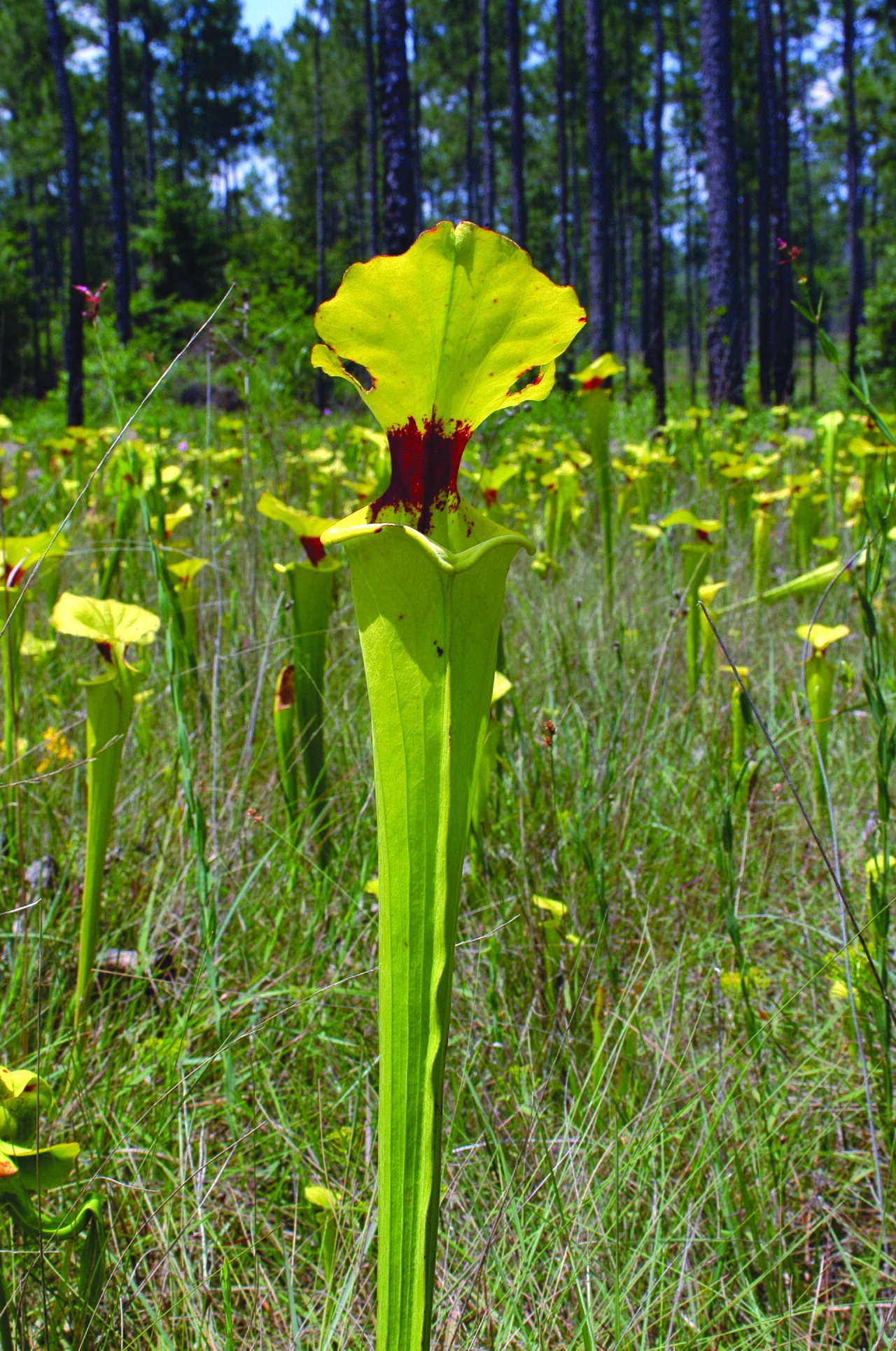
Sarracenia flava, the Yellow Pitcher Plant (also called yellow pitcherplant or trumpets), is the tallest and most striking carnivorous plant of the southeastern Coastal Plain. In spring it sends up slender, upright, trumpet-shaped leaves, often 2 to 3 feet tall, that end in a wide, flaring lid. The pitchers are bright yellow-green, often veined or flushed with red. Early in the season, before or alongside the first pitchers, nodding yellow flowers up to 4 inches across hang from tall leafless stalks. It belongs to the pitcher plant family (Sarraceniaceae) and grows in sunny, wet, acidic, nutrient-poor places: pine savannas and flatwoods, seepage bogs and the edges of swamps and streams.
Each pitcher is a rolled leaf that works as a pitfall trap. Nectar along the rim and bright patterns on the lid lure flies, wasps, bees, ants and beetles. Once an insect slips down the waxy throat, downward-pointing hairs keep it from climbing out, and the drowned prey is broken down in the fluid at the bottom. The plant absorbs the nitrogen and phosphorus its sandy, waterlogged soil cannot provide.
Yellow pitcher plant ranges from southeastern Virginia south to northern Florida and west to southern Alabama. Its habitat has shrunk badly through drainage, development, pine plantations and the loss of natural fire, and wild plants have long been dug for sale. It is protected by law in some states. Gardeners should buy only nursery-propagated plants, which are easy to find, and never dig plants from the wild. This guide covers identification, range, growing it in a bog garden, and its role in fire-dependent wetlands.
Identification
Yellow pitcher plant is easy to recognize by its tall, erect, yellow-green trumpets with a broad lid that arches over the mouth. Several other pitcher plants share its range, and it hybridizes with most of them, so mixed populations can include intermediate plants.
Pitchers
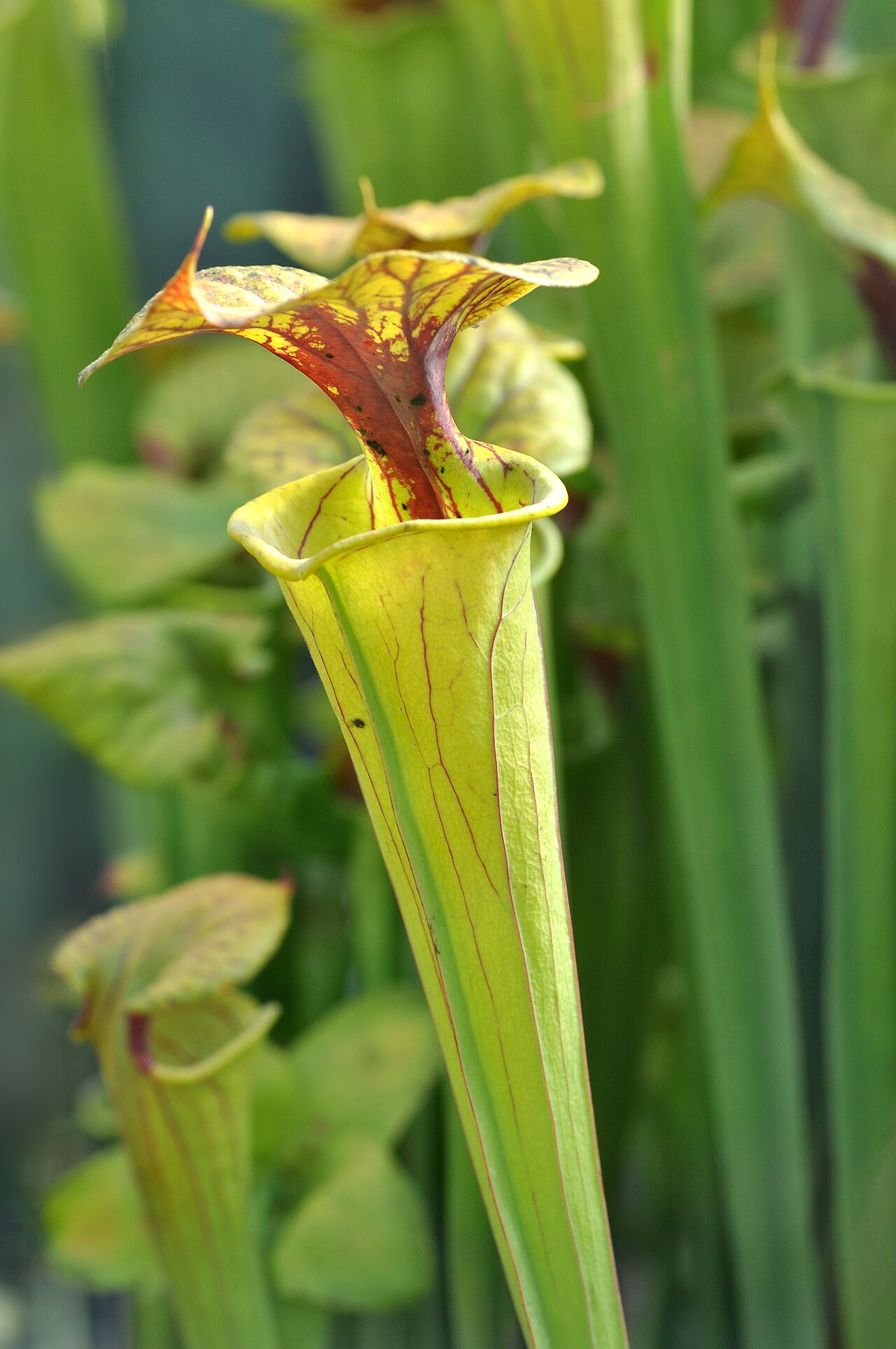
The pitchers rise from a creeping underground rhizome and are typically 1½ to 3 feet tall, occasionally more. They are narrow at the base and widen gradually to a round mouth 1½ to 3 inches across, with a rolled rim (the nectar roll). The lid, or hood, is broad, nearly round, and held upright or arched over the mouth, with a narrow neck where it joins the pitcher. Color varies a great deal. Most plants are yellow-green with red veins in the throat and lid, and many have a red or maroon blotch at the base of the lid. Some forms are veined red all over, and some have solid red or maroon pitchers. Botanists recognize several named varieties based on these color patterns, including var. rugelii, var. ornata, var. rubricorpora and var. atropurpurea.
Phyllodia
From late summer into fall the plant stops making pitchers and produces flat, sword-shaped leaves called phyllodia. They make food by photosynthesis but do not trap insects. Through the winter the old pitchers turn brown and collapse.
Flowers
Flowers appear in early spring, from March into May depending on latitude, usually just before or along with the first pitchers. Each flower nods at the top of a leafless stalk about as tall as the pitchers. It has five long, drooping, bright yellow petals that hang around a large, umbrella-shaped style, and five greenish-yellow sepals above. The Lady Bird Johnson Wildflower Center notes that the flowers have a musty odor.
Fruit & Seeds
Pollinated flowers form a rounded, warty capsule that ripens in late summer and fall and splits to release many small seeds. The seed falls close to the parent plant, which is why pitcher plants often grow in dense colonies.
Similar Species
Pale pitcher plant (Sarracenia alata), west of Mobile Bay, has a smaller lid that does not stand fully erect. White-top pitcher plant (S. leucophylla) has white, net-veined tops. Purple pitcher plant (Sarracenia purpurea) has short, curved, reclining pitchers. Wild hybrids with these species, such as S. ×catesbaei (with purple pitcher plant) and S. ×moorei (with white-top pitcher plant), show intermediate features.
Quick Facts
| Scientific Name | Sarracenia flava L. |
| Family | Sarraceniaceae (pitcher plant family) |
| Plant Type | Carnivorous herbaceous perennial from a rhizome |
| Mature Height | 1½–3 ft (occasionally taller) |
| Mature Spread | 1–2 ft; slowly forms clumps |
| Growth Rate | Slow to moderate |
| Sun Exposure | Full sun |
| Water Needs | High; constantly moist to wet, acidic soil |
| Soil Type | Sphagnum peat and sand; wet, nutrient-poor sands and peats |
| Soil pH | Acidic (about 4.0–5.5) |
| Bloom Time | March–May, before or with the first pitchers |
| Flower Color | Bright yellow |
| Fall Color | Pitchers brown in fall; flat green phyllodia persist |
| Fruit | Warty capsule with many small seeds |
| Deer Resistant | Moderate |
| USDA Hardiness Zones | 6–9 |
Native Range
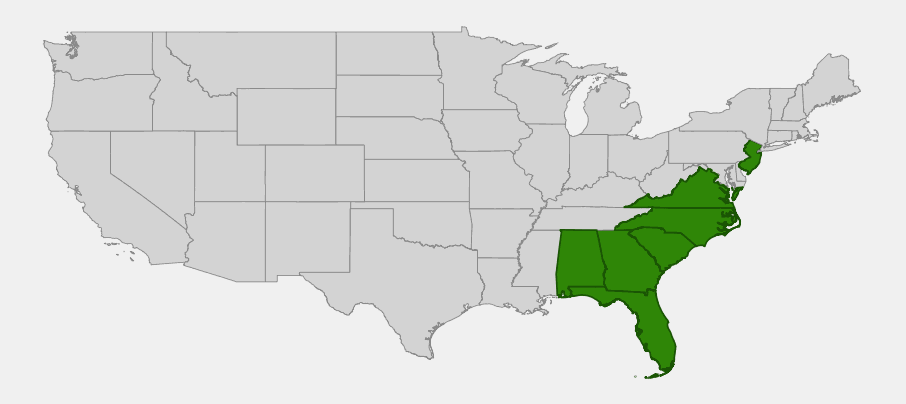
Yellow pitcher plant is a southeastern Coastal Plain species. USDA PLANTS and the Lady Bird Johnson Wildflower Center record it from Virginia, North Carolina, South Carolina, Georgia, Florida and Alabama, and USDA also lists New Jersey. The core of its range runs from southeastern Virginia through the Carolinas and Georgia to northern Florida and the Florida Panhandle, and west to southern Alabama near Mobile Bay. Small populations also occur in the Piedmont and mountains of North Carolina.
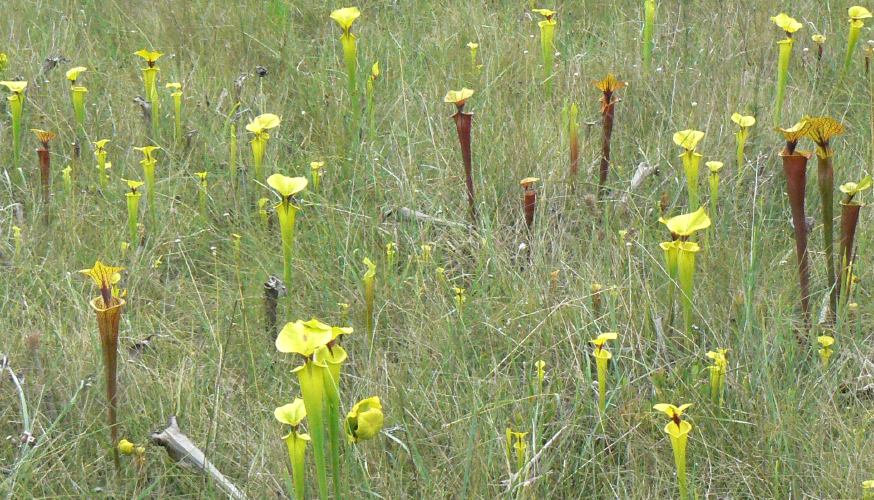
The largest stands are in the wet longleaf pine savannas and seepage bogs of the Carolinas, southern Georgia, the Florida Panhandle and southern Alabama. Famous sites include the Green Swamp of North Carolina, the Apalachicola National Forest in Florida, and Crawford Bog in Alabama’s Conecuh National Forest. In Florida it is mostly a plant of the Panhandle and the northern counties.
Like the other Southeastern pitcher plants, it depends on fire. Frequent, low-intensity burns clear away shrubs and grasses that would otherwise shade it, and pitcher plant bogs that go unburned for many years fill in with titi, gallberry and other shrubs. The plants regrow quickly from their rhizomes after a fire and often bloom heavily the following spring. Drainage, conversion to pine plantations and development have destroyed a large share of the original pitcher plant bogs.
📋 Regional plant lists featuring Yellow Pitcher Plant: North & South Florida · Alabama, Georgia & Mississippi · North & South Carolina · Maryland, Virginia & West Virginia · New York, Pennsylvania & Northern New Jersey · Delaware, Southern New Jersey & Long Island
Growing & Care Guide
Yellow pitcher plant is one of the easiest carnivorous plants to grow outdoors in the Southeast and is widely available from carnivorous plant and native plant nurseries. Always buy nursery-propagated plants, usually grown from seed or by division. Never dig plants from the wild: wild collection has harmed many populations, and the species is protected in some states.
Light
Give it full sun, at least six hours a day and preferably more. In shade the pitchers become weak, floppy and poorly colored, and the plant may stop flowering.
Soil & Water
Grow it in a nutrient-poor, acidic mix such as one part sphagnum peat to one part coarse, lime-free sand or perlite. Never use potting soil, compost or fertilizer. Keep the soil constantly moist to wet, ideally with the water table an inch or two below the surface. Water with rain water or distilled water where possible, since hard, mineral-rich tap water slowly builds up salts. In a container, stand the pot in a tray of water during the growing season.
Planting Tips
Plant in spring in a lined bog garden, a pond margin with acidic, sandy soil, or a large, undrained container or tub. Set the rhizome just below the surface with the growing points at soil level. Keep it outdoors: yellow pitcher plant needs a cool winter dormancy and does not thrive as a houseplant.
Pruning & Maintenance
In late winter, before new growth starts, cut off the brown, dead pitchers at the base. Pull weeds and tree seedlings that would shade the plants. Do not feed the plants; they catch their own insects. In colder parts of zone 6 and 7, protect containers from hard freezes with a layer of pine straw or by moving them to an unheated garage.
Propagation
Divide large clumps in late winter or early spring by cutting the rhizome into sections, each with a growing point and some roots. Seed needs about four to eight weeks of cold, moist stratification and should be sown on the surface of moist peat in bright light. Seedlings take three to five years to reach flowering size. Because the species hybridizes readily, seed from mixed collections may not come true.
Landscape Uses
- Bog gardens: the tall, bold centerpiece for sunny, wet, acidic beds with other carnivorous plants
- Container bogs: in a wide, undrained pot or tub kept wet with rain water
- Pond margins: in acidic, sandy, nutrient-poor shoreline soil
- Savanna and bog restoration: within its native range, using local, propagated stock
- Educational gardens: an easy way to show carnivory to children and visitors
Wildlife & Ecological Value
Yellow pitcher plant is a predator, a source of nectar, and a home for other animals, all at once. Its bogs are some of the most species-rich plant communities in North America.
For Pollinators
Bumblebees and other large bees are the main pollinators. They push into the flower between the hanging petals and the umbrella-shaped style, leave pollen on the stigmas at the tips of the umbrella as they enter, and pick up fresh pollen on the way out. Because the flowers bloom before most pitchers are fully open, pollinators are not usually trapped. Many insects also visit the nectar roll of the pitchers. Researchers have reported that this nectar contains coniine, an alkaloid that may help stupefy prey.
For Birds
Birds have little direct use for the plant itself. The open pine savannas where it grows are home to Bachman’s sparrows, brown-headed nuthatches and red-cockaded woodpeckers.
For Mammals
Deer occasionally browse young pitchers. The Lady Bird Johnson Wildflower Center notes that the young shoots and leaves have been grazed by cattle and sheep, but can be toxic if eaten in quantity. People should not eat it.
Ecosystem Role
The pitchers support a small community of specialist animals. Several moths in the genus Exyra feed only on pitcher plants: their caterpillars live inside the pitchers and eat the leaf tissue. Certain flesh flies and mosquito larvae live in the pitcher fluid and feed on trapped prey, and some wasps nest in old pitchers. Tree frogs and spiders often sit in or near the mouths of pitchers to catch insects drawn to them. Above all, yellow pitcher plant is a signature species of fire-maintained longleaf pine wetlands, and its abundance is a good sign of healthy savanna.
Cultural & Historical Uses
Carl Linnaeus named Sarracenia flava in 1753, using a genus name honoring Michel Sarrazin, a physician and naturalist in New France who sent North American pitcher plants to Europe. The species name flava means “yellow”. In the American South it has long been called “trumpets” or “trumpet pitcher plant” for the shape of its leaves.
Naturalists were fascinated by the plant’s trapping habit long before carnivory was understood. Writers in the early nineteenth century, including the South Carolina physician James McBride in 1819, described how the pitchers caught and held insects. William Bartram also wrote about Southeastern pitcher plants during his travels in the 1770s.
Today yellow pitcher plant is one of the most popular carnivorous plants in cultivation, and many named color forms and hybrids are grown by hobbyists. Its popularity has a downside: wild plants and pitchers have been collected for sale and for the cut-flower trade. Choosing nursery-propagated plants and supporting fire-managed conservation lands are the best ways gardeners can help the species.
Frequently Asked Questions
Is yellow pitcher plant easy to grow?
Yes, if you give it full sun, constantly wet acidic peat and sand, rain or distilled water, and a cold winter dormancy outdoors. Most failures come from too little sun, tap water, potting soil or fertilizer, or keeping it indoors over winter.
Do I need to feed my pitcher plant?
No. Outdoors it catches plenty of insects on its own. Do not fertilize the soil, which can burn the roots and feed weeds.
Can I dig yellow pitcher plants from the wild?
No. Wild collection has damaged many populations, and the plant is protected by law in some states. Nursery-propagated plants are inexpensive, easy to find and adapt better to gardens.
Why do the pitchers turn brown in fall?
That is normal. In late summer the plant switches to flat, non-trapping leaves (phyllodia), and the old pitchers die back during winter dormancy. Trim the dead pitchers in late winter, and new ones will appear in spring after the flowers.
Is it poisonous?
Do not eat it. The Lady Bird Johnson Wildflower Center notes that livestock grazing large amounts of young leaves may be poisoned. The plant poses little risk to people who only handle it.

Looking for a nursery that carries Yellow Pitcher Plant?
Browse our native plant nursery directory: Alabama · Florida & Georgia · New Jersey & North Carolina · South Carolina & Virginia