Scrub Oak (Quercus turbinella)
Quercus turbinella, commonly known as Scrub Oak, Desert Scrub Oak, or Shrub Live Oak, is a tough, drought-adapted evergreen oak native to the desert mountains and plateaus of the American Southwest. Despite its modest stature — rarely exceeding 8 feet in height — Scrub Oak is a genuinely important ecological plant: a keystone species of the desert chaparral community that provides dense, persistent cover for wildlife, produces acorns as a critical food source, and forms virtually impenetrable thickets on rocky desert slopes that stabilize soil and buffer microclimate extremes.
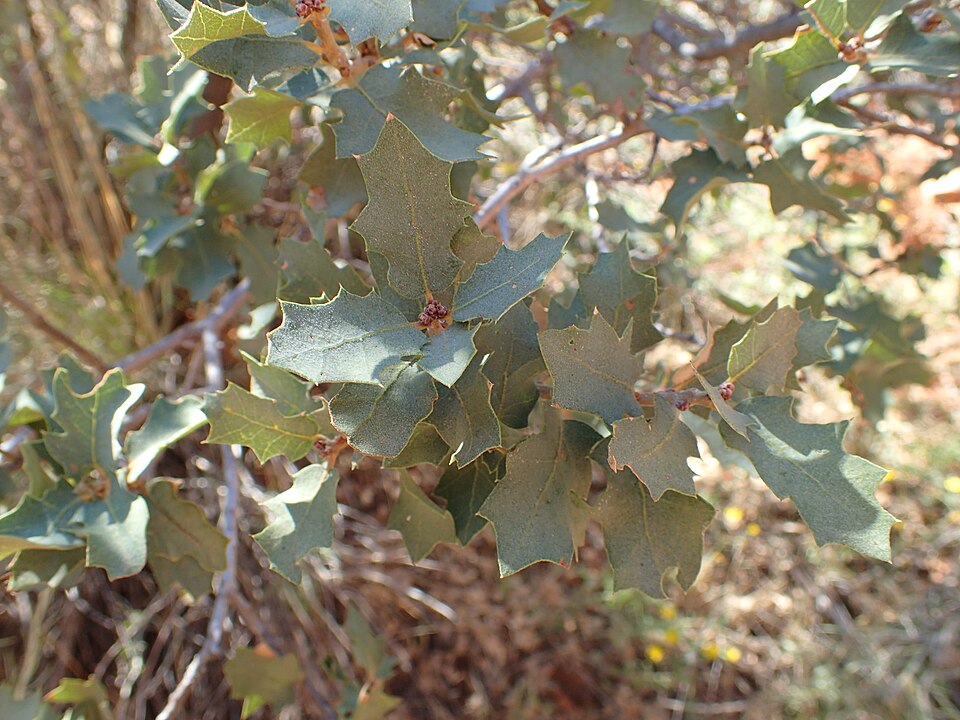
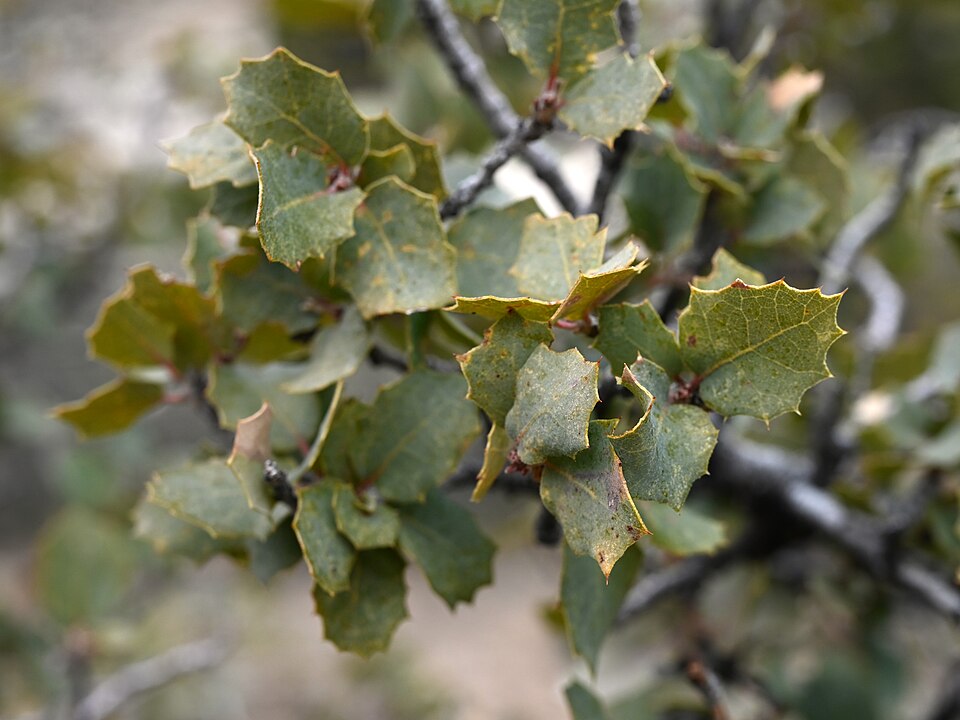
Scrub Oak belongs to the white oak group and bears small, rigid, evergreen leaves with spiny or toothed margins that superficially resemble a miniature holly — an adaptation that protects the nutritious foliage from browsing pressure. The small but nutritious acorns are produced most years and are eagerly consumed by deer, turkeys, bears, and dozens of bird species. In Utah, Scrub Oak occurs primarily in the canyon country and desert mountains of the Colorado Plateau and Basin and Range regions in the southern part of the state, where it is a characteristic plant of the desert chaparral community between about 3,000 and 6,500 feet elevation.
As a landscape plant, Scrub Oak offers year-round evergreen interest, exceptional drought tolerance, and outstanding wildlife value. Its spiny-leaved, dense thicket-forming growth habit makes it an effective barrier plant and wildlife refuge. For gardeners working with rocky, alkaline, or dry soils in Utah’s canyon country, it is one of the most dependable and ecologically valuable native shrubs available.
Identification
Scrub Oak is a low to medium-height evergreen shrub, typically 3 to 8 feet (1–2.4 m) tall, forming dense, often impenetrable thickets through basal sprouting. It can occasionally reach tree form at 10–15 feet under very favorable conditions, but the shrubby form is by far the most common. Multiple stems arise from a woody, fire-resistant root crown.
Leaves
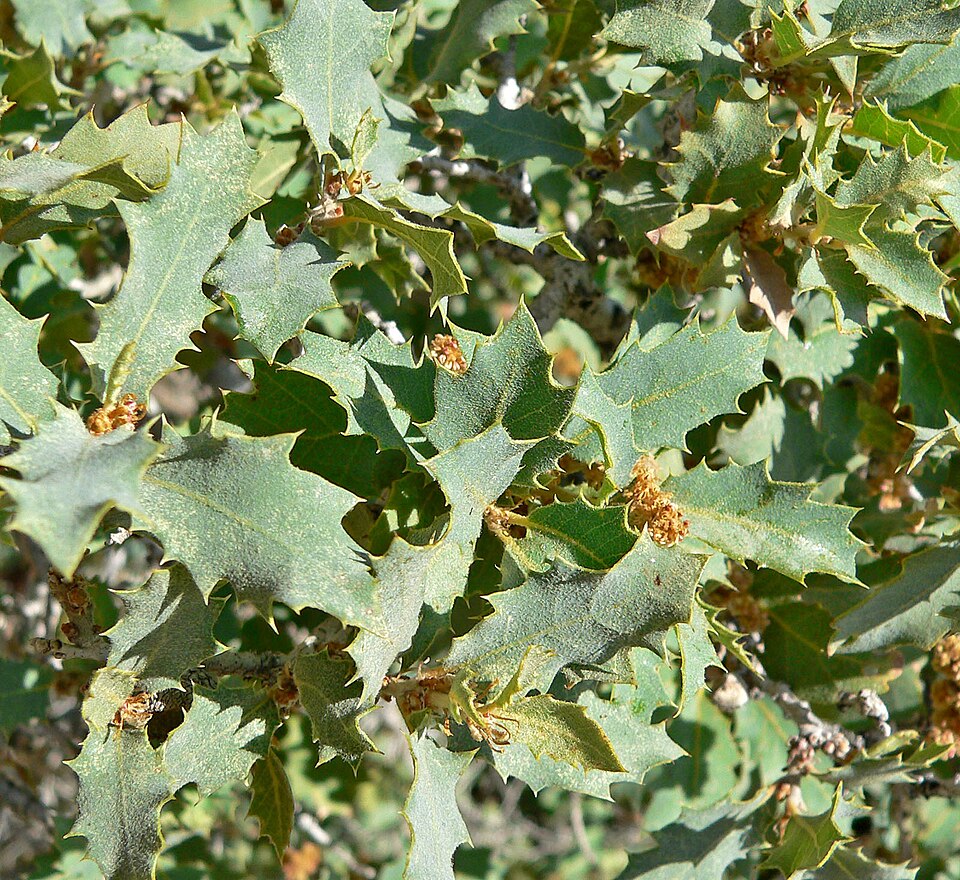
The leaves are the most distinctive feature: small, stiff, and evergreen, about ½ to 1¼ inches (1.2–3 cm) long, holly-like in appearance with 4–6 spine-tipped lobes or coarse teeth on each side. The upper surface is dull gray-green; the underside is pale, often grayish, and may have small star-shaped (stellate) hairs. The texture is leathery and rigid. The leaves are persistent for 2–3 years before dropping, giving the plant a reliably dense, year-round evergreen canopy that is unusual among oaks.
Flowers & Acorns
Like all oaks, Scrub Oak is wind-pollinated. Male flowers are produced in drooping catkins in spring as new leaves emerge; female flowers are tiny and inconspicuous. Acorns are small — about ½ inch (1.2 cm) long — turbinate (top-shaped, as the species name turbinella suggests), with a shallow, scaly cup. They ripen in a single growing season (fall of the current year), which is characteristic of the white oak group. Acorn production begins when the plant is 5–10 years old and continues reliably most years. Small as the acorns are, they are highly nutritious and palatable to wildlife.
Bark & Stems
Bark is gray, rough, and relatively thin. Old stems develop a blocky, checked texture similar to other oaks. The stems are stiff and woody, with the characteristic branching pattern of the oak genus. The root crown is massive relative to the above-ground portion — a feature that allows rapid resprouting after fire, drought, or browsing.
Quick Facts
| Scientific Name | Quercus turbinella |
| Family | Fagaceae (Beech/Oak Family) |
| Plant Type | Evergreen Shrub (occasionally small tree) |
| Mature Height | 8 ft |
| Sun Exposure | Part Shade (also tolerates Full Sun) |
| Water Needs | Low (Drought Tolerant) |
| Bloom Time | March – May (wind-pollinated catkins) |
| Acorn Maturity | September – October (current-year) |
| Leaf Type | Evergreen, spiny-margined, holly-like |
| USDA Hardiness Zones | 6–10 |
Native Range
Scrub Oak is native to the desert mountains and plateau country of the southwestern United States and northern Mexico, ranging from California and Nevada east through Utah, Arizona, New Mexico, and into western Texas and Colorado. It occurs primarily in the transition zone between desert scrub and woodland communities, typically between 3,000 and 6,500 feet elevation, where it is a dominant or co-dominant component of the desert chaparral community.
In Utah, Scrub Oak is concentrated in the canyon country of the Colorado Plateau — the St. George area, Zion Canyon, the Virgin River drainage, the Markagunt Plateau edges, and similar terrain in Washington, Kane, Iron, Garfield, and San Juan Counties. It occurs on rocky slopes, canyon walls, and rocky benches where water drains quickly and soils are shallow. It is often found growing alongside Cliffrose (Purshia stansburiana), Desert Mahogany (Cercocarpus intricatus), and Pinyon-Juniper woodland components.
Scrub Oak communities are known by ecologists as “Sonoran desert chaparral” or “Madrean evergreen woodland” where they extend into Arizona and overlap with subtropical dry forest elements. In Utah, they represent the northernmost extent of this Sonoran-derived vegetation type, and they harbor a distinctive flora and fauna assemblage that differs significantly from the more northerly Great Basin plant communities.
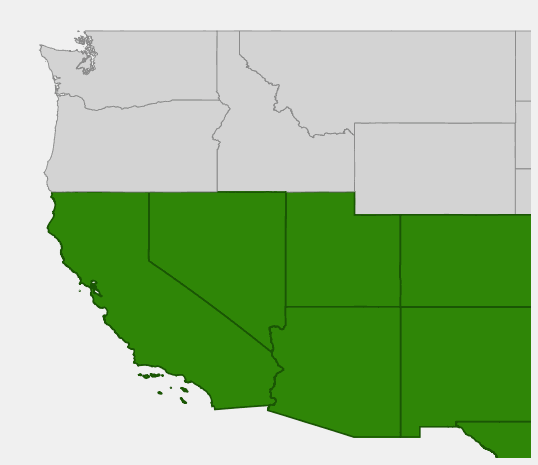
📋 Regional plant lists featuring Scrub Oak: Utah
Growing & Care Guide
Scrub Oak is one of the toughest native shrubs available for dry, rocky garden situations in Utah’s canyon country. It thrives on sites that most plants find challenging — steep, rocky slopes with shallow, alkaline soils, intermittent shade from canyon walls, and minimal rainfall. Once established, it is virtually care-free and will persist indefinitely with no intervention.
Light
Scrub Oak grows in both full sun and partial shade, making it more versatile than many desert natives. In full sun, it develops a denser, more compact form; in partial shade (common on north-facing slopes and in canyon shade), it grows taller and more open. This flexibility makes it suitable for a range of exposures.
Soil & Water
Scrub Oak tolerates — indeed, prefers — poor, rocky, alkaline soils with excellent drainage. It is not suited to rich or irrigated garden soils and may develop root diseases or excessive lush growth susceptible to pests if over-watered. Once established (after 2–3 growing seasons), provide only occasional deep watering during extended dry periods. Native rock garden conditions and rocky slopes with native soils are ideal. It tolerates considerable lime and high pH (up to 8.0 or higher).
Planting Tips
Plant in fall or early spring. Scrub Oak transplants best from container stock — avoid disturbing the root system during planting. Space plants 5–8 feet apart for a dense thicket effect, or 10–12 feet for individual specimens. Mulching the root zone with coarse gravel rather than organic mulch better mimics native conditions and promotes establishment on rocky sites.
Pruning & Maintenance
Scrub Oak requires minimal pruning. Remove dead or damaged branches in late winter. It can be pruned to maintain a desired size or shape, but this is generally unnecessary — the natural, mounding growth form is part of its appeal. The thicket-forming habit can be managed by removing unwanted root sprouts in spring. The spiny leaves make pruning moderately uncomfortable — wear heavy gloves and long sleeves.
Landscape Uses
- Barrier plant — spiny leaves and dense form create an effective physical barrier
- Wildlife habitat — acorns, cover, and nesting structure for many species
- Erosion control on rocky slopes and canyon edges
- Evergreen screen — maintains year-round structure and cover
- Fire-adapted landscaping — resprouting root crown survives most fires
- Rock garden focal plant in canyon-country and Sonoran Desert gardens
Wildlife & Ecological Value
Scrub Oak is an ecological cornerstone of the desert chaparral community, providing essential food (acorns), dense protective cover, and nesting habitat for a diverse array of wildlife species throughout the year.
For Birds
The acorns of Scrub Oak are consumed by Acorn Woodpecker, Mexican Jay, Woodhouse’s Scrub-Jay, Steller’s Jay, and various other corvids and woodpeckers. The dense, thorny thickets provide excellent nesting habitat for Black-chinned Sparrow, Spotted Towhee, Crissal Thrasher, and Gambel’s Quail. Gambel’s Quail, in particular, is strongly associated with Scrub Oak thickets in Utah, using them for both nesting cover and as a food source during acorn years. The evergreen foliage provides critical thermal cover for roosting birds during cold desert nights and winters.
For Mammals
Mule deer browse Scrub Oak foliage and consume acorns extensively; the dense thickets provide fawning cover. Javelina consume acorns where their range overlaps in Arizona. Ringtail, gray fox, rock squirrel, and various chipmunk species harvest and cache acorns. The dense, thorny interior of mature thickets provides secure denning and resting habitat for these and many other small mammals. Acorn production in good years is a critical fall food source for black bear in some areas.
For Pollinators
While Scrub Oak is wind-pollinated, the spring pollen release provides an important protein source for early-season native bees. The bark and deadwood support communities of bark-nesting mason bees and solitary wasps, and the litter zone under mature thickets supports ground-nesting pollinators. The understory plants sheltered by the Scrub Oak canopy — desert wildflowers and shrubs — provide the nectar resources for the local pollinator community.
Ecosystem Role
In the Sonoran desert chaparral zone, Scrub Oak’s most critical ecological function is stabilizing rocky slopes that would otherwise be prone to erosion and supporting a diverse shrub community that creates habitat complexity. The massive root crown — capable of persisting for decades through repeated fire cycles by resprouting vigorously — means that Scrub Oak is the structural “memory” of the chaparral community, providing rapid post-fire recovery of cover and acorn production. The acorn crop provides a high-energy fall pulse of food that sustains populations of seed-caching corvids, which in turn disperse the seeds and maintain the woodland’s spatial distribution.
Cultural & Historical Uses
Scrub Oak acorns were an important food source for Indigenous peoples of the Southwest, including the Navajo, Havasupai, Hualapai, and various Yavapai groups. Although smaller than acorns of some other oak species, the white oak group (to which Scrub Oak belongs) produces acorns that are lower in bitter tannins and can be eaten with minimal or no leaching preparation. The Havasupai are documented as eating Scrub Oak acorns raw, parched, or ground into meal, which was made into cakes or porridge.
The wood, though small in dimension, is extremely hard and dense — harder than most common timber species — and was used for digging sticks, fire-making equipment (fire drills), tool handles, and fuel. Scrub Oak burns hot and slow with excellent coaling properties, making it prized for high-heat applications. The bark and galls were used medicinally: the tannin-rich bark tea was applied as an astringent wash for skin conditions and taken internally to treat stomach ailments and diarrhea. Oak galls (produced by gall wasps and rich in tannic acid) were used as ink, dye, and mordant in some traditions.
The dense, impenetrable thickets of Scrub Oak were also recognized by ranchers and settlers as important livestock cover and, where acorns were abundant, as free-ranging forage for pigs. Hog-driving operations in the 19th and early 20th centuries moved pigs through Scrub Oak-dominated terrain in late summer and fall to fatten them on acorns — a practice known as “masting” that was common throughout oak-bearing regions of the United States until the industrialization of agriculture.
Frequently Asked Questions
Is Scrub Oak the same as Gambel Oak?
No. Gambel Oak (Quercus gambelii) is a different but related species — deciduous, taller (up to 30 feet), and found at higher elevations in Utah. Scrub Oak (Quercus turbinella) is evergreen, shorter (typically under 8 feet), and found at lower, drier, more southerly elevations. The two species sometimes grow near each other in transition zones and can hybridize.
Why doesn’t my Scrub Oak produce many acorns?
Acorn production varies significantly from year to year in all oaks — good mast years alternate with poor ones, and some individual trees are more productive than others. Additionally, young trees (under 5–10 years) rarely produce significant acorn crops. Drought, late frosts, and insect damage can also reduce acorn production in any given year. Given enough years, a healthy Scrub Oak will produce acorns reliably.
Is Scrub Oak deer-resistant?
No — deer browse Scrub Oak foliage and consume acorns. However, the spiny leaves and dense, thorny thicket form do limit deer browsing compared to softer-leaved plants. Protect young plants with deer fencing during the first few years. Once established, the plant can sustain moderate browsing pressure.
Can Scrub Oak be kept as a formal hedge?
Scrub Oak can be lightly pruned and shaped, but its naturally dense, irregular growth form and slow growth make formal hedging labor-intensive. It is better used as an informal, naturalistic barrier or wildlife hedge. The spiny leaves make handling during pruning uncomfortable — always wear protective gloves and long sleeves.
How fire-resistant is Scrub Oak?
Scrub Oak is well-adapted to fire — the above-ground portions are typically killed by fire, but the massive, lignotuber-like root crown sprouts vigorously after fire, often producing dense new growth within weeks. This resprouting ability is one of the key reasons why Scrub Oak is so dominant in the desert chaparral community, where periodic fires have shaped the vegetation for thousands of years.

Looking for a nursery that carries Scrub Oak?
Browse our native plant nursery directory: Utah