Roundleaf Buffaloberry (Shepherdia rotundifolia)
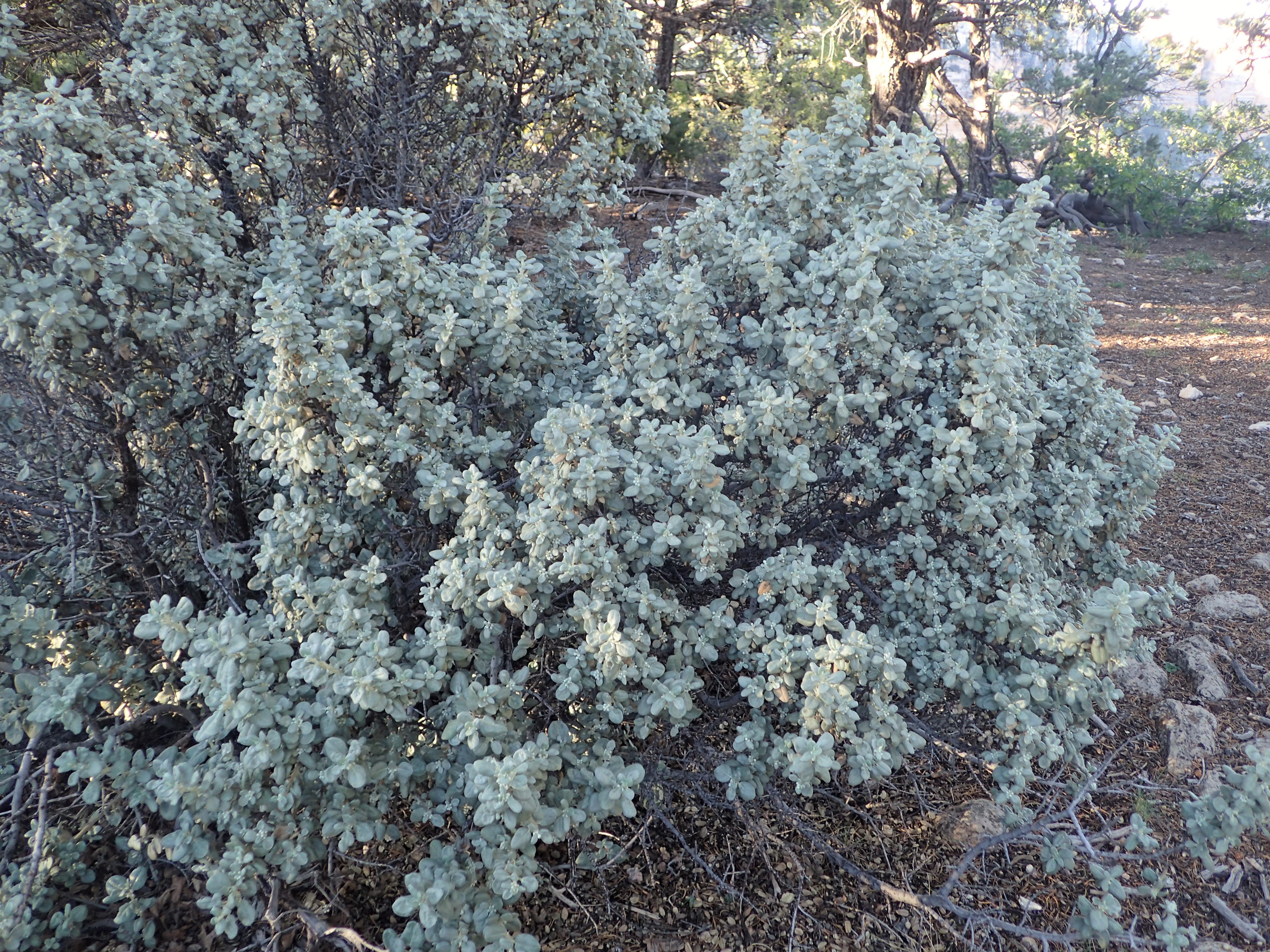
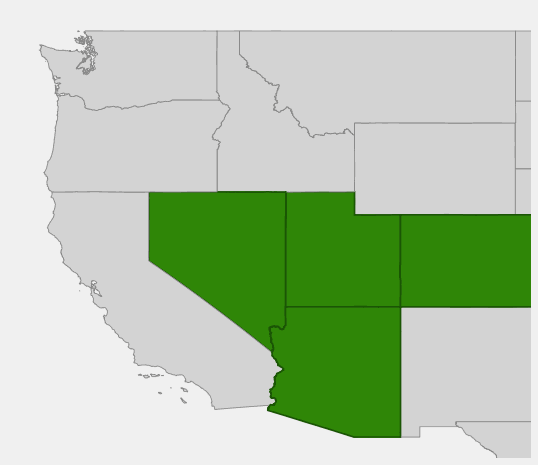
Shepherdia rotundifolia, known as Roundleaf Buffaloberry or Round-leaf Buffaloberry, is one of the most visually stunning and ecologically distinctive native shrubs of the Colorado Plateau. An endemic species found naturally only in Utah, Arizona, Colorado, and Nevada, Roundleaf Buffaloberry is adapted to the extreme conditions of canyon country — intense sun, thin rocky soils, severe drought, and temperature swings that would destroy less adapted plants. Its most remarkable feature is the foliage: the leaves are rounded to oval and coated on both surfaces with a dense layer of silvery-white scales (peltate hairs) that give the plant an almost metallic, reflective appearance — as though the leaves were hammered from polished silver or aluminum.
The reflective quality of the leaves is not merely ornamental — it is a sophisticated drought-adaptation mechanism. The dense silvery coating reflects a significant portion of incoming solar radiation, dramatically reducing leaf temperature and water loss through transpiration. This allows Roundleaf Buffaloberry to thrive in conditions of extreme heat and drought that few plants can tolerate. As noted in the regional plant list, the plant also provides important wildlife value: the berries are consumed by quail and other birds, while the seeds and berries are also taken by chipmunks and other small mammals foraging in canyon country.
For gardeners working with the challenging dry conditions of Utah’s Plateau region, Roundleaf Buffaloberry is an outstanding specimen shrub. It requires virtually no irrigation once established, tolerates rocky and poor soils, and provides year-round ornamental interest with its distinctive silvery foliage. The small yellowish flowers in spring and the reddish berries in fall add seasonal color to the persistent silvery backdrop. This is a plant that earns its place in any water-wise native garden.
Identification
Roundleaf Buffaloberry is a dense, compact evergreen shrub, typically 3 to 5 feet tall and equally wide, sometimes reaching 6–8 feet in particularly favorable conditions. The form is rounded and mounding, with stiff, spreading branches that give the plant a somewhat rigid structure. The overall silhouette is distinctive — compact, silvery, and architectural. Young plants may be more upright; mature plants tend toward a broader, more rounded form. Branches are not thorny (unlike some related species), though they are stiff.
Leaves
The leaves are the defining identification feature of this species — broadly oval to nearly round (hence the common name “roundleaf”), ¾ to 1½ inches long and almost as wide, with entire (untoothed) margins. Both surfaces are densely covered with silvery-white peltate scales (overlapping, shield-shaped hairs) that create the characteristic metallic silvery-white appearance. The texture is distinctive: slightly rough or papery to the touch due to the scaly coating. Leaves are arranged alternately on the branches. Unlike the leaves of many silver-leaved plants that are green on the upper surface and silver only beneath, Roundleaf Buffaloberry leaves are uniformly silver on both surfaces. The plant is evergreen or semi-evergreen depending on winter severity.
Flowers
The flowers are small and inconspicuous — just 2–3 mm across — yellowish-white, and tubular, produced in small clusters along the branches in early spring (March–April) before or with the new leaf growth. Like all Shepherdia species, Roundleaf Buffaloberry is dioecious — male and female flowers occur on separate plants. Both sexes must be present for fruit production. The flowers are wind-pollinated, though they also attract some small native bees and insects.
Fruit
Fruit is produced only on female plants and only when a male plant is present for pollination. The berries are small — ¼ to ⅓ inch in diameter — somewhat fleshy, and reddish to orange-red when ripe, produced in clusters along the branches in summer to fall (July–September). The flavor is astringent and somewhat tart. The berries are not commonly eaten by humans due to their astringency but are actively consumed by birds and small mammals in the canyon country communities where the plant grows.
Quick Facts
| Scientific Name | Shepherdia rotundifolia |
| Family | Elaeagnaceae (Oleaster) |
| Plant Type | Evergreen Shrub |
| Mature Height | 3–4 ft (occasionally to 8 ft) |
| Sun Exposure | Full Sun |
| Water Needs | Extremely Low (Very Drought Tolerant) |
| Bloom Time | March – April |
| Flower Color | Yellowish-white (inconspicuous) |
| Fruit | Red to orange-red berries, summer–fall (female plants only) |
| Wildlife Value | Quail, chipmunks, small mammals (fruit); insects (flowers) |
| USDA Hardiness Zones | 4–8 |
Native Range
Shepherdia rotundifolia is a Colorado Plateau endemic — its natural range is almost entirely restricted to the plateau regions of Utah, northern Arizona, southwestern Colorado, and southern Nevada. This limited distribution makes it one of the more geographically restricted native shrubs of the West, found only within the distinctive canyon and mesa landscapes carved from the Colorado Plateau’s ancient sedimentary rock formations. Unlike its relatives the Silver Buffaloberry (S. argentea) and Russet Buffaloberry (S. canadensis), which have broad ranges across North America, Roundleaf Buffaloberry is specifically adapted to the harsh, dry conditions of Plateau canyon country.
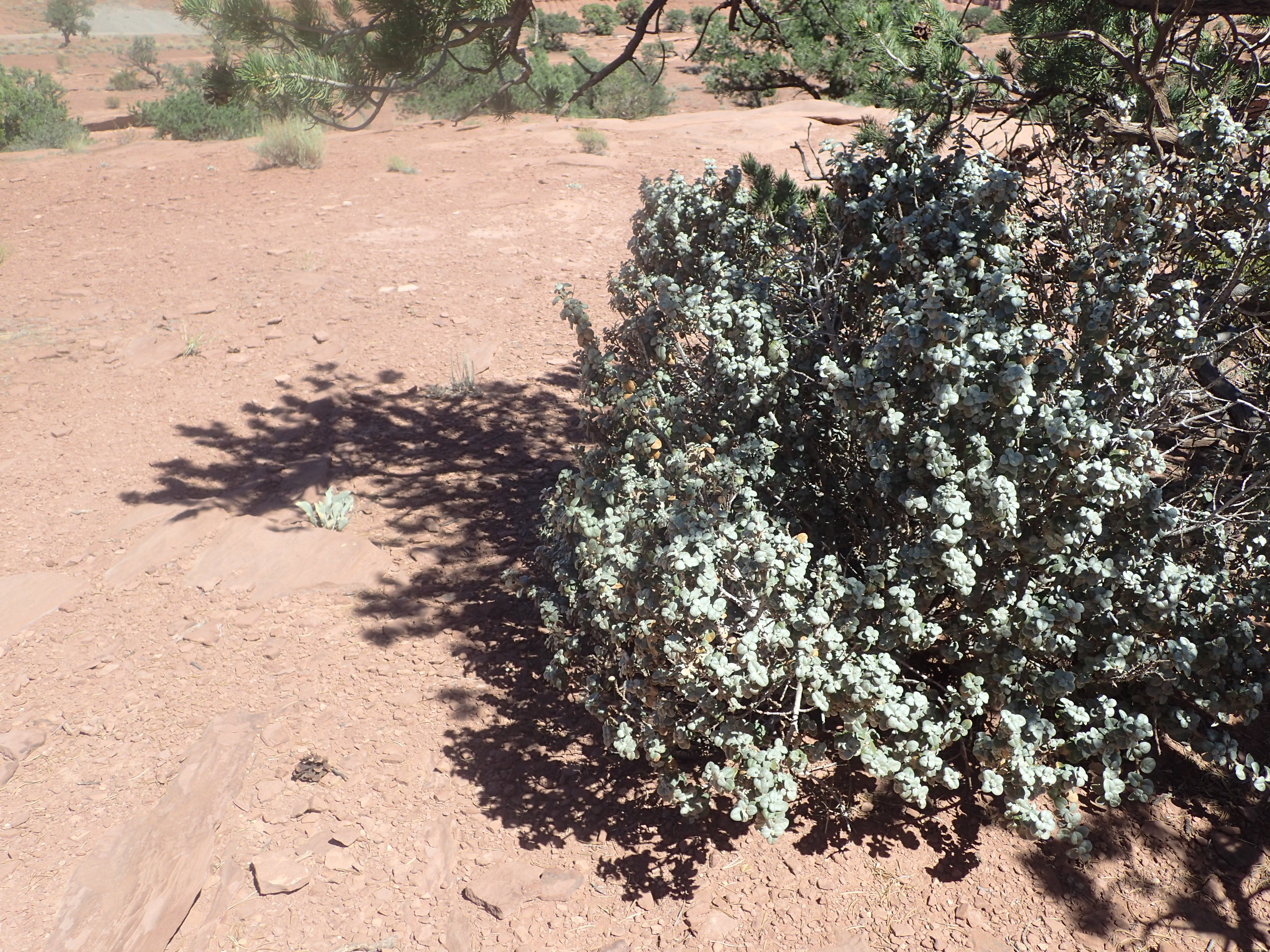
Within its restricted range, Roundleaf Buffaloberry grows primarily on rocky slopes, canyon rims and walls, and desert scrub flats at elevations between 4,500 and 7,500 feet. It is especially characteristic of south- and west-facing canyon walls where solar radiation is most intense and soil moisture lowest — conditions that would eliminate most other shrubs. The plant is often found growing directly in crevices in sandstone and limestone outcrops, its roots penetrating deep into fractures where moisture accumulates after rain. This rock-crack micro-habitat is too harsh for most competitors, giving Roundleaf Buffaloberry a semi-monopoly on an otherwise unused niche.
The species is most abundant in the heart of Utah’s canyon country — Zion, Bryce, Capitol Reef, Canyonlands, and adjacent BLM canyon lands — and the Grand Canyon’s North Rim region in Arizona. Here, it forms one of the characteristic silver-leaved accents of the canyon scrub community, often visible against the red and orange canyon walls where its reflective foliage stands out from a considerable distance.
📋 Regional plant lists featuring Roundleaf Buffaloberry: Utah
Growing & Care Guide
Roundleaf Buffaloberry is a specialist plant — it excels in conditions that challenge other plants, but it will not perform well in garden settings that are too moist, too shaded, or have heavy clay soils. Given the right conditions, it is virtually indestructible.
Light
Roundleaf Buffaloberry requires full sun — the more intense, the better. In partial shade, the silvery leaf coating is reduced, the compact form opens up, and overall vigor decreases. This plant evolved on the most exposed, sun-blasted canyon walls in North America — it thrives in full, unobstructed sun all day. South-facing slopes and exposures are ideal.
Soil & Water
Excellent drainage is non-negotiable. Roundleaf Buffaloberry is among the most drought-tolerant native shrubs available — it naturally grows in rock crevices and shallow desert soils receiving as little as 8–10 inches of annual precipitation. Once established, it requires no supplemental irrigation in most Southwest climates and may actually be harmed by regular irrigation. Plant in rocky, gravelly, or sandy soil with perfect drainage. Heavy clay or consistently moist soil will cause rapid decline and death. This is a rock garden plant, not a garden border plant. Like the related nitrogen-fixing species in its family, Roundleaf Buffaloberry has root associations that allow it to fix atmospheric nitrogen, improving its performance in nutrient-poor soils.
Planting Tips
Plant in spring or fall. Choose the sunniest, driest, most well-drained spot available. Raised beds with gravel mulch or rock garden settings are ideal. Water moderately in the first season to establish roots, then transition to no supplemental irrigation. In typical Utah canyon-country climates, rainfall alone will sustain established plants. Transplanting can be challenging — minimize root disturbance during planting and avoid disturbing the plant once established.
Pruning & Maintenance
Roundleaf Buffaloberry requires virtually no pruning. The compact form is natural and self-maintaining. If shaping is desired, prune lightly in late winter before new growth begins. The plant is slow-growing and does not recover quickly from heavy pruning, so minimal intervention is best. No significant pest or disease issues are known for this species in its native range.
Landscape Uses
- Specimen plant — the silvery foliage is unmatched as a color contrast element
- Rock garden — perfectly adapted to dry, rocky, exposed settings
- Xeriscape anchor — one of the most drought-tolerant native shrubs available
- Canyon-country restoration — for revegetating disturbed rocky slopes
- Wildlife food planting — berries for quail, chipmunks, other desert wildlife
- Contrast planting — brilliant silver against dark green junipers or red rock
Wildlife & Ecological Value
In the harsh canyon country where Roundleaf Buffaloberry grows, even a modest-sized shrub represents a significant ecological resource. Its berries, flowers, and structure all support wildlife in an environment where resources are sparse.
For Birds
As noted in the batch data, the berries of Roundleaf Buffaloberry are consumed by quail — particularly Gambel’s Quail, the characteristic quail of Utah’s canyon country. Other ground-foraging birds also take the fruit. The dense, stiff branching structure provides cover and nesting habitat for small birds including Black-throated Sparrows and various wrens that inhabit the canyon scrub communities.
For Mammals
Chipmunks — particularly the Cliff Chipmunk (Neotamias dorsalis) and Uinta Chipmunk (N. umbrinus), common in Utah canyon country — actively harvest the berries and may cache them for winter food. Mule Deer and Desert Bighorn Sheep occasionally browse the foliage, though the silvery coating makes the leaves less palatable than many other plants. Small rodents use the dense low canopy for shelter and foraging.
For Pollinators
The small spring flowers provide early-season nectar for native bees in the canyon environment — particularly important because few other shrubs are in bloom at the same time in this harsh habitat. The plant is wind-pollinated as well, and on breezy canyon days, pollen distribution is rapid and efficient.
Ecosystem Role
Like all members of the Elaeagnaceae family, Roundleaf Buffaloberry can fix atmospheric nitrogen through symbiotic associations with Frankia bacteria in root nodules. This nitrogen-fixing ability allows it to colonize bare rock crevices and nutrient-poor soils where other plants struggle, and it improves soil fertility around its root zone — a valuable contribution in nutrient-poor canyon-country soils. As a pioneer on disturbed rocky slopes and canyon walls, it plays a role in the ecological succession process, creating soil conditions that allow other plants to establish over time.
Cultural & Historical Uses
As an endemic of the Colorado Plateau, Roundleaf Buffaloberry was within the territory of several Indigenous peoples who have called this landscape home for thousands of years, including the Ancestral Puebloans (Anasazi), their descendants the Hopi and various Pueblo peoples, as well as the Diné (Navajo) and Paiute peoples. The berries, while astringent, were gathered and eaten — sometimes prepared with rendered fat or other ingredients to reduce the astringency, similar to the traditional preparation of other Shepherdia berries. The close relative Silver Buffaloberry (S. argentea) was widely used for food by plains and plateau peoples, and Roundleaf Buffaloberry was similarly utilized in its more restricted range.
The dense, hard wood of Roundleaf Buffaloberry was occasionally used for small tools, bows, and fuel in traditional technologies of plateau peoples. The silvery leaves, with their remarkable reflective quality, were noted by early naturalists and explorers, and the plant was first formally described for Western science in 1892 by botanist John Coulter from specimens collected in the canyon country of Utah and Arizona.
Today, Roundleaf Buffaloberry is primarily appreciated as an ornamental plant for xeriscape and rock gardens, and as a conservation subject — its limited endemic range makes it of conservation interest, and populations on BLM and National Park Service lands are monitored as part of rare plant surveys for the Colorado Plateau ecoregion. It is available in limited quantities from a few specialty native plant nurseries specializing in Plateau and Great Basin plants.
Frequently Asked Questions
Why are the leaves of Roundleaf Buffaloberry silver?
The silver color comes from a dense covering of tiny peltate scales (specialized hairs) on both leaf surfaces. These scales reflect solar radiation, reducing leaf temperature and water loss through transpiration — a critical drought-adaptation mechanism for a plant growing in one of the most sun-exposed, driest habitats in North America. The reflective leaves also give the plant extraordinary ornamental appeal as a silver-accent element in rock gardens and xeriscape designs.
Do I need both male and female plants for berries?
Yes. Like all Shepherdia species, Roundleaf Buffaloberry is dioecious — male and female flowers occur on separate plants. For fruit production, at least one male plant must be present near the female plants. Nurseries may not always indicate which plants are male or female; ask specifically, or plant multiple individuals to ensure you get both sexes.
Is Roundleaf Buffaloberry hard to grow?
It can be challenging if the basic conditions aren’t right. The most common reasons for failure are: (1) too much water or poor drainage, (2) too much shade, and (3) transplant shock from disturbing roots during establishment. In the right site — full sun, excellent drainage, dry conditions — it is essentially care-free and long-lived.
How slow-growing is Roundleaf Buffaloberry?
It is moderately slow-growing, typically adding 4–8 inches per year once established. Do not expect rapid growth — this is a long-lived shrub adapted to harsh conditions where fast growth is not an evolutionary priority. Over a decade, a well-sited plant will develop into a handsome, full-sized specimen of 3–5 feet.
Where can I find Roundleaf Buffaloberry in the wild?
In Utah, look on rocky south-facing slopes and canyon rims in Zion National Park, Bryce Canyon area, Capitol Reef, Canyonlands, and the Grand Staircase-Escalante region. The silvery shrubs are often visible against red sandstone canyon walls, particularly in canyon scrub communities between 5,000 and 7,000 feet.

Looking for a nursery that carries Roundleaf Buffaloberry?
Browse our native plant nursery directory: Utah