Virginia Rose (Rosa virginiana)
Rosa virginiana, the Virginia Rose, is one of eastern North America’s most tough and adaptable native roses — a medium-sized, thorny deciduous shrub renowned for its showy pink flowers, brilliant red rosehips, spectacular fall foliage, and exceptional tolerance of coastal, dry, and saline conditions. Growing naturally from the rocky headlands of Maine and Nova Scotia south through the Mid-Atlantic coast to North Carolina, Virginia Rose has proven itself a true survivor: it thrives in sandy, nutrient-poor soils, stabilizes coastal dunes and slopes, and provides outstanding wildlife value year-round through its persistent, nutritious rosehips.
The plant data characterizes Virginia Rose as “good in dry and seaside landscapes” and “a good barrier” — both descriptions that capture its most celebrated landscape virtues. The dense, thorny canes form impenetrable thickets that function as natural deterrents to foot traffic and browsing animals, while the plant’s deep, spreading root system binds sandy soils and stabilizes slopes against erosion. In the wild, Virginia Rose is a pioneer species of disturbed coastal habitats — old fields, roadsides, beach edges, and rocky bluffs — where it colonizes open ground and begins the process of ecological succession.
For New England gardeners, Virginia Rose offers a trifecta of seasonal interest that few other native shrubs match: fragrant, five-petaled pink flowers in June and July; glossy, dark green compound leaves that turn vivid shades of orange, red, and crimson in fall; and large, bright red to deep orange-red rosehips that persist through winter, providing critical food for birds and visual interest when most other shrubs are bare. In naturalized, low-maintenance landscapes — particularly those near the coast or on exposed, dry, rocky sites — Virginia Rose is an outstanding choice that requires almost no intervention once established.
Identification
Virginia Rose is a medium-sized, arching to upright deciduous shrub typically 3 to 5 feet tall, occasionally to 6 feet, and often spreading as wide as or wider than its height. The plant spreads moderately by root suckers to form dense, multi-stemmed thickets over time. The overall habit is vigorous, arching, and somewhat open — thorny canes arch outward from a central crown.
Stems & Thorns
The stems are green when young, becoming reddish-brown to brown with age. They are armed with straight to slightly curved thorns (prickles) that are stout, broad-based, and persistent — an effective barrier against browsing animals and foot traffic. Thorns are typically present in pairs at leaf nodes and singly along internodes. New growth in spring is often noticeably reddish, adding seasonal color interest. The thorns, along with the plant’s spreading root system, make it an excellent natural barrier hedge.
Leaves
Leaves are pinnately compound with typically 7 to 9 leaflets (occasionally 5 to 11) per leaf. Each leaflet is 0.75 to 2 inches long, oval to elliptical, dark glossy green above, and somewhat paler beneath. Leaflet margins are finely serrate (saw-toothed). The leaf rachis (central axis) often bears small prickles. Virginia Rose has consistently more leaflets and slightly smaller leaflets than most other native roses — a useful field identification character. Fall color is outstanding: the leaflets turn vivid orange, red, and deep crimson — among the most spectacular fall foliage displays of any native shrub in New England’s coastal zones.
Flowers & Fruit
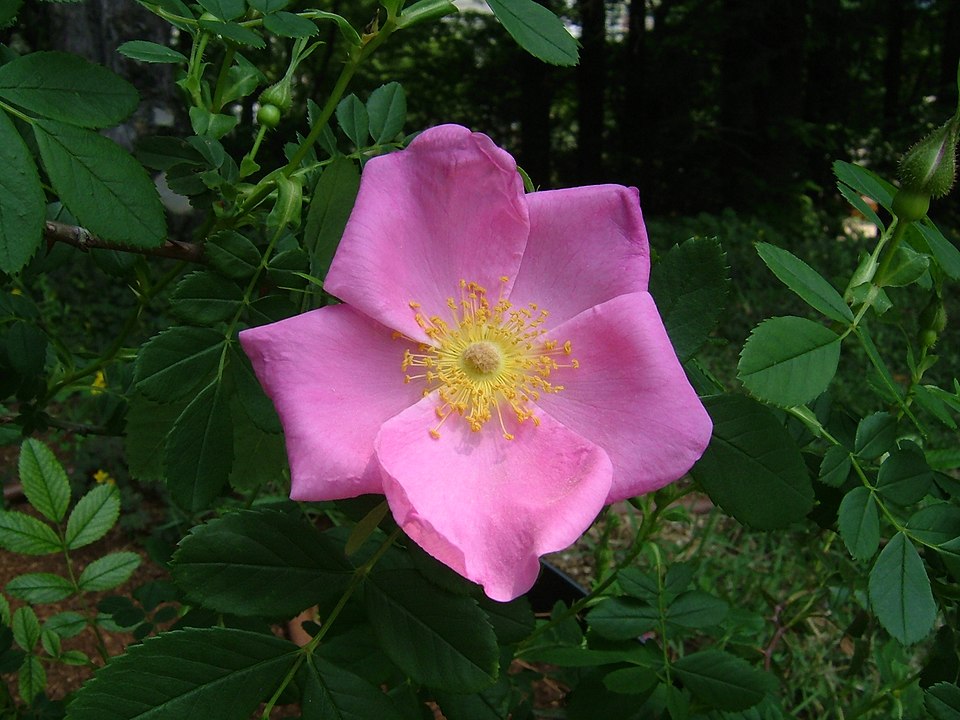
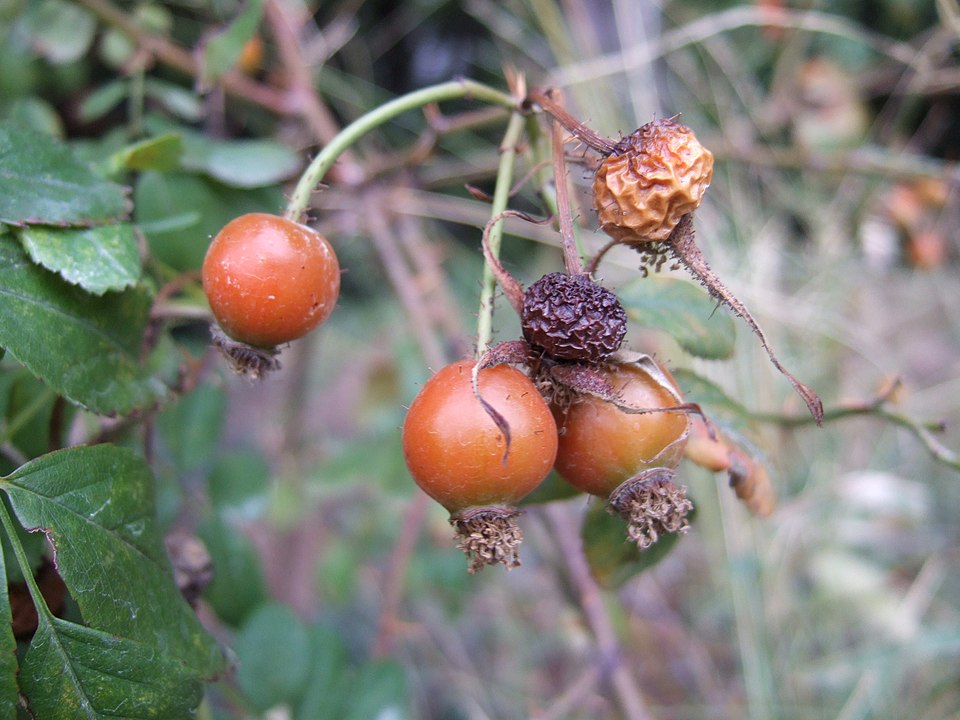
Flowers are borne in small clusters (corymbs) at the ends of lateral shoots, June through July. Each flower is 1.5 to 2.5 inches in diameter with 5 deep pink to bright pink petals surrounding a central cluster of yellow stamens — the classic wild rose form. The flowers are fragrant, with a fresh, sweet rose scent. Sepals are persistent and remain attached to the developing rosehip. The rosehips (technically hypanthia) ripen August to October, turning bright red to deep orange-red, and typically measure 0.4 to 0.6 inch in diameter — among the largest rosehips of any northeastern native rose. Rosehips often persist on the plant through winter and well into the following spring, providing critical food for birds and other wildlife during the leanest season.
Quick Facts
| Scientific Name | Rosa virginiana |
| Family | Rosaceae (Rose) |
| Plant Type | Deciduous Shrub |
| Mature Height | 5 ft |
| Sun Exposure | Full Sun |
| Water Needs | Moderate |
| Bloom Time | June – July |
| Flower Color | Deep pink |
| Fall Color | Orange, red, deep crimson |
| Fruit | Large red rosehips (August – winter) |
| USDA Hardiness Zones | 3–9 |
Native Range
Virginia Rose is native to eastern North America, from Newfoundland and Nova Scotia south along the Atlantic coastal plain and Piedmont to North Carolina, and westward to Quebec and Ontario. In the US, it is native to Maine, New Hampshire, Vermont, Massachusetts, Connecticut, Rhode Island, New York, New Jersey, Pennsylvania, Delaware, Maryland, Virginia, and North Carolina. It is particularly associated with coastal habitats and is one of the most characteristic roses of the northeastern Atlantic coast.
The species is most abundant and typical in coastal environments: sandy beaches and dunes, rocky coastal headlands, salt marsh edges, old fields near the coast, and coastal bluffs. Its tolerance of salt spray, sandy, nutrient-poor soils, and the physical stress of coastal environments (wind, drought, salt deposition) makes it uniquely suited to these challenging habitats. Inland populations also occur in dry, open sites including old fields, roadsides, rocky ridges, and forest edges throughout its range, but coastal populations are most vigorous and characteristic.
In New England, Virginia Rose is common along the coast of Maine, New Hampshire, Massachusetts, Connecticut, and Rhode Island, and less frequent inland. It often grows in association with other coastal and early-successional shrubs including Beach Plum (Prunus maritima), Bayberry (Morella pensylvanica), Rugosa Rose (Rosa rugosa — an invasive exotic that Virginia Rose often competes with), Sweetfern (Comptonia peregrina), and various native grasses and sedges. On exposed coastal headlands in Maine, Virginia Rose forms the characteristic shrub layer of rocky coastal heath communities.
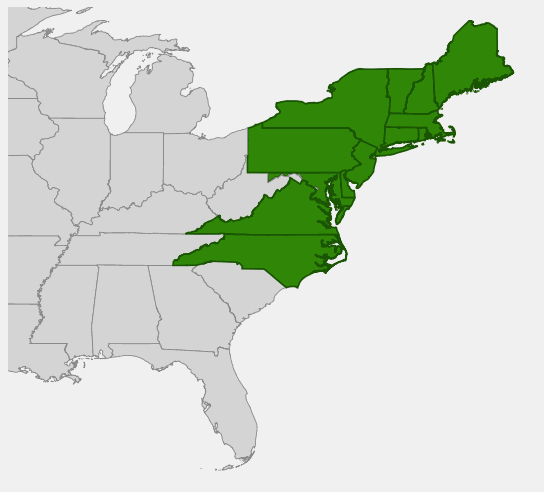
📋 Regional plant lists featuring Virginia Rose: New England
Growing & Care Guide
Virginia Rose is one of the most low-maintenance, tough, and rewarding native shrubs for New England landscapes, especially in coastal and dry sites. Once established, it requires minimal care and rewards the gardener with exceptional multi-season beauty and wildlife value.
Light
Virginia Rose demands full sun — a minimum of 6 to 8 hours of direct sunlight daily for best flowering, rosehip production, and fall color. In partial shade, plants bloom less prolifically, produce fewer rosehips, and may become more open and leggy in form. In deep shade, Virginia Rose fails. Site it in full sun, away from buildings and dense trees that would cast afternoon shadow.
Soil & Water
Virginia Rose is exceptionally tolerant of poor, dry, sandy, or rocky soils — this is one of its greatest landscape virtues. It thrives in the kinds of thin, well-drained soils that defeat many other shrubs, and it is one of the best native plants for sandy coastal soils. It tolerates both salt spray and moderate soil salinity, making it invaluable for seaside plantings where few other ornamentals survive. Soil pH from 5.5 to 7.5 is acceptable, though slightly acidic to neutral is ideal. Established plants are quite drought tolerant and rarely need irrigation in any but the driest years. Avoid heavy clay or poorly drained soils, which lead to root rot.
Planting Tips
Plant Virginia Rose in early spring or fall in a full-sun location with well-drained soil. Container stock establishes reliably; bare-root plants can also be used but should be planted promptly and kept moist. Space plants 4 to 5 feet apart for a naturalized hedge or thicket planting; as a specimen, allow 5 to 6 feet. Mulch lightly with wood chips or pine bark during establishment. No soil amendment is needed in sandy or rocky soils — Virginia Rose prefers low-fertility conditions and may become rank and overly aggressive in rich garden soil.
Pruning & Maintenance
Virginia Rose requires minimal pruning. In late winter (February to March), remove dead canes and any winter-killed tip growth. Every 3 to 5 years, cut one-third of the oldest canes to the ground to rejuvenate the plant and encourage vigorous new growth. Do not shear — Virginia Rose looks best and blooms most prolifically when allowed to maintain its natural arching form. Avoid heavy pruning in fall, which removes rosehips before they benefit wildlife. The thorny canes make pruning best done with long-handled loppers and heavy gloves.
Landscape Uses
Virginia Rose excels in:
- Coastal gardens — one of the best native plants for sandy, salt-spray-exposed seaside sites
- Barrier hedge — dense, thorny canes create impenetrable natural barriers
- Slope and bank stabilization — deep, spreading roots bind sandy soils effectively
- Wildlife gardens — rosehips provide critical winter food for birds
- Dry, rocky sites where moisture-demanding shrubs fail
- Naturalized old field and roadside plantings
- Native rose hedgerow combined with Beach Plum and Bayberry
- Replacing invasive Rugosa Rose in coastal restoration projects
Wildlife & Ecological Value
Virginia Rose is one of the most ecologically productive native shrubs in the northeastern coastal zone, providing food, cover, and nesting habitat for a remarkable diversity of wildlife throughout all seasons.
For Birds
The large, persistent rosehips are consumed by more than 20 bird species, including American Robins, Cedar Waxwings, Eastern Bluebirds, Gray Catbirds, Northern Mockingbirds, Brown Thrashers, Eastern Towhees, and various sparrows. The rosehips are especially valuable as late-season and winter food, persisting on the canes long after most other berries have been depleted. Ring-necked Pheasants, Wild Turkeys, and Ruffed Grouse also consume rosehips. The dense, thorny thickets provide excellent nesting habitat for Yellow Warblers, Common Yellowthroats, Gray Catbirds, and Song Sparrows — all of which preferentially nest in thorny shrubs that offer protection from predators. The June and July flowers produce abundant pollen and nectar for native bees and other pollinators, supporting the insect communities that insectivorous birds depend on during breeding season.
For Mammals
White-tailed Deer browse Virginia Rose foliage and twigs, though the thorny barrier habit discourages sustained browsing better than most shrubs. Red Foxes, Coyotes, Raccoons, and Skunks consume the rosehips. Cottontail Rabbits find cover and browse in rose thickets. Small mammals including voles and mice use the dense thicket interior for nesting and runways. Black Bears occasionally feed on rosehips when other fruits are scarce in fall.
For Pollinators
Virginia Rose flowers are outstanding pollinator plants. The open, five-petaled form exposes both nectar and pollen to a wide variety of pollinators, unlike tubular flowers that restrict access to specialists. Native bumblebees (Bombus spp.) are primary pollinators and are frequently observed working rose flowers intensively. Native mining bees (Andrena spp.) include several specialist species that visit roses almost exclusively. Sweat bees (Halictus and Lasioglossum spp.), plasterer bees (Colletes spp.), and various beetles, flies, and butterflies also visit the flowers for nectar and pollen. The genus Rosa supports over 100 native bee species in eastern North America.
Ecosystem Role
In coastal ecosystems, Virginia Rose plays a critical role as a pioneer and stabilizer species. Its ability to colonize disturbed, sandy, and salt-affected soils where few other plants establish makes it an ecological first responder that begins the process of soil building and succession. The dense thickets trap wind-blown organic matter and sand, gradually building soil organic content and creating conditions for other plants to establish. As a dominant component of coastal shrub communities, Virginia Rose structures habitat for dozens of species and provides the physical complexity — dense, thorny cover at the plant-ground interface — that many coastal wildlife species require.
Cultural & Historical Uses
Roses of all kinds have been among the most culturally significant plants in human history, and Virginia Rose is no exception within its northeastern North American range. Indigenous peoples throughout the plant’s range used Virginia Rose extensively. The nutritious rosehips — rich in vitamin C, vitamin A, and various antioxidants — were consumed fresh, dried, or cooked as a vitamin supplement and food throughout the year. The Algonquian peoples of New England used rosehips as a food source, particularly in late winter and early spring when fresh food was scarce and scurvy (vitamin C deficiency) was a genuine risk. Tea brewed from rosehips was a standard cold and respiratory remedy across many northeastern Indigenous cultures.
European settlers recognized the nutritional and medicinal value of rosehips and adopted their use alongside traditional medicine practices. During World War II, when citrus fruit imports to Britain were severely disrupted, rosehips were harvested en masse from wild British roses and processed into rosehip syrup as a vitamin C supplement for children — an example of the genuine nutritional value of rose fruit that applies equally to North American species. Virginia Rose rosehips are among the richest vitamin C sources in the plant kingdom, containing 20 times the vitamin C content of oranges by weight.
The dense, thorny thickets formed by Virginia Rose were used practically by Indigenous peoples and early settlers as natural fencing and barriers. The wood of rose canes, though small in diameter, is hard and durable — suitable for small tool handles and craft materials. Rose flowers were used in perfumery and to flavor teas and foods. The petals were used medicinally as a mild astringent and anti-inflammatory. In modern horticulture, Virginia Rose has gained renewed attention as an ecologically preferable alternative to the invasive Rugosa Rose (Rosa rugosa), which has spread aggressively in coastal habitats throughout New England and displaces native plant communities. Restoration ecologists increasingly recommend Virginia Rose for coastal habitat restoration projects precisely because it fills the ecological niche occupied by Rugosa Rose without the invasive spread.
Frequently Asked Questions
Is Virginia Rose the same as the beach rose (Rugosa Rose)?
No — they are completely different species. Rugosa Rose (Rosa rugosa) is an invasive exotic from Japan/China that has spread aggressively through coastal habitats in New England, displacing native plants. Virginia Rose (Rosa virginiana) is the native species that naturally belongs in these coastal environments. Virginia Rose has smaller flowers, more leaflets per leaf, and a more open growth habit than Rugosa Rose. Choosing Virginia Rose over Rugosa Rose is an important ecological choice for coastal gardeners.
Can you eat Virginia Rose rosehips?
Yes — Virginia Rose rosehips are edible and nutritious. They are exceptionally rich in vitamin C and can be used to make tea, jam, syrup, or eaten raw (remove the seeds and hairy fibers inside before consuming, as these can be irritating). The flavor is tart and fruity. They are best harvested after the first frost, which sweetens them. Leaving most on the plant for wildlife is the ecologically responsible approach.
Will Virginia Rose spread aggressively in my garden?
Virginia Rose spreads moderately by root suckers, forming thickets over time. In garden settings, it can be managed by removing suckers that spread beyond desired boundaries. It is not invasive in the ecological sense — it is a native species that spreads at a manageable rate. In coastal restoration and naturalized plantings, its spreading habit is a feature, not a problem.
Is Virginia Rose deer resistant?
Virginia Rose has significant deer browse pressure in areas with high deer populations. However, its thorny thicket habit provides better protection than many unarmed plants — deer tend to browse the outer, accessible growth rather than entering dense rose thickets. In high-deer areas, protection of young plants during establishment (tree tubes, fencing) may be necessary. Established large thickets are generally more resilient to deer browsing.
How do I distinguish Virginia Rose from other native roses in New England?
Virginia Rose is identified by its 7 to 9 (typically) leaflets per leaf, glossy dark green leaflets, straight to slightly curved thorns (not strongly hooked), large bright red rosehips, and coastal to dry upland habitat. Compare with Pasture Rose (Rosa carolina), which typically has 5 leaflets and grows in drier, more inland sites; Swamp Rose (Rosa palustris), which grows in wetlands and has more hooked thorns; and Smooth Rose (Rosa blanda), which has few to no prickles and grows in cooler northern habitats.

Looking for a nursery that carries Virginia Rose?
Browse our native plant nursery directory: Maine · New Hampshire · Vermont · Connecticut