
Round-leaved Yellow Violet (Viola rotundifolia)
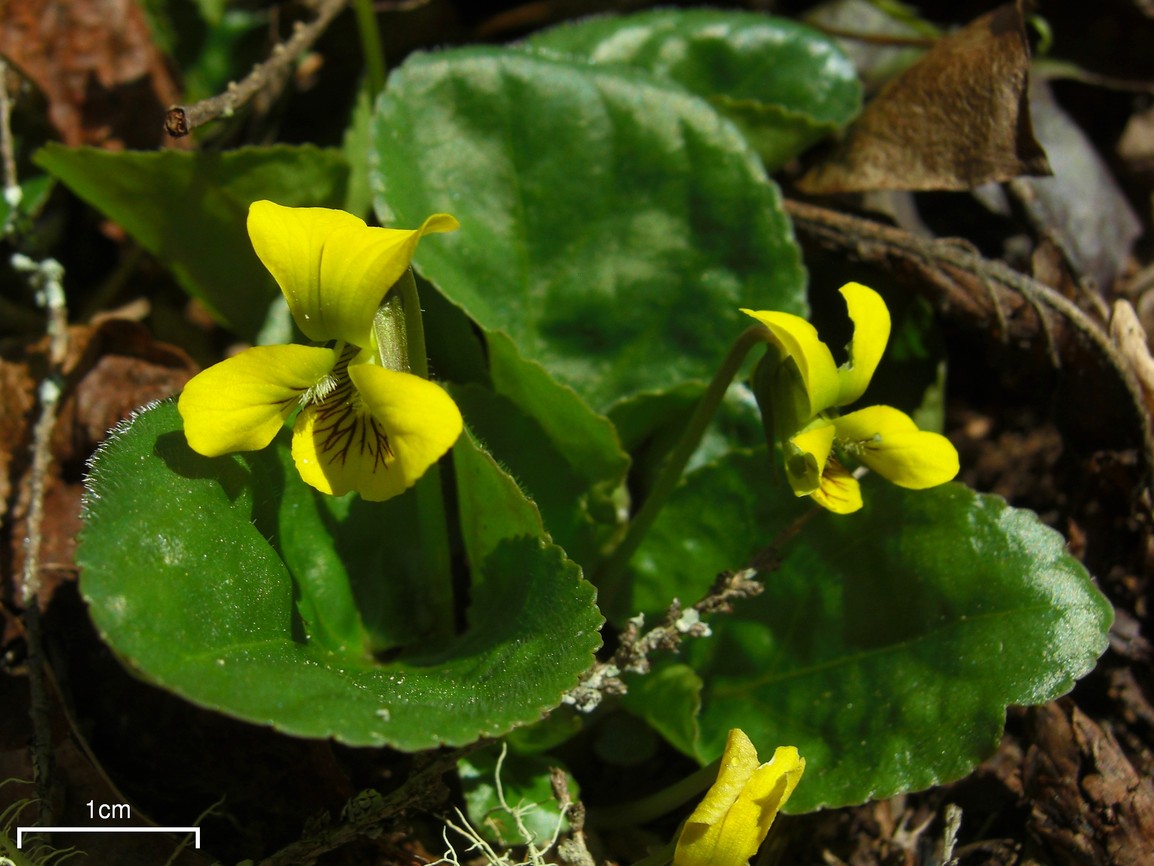
Round-leaved yellow violet (Viola rotundifolia) is a small woodland perennial with bright yellow spring flowers and rounded leaves that expand after flowering. It sits close to the forest floor, so its detail is most rewarding beside a path or in a low, open part of a shade garden. Dark markings on the lower petals give the flowers a delicate patterned center rather than a plain yellow face.
Unlike yellow violets that carry obvious leaves along an upright stem, this species has basal foliage and separate, leafless flower stalks. That distinction is important when identifying it or ordering plants. The botanical name is a better guide than a broad label such as yellow violet, which can refer to several native species with different habits.
Give it moist, humus-rich, drained soil in woodland shade. It can seed around where conditions suit it, but it is not a plant for a hot, dry rock garden simply because it is short. A small colony fits a naturalistic planting better than a tightly controlled border. Buy propagated plants from a knowledgeable source and leave wild populations undisturbed, particularly where the species is locally rare.
Identification
Basal Growth
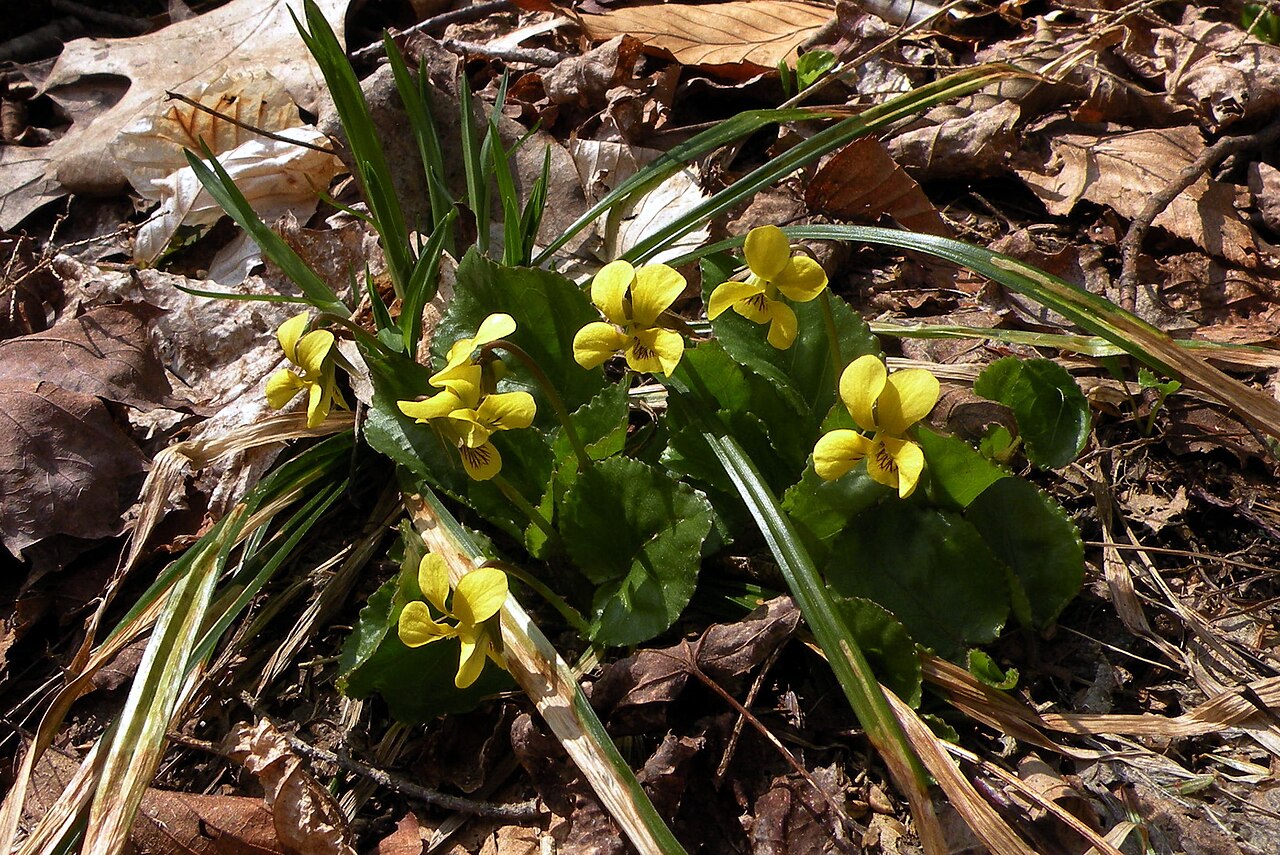
Leaves and flower stalks arise from the base rather than from a tall leafy flowering stem. The plant persists through an underground rhizome. During flowering it can be only a few inches high, easily hidden by a heavy pile of fallen leaves or a larger neighboring plant. There is no woody bark, and the low seasonal rosette should not be mistaken for a seedling that needs to be weeded out.
Rounded Leaves
The simple leaves have a rounded to broadly oval outline and a heart-shaped base, with softly scalloped margins. They are relatively small around flowering time and enlarge later, so a summer leaf can look quite different from one in an early spring photograph. The leaf stalks also change in prominence as the plant develops. Look at both the attachment and outline, not just size, when following the same patch across the season.
Yellow Flowers
Each leafless stalk carries a single flower with five yellow petals. The lower petals have darker lines that are useful close-up characters. Flowers emerge with the young foliage in early spring, with timing shifting according to latitude, elevation, and weather. A March-to-April flowering period in a warm garden should not be treated as a fixed calendar for a cool northern hillside. Observe local plants or ask a regional nursery for the likely season.
Capsules & Later Flowers
The fruit is a small dry capsule, not a berry. As in other violets, inconspicuous closed, self-pollinating flowers can contribute to reproduction after the showier spring display. The ripening capsules release small seeds. A gardener who removes every developing fruit to keep the bed tidy may reduce the natural recruitment that allows a colony to persist and spread into suitable nearby spaces.
Identification Through the Season
In early spring, photograph the whole plant along with a flower. Later, photograph the larger basal leaves and any capsules. This record is more useful than trying to identify an isolated yellow petal or a single leaf. Other yellow violets may have leafy flowering stems, while non-violet woodland plants can have rounded leaves without violet flowers. A regional key or experienced botanist can help resolve an uncertain plant without digging it up.
Quick Facts
| Scientific Name | Viola rotundifolia Michx. |
| Family | Violaceae |
| Plant Type | Native herbaceous woodland perennial |
| Mature Height | Usually about 3–6 inches in garden descriptions; leaves enlarge after bloom |
| Mature Spread | About 6–9 inches for a plant; seedlings may form a wider patch |
| Growth Rate | Seasonal growth with potential self-seeding in suitable conditions |
| Sun Exposure | Part shade to full woodland shade |
| Water Needs | Medium to moist; do not allow repeated severe drying |
| Soil Type | Humus-rich, well-drained woodland soil |
| Soil pH | Use a suitable woodland soil; no narrow numeric target prescribed |
| Bloom Time | Early spring; timing varies by region |
| Flower Color | Yellow with darker lower-petal markings |
| Fall Color | Not selected for a dependable autumn display |
| Fruit | Small dry capsule containing seeds |
| Deer Resistant | Often tolerated by deer according to Missouri Botanical Garden; not guaranteed |
| USDA Hardiness Zones | 3–7 in Missouri Botanical Garden guidance |
Native Range
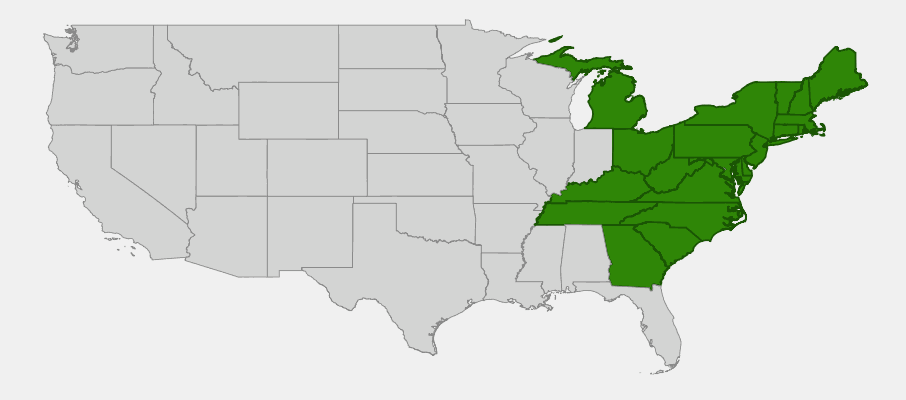
Round-leaved yellow violet is native to eastern Canada and the eastern United States. Its distribution includes New England and continues south through parts of the Appalachian region. Kew’s Plants of the World Online recognizes the species under Viola rotundifolia and lists Ontario and Quebec in Canada, together with the eastern U.S. states shown in the range box.
Within New England, Go Botany documents the species in all six states. Local abundance is uneven: a woodland plant that is familiar in one area can be rare in another. Check local conservation information before undertaking restoration work, and use nursery-propagated stock rather than collecting plants from a natural population. The state-level map is an overview of native distribution, not a representation of every county or suitable planting site.
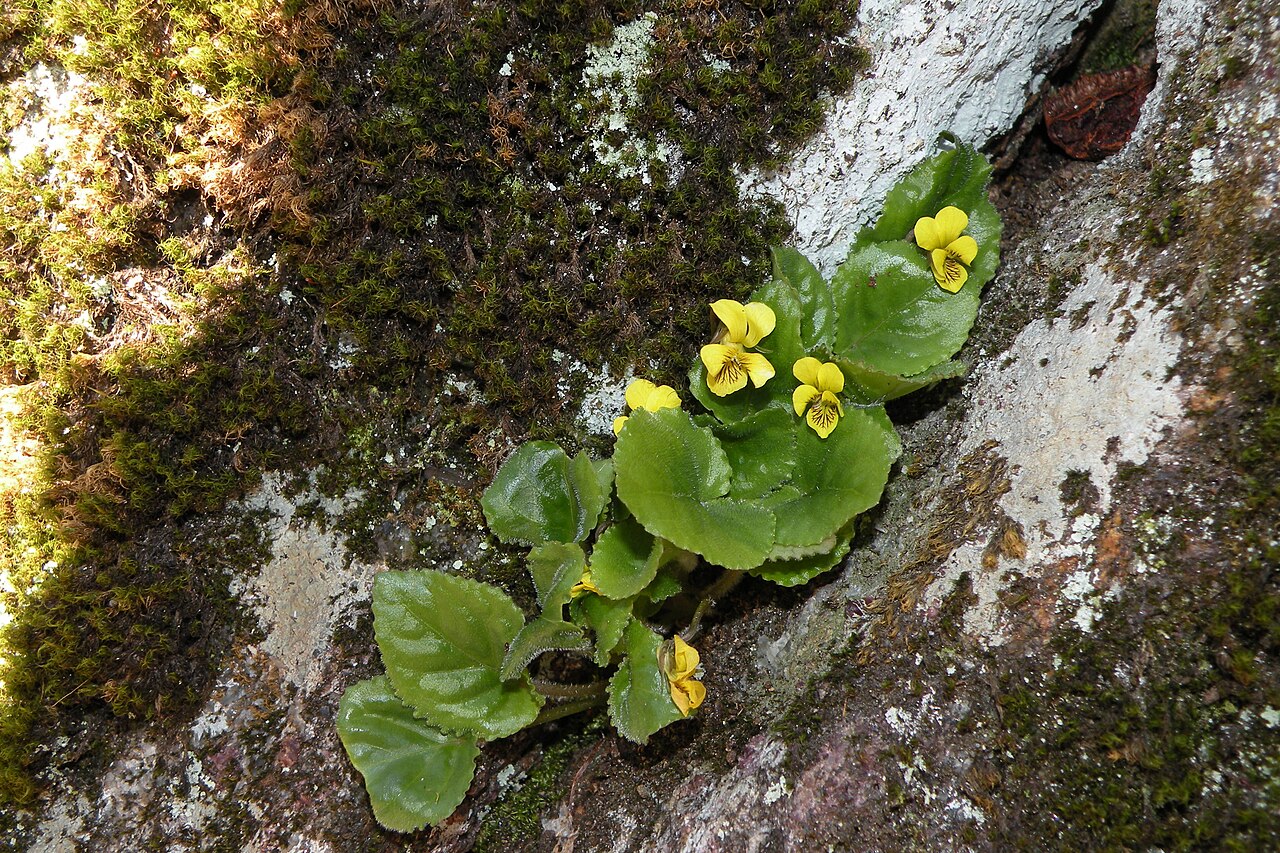
The typical setting is mesic woodland or a forest edge, especially deciduous forest and occasionally mixed evergreen-deciduous woods. Mesic means a balanced moisture supply rather than either severe drought or permanent flooding. In a garden, reproduce that protected soil environment instead of using the native-range map as the only planting criterion. A shaded, leaf-enriched bed can be suitable while an exposed bed in the same town is not.
📋 Regional plant list: New England
Growing & Care Guide
Select Woodland Light
Use shade or filtered woodland light, including the brighter period before deciduous trees leaf out. Avoid treating the spring sun exposure of a woodland as evidence that the plant wants full summer sun. In an open garden, nearby shrubs or a north- or east-facing location may provide a more suitable shelter. Watch the actual summer light pattern before committing a small, valuable plant to a permanent position.
Keep the Root Zone Moist but Drained
Moisture is central to good performance. The soil should hold enough water to remain cool and workable without staying stagnant around the roots. Improve the broader bed gently with leaf-derived organic matter when appropriate rather than excavating an isolated compost-filled hole. If the site is persistently dry under mature tree roots, choose a more drought-adapted species or plan for careful supplemental watering instead of expecting this violet to solve the problem.
Plant Without Burying the Crown
Set a nursery-grown plant at its original soil level and firm the surrounding soil lightly. Water thoroughly after installation and maintain moisture while the roots establish. Keep mulch loose around the crown rather than covering the growing point with a thick pile. A small marker helps protect the plant from accidental weeding and makes it easier to inspect the same location after the flowering season ends.
Allow Seasonal Change
The leaves expand after the flowers, and the appearance of the planting will change accordingly. Do not assume that a larger summer leaf means the original plant has been replaced by a weed. Compare the leaf base and position with spring photographs. In hot or dry weather, foliage quality may decline; first assess moisture and heat exposure. Do not dig up a stressed plant repeatedly to check its roots, because that adds another disturbance.
Manage Seedlings Intentionally
In suitable conditions the violet can self-seed enough to become unwelcome in a very formal bed. In a naturalistic woodland patch, recruitment may be an advantage. Decide which areas can support new seedlings, then remove extras gently while they are small if needed. Do not confuse spreading within a native garden with being a non-native invasive species, but also do not assume every seedling can be allowed to crowd a delicate neighboring plant.
Mulch & Feeding
A light layer of leaf mold or loose fallen leaves supports the woodland soil surface. Remove only thick mats that block emerging growth. Routine heavy feeding is unnecessary for a planting whose main limitations are often moisture and exposure; if a deficiency is suspected, use a soil test before correcting it. Keep fertilizer or lawn-treatment drift out of the bed. The aim is a stable woodland environment, not rapid bedding-plant production.
Propagation & Sourcing
For an initial planting, purchase nursery-propagated material with a reliable species identification. A source specializing in native woodland plants is more useful than a generic violet label. Seed propagation requires attention to fresh seed and seasonal dormancy; obtain instructions specific to this species from the grower rather than applying an annual-pansy schedule. Divide established garden material only when there is enough healthy growth to retain viable roots on each portion.
Troubleshooting
A plant that fades in summer may be responding to heat or dry soil rather than an insect outbreak. Inspect beneath the leaves for actual damage and check the root-zone moisture before choosing a treatment. Missouri Botanical Garden reports no major routine pest or disease problem in suitable culture. Keep the response proportionate: correct watering or exposure first, protect a newly installed plant from trampling, and avoid indiscriminate pesticide use around a small woodland colony.
Landscape Uses
- Early yellow flowers beside a shaded path where small plants can be seen closely.
- A low component of a naturalistic eastern woodland garden.
- A spring accent among restrained native ferns and other shade perennials.
- A learning garden for observing basal leaf growth, capsules, and seed dispersal.
Wildlife & Ecological Value
Ant-Dispersed Seeds
Native ants help disperse the seeds of this violet, moving them away from the parent plant. This relationship is a reminder that the soil surface is part of the habitat, not merely empty space between ornamental plants. Avoid unnecessary broad insecticide use and leave suitable litter and small sheltered areas around the colony. Go Botany also notes that invasive fire ants can damage seeds and place them in unsuitable locations; not every ant interaction has the same ecological result.
Flowering Layer
The spring flowers add to the seasonal diversity of a woodland planting. Their presence should be understood as one component of a garden that offers different structures and flowering periods, not as proof of support for every pollinator species. Pair the violet with other regionally native plants that bloom later, and observe which insects actually visit. Do not substitute unsupported lists of specialist wildlife for direct species-level evidence.
Protecting Woodland Communities
A small plant can still be an important member of a natural woodland flora. Keep wild colonies intact and use garden-propagated stock for landscaping. Foot traffic, digging, and repeated removal of the litter layer can alter a site even when the canopy remains. In a designed garden, leave space for modest plants to complete their seasonal growth rather than filling every gap with a vigorous competitor.
Cultural & Historical Uses
The name rotundifolia refers to the rounded leaves, while the common name highlights the yellow flowers. Older botanical records may use Viola clandestina, a synonym listed by Kew and Go Botany. Checking synonyms helps avoid treating older references as a different plant or creating duplicate entries in a collection.
This violet illustrates how much seasonal information can be hidden behind a simple plant name. The small spring leaves and flowers are only one stage; later foliage and capsules tell another part of the story. Recording the same plant over several months is a useful way to learn identification and distinguish it from the many other violets that share eastern woodlands.
The guide treats this species as a native ornamental and ecological garden plant, not as a food or medicine. Generic statements about edible violets should not be used to identify or consume an unfamiliar plant. The most responsible use is to enjoy a correctly identified, nursery-propagated colony in appropriate habitat and to preserve the wild populations that maintain regional diversity.
Frequently Asked Questions
Is this the same as every yellow woodland violet?
No. Several species have yellow flowers. Viola rotundifolia has basal leaves and leafless flower stalks; a regional key helps separate it from leafy-stemmed yellow violets.
Why are the leaves larger after the flowers fade?
Seasonal leaf expansion is normal. Follow the same plant through the year and compare its leaf attachment and shape rather than expecting a spring photograph to represent its final foliage size.
Will it grow in a dry rock garden?
That is usually a poor match. It prefers a moist, humus-rich, drained woodland root zone, and foliage can decline in hot or dry conditions.
Can it spread too much?
It can self-seed freely where conditions suit it. Allow that in a naturalistic patch or remove surplus seedlings gently where a more controlled arrangement is needed.
Should I collect a wild plant for my garden?
No. Purchase propagated stock. Local populations can be rare even within a state included on the native-range map.
Do the seeds form berries?
No. They develop in dry capsules. Native ants participate in seed dispersal after the capsules release the seeds.
Sources & Further Reading
- Go Botany: Viola rotundifolia
- Kew Plants of the World Online: Viola rotundifolia
- Missouri Botanical Garden: Viola rotundifolia
- USDA PLANTS: Viola rotundifolia
Find Native Plants
Ask growers about nursery propagation and regional provenance. Browse our Maine native plant nurseries, New Hampshire native plant nurseries, Vermont native plant nurseries, Connecticut native plant nurseries directory for suppliers.