
Crossvine (Bignonia capreolata)
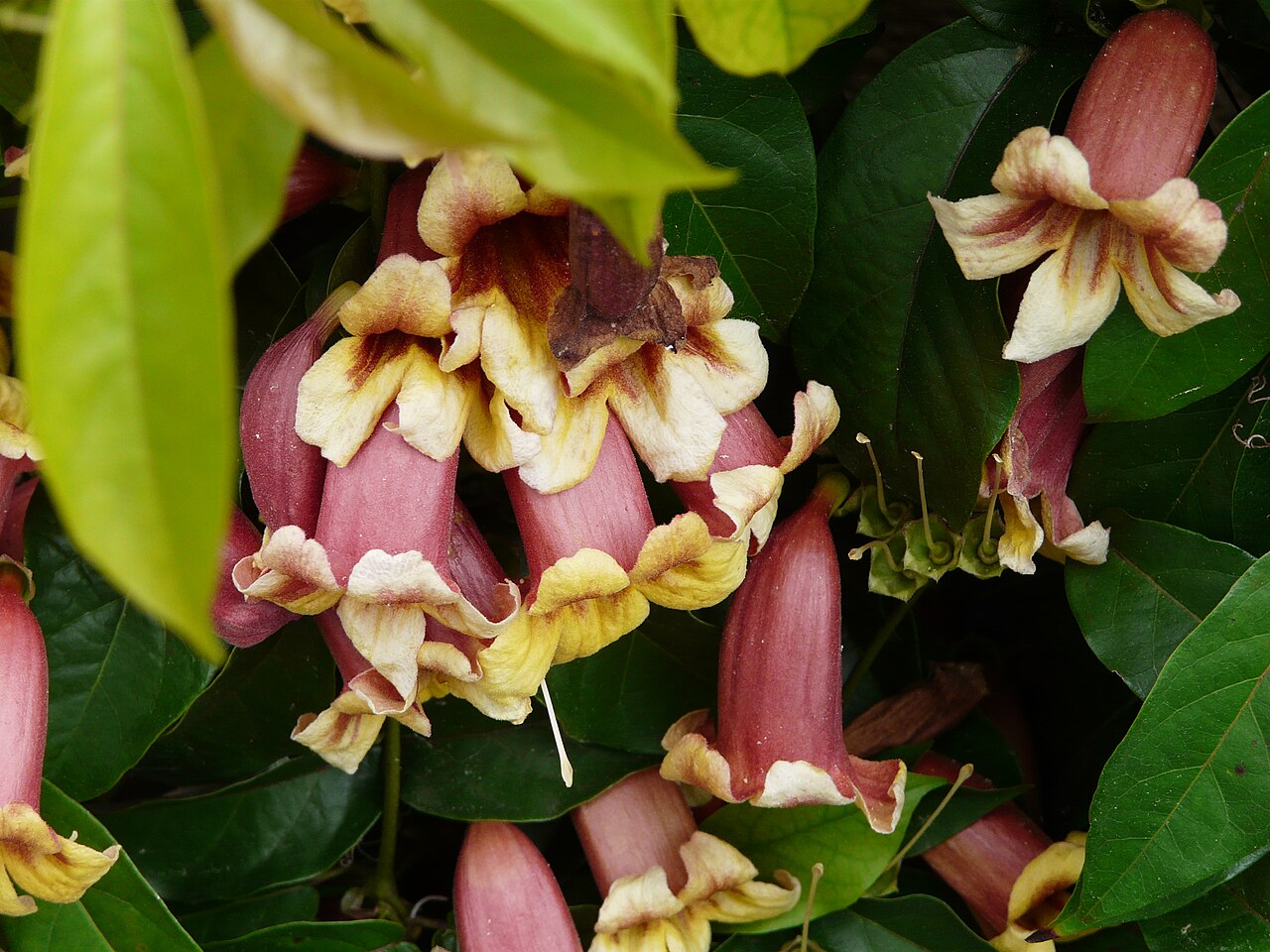
Crossvine brings a curtain of warm-colored trumpets to the southern garden while many summer vines are still waking up. The paired leaflets and branching tendrils are as useful for identification as the flowers: this is a substantial native woodland climber, not a small bedding plant to tuck between annuals. A mature specimen needs a permanent structure and a gardener who is comfortable directing vigorous growth.
In Arkansas, Louisiana, eastern Oklahoma and eastern Texas, look for its ecological model in wooded stream corridors and sunny forest margins. The roots have access to moisture while the stems travel upward toward light. Re-creating that arrangement—a mulched root zone with a bright, open canopy—usually makes more sense than placing a young vine against a hot, dry wall and expecting it to fend for itself.
The table's brief description of orange-red trumpet flowers is accurate, but 'twining tendrils' deserves clarification. Crossvine uses branched tendrils with adhesive tips to climb; it does not wind its whole stem around a support in the same way as yellow jessamine. Its underground spread also means that native status should not be mistaken for a promise of restrained growth.
Identification
Bark & Stems
Young stems are relatively slender, becoming woody and gray-brown with age. Older bark develops narrow longitudinal splits and a finely scaled surface. A stem cross-section can show the cross-like arrangement that gave the plant its common name, but there is no reason to cut a healthy vine merely to identify it. Observe the leaves, tendrils and flowers first. On a trellis, follow each stem back to its base before pruning so a desirable leader is not accidentally removed.
Leaves
The opposite leaves are compound, typically with two conspicuous leaflets and a branched tendril at the tip. Leaflets are several inches long, dark green and somewhat glossy. Winter foliage can turn bronze or purple, especially toward the colder edge of cultivation. That seasonal color is not by itself a disease diagnosis. Contrast this two-leaflet pattern with the many leaflets of trumpet creeper and the simple leaves of Carolina jessamine.
Flowers
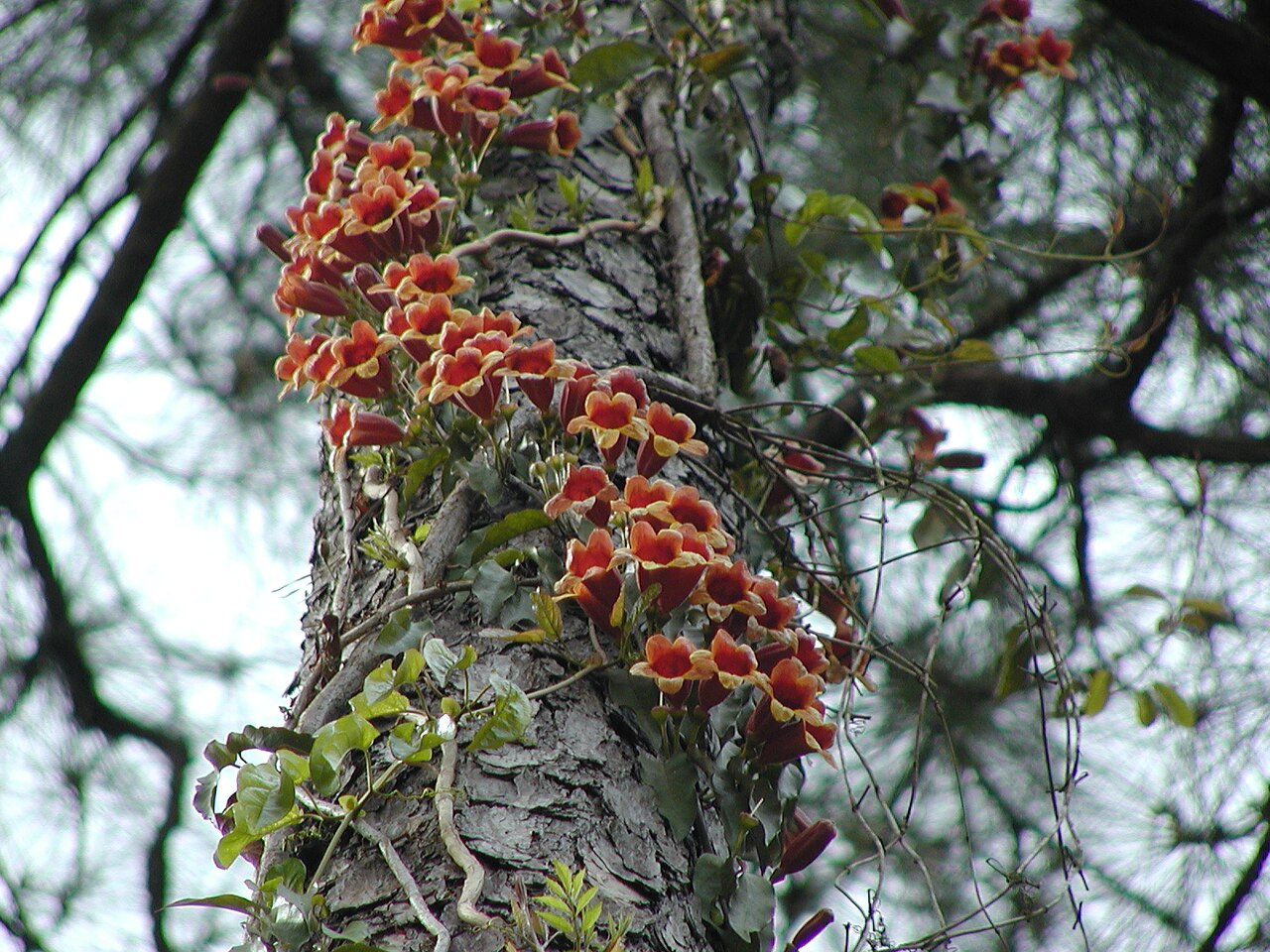
Clusters of tubular blooms open with flared ends, combining red or orange exteriors and a lighter throat. Individual plants and named selections differ in color. The main display is in spring, with timing determined by latitude and season. Hummingbirds can reach into the flowers, while insects also visit them. Use a photograph of both foliage and flowers when confirming a plant; flower color alone is a poor way to distinguish ornamental trumpet-flowered vines.
Fruit & Seeds
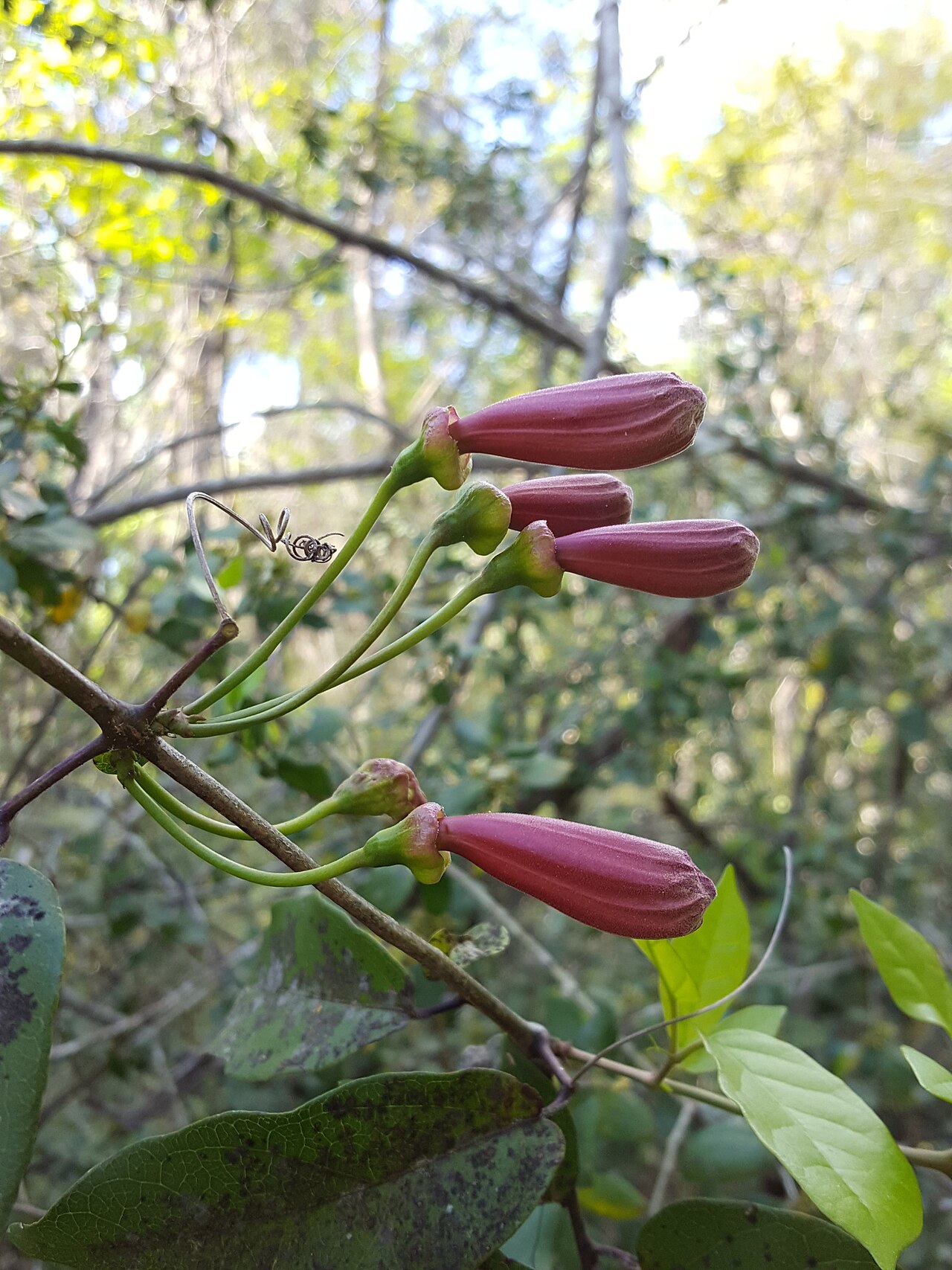
After successful pollination, narrow flattened capsules develop and turn brown as they mature. They contain winged seeds rather than fleshy berries and should not be confused with edible pods. Seed production and root spread are separate processes: removing capsules will not stop shoots arising from the root system. Retain some fruit when it fits the garden plan, but inspect surrounding beds for volunteer growth.
Quick Facts
| Scientific Name | Bignonia capreolata |
| Family | Bignoniaceae |
| Plant Type | Woody climbing vine; evergreen to semi-evergreen |
| Mature Height | 30–50 ft with suitable support |
| Mature Spread | About 6–9 ft on a support; runners can extend farther |
| Growth Rate | Rapid once established |
| Sun Exposure | Full sun to partial shade; flowering declines in deep shade |
| Water Needs | Moist, well-drained soil; tolerates occasional dryness after establishment |
| Soil Type | Humus-rich loam or sandy loam; adaptable with drainage |
| Soil pH | Near-neutral soil generally suitable; no amendment without a soil test |
| Bloom Time | Spring; earlier in warm southern sites |
| Flower Color | Orange-red tubes with yellow to orange throats |
| Fall Color | Bronze to reddish-purple winter foliage; may lose leaves in cold sites |
| Fruit | Long, flattened dry capsules with winged seeds |
| Deer Resistant | Not deer-proof; browsing can occur |
| USDA Hardiness Zones | 5–9; winter leaf retention varies |
Native Range
Kew recognizes crossvine as native to central and eastern parts of the United States. The map follows that native-state treatment rather than every place a cultivated vine can survive. In the regional list represented here, the species fits the wooded portions of Arkansas, Louisiana, Oklahoma and Texas; those state names are not a claim that it belongs in every dry western county.
Natural sites include bottomland woodland, thickets and forest margins where a vine can climb into brighter conditions. Moisture availability in these habitats helps explain why newly planted crossvine responds poorly to an unwatered, compacted strip of soil beneath an overhang. Established drought tolerance does not eliminate the need for establishment irrigation.
The state map is deliberately coarse. Consult the USDA county-level record and a state flora for local decisions, especially near the western or northern range boundary. A photograph made in a European garden demonstrates cultivation, not European nativity. For restoration plantings, ask a nursery about source population rather than relying on the common name printed on a retail label.
Native Range at a Glance
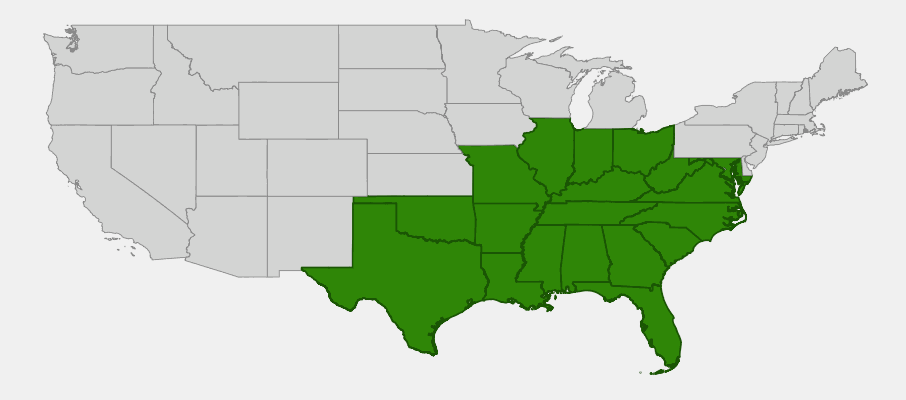
| U.S. States | Alabama, Arkansas, Florida, Georgia, Illinois, Indiana, Kentucky, Louisiana, Maryland, Mississippi, Missouri, North Carolina, Ohio, Oklahoma, South Carolina, Tennessee, Texas, Virginia, West Virginia |
| Mexico / Canada / Other Range | No Canadian or Mexican native range included in the Kew treatment used here |
| Ecoregion | Southeastern forested coastal plains and central/eastern deciduous forest regions |
| Elevation Range | Primarily lowlands and lower slopes; local occurrence varies |
| Habitat | Woodland edges, bottomland woods, thickets and stream corridors |
| Common Associates | Pines and deciduous hardwoods of local forests; not a fixed planting prescription |
📋 Explore the native plant list for Arkansas, Louisiana, eastern Oklahoma and eastern Texas. Species occurrence differs within this multi-state region.
Growing & Care Guide
Light
Give the upper growth plenty of sun for a dense flower display. Partial shade is workable, particularly where afternoon heat is strong, but a deeply shaded fence may produce mostly foliage. Before planting, observe the site in spring and summer: a sunny winter wall can become heavily shaded when nearby trees leaf out.
Soil & Water
Aim for moisture with drainage rather than permanent saturation. Water the root ball and adjacent soil deeply when needed during establishment, then let observations of the soil guide the interval. Mulch keeps the surface cooler, but keep it away from the crown. Do not pour fertilizer into the planting hole; excessive feeding can make a large vine still harder to manage without solving poor light or drainage.
Planting Tips
Install a sturdy trellis or arbor before planting and leave space to inspect the structure. Set the plant at its nursery depth, loosen circling roots carefully and water it in. Guide the first stems with loose ties until the tendrils grip. Keep it away from loose siding, gutters and small young trees. A freestanding structure is easier to maintain than a vine attached directly to a building.
Pruning & Maintenance
Remove dead or damaged growth and direct healthy leaders where coverage is wanted. When reducing a flowering plant, wait until the main spring display has finished so the work does not remove that display. Check for runners in adjacent beds through the growing season and remove unwanted shoots at their origin. Regular small corrections are easier than trying to rescue an arbor after years of unrestrained growth.
Propagation
Seed and root cuttings are recognized methods of propagation. Seed-grown plants can vary, while a cutting retains the identity of the parent selection. Use nursery-propagated material or seed collected with permission, never material stripped from a wild population. A rooted runner from a known garden plant can be useful, provided moving it does not spread weeds or pests with the soil.
Landscape Uses
- A substantial arbor with spring flowers at eye level.
- A freestanding fence screen with an accessible pruning strip.
- A sunny woodland-edge planting where root spread can be monitored.
- A hummingbird garden combined with later-flowering native plants.
Wildlife & Ecological Value
For Pollinators
The tubular flowers provide nectar opportunities for hummingbirds and visiting insects early in the growing season. A single flowering vine is only one part of habitat: combine it with plants that bloom at different times, and avoid insecticide treatment of flowers.
For Birds
Dense foliage and stems offer cover and perching structure. The fruits are dry capsules, not the bird-attracting fleshy berries of many shrubs; do not advertise this species as a berry crop. Its contribution to birds is better understood as a mix of floral resources for hummingbirds, insect activity and vegetative shelter.
For Mammals
Deer and other browsers may eat foliage. Planting a vine because it is sometimes described as deer-resistant is not a substitute for protecting a new plant where browsing pressure is high. Check lower shoots before blaming missing leaves on insects.
Ecosystem Role
In woodland systems, crossvine occupies vertical space and responds to openings in the canopy. In a small garden, its vigor has to be balanced against neighboring shrubs and young trees. Keeping the vine on a designed support lets its ecological and ornamental value remain useful without allowing it to smother the planting around it.
Cultural & Historical Uses
The name crossvine records an observable feature of its wood, while the botanical name has appeared in older literature under Doxantha and Anisostichus. Those names can be relevant when searching old nursery catalogs, but a synonym is not evidence that every vine called 'trumpet vine' is this species.
Modern horticulture has selected crossvines for flower color and garden performance. A named cultivar such as 'Tangerine Beauty' is a selection of the species, not a separate wild range. Garden photographs may show selected plants; they should not be used to define the color of every wild population.
Some sources mention historical medicinal use, but a garden profile is not a basis for preparing bark or root remedies. The practical cultural value here is a long-lived native flowering vine that can replace inappropriate exotic climbers when the site and maintenance plan suit it.
Frequently Asked Questions
Is crossvine the same as trumpet creeper?
No. Crossvine is Bignonia capreolata; trumpet creeper is Campsis radicans. Examine the paired leaflets and branched tendrils rather than relying on orange flowers.
Will it stay green all winter?
Often in mild sites, but leaves may bronze, turn purple or fall in colder weather. Evergreen behavior varies across its cultivation range.
Can it grow in shade?
It tolerates shade, but the best flower display generally needs a brighter position. A shaded root zone with sun on the climbing stems is a useful arrangement.
Will it damage a fence?
Its weight, attachment and vigorous growth can be a problem on weak or neglected structures. Use a strong support and inspect it regularly.
Why are shoots appearing away from the trellis?
Crossvine can spread from its root system. Remove unwanted shoots early and provide a maintenance strip rather than assuming seed removal will stop them.
Sources & Further Reading
- Kew Plants of the World Online: identity, synonyms and native distribution
- USDA PLANTS profile
- NC State Extension Gardener Plant Toolbox: identification and cultivation
- Virginia Tech Dendrology: diagnostic characters
Find Native Plants Near You
Ask a native-plant nursery for correctly identified, nursery-propagated stock and information about regional provenance. Match the plant to your site rather than collecting it from a wild population.
Arkansas native plant nurseries · Louisiana native plant nurseries · Oklahoma native plant nurseries · Texas native plant nurseries