
Showy Penstemon (Penstemon speciosus)
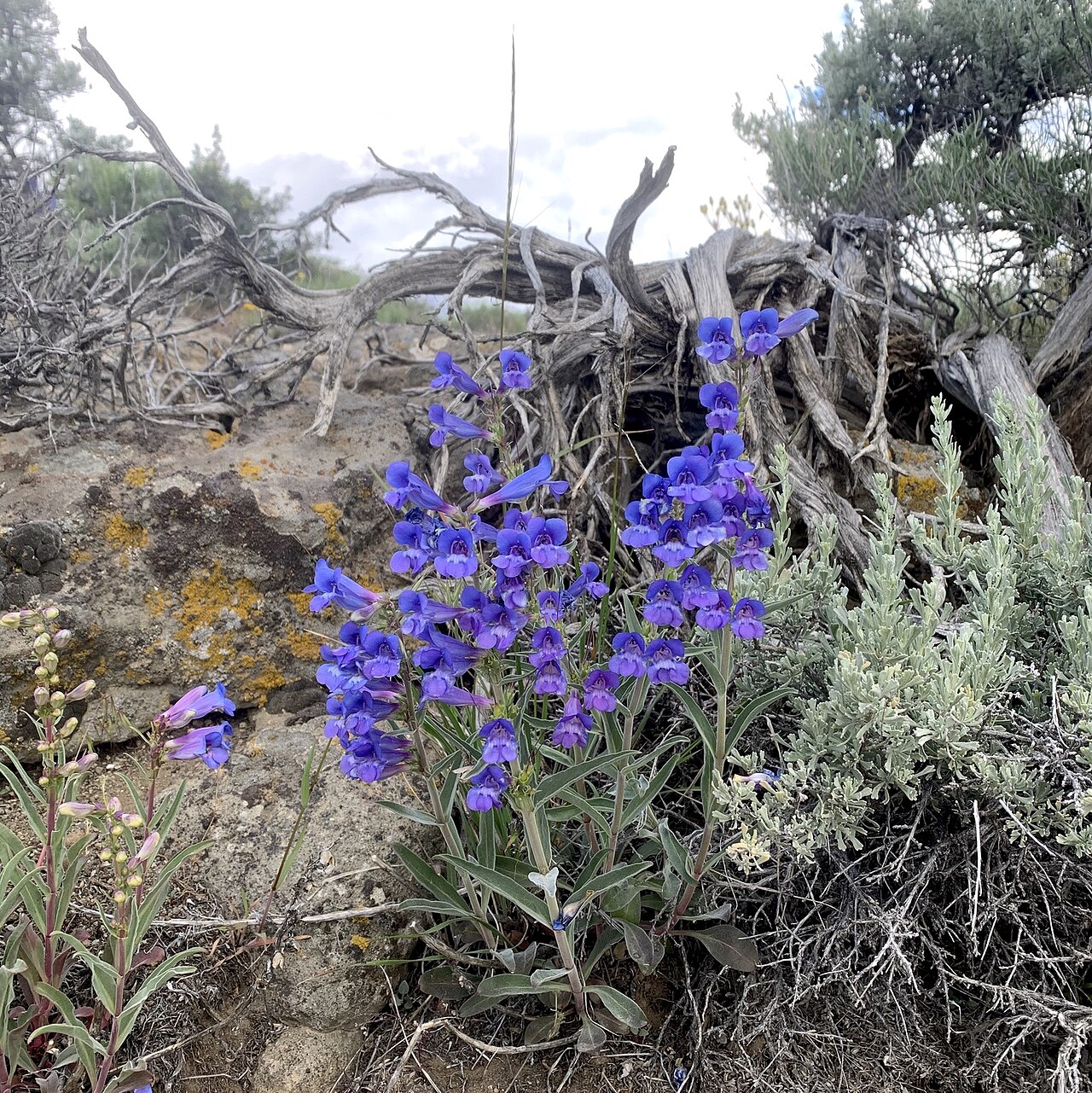
Showy penstemon, also called royal penstemon, puts conspicuous blue flower tubes above a sturdy western perennial clump. The blossoms are large enough to read clearly from a path, yet the plant fits naturally among grasses, sagebrush and open gravel rather than demanding a richly fed perennial border. Its scientific name is Penstemon speciosus; the common name showy penstemon is also used for other species, so the name on a nursery label matters.
This is an excellent candidate for an open, relatively dry inland garden within its native range. The USDA plant guide describes plants commonly one to two feet tall, not two to six inches. Our regional table has been corrected accordingly. The flowering shoots should stand above low companions, and plants require a real root run and good drainage rather than a tiny crevice intended for a cushion alpine.
Royal penstemon is used in restoration and low-water landscapes, but that does not make it a universal solution for poor sites. Competitive weeds, repeatedly saturated crowns and the wrong seed source can defeat an otherwise promising planting. Start with propagated plants or documented seed, learn where spring moisture gathers and where excess water escapes, and build the surrounding planting around similar water requirements.
Identification
Crown and stems
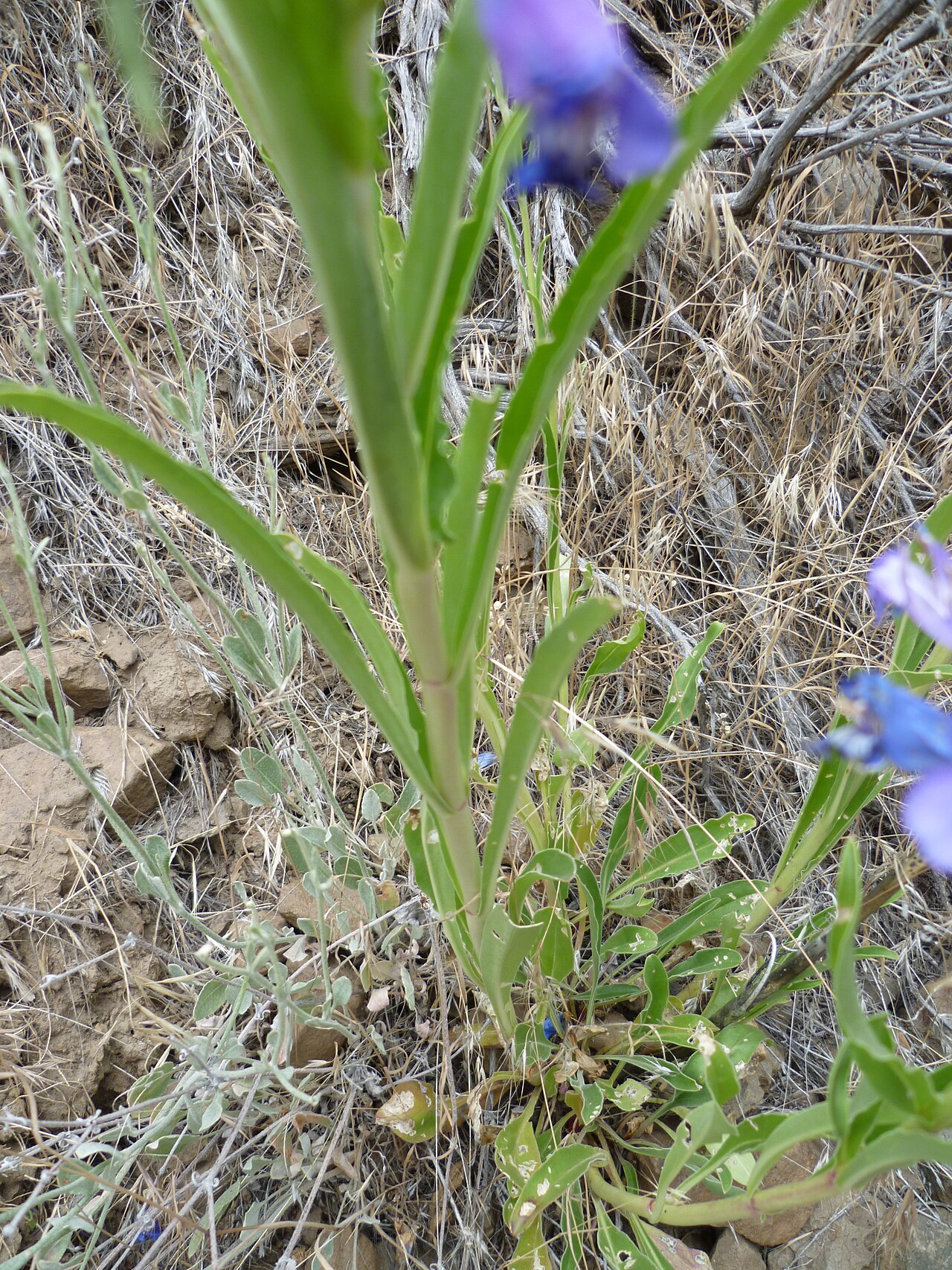
Several upright or ascending stems arise from a branched perennial crown. Typical flowering height is around 30–60 cm, with variation beyond that in the broader flora. Shoots are not the long woody framework of a shrub. A newly purchased small plug can be misleadingly compact, so use mature descriptions when allowing space. Avoid diagnosing poor growth from height alone before the plant has had an establishment season.
Leaves
Leaves are narrow, generally smooth-edged and arranged in opposite pairs on the stem. Some can reach about 15 cm long, but upper leaves are usually smaller and can clasp the stem. The generally slender foliage gives the flower spikes a different appearance from the broad, strongly toothed leaves of lovely penstemon. A good identification photograph includes a lower leaf, an upper leaf pair and the flowers rather than just a saturated blue patch.
Flowers
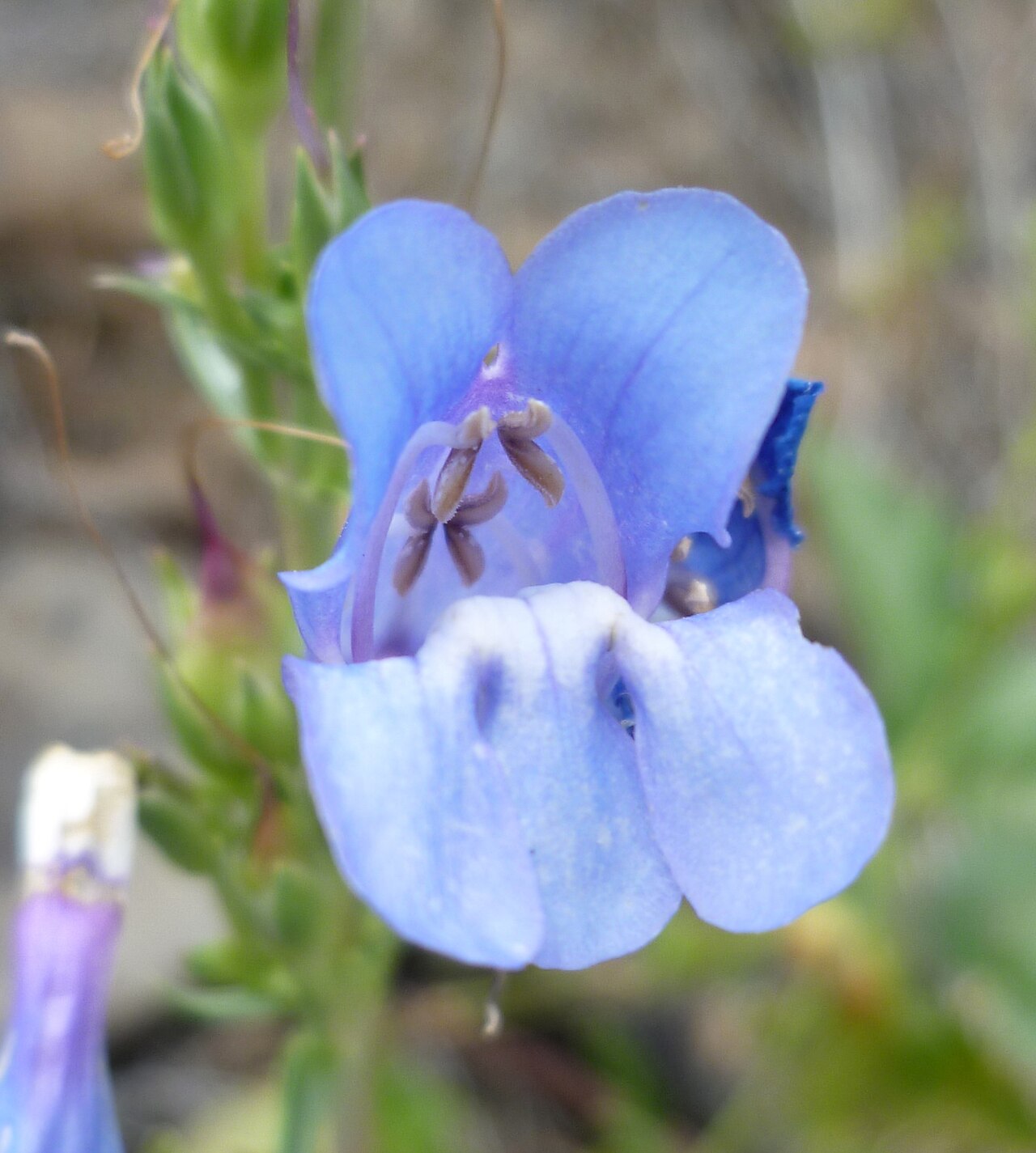
The blue tubes can reach about 4 cm long, with a flared, two-lipped opening. Upper and lower lobes form a landing and entrance structure for visitors. Flower size and the narrow leaves help distinguish the species from smaller-flowered meadow penstemons, but detailed anther and staminode characters may be needed for a confident botanical determination. Shade, camera settings and plant variation all change the apparent blue, so color is not a sufficient identification test.
Fruit and similar species
The fruit is a dry capsule that ripens after the flower falls. Seeds are small and numerous; collect into a paper bag before fully open capsules shed their contents. Do not substitute Penstemon spectabilis because both are sold as showy penstemon. Several historical names are associated with P. speciosus, including P. kennedyi and P. piliferus in taxonomic treatments. Use an accepted-name reference and the source locality to reconcile older labels.
Quick Facts
| Scientific Name | Penstemon speciosus |
| Family | Plantaginaceae |
| Plant Type | Herbaceous perennial with a branched persistent crown |
| Mature Height | Usually 12–24 inches; taller specimens can approach 32 inches |
| Mature Spread | Multi-stemmed clump; allow roughly a foot or more of open space, then adjust |
| Growth Rate | Spring-active perennial; may be short-lived in unsuitable wet sites |
| Sun Exposure | Full sun; light partial shade on an open site |
| Water Needs | Low after establishment; spring moisture and excellent drainage |
| Soil Type | Well-drained sandy, gravelly or rocky mineral soil |
| Soil pH | No universal optimum; do not acidify or lime without a soil test |
| Bloom Time | Usually May–July; elevation and spring weather shift the season |
| Flower Color | Sky blue to deep blue or violet-blue |
| Fall Color | Not a principal fall-color plant; foliage ages or persists according to climate |
| Fruit | Dry seed capsules |
| Deer Resistant | No guarantee of resistance; monitor browsing |
| USDA Hardiness Zones | Match local provenance and winter drainage; no single zone rating used here |
Native Range
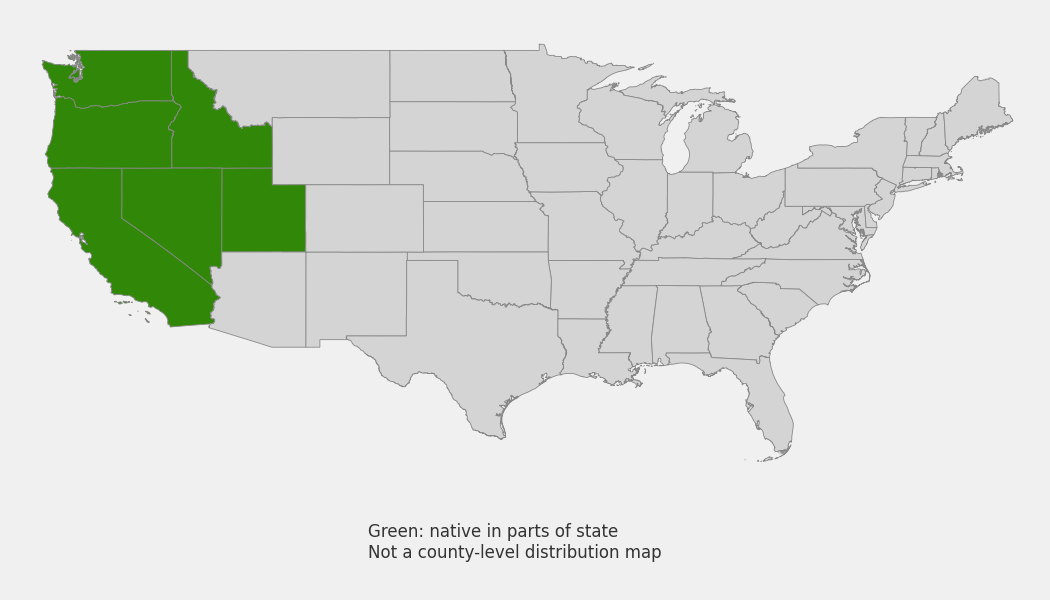
The USDA Forest Service’s Western Forbs synthesis places royal penstemon from the eastern slopes of the Cascades and Sierra Nevada across parts of Washington, Oregon and southwestern Idaho, south through California and Nevada, with limited occurrence in northwestern Utah. The map shades those six states as a broad guide, not as a statement that the plant naturally occupies their entire area.
The native landscape is often open and seasonally dry: sagebrush country, rocky slopes and related interior habitats. Winter and spring precipitation support growth before summer dryness intensifies. A site with frequent summer irrigation and heavy mulch touching the crown can be less suitable than a leaner, sunnier bed even though the irrigated site appears more fertile.
Choose local or regionally adapted seed for ecological work. A seed increase grown far from the original collection area can still be useful horticulturally, but it is not automatically the right material to introduce into a natural population. County-level records and project-specific restoration guidance should refine the state map, especially near the edges of the distribution in Idaho and Utah.
📋 Regional plant list: Idaho, Eastern Oregon and Eastern Washington
Growing & Care Guide
Light
Choose full sun for sturdy growth and good flowering. Light shade can be tolerated on an otherwise open site, but placing the plant under an increasingly dense shrub is unlikely to reproduce its natural setting. Consider the future size of companions when planting. The north side of a tall evergreen may be cool, but it can also be too dark and crowded; an open mineral bed with good air circulation is a more logical starting point.
Soil and water
Drainage is the first design decision. Use a sloping, raised or naturally permeable site where water does not collect around the crown. Water new plants deeply enough to wet their root balls and nearby soil, then allow the surface and upper zone to lose excess moisture. Established plants generally need much less irrigation than lawn perennials, yet a severely dry spring may warrant supplemental water. Avoid a rigid weekly schedule copied from an adjacent vegetable bed.
Planting tips
Plant during a moderate season and keep the crown at its nursery depth. Remove perennial weeds before planting rather than relying on the penstemon to suppress them. A lean bed does not mean a compacted bed: loosen the planting area without creating a tiny amended basin that holds water. Give the roots contact with surrounding soil, irrigate to settle them and check that the plug has not been left perched above the bed after settling.
Maintenance and longevity
Cut off finished flower stalks for appearance or leave some for seed. Retain living basal growth. Too much fertilizer may encourage weak vegetative growth and competition rather than a better plant. If a clump disappears, inspect drainage, winter wetness and neighboring root competition before simply increasing summer water. Maintaining a few younger plants from seed can give continuity where individuals prove short-lived. Do not mistake that strategy for permission to let seedlings invade a nearby natural site outside the native range.
Propagation
Seed propagation is useful for this species, and the USDA plant guide discusses cold treatment and nursery production. Follow the instructions for the actual seed lot rather than assuming every penstemon germinates identically. Sow in labeled containers or a prepared weed-free seedbed, keep the medium aerated and avoid letting tiny new seedlings dry out completely. For a restoration sowing, seed origin, competing vegetation and suitable seasonal moisture all matter as much as the nominal sowing rate.
Landscape Uses
- Blue-flowered accents in an inland low-water border.
- A forb component in a locally appropriate sagebrush or bunchgrass restoration.
- An open slope where spring growth and summer drainage match the plant’s ecology.
- A pollinator garden with plants providing flowers before and after its main bloom.
Wildlife & Ecological Value
For pollinators
Royal penstemon flowers support visiting pollinators, and USDA guidance identifies the species as useful for wildlife habitat enhancement. A planting of several individuals makes a more discoverable floral patch than a single isolated plug. Retain other locally appropriate flowers across the season. Do not infer that a blue-flowered species is exclusively bee-pollinated or exclusively hummingbird-pollinated; watch the actual visitors and distinguish nectar use from effective pollination.
For birds
The plant contributes to a diverse insect-supporting vegetation layer rather than producing fleshy bird fruit. Habitat projects use flowering forbs as part of a broader plant community, not as a one-species substitute for cover, seed resources and seasonal food. Allow some standing structure where it suits the garden, and choose compatible grasses and shrubs to supply the functions a small penstemon cannot provide alone.
For mammals
Young plants may be browsed or disturbed, and no species-wide deer-proof promise is appropriate. A temporary cage can be more reliable than repellents when establishing a valuable seed-grown plant. Royal penstemon should not be advertised as a pet-safe snack or human herb simply because it is native. Its main role in this garden context is flowering habitat and regional plant diversity.
Ecosystem role
A successful native forb planting helps retain diversity in landscapes otherwise dominated by grasses or invasive annuals. It is important, however, to control weeds before and during establishment; tiny penstemon seedlings cannot repair a dense weed stand unaided. Use locally appropriate material and realistic success criteria. Long-term flowering, recruitment and persistence are more useful measures than the number of seed packets scattered in the first year.
Cultural & Historical Uses
The name speciosus refers to a showy appearance, and royal penstemon is an apt horticultural description of its blue flowers. Scientific naming helps prevent a practical problem: different penstemons share the common name showy. Keep the botanical name and source on records when ordering seed, especially where suppliers offer both P. speciosus and P. spectabilis.
The species has a documented modern role in western restoration and low-water landscape work. USDA plant-materials and Forest Service publications discuss its ecology and use, giving gardeners a better foundation than assuming all penstemons behave like bedding hybrids. Species selection should begin with habitat and source rather than the brightness of the catalogue photograph.
No species-specific food or medicinal use is prescribed here. Historical information about another beardtongue cannot establish safe use of this one. Its most useful cultural contribution to a home landscape is a visible connection to Great Basin and inland western flora, supported by nursery propagation rather than removal from wild populations.
Frequently Asked Questions
Is showy penstemon only a few inches tall?
No. For Penstemon speciosus the USDA guide gives a typical height of one to two feet. Older two-to-six-inch table text was incorrect and has been replaced.
Is royal penstemon the same plant?
Yes, royal penstemon is a common name for P. speciosus. Showy penstemon can also refer to other species, so check the scientific name before buying.
Does it need irrigation after establishment?
Often only limited supplemental water in a suitable inland site, but spring moisture is important. Establishment watering and local rainfall should determine the plan rather than a blanket no-water rule.
Why did my plant collapse in wet weather?
A persistently wet crown or poorly aerated soil can damage penstemons. Check drainage and root condition before adding more water or fertilizer. A better site may be needed.
Can I collect seed from roadside plants?
Only where lawful and permitted, and only after confirming identity and whether the population was planted. Roadside presence does not by itself prove local native provenance.
Sources & Further Reading
- USDA NRCS — Royal Penstemon plant guide
- USDA Forest Service — Royal Penstemon ecology and restoration
- Burke Herbarium — Penstemon speciosus
- Colorado State University Extension — Growing Penstemons
Find Native Plants
Ask growers about nursery propagation and regional provenance. Browse our ID native plant nurseries, OR native plant nurseries, WA native plant nurseries directory for suppliers. Explore the native nursery finder.